
On this page
Start here
Quick answer
Start by confirming that the Electrolux freezer has power, is set to a normal cold setting, and has a fully closed door with an intact seal. Clear food from the air vents, inspect for heavy frost, and keep the door closed while the temperature recovers. Electrolux says a recently installed or reconnected freezer can need up to 24 hours to stabilize; compressor hum, fan airflow, and refrigerant gurgling indicate that it is attempting to cool. If it has run for 24 hours without cooling, or if the door seal, frost, airflow, power, or temperature setting cannot explain the warmth, stop relying on user checks and arrange qualified appliance service.
Before you begin
Safety first
- Do not remove panels, probe live electrical parts, touch moving or hot components, chip ice with sharp tools, use improvised heat, or work on the sealed refrigeration circuit.
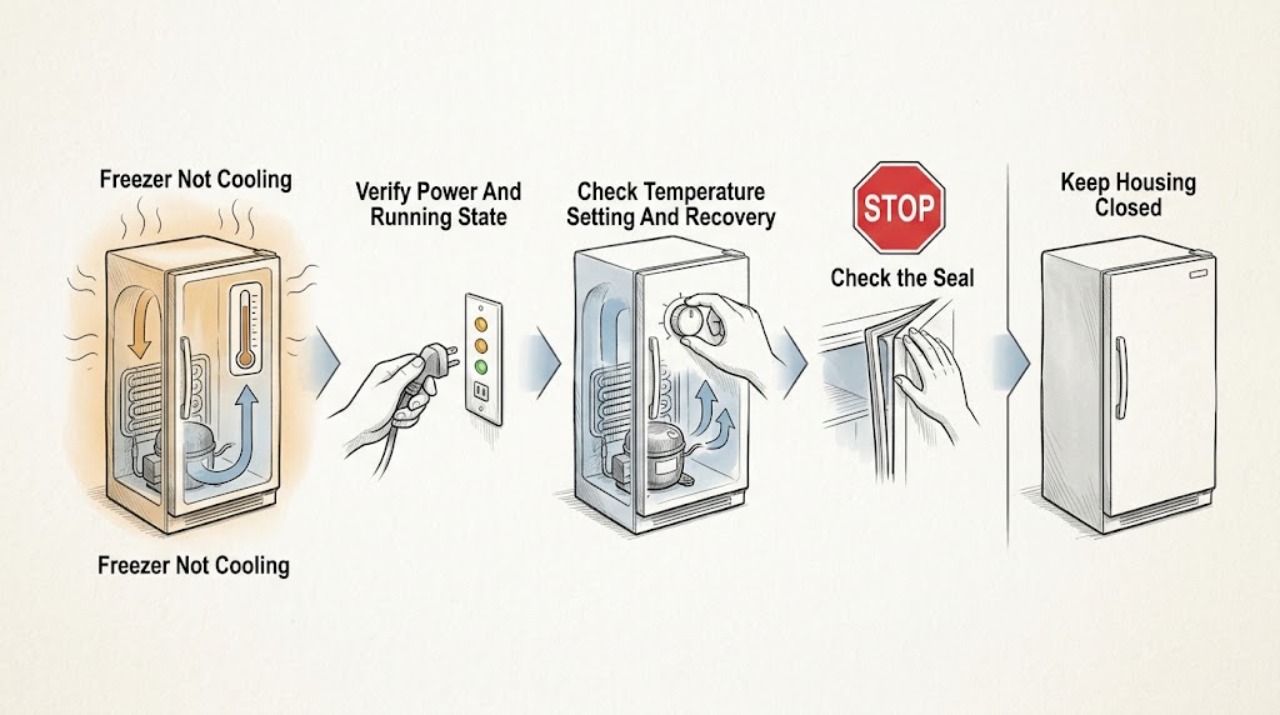
Work through in order
Diagnostic checks
Use only checks that match the exact appliance or system and its official guide.
-
Check 1
Check that the freezer control is not OFF, the power cord is firmly seated in its wall outlet, and the interior or control-panel indicators work. If the outlet is protected by a resettable device, check whether it has tripped. Do not use an extension cord.
Expected result: The freezer is dark and silent, the control is OFF, the outlet has no power, or the breaker/GFCI has tripped; alternatively, lights and controls work and the compressor or fan can be heard.
Next step: Correct only the accessible control or outlet condition. If the protective device trips again or the unit remains dead, stop and request service; if it runs, continue to check temperature and airflow.
Stop if: Do not repeatedly reset a breaker, use an extension cord, or touch damaged wiring or a damaged plug.
Why this matters
Why: No lights or operation points first to a power or control-state problem rather than a confirmed refrigeration failure. Working lights with no cooling means the unit has power but still needs the temperature and airflow checks.
-
Check 2
Read the current temperature setting and compare it with the exact model's Use and Care information. If the freezer was newly installed or recently reconnected, note the elapsed time and avoid frequent door openings while it stabilizes.
Expected result: The control is OFF or warmer than intended, the unit has been running less than a day after installation or reconnection, or it has operated for about 24 hours and is still warm.
Next step: Set the control only as the model manual directs, keep the door closed, and allow the stated stabilization period. If 24 hours has passed with no meaningful cooling, move to professional service instead of making repeated setting changes.
Stop if: Do not alter sealed-system controls or continue storing food as though it were safely frozen when the temperature remains unknown or rising.
Why this matters
Why: A wrong setting or normal stabilization period can mimic a cooling failure. Electrolux states that a freezer may take up to 24 hours to stabilize after installation or reconnection; failure to cool after that period is a service signal.
-
Check 3
Check that no food, shelf, basket, or packaging prevents the door from closing. Inspect the gasket around the entire opening for dirt, gaps, cracking, or sections that are pulled out of position; clean it with warm soapy water as Electrolux describes.
Expected result: The door closes fully and the gasket grips evenly, or the door remains ajar / the gasket has a gap, dirt, damage, or weak contact.
Next step: Remove the obstruction and clean the accessible gasket. If it is cracked, badly fitted, or still does not seal, keep the door closed as much as possible and arrange service rather than forcing or dismantling it.
Stop if: Do not use sharp tools, solvents, or force that could tear the gasket or damage the door liner.
Why this matters
Why: A door that does not seal lets warm air in and can keep the temperature unstable. A clean, undamaged seal with full contact makes air leakage less likely, so continue to frost and airflow checks.
-
Check 4
Look inside without removing panels: keep food from covering the air vents and leave room for circulation. Inspect accessible surfaces for a thick or widespread frost layer that could obstruct airflow or prevent the door from closing.
Expected result: Vents are blocked by food, the compartment is packed tightly, or frost is heavy; alternatively, vents are open and no significant frost buildup is visible.
Next step: Rearrange or remove only enough items to uncover vents and permit circulation. Do not chip ice with a sharp object or use an unapproved heat source; if heavy frost returns or cannot be safely addressed using the model manual, request service.
Stop if: Stop if ice is fused to wiring, liners, or components, or if safe defrost instructions are unavailable for the exact model.
Why this matters
Why: Electrolux says blocked vents reduce airflow and over-frosting can decrease airflow or keep the door from shutting correctly. If airflow is open and frost is not the issue, the cooling system needs a different diagnosis.
-
Check 5
With the door closed, listen from outside for a compressor hum, fan airflow, or refrigerant gurgling, and note whether the freezer is cycling or running continuously. Do not place hands near moving or hot components.
Expected result: The freezer makes the listed operating sounds and the temperature is gradually falling, it is silent despite having power, or it runs for a full day while remaining warm.
Next step: If it is recovering after a door opening, power event, or warm load, keep the door closed and monitor temperature. If it remains warm after 24 hours, or sounds are accompanied by overheating, odor, or repeated cycling, leave it off and call a technician.
Stop if: Do not remove a cover, touch the compressor or fan, or attempt sealed-system or electrical testing.
Why this matters
Why: Electrolux describes compressor hum, fan airflow, and refrigerant gurgling as signs that the unit is attempting to cool, but those sounds alone do not confirm successful cooling. Silence with power can indicate a control or cooling-system issue; 24 hours of running without cooling requires service.
-
Check 6
If an alarm or buzzer sounds, note the display or alarm state and whether the door is level and sealing. Check the temperature trend with the appliance's normal indicator or a suitable independent thermometer, without leaving the door open unnecessarily.
Expected result: The alarm corresponds to a rising temperature, the door is not level or sealing, or the temperature falls after the door is closed; alternatively, the alarm or warm condition persists despite a good seal and open airflow.
Next step: Close and secure the door, correct an accessible alignment issue only as the model manual allows, and keep it closed while it recovers. If the alarm or warm temperature persists, arrange service and provide the temperature trend and display details.
Stop if: Do not ignore a continuing high-temperature alarm for food safety, and do not disassemble the alarm or control assembly.
Why this matters
Why: On some Electrolux freezer models, the temperature alarm sounds when the compartment rises above 20°F. A proper seal and closed door allow the temperature to decrease; persistence after those checks points beyond a simple alarm acknowledgement.
Use your observations
Decision map
Find the observation that best matches what you see, then follow the next safe action.
-
PATH 01Next step
What you see
The freezer has no interior light or control response.
Do this next
Check the accessible power connection, control position, and resettable outlet or breaker once. If power does not return or the protective device trips again, stop and arrange service.
-
PATH 02Next step
What you see
The freezer was newly installed or recently disconnected and has been running for less than 24 hours.
Do this next
Keep the door closed and allow stabilization for the period stated in the model information. If it remains warm after 24 hours, request service.
-
PATH 03Next step
What you see
The door is obstructed, the gasket has a gap, or the door does not close evenly.
Do this next
Remove the obstruction and clean the gasket. If the seal remains poor or damaged, keep the door closed and arrange service rather than forcing the door or removing the gasket assembly.
-
PATH 04Next step
What you see
Food blocks vents or heavy frost is reducing circulation.
Do this next
Uncover vents and reduce crowding. Follow only the exact model's safe defrost instructions; do not chip ice or use improvised heat. Escalate if frost returns or cannot be safely cleared.
-
PATH 05Next step
What you see
The compressor or fan runs, but the freezer remains warm after about 24 hours.
Do this next
Stop user-level troubleshooting and schedule qualified appliance service. Provide the model, temperature trend, sounds, frost state, and door-seal findings; do not infer a particular part from the sound.
-
PATH 06Next step
What you see
There is a burning smell, smoke, damaged cord, repeated breaker trip, exposed wiring, severe leak, or persistent high-temperature alarm.
Do this next
Stop using the freezer, keep clear of damaged or hot components, and arrange professional service. Do not open panels or work on the sealed refrigeration system.
Helpful context
Understand the symptom
Protect the food while you diagnose
Keep the freezer closed as much as possible and move temperature-sensitive food to a known-cold location if the contents are warming. Note whether the problem started after installation, a power interruption, a long door opening, or loading warm food. Those observations change the next check without requiring access to the sealed cooling system.
What can make an Electrolux freezer feel warm
A freezer can be warm because it has no power, the setting is wrong, warm air is entering through the door, food or frost is blocking circulation, or it is still stabilizing after installation or reconnection. A running compressor or fan does not prove that the freezer is reaching temperature; if it runs for a full day without cooling, the manufacturer directs the owner toward service.
When the checks are no longer enough
Do not remove panels, work on the sealed refrigeration circuit, or guess a failed part from a sound alone. A technician needs the model information, temperature symptoms, display or alarm state, and the results of the safe checks below.
Safety boundary
Stop conditions
- Stop immediately for smoke, a burning smell, a damaged cord, exposed wiring, severe water leakage, or repeated breaker trips.
- Do not remove panels, probe live electrical parts, or work on the sealed refrigeration circuit.
- Do not chip frost with sharp tools or apply improvised heat inside the freezer.
- Do not keep perishable food in a freezer that remains warm or has a continuing high-temperature alarm.
When checks do not resolve it
Need a professional?
Arrange qualified appliance service if the freezer has run for about 24 hours without cooling, if power and user-level airflow or seal checks do not resolve the problem, if frost returns or blocks circulation, if the high-temperature alarm persists, or if there is damage, smoke, burning odor, erratic operation, or a repeated breaker trip.
Safety scope: Do not remove panels, probe live electrical parts, touch moving or hot components, chip ice with sharp tools, use improvised heat, or work on the sealed refrigeration circuit.
Common questions
FAQ
How long should an Electrolux freezer take to cool after installation or reconnection?
Electrolux says a newly installed or reconnected freezer may need up to 24 hours to stabilize. Keep the door closed during recovery; if it is still not cooling after that period, arrange service.
What should I check first when an Electrolux freezer is warm?
Check power and the control position, then the temperature setting, door closure and gasket seal, blocked vents, and heavy frost. These are the manufacturer-supported user checks before service.
Does a compressor hum mean the freezer is cooling correctly?
Not by itself. Electrolux says compressor hum, fan airflow, and refrigerant gurgling show that the unit is attempting to cool, but it directs owners to service when the freezer has run for 24 hours without becoming cold.
Why is my Electrolux freezer alarm sounding?
On some models, Electrolux says the alarm sounds when the freezer temperature rises above 20°F. Check that the door closes and seals, then leave it closed while the temperature decreases; persistent alarm or warmth needs service.
Read the exact guide
Official sources
- Freezers - Can I make my freezer’s temperature warmer?Electrolux · Official Electrolux guidance that the freezer control location and adjustment should be taken from the Use and Care Manual and changes should be made in small increments.
- Freezer - Not Freezing or Not CoolingElectrolux · Official Electrolux troubleshooting for a freezer that is not cooling, too warm, or showing a high-temperature condition.
- What does the alarm or “buzzer sound” mean?Electrolux · Official Electrolux guidance for freezer temperature alarms and checks of level, door closure, and seal.
- Freezer Runs Too MuchElectrolux · Official Electrolux guidance on stabilization after installation or power recovery, door opening, temperature setting, warm loads, and gasket condition.
- What should I do if my freezer isn't running?Electrolux · Official Electrolux guidance for an appliance with no operation, including control position, power connection, breaker, and outage checks.
Community feedback
Share a repair observation
Share a plain-text repair observation. Accepted observations are published automatically; this page may take a moment to update.