
On this page
Start here
Quick answer
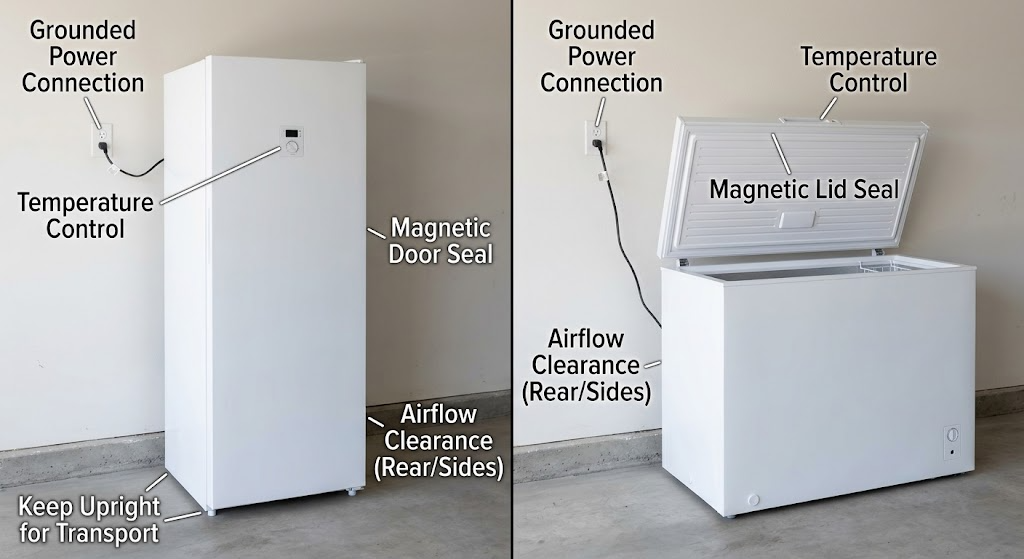
Start by separating no power from weak cooling. Danby's freezer guidance says to confirm that the unit is plugged in and turned on, and to allow a freezer that was transported on its side to stand upright for 6 hours before plugging it in. Then check the exact model's temperature setting, that the door or lid closes and seals, that air can circulate, that warm food or frequent openings are not overwhelming the cabinet, and that the freezer is away from direct heat or sunlight. Do not use an extension cord or change the required voltage. If the display or compressor remains inactive, the unit stays warm after these external checks, a fuse or breaker trips again, there is a damaged cord, burning smell, smoke, refrigerant or water leak, or the freezer was recently moved and cooling does not recover, stop repeated testing and arrange qualified Danby service or electrical inspection. The exact defrost system and temperature range are model-specific.
Work through in order
Diagnostic checks
Use only checks that match the exact appliance or system and its official guide.
-
Check 1
From a dry, safe position, note whether the freezer has any display or indicator, interior light, compressor or normal operating sound, and whether the interior is slightly cool or completely warm; do not remove covers to listen or touch components.
Expected result: The freezer has no signs of power, runs but stays warm, runs continuously, cools briefly and warms again, or has a burning smell, abnormal heat, water, or a repeated power trip.
Next step: Continue only with external power, setting, seal, loading, and placement checks when there is no hazard. For an electrical or thermal warning, stop using the freezer and arrange qualified appliance or electrical service.
Stop if: Stop immediately for smoke, sparking, a hot or damaged cord, melting plastic, burning odor, water at electrical parts, or a protective device that trips again.
Why this matters
Why: No signs of power direct the first check to the plug, outlet, switch, fuse, or breaker. Continuous operation or brief cooling can also reflect a warm load, door or lid leakage, poor placement, airflow restriction, or a cooling fault. Burning, smoke, abnormal heat, water near electrical parts, or repeated trips is a safety branch rather than a cooling adjustment.
-
Check 2
Check that the plug is fully inserted in the intended wall outlet, the freezer is switched on, and the temperature control is set according to the exact model manual; use no extension cord or improvised voltage source.
Expected result: The plug or switch was off, the outlet or circuit has no power, the control was set too warm or off, the outlet works but the freezer remains inactive, or the unit starts after the correction.
Next step: Restore only the normal connection or model-documented setting and allow the freezer time to cool. If the outlet is faulty, have a qualified electrician inspect it; if the freezer remains inactive or warm, arrange Danby service.
Stop if: Do not use an extension cord, change voltage, replace a protective device with a different rating, open the electrical compartment, or repeatedly reset a tripping circuit.
Why this matters
Why: Danby lists no power, an unplugged cord, wrong voltage, and a setting that is too warm as possible causes of no operation or insufficient cooling. A working outlet and one start do not prove that the internal cooling system can maintain temperature.
-
Check 3
Inspect the visible door or lid gasket and closing path, then close the freezer fully and observe whether the seal is continuous without a trapped package, warped edge, visible gap, or obstruction; note how often the door or lid has been opened.
Expected result: The door or lid closes securely, a package prevents closure, the gasket is dirty or damaged, a gap remains, or the freezer has been opened often or left open.
Next step: Remove only an obvious obstruction, close the door or lid, and minimize openings while the cabinet cools. Arrange service for a torn gasket, a warped or misaligned closure, or cooling that remains poor after the seal is sound.
Stop if: Do not pry, bend, glue, or replace a gasket without model confirmation, and do not force a lid or door that is misaligned or structurally damaged.
Why this matters
Why: Danby identifies an unclosed door or lid and excessive opening as causes of an internal temperature that is not cold enough. A damaged gasket or persistent gap allows warm air in and can cause long running, frost, or poor cooling; visual inspection does not identify a compressor or sealed-system fault.
-
Check 4
From ordinary user access, look for a large quantity of recently added warm food, packages blocking vents or inner airflow space, heavy frost on a manual-defrost model, or items pressing against the door or lid; do not chip ice or dismantle an air path.
Expected result: Warm food was recently loaded, airflow is obstructed, heavy frost is present, the cabinet is overloaded, or the load and visible airflow are normal.
Next step: Rearrange only loose items that clearly block normal airflow, reduce a newly added warm load as the manual allows, and follow the exact manual for defrosting. If cooling remains poor with normal loading and airflow, arrange service.
Stop if: Do not use a knife, pick, drill, heater, boiling water, or other force to remove frost, and do not remove inner panels or sealed covers.
Why this matters
Why: Danby manuals identify warm food, overloading or restricted airflow, and on applicable models frost or defrost condition as contributors to poor cooling. Heavy frost can require the exact model's defrost procedure, but it does not justify sharp tools or heat applied to the liner.
-
Check 5
Review the installation from outside: confirm the freezer is not in direct sunlight or against a heat source, has the model-required airflow clearance, and, if it was carried on its side or back, record whether it stood upright for the time stated by Danby before power was applied.
Expected result: The freezer was recently transported on its side or back, sits beside heat or sunlight, lacks airflow clearance, is in an unsuitable ambient location, or the placement appears correct.
Next step: Move or allow the freezer to settle only when it is safe to do so and the exact manual permits the placement; after a recent side transport, follow the full upright period before one normal cooling check. Arrange service if it still does not cool.
Stop if: Do not drag a loaded or unstable freezer, move it across a damaged cord, place it outdoors unless the exact model is designed for that environment, or reconnect it repeatedly after transport.
Why this matters
Why: Danby says a freezer moved on its side should stand upright for 6 hours before plugging in, and its troubleshooting tables identify heat sources, direct sunlight, ambient conditions, and restricted airflow as contributors to insufficient cooling. Placement correction cannot repair an internal cooling fault if the cabinet remains warm.
-
Check 6
After one safe correction, keep the door or lid closed and observe the freezer during a normal cooling period described by the exact manual; record temperature readings if the model provides them, plus compressor behavior, frost pattern, and whether the internal temperature improves.
Expected result: The freezer returns to normal cooling, remains warm, runs continuously without reaching temperature, cools unevenly, or develops an odor, leak, repeated error, or power trip.
Next step: Use the freezer normally only when it is cooling as expected and no hazard is present. Otherwise stop repeated tests, protect the contents, and arrange qualified Danby appliance service with the observations and model information.
Stop if: Do not open the sealed system, handle refrigerant, access the compressor or wiring, repeatedly cycle power, or keep operating a freezer that is warm and showing a safety warning.
Why this matters
Why: Recovery after a setting, placement, warm-load, or opening correction supports an external cause. Continued warmth, continuous operation without cooling, uneven cooling, a leak, or a safety symptom remains unresolved and may involve the sealed system, thermostat, fan, compressor, defrost system, wiring, or another part.
Use your observations
Decision map
Find the observation that best matches what you see, then follow the next safe action.
-
PATH 01Next step
What you see
There is no light, display, sound, or other sign of operation.
Do this next
Check only the normal plug, switch, and outlet from a dry position. Have a qualified electrician inspect a faulty outlet or recurring trip, and arrange Danby service if the freezer has power but remains inactive.
Why this path and its safety boundary
Why it matters: Power connection, outlet, switch, fuse or breaker, or wrong voltage is more likely than a temperature-setting or airflow-only issue.
-
PATH 02Next step
What you see
The freezer was transported on its side or back before the cooling problem began.
Do this next
If safe and consistent with the exact manual, leave it upright for the stated period and make one normal cooling check. If it remains warm, arrange service and report the transport position and timing.
Why this path and its safety boundary
Why it matters: Danby advises allowing the unit to stand upright for 6 hours before plugging it in; the settling period is model guidance, not a guarantee of recovery after an incorrect start.
-
PATH 03Next step
What you see
The freezer runs, but the temperature setting is too warm, the door or lid was open, warm food was added, or airflow is obstructed.
Do this next
Use the documented setting, close the door or lid, clear only obvious airflow obstruction, and minimize openings while it recovers. Request service if cooling does not improve.
Why this path and its safety boundary
Why it matters: Danby lists these external conditions as possible reasons the internal temperature is not cold enough.
-
PATH 04Next step
What you see
The freezer is near direct sunlight or a heat source, lacks clearance, or is exposed to ambient conditions outside the exact model guidance.
Do this next
Correct placement only when safe and permitted by the manual, then make one normal cooling observation. Arrange service for persistent warmth or overheating.
Why this path and its safety boundary
Why it matters: Heat and restricted airflow can reduce cooling performance, but correction does not identify whether the cooling system itself is faulty.
-
PATH 05Next step
What you see
A model that is not frost-free has heavy frost or an airflow path visibly blocked by ice.
Do this next
Follow the exact manual's defrost procedure, protecting food and the liner. Do not chip ice or remove panels; arrange service if frost returns quickly or cooling remains poor.
Why this path and its safety boundary
Why it matters: Danby says manual freezers should be defrosted according to the model guidance; frost can obstruct effective cooling, but the defrost system and safe method vary.
-
PATH 06Next step
What you see
The freezer remains warm after power, setting, seal, loading, airflow, placement, and transport checks.
Do this next
Stop repeated testing and arrange qualified Danby appliance service. Provide the model, temperature history, power behavior, frost pattern, door or lid condition, and all safe checks completed.
Why this path and its safety boundary
Why it matters: The remaining cause may be a thermostat, fan, compressor, defrost, sealed-system, electrical, or other internal fault that cannot be identified safely from outside.
-
PATH 07Next step
What you see
There is smoke, burning smell, sparking, a hot or damaged cord, repeated power trips, oil or refrigerant-like residue, or a leak near electrical parts.
Do this next
Stop using the freezer, keep people away, and isolate power only if it can be done without contacting water or damaged equipment. Arrange qualified appliance or electrical inspection.
Why this path and its safety boundary
Why it matters: This is a safety and professional-service condition, not a temperature adjustment or home refrigerant repair.
Helpful context
Understand the symptom
Identify whether the freezer is dead or simply not cold enough
A blank or silent freezer, a freezer that runs continuously, and a freezer that runs but remains warm are different observations. Check the normal power connection, the temperature control, door or lid closure, airflow, and whether warm food or a hot location is adding heat. Danby publishes both upright and chest models, and defrost systems and temperature ranges vary by model, so use the exact owner's manual before changing a control or starting a defrost procedure.
Placement and loading can look like a cooling failure
A recently moved freezer may need the upright settling period stated by Danby before it is powered. Once operating, a door or lid opened often, a large amount of warm food, direct sunlight, a nearby heat source, restricted airflow, or high ambient conditions can keep the cabinet from reaching its intended temperature. These clues change the external correction to make first; they do not prove that the compressor or sealed system is healthy.
Do not turn a no-cooling symptom into an internal repair
Danby manuals reserve persistent improper operation for authorized service after the basic checks. Do not open the sealed cooling system, handle refrigerant, change wiring or voltage, bypass a protective device, or remove electrical covers. If the freezer stays warm after the safe checks, protect the contents according to applicable food-safety guidance and give the technician the model, temperature history, power behavior, and placement details.
Safety boundary
Stop conditions
- Stop using the freezer for smoke, sparking, burning smell, melting plastic, abnormal heat, a hot or damaged cord, water near electrical parts, a suspected refrigerant or oil leak, or a repeated power trip.
- Do not open the compressor or sealed cooling system, handle refrigerant, remove electrical covers, probe wiring, change voltage, or bypass a protective device.
- Do not use an extension cord, repeatedly reset a breaker, cycle power after transport, or continue operating a freezer that remains warm with a safety warning.
- Do not chip frost with a sharp tool, apply a heater or boiling water to the liner, remove internal panels, or force a door, lid, gasket, or fan cover.
- Stop troubleshooting and arrange service when the freezer remains warm after the exact manual's external checks, cools unevenly, runs continuously without reaching temperature, or cooling returns only briefly.
Only after diagnosis
Potential parts
- freezer door or lid gasket
Consider this only when the exact model's gasket is torn, deformed, or fails to seal after cleaning and qualified diagnosis links the cooling loss to the closure seal.
Confirm the exact Danby model and manufacturer fit information before ordering; poor cooling alone does not establish gasket failure or compatibility. - freezer thermostat or temperature control
Consider this only after qualified diagnosis confirms that the temperature-control component fails to regulate cooling after power, setting, closure, and airflow checks.
Confirm the exact model, control design, and manufacturer fit information with a qualified technician; do not open the cabinet to identify a control. - freezer evaporator or condenser fan
Consider this only if qualified diagnosis identifies a failed or obstructed fan as the cause of persistent or uneven cooling after safe external airflow checks.
Confirm the exact freezer design and manufacturer fit information before ordering; a silent or warm freezer does not identify a compatible fan.
When checks do not resolve it
Need a professional?
Arrange qualified Danby appliance service or electrical inspection when the freezer remains warm after confirming power, temperature setting, closure, airflow, load, placement, and transport conditions; when it is inactive, runs continuously without cooling, cools unevenly, or has recurring frost; or when there is a code, repeated trip, damaged cord, smoke, burning smell, abnormal heat, suspected refrigerant leak, or water near electrical parts.
Common questions
FAQ
What should I check first when a Danby freezer is not cooling?
Confirm that it is plugged in and turned on. If it was transported on its side or back, allow the upright period stated by Danby before plugging it in. Then check the exact model's temperature setting, door or lid closure, airflow, load, and placement; request service if it remains warm.
How long should a Danby freezer stand upright after transport?
Danby states that a freezer transported on its side should stand upright for 6 hours before it is plugged in. Follow the exact model manual, and arrange service if it still does not cool after the settling period and normal external checks.
Can a door seal or open lid make a Danby freezer warm?
Yes. Danby troubleshooting identifies a door or lid that is not closed and excessive openings as causes of an internal temperature that is not cold enough. Check for an obstruction or visible gap, close it securely, and arrange service for a damaged gasket or persistent cooling loss.
Why does my Danby freezer run continuously but not get cold?
A warm load, frequent openings, poor sealing, a warm location, restricted airflow, a temperature setting, or an internal cooling fault can all produce that pattern. Correct only the visible external conditions and request service if the freezer still cannot reach temperature.
How do I defrost a Danby freezer that is not cooling?
First confirm from the exact model manual whether it is manual-defrost and follow that model's procedure. Do not chip ice with a sharp tool, apply a heater or boiling water, or remove inner panels; arrange service if frost returns quickly or cooling remains poor.
When should I call for Danby freezer service?
Arrange service when the freezer remains warm after power, setting, seal, load, airflow, placement, and transport checks, or when it runs continuously without cooling, cools unevenly, repeatedly trips power, or has smoke, burning smell, abnormal heat, damaged wiring, or a suspected refrigerant leak.
Read the exact guide
Official sources
- The freezer is not cooling properly. What should I do?Danby USA · Directly addresses Danby freezer not cooling; exact model instructions remain controlling.
- Danby 7.2 cu. ft. Chest Freezer - DCF072A2WDB1Danby USA · Product FAQ for one Danby chest-freezer family used only for general triage; the exact model manual controls.
- TROUBLESHOOTINGDanby · Danby chest-freezer guide; exact model defrost and temperature procedures vary.
- UPRIGHT FREEZERDanby · Danby upright-freezer owner manual; other Danby models may use different controls and defrost systems.
- Faqs Category: FreezersDanby USA · General Danby USA freezer guidance across chest, upright, and compact designs.
Community feedback
Share a repair observation
Share a plain-text repair observation. Accepted observations are published automatically; this page may take a moment to update.