
On this page
Start here
Quick answer
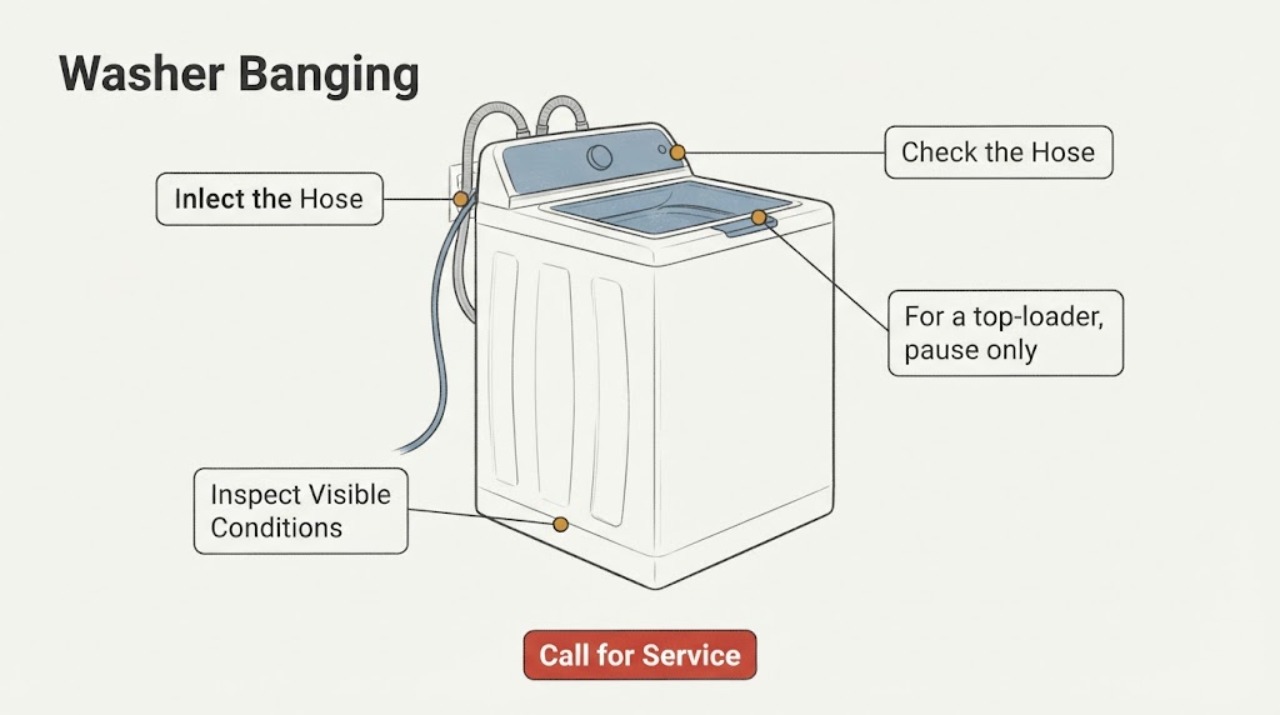
A banging Amana washer does not prove that suspension rods are worn, even if the washer is about a year old. Amana's official guidance first separates the cycle phase: hoses or nearby objects can bang against the cabinet, an uneven load can move the basket during spin, and an unlevel washer can amplify vibration. On an Amana front-loader, shipping bolts left in place can also cause noise and vibration. Check the outside of the washer, redistribute a bulky or single-item load, verify all four feet are firmly on the floor, and confirm the front-loader's shipping hardware was removed according to its installation instructions. If the washer bangs when empty or with a balanced load after these checks, stop trying to diagnose suspension parts by sound and arrange model-specific service.
Work through in order
Diagnostic checks
Use only checks that match the exact appliance or system and its official guide.
-
Check 1
Observe one short cycle from a safe distance and record whether the bang occurs while filling, during agitation or wash, at the transition to spin, or only during high-speed spin. Stop the cycle if the cabinet moves sharply, hoses pull, water leaks, or a burning smell appears.
Expected result: The sound occurs during water entry, during a mode change, only with a bulky or uneven load, or when the basket reaches high spin speed.
Next step: Use the hose and outside-object check for fill-time noise, the load check for wash or spin noise, and the leveling and installation check for repeated high-speed vibration.
Why this matters
Why: Amana associates water-entry noise with hose movement, mode-change knocks with the drive system, and spin banging with an off-balance basket or leveling problem. Timing narrows the next safe check but does not identify suspension-rod wear.
-
Check 2
With the washer stopped, inspect the drain and inlet hoses behind the cabinet and remove nearby objects that could touch or lean against it. Secure a hose only in the manner allowed by the Amana installation instructions, leaving room for the hose to drain correctly.
Expected result: A hose can strike the rear cabinet, a rack or object is touching the washer, or the outside area is clear.
Next step: Correct only the visible outside contact, then reassess with a normal load. If the bang continues without outside contact, continue to the load and level checks rather than opening the machine.
Why this matters
Why: Amana says hose movement and objects leaning against the washer can create a banging or rattling noise, especially as water moves or spin vibration increases. Clearing the outside does not prove the internal suspension is good or bad.
-
Check 3
For a top-loader, pause only as the owner's instructions permit and redistribute clothing loosely around the basket or agitator; avoid testing with one bulky item by itself. Run a normal balanced load after the adjustment and note whether the sound returns only with one type of load.
Expected result: The noise stops after redistribution, returns only with a blanket or single heavy item, or continues with a balanced ordinary load.
Next step: Use balanced loads and the cycle guidance in the manual when redistribution resolves the sound. If a balanced load still bangs, stop repeated test cycles and arrange service.
Why this matters
Why: Amana says uneven loads can move the basket and trigger balance correction, while a bulky or single item can create thumping. A bang that persists with balanced loads is less consistent with a simple load-distribution issue, but it still does not identify a rod or other part.
-
Check 4
Check that the washer is stable and level according to its installation instructions: gently rock it diagonally from corner to corner with the machine empty, and verify that all four feet remain firmly on the floor. If it is a front-loader, also verify from the exact manual or installation record that the transport bolts and plastic spacers were removed before use.
Expected result: The cabinet rocks, a foot is not firmly planted, the washer is on an unstable pan or pedestal, shipping hardware may remain, or the installation is stable and complete.
Next step: Correct leveling only as the exact installation instructions allow. Do not remove suspected shipping hardware or alter a pedestal without the model instructions; request qualified service if installation history is uncertain or banging persists.
Why this matters
Why: Amana links an unlevel washer and feet that do not contact the floor to excessive noise and vibration. Amana also says front-load shipping bolts left in place can cause noise, vibration, and damage. Stable installation makes an internal service issue more relevant but does not prove worn suspension rods.
Use your observations
Decision map
Find the observation that best matches what you see, then follow the next safe action.
-
PATH 01Next step
What you see
The bang occurs while filling and a drain or inlet hose can touch the rear cabinet, or an outside object is leaning against the washer.
Do this next
Secure or reposition only the visible outside contact as the installation instructions permit, then reassess with a normal load. Arrange service if the noise remains without contact.
Why this path and its safety boundary
Why it matters: The observed pattern matches Amana's external hose or contact explanation more closely than a suspension diagnosis.
-
PATH 02Next step
What you see
The bang is limited to an uneven, bulky, or single-item load, and the washer is otherwise stable and level.
Do this next
Redistribute clothing and avoid washing one bulky item alone, following the exact Amana cycle guidance. Stop using the machine and call service if a balanced load still bangs or the cabinet moves excessively.
Why this path and its safety boundary
Why it matters: The load distribution is the leading supported explanation; the symptom does not establish worn suspension rods.
-
PATH 03Next step
What you see
The washer bangs with a balanced load or empty basket, the installation is level, and no hoses or outside objects are contacting it; a front-loader may also have unknown shipping-bolt history.
Do this next
Stop repeated high-speed tests and arrange model-specific qualified service. Provide the model number, cycle phase, load conditions, leveling result, shipping-bolt history, and any movement or leak observed.
Why this path and its safety boundary
Why it matters: An internal installation or suspension-related service issue remains possible, but Amana's public symptom pages do not support naming a failed rod or part from sound and age alone.
Helpful context
Understand the symptom
A banging sound is a symptom, not a suspension diagnosis
The supplied topic has no Amana model and the title hint mentions suspension rods, but Amana's public troubleshooting pages do not say that a one-year-old washer with banging has worn rods. Their first decision points are the cycle phase, hose contact, load distribution, leveling, and front-load shipping hardware. Treat suspension wear as a service hypothesis only after those checks and model-specific diagnosis.
Use the cycle phase to narrow the safe check
Amana says hose movement can create a bang while water is entering, a drive-system shift can make a knock during agitation or wash, and an off-balance basket can hit the cabinet during spin. A single bulky item or a load that is not distributed evenly can therefore mimic a mechanical failure. Note when the sound starts before ordering an internal part.
Front-load installation has a separate branch
If the Amana washer is a front-loader, check its model-specific installation instructions for shipping bolts and plastic spacers. Amana says these transport parts must be removed before use and that leaving them installed can cause excessive noise and vibration. Do not borrow a bolt-removal sequence from another model; if the installation history is unknown, have the manual or a technician confirm it.
Stop before opening the cabinet
The resident-level checks end at the load, visible hoses and objects, cabinet stability, leveling, and front-load shipping hardware. Do not remove the cabinet, reach under a moving tub, pull suspension rods, or order a rod set from the sound alone. Persistent banging with a balanced load or an empty basket needs model-specific qualified service.
When checks do not resolve it
Need a professional?
Arrange qualified Amana service when banging persists with a balanced load after visible hose, object, leveling, and installation checks; when the washer bangs empty, walks, leaks, shows structural damage, or has an unknown front-load shipping-bolt history. Do not pull suspension rods or continue high-speed tests to confirm a suspected part.
Common questions
FAQ
Do banging noises prove that Amana suspension rods are worn out?
No. Amana's public guidance first points to hose contact, an uneven load, leveling, nearby objects, and—on front-load models—shipping bolts. A suspension issue may be found by a technician, but the sound and one-year age alone do not identify a failed rod set.
Why does my Amana washer bang only during spin?
Amana says an uneven load can move the basket so it hits the cabinet, and an unlevel washer can create excessive vibration. Redistribute the load, verify all four feet are firmly on the floor, and stop using the washer if a balanced load still bangs severely.
Could the hoses be causing the banging?
Yes. Amana says drain and water-inlet hoses can strike the rear cabinet as water moves or the washer vibrates. Inspect the outside and secure only what the exact installation instructions allow; do not open the cabinet to reach the hoses.
What if an Amana front-loader has banged since installation?
Check the exact installation instructions or installation record for the shipping bolts and plastic spacers. Amana says these transport parts must be removed before use and that leaving them in place can cause excessive noise, vibration, or damage. If the history is uncertain, have service verify it rather than guessing.
Read the exact guide
Official sources
- Banging Noise - Front Load WasherAmana Product Help · Official Amana front-load symptom guidance used only in the front-loader branch; it does not establish a specific model's suspension part.
- Removing Shipping Bolts for Front Load WasherAmana Product Help · Official Amana installation support used to explain why front-load shipping hardware must be verified; exact model instructions govern the actual installation.
- Troubleshooting Washer NoisesAmana · Official Amana overview used for symptom-level distinctions and escalation; it does not diagnose suspension rods from sound or age.
- Bang or Banging - NoiseAmana Product Help · Official Amana top-load washer symptom guidance used for general external checks because no exact model is assigned.
Community feedback
Share a repair observation
Share a plain-text repair observation. Accepted observations are published automatically; this page may take a moment to update.