
On this page
Start here
Quick answer
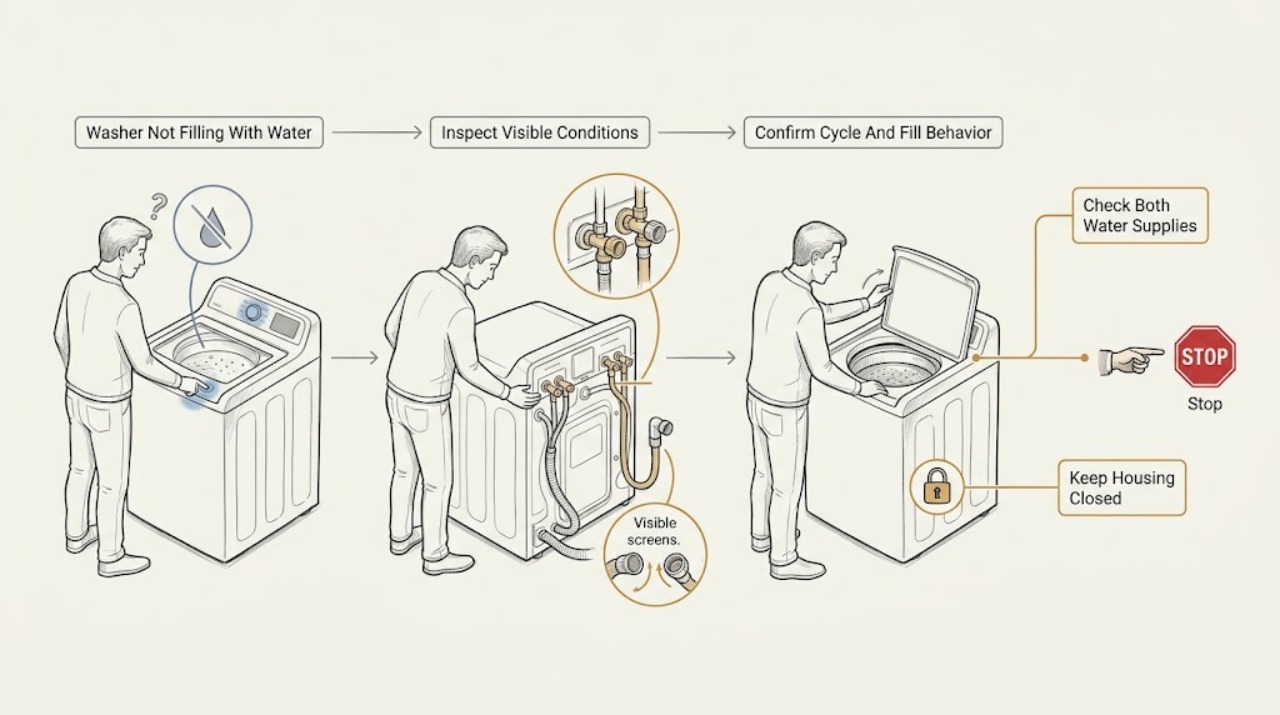
An Amana washer that appears not to fill may be waiting during sensing, using a low-water or bulky cycle, missing one of its required hot or cold water supplies, restricted by a kinked hose or inlet screen, prevented from running by a lid or door condition, or filling and immediately siphoning through an incorrectly installed drain hose. First observe the selected cycle and controls, wait through any model-specific sensing or fill pause, and confirm both supply valves and visible hoses from a dry position. Do not add water by hand, force a lid or door, remove an inlet screen, open panels, or test live parts. If there is no water with both supplies open, the washer fills and drains at once, an inlet connection leaks, an error returns, or the machine has a wet or damaged power area, stop using it and arrange qualified Amana appliance or plumbing service.
Before you begin
Safety first
- This article supports dry ordinary-access control, supply, hose, drain-routing, and latch observation, plus a model-permitted inlet-screen check only with the water off and residual water contained. Do not handle wet electrical areas, force or bypass a lid or door lock, open panels, test live parts, disconnect pressurized plumbing, add water by hand, move the washer, or repeat cycles against a leak or siphon.
Work through in order
Diagnostic checks
Use only checks that match the exact appliance or system and its official guide.
-
Check 1
Stop the washer using its normal control if it responds, keep the floor and power area dry, and look from a safe position for water near the outlet or cord, smoke, sparks, a hot or damaged connection, active leaking, or an unstable machine. Note the selected cycle, display, sensing or fill indicator, and whether the controls respond.
Expected result: Record whether there is no water at all, a small or delayed amount, water that immediately disappears, a code or flashing light, a locked lid or door, a tripped circuit, or a wet electrical area.
Next step: Leave the washer off and arrange qualified appliance or electrical help for a wet power area, smoke, sparks, heat, damage, or repeated trips. If the area is dry and the controls respond, wait through the exact model's expected sensing or fill sequence before changing settings.
Stop if: Do not touch a wet plug, outlet, cord, or cabinet, pull a plug through pooled water, reset a tripped breaker repeatedly, add water by hand, or force a locked lid or door.
Why this matters
Why: Water near electricity, smoke, sparks, heat, active leaking, a damaged cord, or a repeated circuit trip is a stop-use condition. A sensing or fill pause can be normal on some models, while an unresponsive control or recurring code needs the model manual and service path.
-
Check 2
Identify whether the Amana washer is top-load, front-load, or another model family and note the selected cycle, water-level option, load type, and time since Start. Observe whether the tub agitates or tumbles while filling, whether the fill pauses, and whether water is entering or draining away.
Expected result: Record a normal-looking staged fill, no water with no sound, a fill that is slow but continuing, a bulky or deep-water cycle that pauses while sensing, or water that flows out as quickly as it enters.
Next step: Let a model-appropriate cycle complete its documented sensing period without manually advancing controls. If no water enters after the expected stage, use the supply checks; if water enters and disappears, use the drain-installation branch.
Stop if: Do not select a different cycle repeatedly, manually advance a timer, defeat sensing or lid-lock behavior, or continue if water leaks or reaches electrical parts.
Why this matters
Why: Amana says some cycles use sensing, agitation, or extended fill stages and can appear to have too little water early. Water that immediately leaves points toward drain-hose siphoning; no water with no staged activity shifts attention to supply, lid or door, controls, screens, or the inlet valve.
-
Check 3
From a dry, ordinary-access position, verify that the hot and cold household water valves are open, both inlet hoses are connected to the washer, and neither visible hose is kinked, crushed, or sharply bent. Do not loosen a pressurized or wet connection.
Expected result: Record whether both valves are open, one supply is closed, hoses are swapped or kinked, an anti-flood device is installed, or water is leaking at a faucet or hose fitting.
Next step: Correct only an obvious, dry, accessible valve position or hose placement allowed by the exact manual. Keep the valves closed and arrange appliance or plumbing service for a damaged hose, leaking faucet, wet connection, or persistent no-fill.
Stop if: Do not disconnect a pressurized hose, reach behind a wet appliance, cross-thread a fitting, force a valve, use tape as a substitute for a seal, or restore water to a visibly damaged connection.
Why this matters
Why: Amana identifies both connected, open supplies and unrestricted hoses as prerequisites for proper filling on applicable models. A kink or anti-flood device can restrict flow; a faucet or hose leak may be an external plumbing or hose problem rather than a washer control fault.
-
Check 4
Only if the exact Amana instructions permit hose removal and the area is dry, turn off the water supply, contain residual water in a bucket, and inspect the visible inlet screens and hose ends without removing a screen. A brush and mild soap-and-water cleaning is appropriate only where the model guidance permits it; do not use force or compressed air.
Expected result: Record mineral scale, sediment, debris, a blocked-looking screen, a restricted hose stream, a damaged seal, or a clean inlet path; note whether the hose has been disconnected recently.
Next step: Restore the hose and any seal only as the exact manual directs, reopen water only when the connection is dry and secure, and make one observation. Leave the washer off for persistent no-fill, leakage, a damaged screen, or an inaccessible inlet valve.
Stop if: Do not remove inlet screens, probe an opening, scrape with metal, disconnect water while the floor or power area is wet, or perform live voltage tests at the valve.
Why this matters
Why: Amana identifies inlet-screen buildup and restricted hoses as fill causes. A clean screen with no flow, a damaged hose or seal, or a connection that leaks after safe reassembly needs service or a verified replacement; it does not prove the inlet valve is defective.
-
Check 5
If water enters but the level falls or the washer appears to fill and drain together, observe the visible drain hose and standpipe from a dry position. Check the exact installation instructions for hose depth, an air gap, the supplied form or clip, and the required standpipe arrangement; do not seal or push the hose deeper.
Expected result: Record whether the hose is taped or sealed to the drain, inserted too far, routed unusually low, missing its installation form or clip, kinked, or visibly discharging while the fill valve is active.
Next step: Use only the model's installation guidance to correct an obvious hose-routing issue from dry access; request plumbing service for an unsuitable standpipe or drain and appliance service when the washer still will not fill.
Stop if: Do not tape over the drain opening, pour drain chemicals into it, disconnect the hose while water is present, move the appliance, or alter plumbing height by guesswork.
Why this matters
Why: Amana explains that incorrect drain-hose insertion, sealing, or height can create siphoning so water leaves as it enters, which looks like a washer that will not fill. A correctly installed hose with no water entering keeps the supply, control, or valve path in focus.
-
Check 6
With the washer idle, check that a top-load lid or front-load door closes and latches evenly and that no clothing, packaging, detergent buildup, or visible debris interferes with the striker or latch. Observe the lock indicator without pressing, wedging, or bypassing the interlock.
Expected result: Record whether the lid or door closes normally, the lock light or latch responds, the control remains in sensing, or the machine refuses to fill while the lid or door remains open or unlatched.
Next step: Remove only loose visible debris from external surfaces with the washer off and as the exact manual permits. Request service for a damaged striker, lock, hinge, latch, recurring lock indication, or a door or lid that cannot safely close.
Stop if: Do not bypass, tape, wedge, jumper, or defeat the lid or door lock, reach into a moving basket, or force the lid or door closed.
Why this matters
Why: Amana says some newer top-load models will not fill, wash, drain, rinse, or spin with the lid open, and a lid-lock self-test occurs at cycle start. A damaged or misaligned latch can prevent filling; a normal latch with no water shifts attention to supply and valve checks.
-
Check 7
After one clearly safe correction to a valve, visible hose position, drain routing, load setting, or external latch obstruction—and only when the floor and electrical area are dry—use the model-documented cycle or fill check once. Stop at the first leak, error, abnormal sound, or no-fill result.
Expected result: Record whether water enters and stays, enters slowly, enters then siphons away, or does not enter; note any code, repeated pump-out, lock behavior, leak, or circuit event.
Next step: Leave the washer off and request qualified Amana appliance service for a repeat no-fill, returning code, leaking connection, inaccessible screen or valve, or any internal diagnosis. Request plumbing service for a supply or drain defect.
Stop if: Do not repeat start-and-stop tests, open panels, measure live voltage, remove a valve, bypass a lock, or keep running a washer that leaks, overflows, or fills and drains simultaneously.
Why this matters
Why: A restored fill after a clear external correction supports that correction as the immediate cause. A repeat no-fill with both supplies available and the drain correctly routed raises the likelihood of an inlet valve, pressure sensor, lid or door circuit, control, wiring, or another model-specific fault.
-
Check 8
Gather the exact Amana model and serial information if safely visible, washer style, selected cycle, fill timing, water-supply status, hose and drain observations, display or light pattern, and any photo of a visible connection or leak before requesting service.
Expected result: Confirm whether the issue is no water, slow water, fill-and-drain siphoning, a lid or door lock problem, a supply leak, or a code that returns after one safe check.
Next step: Use Amana's model documentation and service route for a persistent or internal no-fill; use a plumber for household supply or drain faults and an electrician for a wet, hot, damaged, or repeatedly tripping circuit.
Stop if: Do not order an inlet valve, screen, control, pressure sensor, or lid lock without an exact model diagnosis, and do not open the cabinet or test energized parts.
Why this matters
Why: These distinctions keep a supply or plumbing issue separate from an inlet screen, valve, control, pressure-sensor, latch, or wiring fault and prevent ordering a part from the symptom alone.
Use your observations
Decision map
Find the observation that best matches what you see, then follow the next safe action.
-
PATH 01Next step
What you see
The washer is in a model-documented sensing, staged-fill, or bulky cycle, some water or agitation is present, no leak or electrical hazard exists, and the controls are responding.
Do this next
Wait through the exact cycle sequence without adding water or manually advancing controls. If the fill never progresses, water disappears, or a code returns, move to supply and drain checks rather than treating the initial low level as a valve failure.
-
PATH 02Next step
What you see
No water enters, both hot and cold supplies are not confirmed open, an inlet hose is kinked or restricted, an anti-flood device limits flow, or an inlet screen or hose shows mineral or debris restriction.
Do this next
From dry access, correct only an obvious model-approved valve or hose position; use the manual for any screen check with the water off and residual water contained. Request service for a damaged hose, leaking connection, inaccessible screen, or persistent no-fill.
-
PATH 03Next step
What you see
Water enters but the level does not rise, the washer appears to fill and drain simultaneously, or water immediately leaves through a drain hose that is too deep, sealed, too low, or incorrectly formed.
Do this next
Keep the washer off and correct only a visible hose-routing issue allowed by the exact installation instructions; request plumbing assessment for the standpipe or drain and appliance service if the symptom remains.
-
PATH 04Next step
What you see
The lid or door will not close or latch evenly, the lock indicator remains abnormal, the cycle is held in sensing, or a visible striker, latch, or clothing obstruction prevents the machine from starting its fill sequence.
Do this next
Remove only loose external debris with the washer off and follow the exact manual's closure check. Do not bypass the lock; request service for a damaged latch, striker, hinge, lock, control, or recurring indicator.
-
PATH 05Next step
What you see
Both supplies are open, visible hoses and model-permitted screens are clear, the drain is correctly routed, the lid or door latches, and the washer still does not fill or returns a no-fill condition after one safe recheck.
Do this next
Leave the washer off and arrange qualified Amana appliance service. A technician should diagnose the inlet valve, pressure sensor, control, wiring, latch circuit, or another model-specific cause without live user testing or guessed part replacement.
Helpful context
Understand the symptom
Not filling is not always the same as no water
A modern Amana washer may sense the load, tumble while filling, pause, or use less water at the beginning of a cycle. The Bulky cycle on some top-load models can add water in stages while sensing and agitating, so a low level early in the cycle is not proof of a failed valve. Wait through the exact manual's expected sequence and note whether any water enters, whether the washer drains immediately, or whether the controls stop with an indicator. Do not add water by hand.
Check the supply before blaming the inlet valve
Both hot and cold supply valves and hoses matter on models that require both connections. A closed faucet, kinked hose, clogged inlet screen, mineral-restricted hose, or anti-flood device can reduce or stop the flow before a valve fault is established. Inspect only from dry access. If a hose must be disconnected, the water supply must be shut off, residual water contained, and the exact model instructions followed; otherwise leave it for service.
Filling and draining at the same time is a drain-installation clue
If water enters but the level never rises, observe the drain hose and standpipe. Amana explains that a hose inserted too far, sealed with tape, or routed into an unsuitable drain height can siphon water out while the washer fills. That symptom is different from a closed faucet or failed inlet valve. Do not seal the hose, pour chemicals into the drain, or alter plumbing from guesswork; use the model installation instructions or a plumber.
The lid or door can be a prerequisite
Some Amana top-load models will not fill, wash, drain, rinse, or spin with the lid open, and a lid-lock check can occur when a cycle starts. A front loader likewise requires the door to latch according to its model. Observe the lock or latch without defeating it. A damaged striker, lock, hinge, or latch that prevents the cycle from starting needs service rather than a bypass.
Safety boundary
Stop conditions
- Water is near an outlet, plug, cord, wiring, or other electrical connection; the cord or outlet is hot or damaged; or a breaker or GFCI trips.
- Active flooding, a leaking pressurized connection, water spreading under the appliance, or a washer that is unstable or moving severely.
- The washer fills and drains at the same time, the standpipe backs up, wastewater appears, or the drain hose cannot be inspected without moving the machine.
- The lid or door will not safely close or release, the lock or latch would need to be bypassed, or the basket is moving while access is attempted.
- A hose, connector, valve, inlet screen, seal, or drain component is cracked, missing, inaccessible, or cannot be safely handled with water shut off and residual water contained.
- The washer makes an abnormal electrical or mechanical sound, emits smoke or a burning odor, or produces a code that returns after one model-permitted check.
- No fill continues after both supplies, visible hose routing, model-permitted inlet checks, drain installation, and the lid or door prerequisite are confirmed.
- Any proposed step requires opening the cabinet, testing energized parts, removing an inlet valve or control, tilting or moving the appliance, adding water by hand, or ordering a part from a symptom alone.
Only after diagnosis
Potential parts
- water inlet hose or connector seal
Consider only when a hose body, connector, or seal is confirmed damaged or leaking and the source is separated from the household faucet or valve.
Verify the full Amana model, connection style, hose routing, and water-shutoff procedure before ordering or disconnecting a hose. - water inlet screen
Consider only when the exact model has a replaceable screen and diagnosis confirms damage or a restriction that cannot be safely cleaned according to the manual.
Amana instructs owners not to remove the screen during cleaning; confirm whether the screen is serviceable and model-compatible before any part decision. - water inlet valve
Consider only after both supplies, hoses, screens, drain routing, and lid or door prerequisites are confirmed and a technician identifies the valve as the no-fill cause.
Verify the full model and valve configuration; do not use live testing or a valve replacement as a trial. - lid lock or door latch component
Consider only when the exact model cannot begin its fill sequence because a damaged or misaligned latch or lock is confirmed.
Never bypass the interlock; confirm washer type, model, lock design, and service diagnosis before ordering. - water-level pressure sensor or control
Consider only after supply, hose, screen, drain, and latch causes are excluded and a technician diagnoses a model-specific sensing or control fault.
Do not infer a sensor or control failure from a low water level or single indicator; verify the exact model and repair procedure.
When checks do not resolve it
Need a professional?
Arrange qualified Amana appliance service when both water supplies are available but the washer still will not fill, a no-fill code or indicator returns, a valve, pressure sensor, control, latch, or wiring fault is suspected, or the washer fills and stops after safe external checks. Request plumbing service for a leaking faucet, restricted standpipe, siphoning installation, or household water-supply fault. Treat water near electricity, active flooding, smoke, sparks, a hot or damaged cord, and a pressurized leak as urgent stop-use conditions.
Safety scope: This article supports dry ordinary-access control, supply, hose, drain-routing, and latch observation, plus a model-permitted inlet-screen check only with the water off and residual water contained. Do not handle wet electrical areas, force or bypass a lid or door lock, open panels, test live parts, disconnect pressurized plumbing, add water by hand, move the washer, or repeat cycles against a leak or siphon.
Common questions
FAQ
Why is my Amana washer not filling with water?
Check for a model-specific sensing or staged-fill pause first, then confirm both hot and cold supplies, unrestricted inlet hoses, the lid or door prerequisite, and correct drain-hose routing. If both supplies are available but no water enters, arrange service rather than testing the inlet valve live.
Does an Amana washer need both hot and cold hoses connected?
Amana says both hot and cold water lines must be connected and turned on for proper operation on the applicable washer guidance. Follow the exact model instructions for any approved installation variation; do not leave a visibly damaged or leaking connection in service.
Why does my Amana washer fill and drain at the same time?
A drain hose inserted too far, sealed to the standpipe, routed too low, or otherwise incorrectly installed can siphon water out while the washer fills. Check the exact installation instructions from dry access and request plumbing help if the standpipe or drain arrangement is unsuitable.
Can a clogged inlet screen stop an Amana washer from filling?
Yes. Amana identifies mineral or debris restriction at an inlet screen or hose as a slow- or no-fill cause. If the model permits a screen check, shut off water, contain residual water, and clean without removing the screen; persistent restriction, damage, or inaccessible parts need service.
Why does my Amana washer take a long time to fill?
Some cycles, especially certain bulky or sensing cycles, add water in stages and may pause while measuring the load. A kinked hose, restricted screen, anti-flood device, low supply, or drain siphoning can also lengthen filling. Compare the behavior with the exact manual before changing parts.
Can an open lid stop an Amana washer from filling?
Some newer Amana top-load models will not fill, wash, drain, rinse, or spin with the lid open, and the washer may perform a lid-lock check when a cycle starts. Close it normally and remove only loose visible interference; never bypass a lock or force a damaged lid or striker.
Read the exact guide
Official sources
- Checking the Fill Hoses if the Washer is not FillingAmana · General Amana washer guidance; the exact model manual controls hose connections, screen access, water requirements, and safe service procedure.
- Not Filling or Long Fill - Washer - Product Help | AmanaAmana · Applies to Amana top-load families as a model-family guide; exact model cycle, water-level, and installation instructions control.
- Product Manuals & Literature | AmanaAmana · Use the exact model manual for cycle behavior, water-level options, screen and hose access, lock behavior, and service limits.
- Washer Leaks and Other Washer Water IssuesAmana · General Amana washer water-issue guidance; exact model controls cycle timing, hose routing, and any service procedure.
- Not Filling or Filling Slowly - Front Load Washer - Product Help | AmanaAmana · Applies to Amana front-load families as a model-family guide; exact model controls water supply, screen access, drain routing, and repair procedure.
- Lid Light Flashing - Product Help | AmanaAmana · Applies to Amana top-load families and model-specific lid-lock behavior; it does not replace a front-load door manual or service diagnosis.
- LF - Error Code - Product Help | AmanaAmana · Applies to Amana models that display LF or F8 E1; do not generalize the code or exact installation dimensions to another model.
Community feedback
Share a repair observation
Share a plain-text repair observation. Accepted observations are published automatically; this page may take a moment to update.