
On this page
Start here
Quick answer
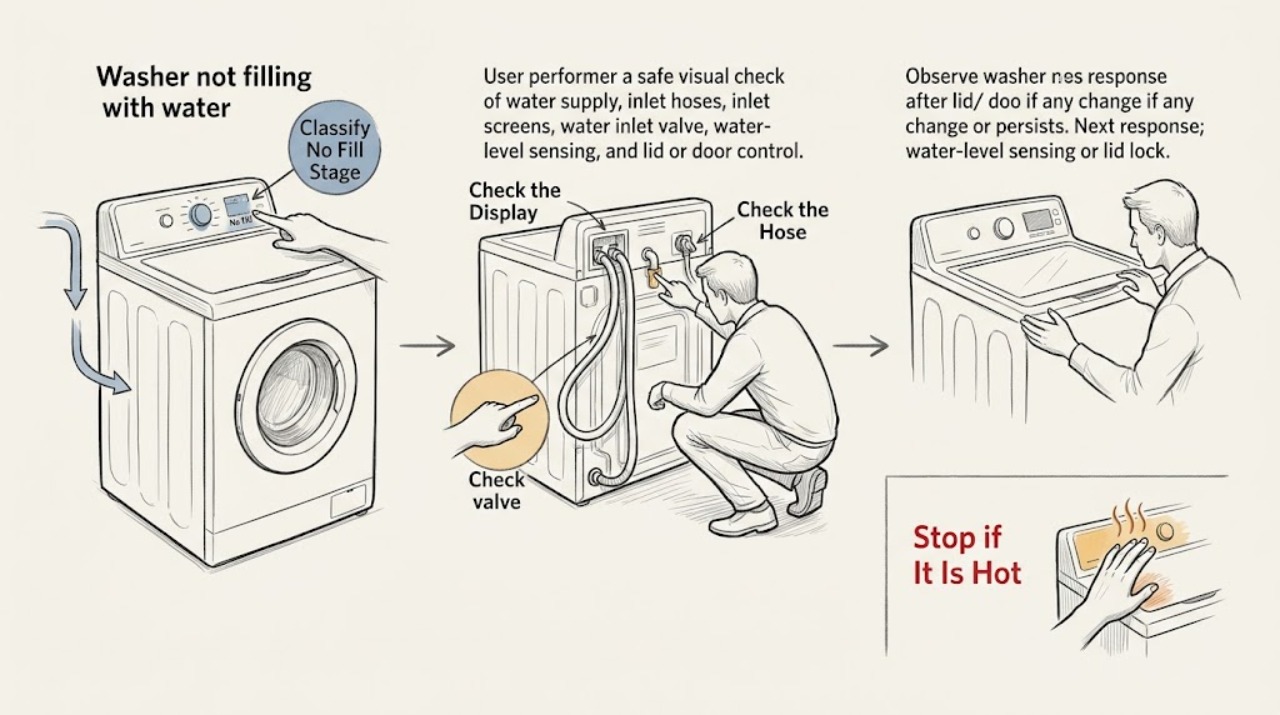
First decide whether the Hotpoint washer never starts filling, fills slowly, receives only hot or cold water, or begins filling and then stops. Confirm the cycle is not paused, the lid or door is closed, and both household water valves are open. From a dry position, inspect the visible hot and cold hoses for kinks, crushed sections, leaks, or reversed connections. If you need to disconnect a hose or inspect an inlet screen, unplug the washer and shut off the water valves first, then follow the exact model instructions. Low water pressure or debris at the inlet screens can cause a slow fill; a top-loader that agitates without filling can point toward water-level sensing. If the washer fills while switched off, close the water valves and arrange service for the water inlet valve. Stop for water near electrics, smoke, burning odor, a hot cord, or an uncontrolled leak.
Work through in order
Diagnostic checks
Use only checks that match the exact appliance or system and its official guide.
-
Check 1
Select the normal cycle without forcing a start and note whether the washer is completely silent, clicks or hums but receives no water, fills slowly, receives only one temperature, agitates without filling, or fills when switched off. Record any display message and whether the lid or door is fully closed.
Expected result: The cycle is paused, the lid or door is open, the washer is silent, water enters slowly, only hot or cold water enters, the washer agitates without filling, or water enters while the controls are off.
Next step: If water enters while off, close both water valves and stop using the washer. For water near electrics, smoke, burning odor, a hot cord, or an uncontrolled leak, keep clear and arrange qualified or emergency help. Otherwise continue with the matching visible check.
Why this matters
Why: A pause or interlock can prevent a fill command. Slow or one-sided filling points toward supply, hose, screen, or valve flow. Agitation without fill is a distinct top-load sensing path, while filling while off points toward a valve fault.
-
Check 2
Confirm the washer is not paused or delayed, the lid or door is closed without clothing caught at the seal, and both hot and cold household water valves are open. Check the dedicated outlet and control display only from a dry position; do not bypass a lid or door interlock.
Expected result: The cycle was paused, the lid or door was not closed, a water valve was closed, the outlet has no power, or all controls and supplies appear normal but no water enters.
Next step: Correct only the confirmed control or supply condition and make one supervised start attempt. If the lid or door sensing is faulty, the outlet is wet or damaged, or no-fill continues with normal supplies, stop and arrange service.
Why this matters
Why: A paused cycle, closed valve, open lid or door, or loss of power can look like a failed inlet valve. A normal control state with no fill keeps the hose, screen, inlet valve, pressure, and model-specific control path in focus.
-
Check 3
If the washer is dry and the water valves are closed, unplug it before any hose or screen inspection. Check the visible hot and cold hoses for kinks, pinching, reversed connections, damaged sealing washers, or leaks; inspect inlet screens only as the exact Hotpoint model instructions permit.
Expected result: A hose is kinked or crushed, hot and cold connections are reversed, a screen has sediment or scale, a sealing washer is missing or damaged, or hoses and screens look clear.
Next step: Correct only a visible routing or connection issue under the model instructions, then restore water slowly and check for leaks before reconnecting power. Do not force screens, over-tighten fittings, or continue if a hose or connector is cracked; arrange service.
Why this matters
Why: A restricted hose or screen can reduce or stop fill flow, and reversed connections can produce a one-temperature symptom. Clear visible supply hardware shifts suspicion toward the inlet valve, water pressure, or control system.
-
Check 4
If some water enters but the fill is slow or times out, compare the flow at the hot and cold household faucets only when the hose connections are secure and no leak is present. Note whether both sides are weak, only one side is weak, or the washer fills normally after a visible screen or hose correction.
Expected result: Both household supplies are weak, only hot or cold flow is weak, the washer has adequate faucet flow but fills slowly, or fill returns after a restriction is corrected.
Next step: Have a plumber or water provider evaluate weak household flow when appropriate. For adequate supply with persistent slow filling, keep the washer off and arrange appliance service rather than adjusting an unverified pressure setting.
Why this matters
Why: Weak household flow points upstream to water supply or plumbing. A one-sided result points to that hose, screen, valve inlet, or connection. Adequate supply with persistent slow fill makes the washer inlet valve or control path more likely.
-
Check 5
If a top-load Hotpoint washer agitates without first filling, stop the cycle and record whether the lid closes and locks normally, whether water valves and hoses are clear, and whether the symptom repeats after one model-approved control reset. Do not reach into a moving basket or bypass the lid switch.
Expected result: The washer agitates with no water, the lid or lock does not register, the symptom clears after the model reset, or it repeats with normal supply and lid operation.
Next step: Use only the exact model's documented reset. If the washer again agitates without water, the lid control fails, or the basket moves while open, stop and arrange qualified service.
Why this matters
Why: Agitation without fill is a different path from a closed faucet or clogged screen; official top-load guidance associates it with water-level sensing when basic checks do not correct it. A persistent lid or control issue also needs service.
-
Check 6
With the cycle ended and the controls off, observe whether water continues to enter the tub or reappears without a fill command. Record the complete Hotpoint model, washer style, supply pattern, display, and every visible correction; do not keep the valves open to reproduce an idle fill.
Expected result: Water enters while off, the tub stays dry with normal supply but no commanded fill, a leak appears at a hose, or no-fill remains after supply and screen checks.
Next step: Close both water valves for idle filling or any leak, keep the washer off, and arrange qualified service. Do not replace a valve, sensor, or control based only on the symptom and do not open the cabinet.
Why this matters
Why: Filling while off points toward a water inlet valve that may be failing open. No commanded fill with normal supply keeps the inlet valve, level sensor, lid or door control, and main control path in focus; a hose leak is a separate water hazard.
Use your observations
Decision map
Find the observation that best matches what you see, then follow the next safe action.
-
PATH 01Next step
What you see
Do this next
Clear only the model-documented pause, delay, or lid or door condition and make one supervised start attempt. Arrange service if the control or interlock will not respond.
-
PATH 02Next step
What you see
Do this next
Shut off water and unplug before hose or screen access, correct only visible issues under the exact model instructions, and check for leaks before power is restored. Arrange service for cracked hardware or persistent no-fill.
-
PATH 03Next step
What you see
Do this next
Use only the model's documented reset once; if the washer repeats the symptom, keep it off and arrange appliance service. Do not bypass the lid switch or reach into the basket.
-
PATH 04Next step
What you see
Do this next
Close both water valves, leave the washer off, and arrange qualified appliance service. Do not leave the supply open or replace the valve without model-specific diagnosis.
-
PATH 05Next step
What you see
Do this next
Keep the washer off and arrange qualified service. For water near electrics, smoke, burning odor, a hot cord, or an active leak, keep clear and seek emergency help as appropriate.
Helpful context
Understand the symptom
No fill is not always a failed valve
A washer may be waiting in a pause, have one supply valve closed, fill too slowly to complete, or be prevented from filling by a lid or door condition. A front-loader and top-loader can also use different sensing and control paths. Record the washer style, selected cycle, display, and whether any water enters before changing a connection.
Use water shutoff and power isolation before hose work
Keep hose disconnection and inlet-screen access to a dry, controlled check. Unplug the washer and close both water valves before loosening a hose, and catch residual water in a container. Do not work behind a wet appliance, touch a wet plug, or reconnect a leaking hose to see if the fill returns.
A washer that fills while off needs service
If water enters the tub when the controls are off, close the household water valves immediately. That pattern is different from a washer that will not fill on command and can indicate a water inlet valve that is not closing. Keep the washer out of service until the valve and related wiring are diagnosed.
Only after diagnosis
Potential parts
- washer water inlet valve
Consider this only after qualified diagnosis confirms the washer valve does not open on command or remains open when the controls are off, after supply, hose, and screen checks.
Valve ports and electrical connections vary by model. Confirm the complete Hotpoint model and manufacturer's fit information before ordering. - washer inlet hose
Consider this only when a visible inlet hose is cracked, kinked beyond safe correction, leaking, or otherwise confirmed as the fill restriction.
Hose length, ends, screens, and sealing washers vary. Confirm the complete Hotpoint model and installation guidance before ordering. - washer water level sensor
Consider this only for a top-load washer that agitates without filling after supply and lid checks, when model-specific service diagnosis confirms a level-sensing fault.
Sensing systems vary by control generation and model. Confirm the complete Hotpoint model and qualified diagnosis before ordering.
When checks do not resolve it
Need a professional?
Arrange qualified service for no-fill after visible supply and hose checks, a recurring fill timeout, a top-load washer that agitates without filling, an idle fill, a damaged hose or connector, or any inlet-valve, level-sensor, or control diagnosis. Shut off water and isolate power only from a safe dry location for leaks near electrics.
Common questions
FAQ
Why is my Hotpoint washer not filling with water?
Check for a paused cycle, an open lid or door, closed household valves, kinked hoses, reversed connections, clogged inlet screens, and low water pressure. If these are normal, the inlet valve, level sensing, or control path may need service.
Why does my Hotpoint washer fill slowly?
Low household flow, a kinked hose, or sediment at an inlet screen can reduce fill speed. Shut off water and unplug before approved hose or screen access, then arrange service if the restriction is not visible or the slow fill returns.
Why is my Hotpoint washer getting only hot or only cold water?
A closed faucet, reversed hose, one restricted hose or screen, or a one-sided supply issue can create that pattern. Check only visible connections with water shut off before hose work and use the exact model instructions.
Why does a top-load Hotpoint washer agitate but not fill?
After supply, hose, and lid checks, agitation without fill is a distinct symptom that can involve water-level sensing. Use only the documented model reset once; if the symptom repeats, arrange service and do not bypass the lid switch.
What if my Hotpoint washer fills when it is turned off?
Close both household water valves immediately and leave the washer off. Water entering while the controls are off can indicate a water inlet valve that is not closing and needs qualified diagnosis.
Can clogged inlet screens stop a Hotpoint washer from filling?
Yes. Sediment or scale at the inlet screens can slow or stop fill. Unplug and shut off the water before any model-approved screen check, and do not force screens or hose fittings.
Should I replace the Hotpoint washer water inlet valve?
Not from the symptom alone. First separate the cycle state, water supply, hose, screen, and lid or door checks. Consider a valve only after model-specific diagnosis confirms it is not opening on command or is allowing water in while the washer is off.
When should a Hotpoint washer that will not fill be serviced?
Arrange service for persistent no-fill, recurring timeouts, agitation without fill, an idle fill, a damaged hose or connector, or any inlet-valve, level-sensor, or control issue. Stop immediately for water near electrics, smoke, burning odor, a hot cord, or an uncontrolled leak.
Read the exact guide
Official sources
- Washer - Inlet Fill HosesGE Appliances · Official GE Appliances washer inlet-hose and hot or cold connection reference relevant to Hotpoint-family washer installation
- Washer - Drain Hose InformationGE Appliances · Official GE Appliances guidance for GE and Hotpoint branded washer drain-hose installation
- Top Load Washer - Agitates But Does Not FillGE Appliances · Official GE Appliances support for top-load washer agitation without fill and water-level sensing
- Front Load Washer - No FillGE Appliances · Official GE Appliances and Hotpoint-family support for front-load no-fill, water valves, power, inlet screens, and service
- Top Load Washer - Fill FunctionGE Appliances · Official top-load washer fill behavior, supply pressure, inlet restrictions, and modern fill-level context
- Washer - Slow Water FillGE Appliances · Official washer slow-fill guidance for household pressure, inlet screens, power isolation, water shutoff, and service
- Washer - Drips or Fills When Not Turned OnGE Appliances · Official washer guidance for an idle fill and water inlet valve service condition
Community feedback
Share a repair observation
Share a plain-text repair observation. Accepted observations are published automatically; this page may take a moment to update.