
On this page
Start here
Quick answer
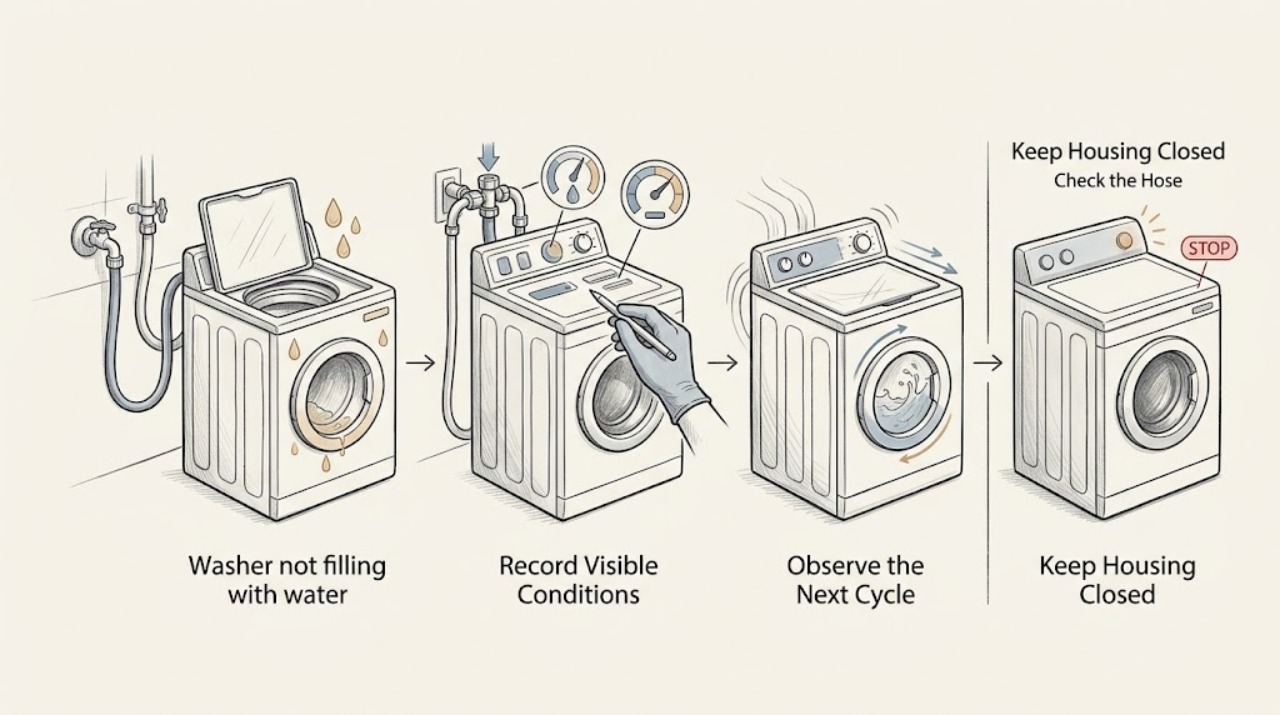
An LG washer that is not filling may be waiting briefly while it senses the load, or it may have a closed or weak water supply, kinked hose, clogged inlet filter, frozen connection, lid or door condition, drain-hose siphoning, or an internal inlet-valve or control fault. Watch the first start-up phase and any IE or dE indication, then check only visible, model-appropriate conditions: both supply taps, hose routing, the drain hose position, and the inlet screens with water isolated and power disconnected from a dry, safe location. Do not bypass a lid or door lock, open the cabinet, run the washer without inlet screens, or keep repeating a fill attempt. Stop for a leak near electrical parts, a damaged cord or outlet, smoke, burning odor, sparks, repeated breaker trips, or water that cannot be controlled; if the visible supply path is correct and filling still does not start, leave the washer off and arrange qualified LG appliance service.
Before you begin
Safety first
- Do not open the cabinet, defeat a lid or door lock, test energized wiring, operate without inlet screens, or continue using the washer with an active leak or electrical hazard.
Work through in order
Diagnostic checks
Use only checks that match the exact appliance or system and its official guide.
-
Check 1
Press Start once as the exact LG manual allows and watch from outside the washer. Record whether the tub moves briefly before filling, whether water starts afterward, and every display code or light pattern. Keep the lid or door closed while motion is possible.
Expected result: Water starts after a short sensing period, the tub moves but never fills, IE appears, dE appears, or the washer makes no normal start response.
Next step: If water begins normally, stop troubleshooting. If a code persists or any smoke, burning odor, sparks, hot connection, leak near electrics, or tub movement that will not stop occurs, stop and isolate the washer safely. Otherwise continue with the visible supply checks without bypassing a lock.
Why this matters
Why: A short model-specific sensing period can be normal; IE points to inadequate inlet flow, while dE or an open lid or door can prevent operation. No response can be a control or power issue rather than a water-path issue.
-
Check 2
From a dry, safe position, confirm that each water tap connected to the LG washer is fully open and that the household water supply is available. Do not disconnect a hose while the tap is open or pull the washer across a wet floor.
Expected result: A tap is closed or only partly open, the home supply is interrupted, or both taps are fully open with no other supply problem visible.
Next step: Open a safely reachable tap fully and allow one normal start attempt. If water still does not enter, stop repeated attempts and inspect hose routing only after water is isolated; use the exact model manual if the connection arrangement is unusual.
Why this matters
Why: A closed or restricted tap can prevent filling or make it take too long. Correct taps with a good household supply make a kink, filter, drain-routing, or washer-side fault more likely.
-
Check 3
With the taps closed and the washer disconnected from power from a dry location, inspect the visible hot and cold inlet hoses for crushing, sharp bends, cracks, loose connections, or a hose pressed against the cabinet. Do not energize the washer with a damaged hose.
Expected result: A hose is kinked or crushed, a connection or hose is damaged, or the hoses are open and undamaged.
Next step: If a hose is only visibly bent, restore a smooth routing without stressing the connection and reopen the tap slowly while watching for leaks. Replace or service a damaged connection; do not run the washer if it leaks or the hose cannot be safely routed.
Why this matters
Why: Vibration or cabinet movement can restrict a hose and reduce fill flow. A damaged hose creates a leak risk; clear, undamaged hoses shift attention to inlet screens, water pressure, freezing, drain siphoning, or the washer's inlet system.
-
Check 4
After both taps are closed and power is disconnected, place a towel or container under the hose ends and inspect the inlet filter screens at the washer connections. Remove only a screen that the exact LG manual identifies as user-accessible, and clean visible rust, sand, scale, or other debris without operating the washer with a missing screen.
Expected result: A screen is visibly blocked, damaged, missing, or clean and intact; residual water is present in a hose.
Next step: Rinse and reinstall a reusable screen only as the manual directs, reconnect the hoses securely, and check for leaks with the taps opened slowly. Stop and arrange service for a missing or damaged screen, a leak, or continued no-fill; do not open the cabinet or test the valve live.
Why this matters
Why: Sediment or foreign material can reduce or stop inlet flow. A damaged or missing screen is not a reason to run the washer, and a clean screen makes an inlet valve, pressure, control, or another model-specific cause more likely.
-
Check 5
If the problem occurs in freezing weather, with the taps closed and power disconnected, separate the hose only as the LG guide permits and check whether water flows from the tap. Inspect for ice at the tap or hose; never use an open flame or force a frozen fitting.
Expected result: No water comes from a frozen tap or hose, water flows normally from the tap but not through the washer, or the connection is thawed and the no-fill condition remains.
Next step: Thaw only with the gentle warm-water method in the exact LG guidance, reconnect after ice is gone, and watch one supervised fill for leaks. Stop for a split hose, leak, or recurring no-fill; do not heat plastic fittings aggressively or continue cycling a frozen or damaged connection.
Why this matters
Why: LG identifies frozen water in a supply line or hose as a cause of no fill. A flowing tap with a thawed, correctly connected hose points away from the household supply and toward the washer inlet path or controls.
-
Check 6
With the washer stopped, inspect the visible drain hose where it enters the standpipe or drain, using the exact LG manual for the required holder and depth. Look for a hose inserted too deeply, a submerged end, a loose holder, or a drain that immediately removes incoming water; do not push the hose farther into the drain.
Expected result: Water enters but runs out, the drain hose is too deep or submerged, the holder is missing or displaced, or the drain route appears correct but the tub still will not fill.
Next step: Restore only the model-approved drain routing and secure the hose. Run at most one supervised fill if the floor and connections are dry; if water still will not remain, stop using the washer and arrange qualified service.
Why this matters
Why: A siphoning drain can mimic a fill failure even when supply water is available. Correct visible routing can resolve that branch; a correct route with persistent no-fill makes an inlet valve, sensor, or control fault more likely.
Use your observations
Decision map
Find the observation that best matches what you see, then follow the next safe action.
-
PATH 01Next step
What you see
Do this next
Use the washer normally unless the delay exceeds the exact model behavior or IE/dE returns.
-
PATH 02Next step
What you see
Do this next
Correct the visible tap or hose condition safely, then make one supervised fill attempt; clean the inlet screens only with water and power isolated.
-
PATH 03Next step
What you see
Do this next
Clean and reinstall the screens according to the exact model guide; do not run the washer without them. Escalate if a screen is damaged or flow remains absent.
-
PATH 04Next step
What you see
Do this next
Restore the exact LG drain-hose routing and secure the holder; stop if the condition continues or the drain backs up.
-
PATH 05Next step
What you see
Do this next
Use only the gentle thawing method in LG's guidance, reconnect after the ice is gone, and stop for a split hose or leak.
-
PATH 06Next step
What you see
Do this next
Leave the washer off and arrange qualified LG appliance service with the model, code, cycle stage, and results of the visible checks.
-
PATH 07Next step
What you see
Do this next
Keep clear, isolate water and power only from a dry safe location, and obtain qualified appliance or electrical service. Do not restart or bypass the lid or door lock.
Helpful context
Understand the symptom
First separate sensing from a failed fill
Some LG top-load models briefly move or spin the tub after Start while they sense the laundry weight. If water begins after that model-specific delay, the washer may be operating normally. A prolonged delay, an IE water-inlet indication, no water at all, or a dE lid or door indication is a different branch. Record the exact model, cycle, display text, and whether either hose supplies water before changing anything.
The supply path is the safest first inspection
A fully open household tap, an inlet hose without a crush or kink, and clean inlet screens are prerequisites for filling. Check both hot and cold connections that your model uses, but do not assume a front-load and top-load procedure is interchangeable. Turn off the water and disconnect power from a dry, safe location before removing a hose; keep a towel or container ready for residual water.
Water can enter and still fail to remain in the tub
If water arrives but immediately runs away, inspect only the visible drain-hose routing against the exact LG manual. LG warns that a drain hose positioned too deeply or submerged can create siphoning. A hose that is loose, damaged, blocked, or routed contrary to the manual should not be forced into another position, and a recurring IE condition after supply checks needs service.
Keep water and electricity on separate sides of the diagnosis
Do not reach behind a wet washer, remove the cabinet, defeat a lid or door lock, or apply live electrical tests as an ordinary homeowner check. Stop for water at the outlet or controls, a damaged cord, smoke, burning odor, sparks, a hot connection, or repeated breaker trips. Isolate water and power only when the controls can be reached without standing in water, then arrange qualified service.
Safety boundary
Stop conditions
- Stop immediately for water near the outlet, cord, plug, controls, or other electrical parts; a damaged cord or outlet; smoke, burning odor, sparks, repeated breaker trips, or a hot connection. Isolate power only from a dry, safe location and arrange qualified service.
- Do not reach into a moving basket, defeat a lid or door interlock, force a locked door, or continue start attempts to reproduce the problem.
- Turn off both water taps and disconnect power before removing an inlet hose or screen. Do not run the LG washer with a missing or damaged inlet filter, cracked hose, active leak, or frozen connection.
- Do not open the cabinet, probe energized wiring, or replace an inlet valve based only on a generic guide. Use the exact LG model manual and qualified service for internal diagnosis.
- If the taps, hose routing, inlet screens, freezing condition, and drain routing are correct but the washer still will not fill or IE returns, stop using it and arrange service rather than repeating cycles.
Only after diagnosis
Potential parts
- water inlet valve or solenoid assembly
Consider only when the taps, hoses, inlet screens, freezing condition, and drain routing are correct but the washer still has no fill and qualified diagnosis identifies the washer-side inlet path.
Confirm the full LG model number and the exact model's parts information before ordering; top-load and front-load assemblies are not interchangeable by appearance alone. - inlet hose
Consider only if an inlet hose is cracked, damaged, or cannot maintain a safe unrestricted connection after the water is isolated.
Confirm hose length, connection type, temperature-side arrangement, and model or installation requirements before ordering. - water inlet filter screen
Consider only if the exact model uses a replaceable screen and the existing screen is damaged or missing rather than merely dirty.
Verify the exact model and inlet configuration; never operate the washer without the required screen.
When checks do not resolve it
Need a professional?
Arrange qualified LG appliance service when the washer still will not fill after safe visible supply checks, IE returns with good flow, a screen or hose is damaged, water leaks from inside the cabinet, or the exact model requires an internal inlet-valve, sensor, wiring, or control diagnosis. Use urgent service for any electrical or uncontrolled-water safety symptom.
Safety scope: Do not open the cabinet, defeat a lid or door lock, test energized wiring, operate without inlet screens, or continue using the washer with an active leak or electrical hazard.
Common questions
FAQ
Why does my LG washer move before it fills with water?
Some LG top-load models briefly sense the laundry weight after Start and may move the tub before supplying water. If water starts after that model-specific period, it can be normal; a prolonged delay, IE, or no fill needs the supply checks above.
What does IE mean on an LG washer?
LG uses IE for a water-inlet condition when the tub does not receive enough water in the expected time. Check the fully open taps, kinked hoses, inlet screens, freezing, and applicable drain-hose siphoning; recurring IE after those checks needs service.
Can a kinked hose stop an LG washer from filling?
Yes. LG says a pressed, bent, or crushed inlet hose can restrict flow. Isolate water and power before correcting a severe bend, and replace a damaged hose rather than operating it.
Why does water enter an LG washer but not stay in the tub?
A drain hose inserted too deeply or with its end submerged can siphon water away as the washer fills. Check the exact LG installation guidance and stop if the hose is damaged, the drain backs up, or the tub still will not retain water.
Should I remove an LG washer inlet filter to improve flow?
Only with the taps closed, power disconnected from a dry location, and the exact model guide confirming the screen is user-accessible. Clean visible sediment and reinstall the screen; do not run the washer with a missing or damaged screen.
When should I stop using an LG washer that will not fill?
Stop for an active leak, water near electrical parts, smoke, burning odor, sparks, a hot or damaged cord or outlet, repeated breaker trips, a broken lock, or a no-fill condition that remains after the safe visible checks. Leave it off and arrange qualified service.
Read the exact guide
Official sources
- LG Top Load Washer - Troubleshooting an IE Error CodeLG USA Support · IE and drain-hose guidance is model/style dependent; use the exact manual for installation dimensions and access.
- LG top load washing machine - Why is no water supplied to my washing machine?LG USA Support · Top-load-specific guidance; do not assume the same timing or lid behavior for a front-load model.
- LG Washer - My Washing Machine is Not Adding WaterLG USA Support · General LG guidance; newer and older models can differ in sensing behavior.
- LG Washer - Troubleshooting Fills Too Slow / Does Not FillLG USA Support · LG support guidance for washers; exact controls and access vary by model.
- MAINTENANCELG Electronics · Manual content is model-family specific; use the washer's exact manual where it differs.
- LG Washer - Why is There No Water in My Front Load Washing Machine?LG USA Support · Front-load-specific guidance; page states all-model images and procedures may differ from the product.
Community feedback
Share a repair observation
Share a plain-text repair observation. Accepted observations are published automatically; this page may take a moment to update.