
On this page
Start here
Quick answer
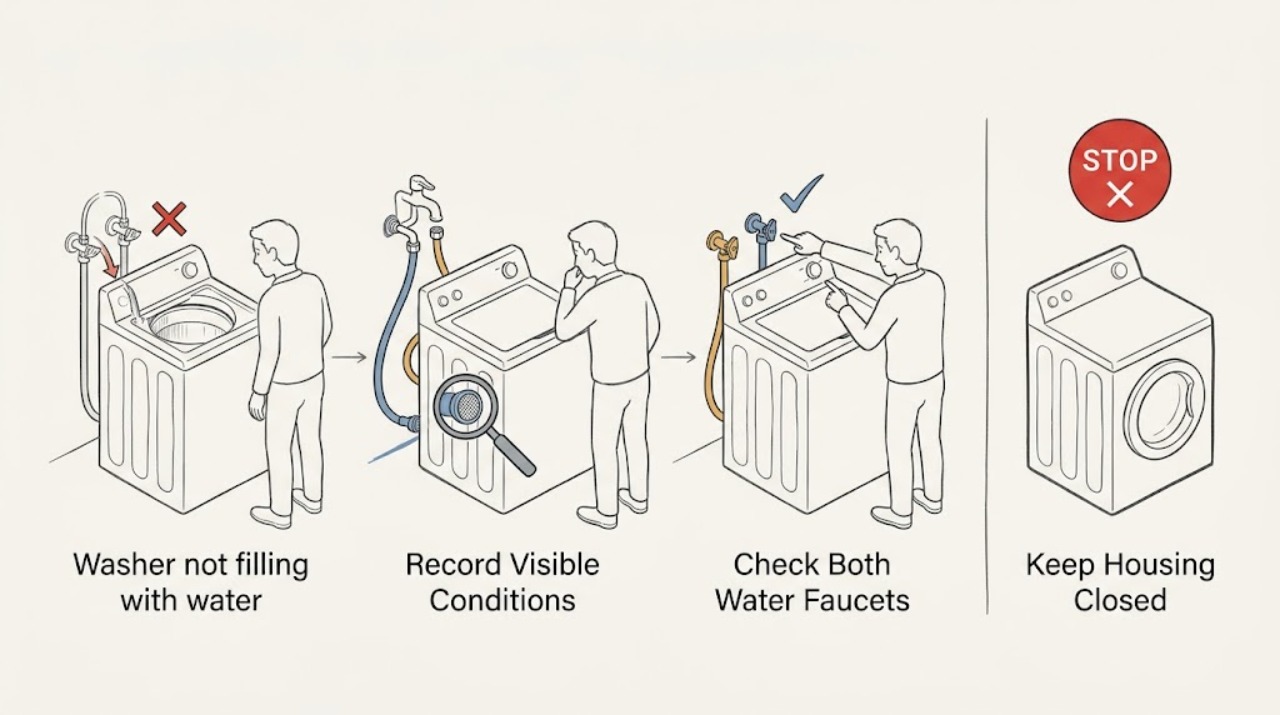
Record the exact Electrolux model, display code, and whether the washer is completely dry, filling slowly, filling and draining at once, or stopping after the door locks. Start with safe exterior checks: both hot and cold household faucets should be on, the supply hoses should be connected to the matching inlets without kinks or cross-threading, and the inlet screens should not be visibly restricted. If the washer was recently installed or moved, verify the hose and drain routing against its installation guide. Electrolux identifies E11 on applicable front-load models as a long-fill condition and HO SE as reversed hot and cold hoses, but codes and lockout behavior are model-specific. Do not disconnect a hot or pressurized hose, open panels, bypass a door lock, or repeatedly unplug during a model-specific lockout. Arrange service when supply is present but the washer still will not fill, the inlet valve or pressure system needs diagnosis, the machine fills and drains simultaneously, a hose leaks, or water is near electrical parts.
Before you begin
Safety first
- This article supports model identification and ordinary-access checks of faucets, visible hoses, accessible screens, door or lid state, and drain routing only. It does not authorize hot or pressurized hose disconnection, panel or pump access, live electrical testing, lock bypass, appliance movement, or operation after a water or electrical hazard.
Work through in order
Diagnostic checks
Use only checks that match the exact appliance or system and its official guide.
-
Check 1
With the washer stopped and safe to approach, record the full Electrolux model, exact display or code, selected cycle, and whether the washer is completely dry, filling slowly, filling briefly, or filling and draining at once.
Expected result: Note any E11, HO SE, another code, no code, locked door or lid, valve hum, no valve sound, water entering, or water immediately leaving through the drain.
Next step: Photograph the display and model tag, then use the matching visible check; do not apply an error-code meaning from another Electrolux model.
Stop if: Stop for water near the outlet, plug, controls, or wiring; a leaking hose, damaged cord, smoke, sparking, hot water, or an abnormal burning smell.
Why this matters
Why: This separates supply and inlet checks from door, drain-siphoning, pressure-sensing, and control paths. Electrolux's E11 and HO SE descriptions apply only to the models and front-load context named in those pages.
-
Check 2
From a dry, accessible position, confirm that both household hot and cold water faucets feeding the washer are open and that no nearby shutoff has been closed; do not reach through standing water or open a pressurized connection.
Expected result: Record whether both faucets are open, only one side has water, a faucet does not supply water, water pressure is visibly abnormal, or opening a valve creates a leak.
Next step: Restore only an accidentally closed valve from a dry safe position and verify no leak; use a plumber for a supply or pressure problem and appliance service when household water is available but the washer remains dry.
Stop if: Do not adjust or remove plumbing under pressure, handle hot water without cooling time, or operate with a leaking faucet or hose.
Why this matters
Why: Electrolux says both hot and cold supplies must be available for proper operation on its washer guidance. A missing household supply can mimic an inlet-valve or control failure; a leak at the faucet is a plumbing issue first.
-
Check 3
Inspect the visible hot and cold inlet hoses and their washer-side and faucet-side connections for kinks, crushing, cross-threading, cracks, missing sealing washers, or reversed hot and cold connections without disconnecting a hot or pressurized line.
Expected result: Record a kink, hole, loose or cross-threaded connection, displaced washer, hose connected to the wrong inlet, a flood-safe hose issue, or intact matching connections.
Next step: If the water is isolated and the exact installation instructions permit it, have a qualified installer correct a visibly reversed or misrouted connection; arrange service for a damaged hose, sealing problem, or any pressurized disconnection.
Stop if: Do not force threads, use tape to compensate for a damaged washer, disconnect a hot or pressurized hose, or continue after a hose begins spraying or leaking.
Why this matters
Why: A restricted or reversed hose can prevent or slow filling. Electrolux identifies HO SE on applicable front-load models as reversed hoses and warns against cross-threading, over-tightening, bending, or pinching the hoses.
-
Check 4
Only when the exact Electrolux manual identifies the inlet screens as accessible and the water is safely isolated, inspect the visible screens or connector area for sediment or debris; do not pry screens out, open the cabinet, or test the inlet valve electrically.
Expected result: Record clean screens, visible deposits or blockage, a damaged or missing screen, a valve connector leak, or an inaccessible screen on a model with no user procedure.
Next step: Follow the exact manual's cleaning or replacement instructions, restore the screen and hose without over-tightening, and request service if the inlet path remains restricted or the washer still does not fill.
Stop if: Do not remove an inaccessible screen, use sharp tools, open panels, test voltage, or work with residual water near electrical parts.
Why this matters
Why: Electrolux lists inlet filters as a check when a washer does not fill, so visible sediment can restrict flow. A clean screen with no fill, a damaged screen, or a valve that does not open requires model-specific diagnosis rather than live testing.
-
Check 5
For a front-load washer, verify from outside that the door closes and latches normally; for any washer that fills and drains at once, inspect the visible drain-hose routing for an unintended low or loose route without sealing the drain or moving the machine.
Expected result: Record a door or lid that will not latch, an active lock indicator, water entering and immediately leaving, a drain hose that is too far into or poorly secured at the standpipe, or normal door and drain routing.
Next step: Use the exact manual or installation guide for normal latch and drain routing; request appliance service for a failed lock and plumbing or appliance service for a concealed or blocked drain path.
Stop if: Do not bypass the door or lid lock, tape or seal the drain hose, disconnect plumbing, or run the washer when water leaks toward controls.
Why this matters
Why: A door or lid interlock can prevent a fill cycle, while incorrect drain routing can siphon water away and make a fill look unsuccessful. These findings point to different installation or lock paths, not automatically to an inlet valve.
-
Check 6
If the washer was installed or moved recently, compare the hot and cold connections, hose routing, drain hose position, and model requirements with the exact installation instructions from a dry position before trying another cycle.
Expected result: Record a recent reconnection, reversed hoses, kinked or pinched lines, missing washers, a drain hose installed too far into the standpipe, or an installation that matches the guide.
Next step: Have the installer correct an installation issue when appropriate; otherwise preserve the model, code, and observations for qualified Electrolux service.
Stop if: Do not move the washer alone, disconnect hot or pressurized hoses, open panels, or operate while a connection leaks.
Why this matters
Why: Electrolux flags recent installation or movement as a reason to have the installer verify the setup when a front-load washer shows a long-fill condition. A correct visible installation makes a supply, inlet, sensor, lock, or control diagnosis more likely.
-
Check 7
After one safe visible correction, retry only the model-approved fill cycle once while observing from a dry distance, then document whether water enters normally, enters slowly, siphons away, or does not enter at all.
Expected result: Classify the result as restored fill, intermittent fill, no valve response, valve sound with no water, fill-and-drain, recurring code, leak, or unsafe to retry.
Next step: Keep the washer off and arrange qualified service with the exact model, code, stage, supply and hose findings, door or drain observations, and any short recording; do not order a valve or control from the symptom alone.
Stop if: Stop for water near electrical parts, a damaged cord, active leak, smoke, sparking, abnormal heat, or a door or lid that cannot latch.
Why this matters
Why: Persistent no-fill after both supplies, correct hoses, accessible screens, door state, and drain routing are confirmed points toward an inlet valve, pressure sensor, wiring, control, or another model-specific fault.
Use your observations
Decision map
Find the observation that best matches what you see, then follow the next safe action.
-
PATH 01Safety boundary
What you see
Neither hot nor cold faucet supplies water, a shutoff is closed, or water pressure is abnormal before the washer's inlet.
Do this next
Restore only an accidentally closed valve from a dry safe position and use a plumber for supply or pressure diagnosis; do not disconnect the washer hoses to investigate an active leak.
Why this path and its safety boundary
Why it matters: The household supply or plumbing is more likely than the washer inlet valve or control.
Safety stop: Stop for hot water, a leaking faucet, water near electricity, or any pressurized plumbing work.
-
PATH 02Safety boundary
What you see
Both faucets work, but an inlet hose is kinked, crushed, cross-threaded, leaking, damaged, missing its sealing washer, or connected to the wrong hot or cold inlet.
Do this next
Use the exact installation guide and a qualified installer or technician for water-isolated correction; replace a damaged hose or seal only after exact fit is confirmed.
Why this path and its safety boundary
Why it matters: The washer may be receiving restricted, misdirected, or no water. Electrolux's HO SE example is a front-load, model-specific reversed-hose condition.
Safety stop: Do not force threads, tape over a damaged connection, or disconnect a hot or pressurized hose.
-
PATH 03Safety boundary
What you see
The model is an applicable Electrolux front-load washer, the display exactly matches E11 or a long-fill symptom, and water is not entering or enters too slowly.
Do this next
Follow the model-specific water-supply and installation guidance, including the documented lockout behavior; service the washer or installer when supplies and connections are correct but the code persists.
Why this path and its safety boundary
Why it matters: Electrolux defines E11 on the named front-load models as a washing-phase no-fill or long-fill condition and notes that installation, supply, and model lockout behavior matter.
Safety stop: Do not unplug repeatedly to bypass a model lockout, enter diagnostics, open panels, or continue with leaks or electrical symptoms.
-
PATH 04Safety boundary
What you see
Water enters the washer but immediately leaves through the drain, or the fill level never rises despite open supplies and normal inlet connections.
Do this next
Check visible drain routing against the exact installation guide without sealing the hose; use plumbing or appliance service for concealed drainage, pump, pressure, or control diagnosis.
Why this path and its safety boundary
Why it matters: Drain-hose siphoning, low or incorrect standpipe routing, or another drain installation issue is more likely than no household water; an internal pressure or control fault remains possible if routing is correct.
Safety stop: Do not tape the drain hose closed, pour chemicals into the drain, disconnect plumbing, or move the washer while water is present.
-
PATH 05Safety boundary
What you see
Both supplies are available, hoses and visible screens are correct, the door or lid latches, drain routing is normal, but the washer remains dry or shows a recurring code.
Do this next
Keep the washer off and arrange qualified Electrolux service with the model, display, stage, supply observations, and any recording.
Why this path and its safety boundary
Why it matters: An inlet valve, pressure sensor, door or lid interlock, wiring, control, or another model-specific component becomes more likely and cannot be confirmed by ordinary-access checks.
Safety stop: Do not test live voltage, open panels, bypass a lock, replace a valve or control by guesswork, or restart after a leak or electrical symptom.
Helpful context
Understand the symptom
No fill, slow fill, and fill-and-drain are different symptoms
A washer that never admits water, one that fills slowly, and one that sends water down the drain as it fills do not point to the same part. Record the stage and sound: a valve hum without water, no valve sound, water entering briefly, or water entering and leaving together. A code such as E11 or HO SE is useful only when the exact model and display match the Electrolux support article.
Check both supply sides without opening the appliance
Electrolux's supply guide applies to front-load and top-load washers and calls for hot and cold faucets to be on, hoses correctly matched and free of kinks, snug connections without cross-threading or over-tightening, and clean inlet filters. A recently moved washer deserves an installation check before a valve or control is blamed. Do not disconnect a hot or pressurized line merely to prove water flow.
A door lock or drain route can prevent a normal fill
The washer may not proceed if a front-load door is not properly latched, and an incorrect drain-hose route can siphon water away while the washer is trying to fill. If the machine fills and drains at the same time, inspect the visible drain route rather than increasing supply pressure. Any leak, water near electrical parts, or need to reach a pump or control is a service boundary.
Safety boundary
Stop conditions
- Do not disconnect hot or pressurized inlet hoses, handle hot water without cooling time, or work through standing water.
- Do not open panels, test live voltage, pry inaccessible inlet screens, enter undocumented diagnostics, or replace an inlet valve, sensor, or control by guesswork.
- Do not bypass a door or lid lock, tape or seal the drain hose, pour chemicals into a blocked drain, or move a water-filled washer alone.
- Stop for water near the plug, outlet, controls, or wiring; an active hose leak, damaged cord, smoke, sparking, abnormal heat, or a door or lid that will not latch.
- Do not apply E11, HO SE, or another Electrolux code meaning without matching the exact model, washer type, display, and stage; repeated unplugging may restart model-specific lockout behavior.
Only after diagnosis
Potential parts
- washer inlet hose or sealing washer
Consider this category only when a visible supply connection has a split hose, damaged sealing washer, or confirmed connection fault after water is safely isolated.
Confirm the full Electrolux model, hose length, temperature use, thread, and manufacturer fit information; do not compensate for a mismatch by force or tape. - inlet screen or water inlet valve
Consider this category only when both household supplies and hose routing are correct but a qualified diagnosis confirms a damaged screen or valve that prevents filling.
Verify the exact model, valve configuration, screen design, electrical rating, and service procedure; do not order from E11 or no-fill symptoms alone. - door or lid lock assembly
Consider this category only when the exact model shows a failed latch or interlock that prevents a fill cycle after the door or lid is clean, aligned, and normally closed.
Match the exact Electrolux model and lock design; never bypass the lock or substitute a part based on a locked-door symptom alone. - pressure sensor or control assembly
Consider this category only after supply, hoses, screens, door or lid, and drain routing are confirmed and qualified diagnosis identifies a sensing or control fault.
Confirm exact model, control revision, sensor interface, and professional service requirements; live electrical diagnosis is not an ordinary-access check.
When checks do not resolve it
Need a professional?
Arrange qualified Electrolux appliance service when both water supplies are available but the washer remains dry, a model-specific E11 or other fill code returns, the inlet screens are inaccessible or clean without restoring fill, the door or lid will not latch, the washer fills and drains simultaneously after visible routing is correct, or diagnosis requires a valve, pressure sensor, wiring, control, pump, panel, or live electrical access. Use a plumber for household water supply, pressure, or standpipe problems. Treat water near electrical parts, an active leak, hot water exposure, smoke, sparking, abnormal heat, or a damaged cord as stop-use conditions.
Safety scope: This article supports model identification and ordinary-access checks of faucets, visible hoses, accessible screens, door or lid state, and drain routing only. It does not authorize hot or pressurized hose disconnection, panel or pump access, live electrical testing, lock bypass, appliance movement, or operation after a water or electrical hazard.
Common questions
FAQ
Why is my Electrolux washer not filling with water?
Check the exact model and stage first. Possible paths include closed household hot or cold supplies, kinked or reversed hoses, blocked inlet screens, a door or lid that is not latched, drain siphoning, excessive suds, an inlet valve, pressure sensor, wiring, or control fault.
What does E11 mean on an Electrolux washer?
On the applicable Electrolux front-load models, E11 indicates the washer is not filling during the washing phase or has a long-fill condition. Check supplies and hose order using the model guidance, respect any model lockout, and arrange service if the code returns.
What does HO SE mean on an Electrolux washer?
On the applicable Electrolux front-load models, HO SE indicates hot and cold inlet hoses are reversed. Turn off the water before any connection correction and use the exact installation guide; do not transfer this meaning to another model without matching its display.
Why does my Electrolux washer fill and then drain away?
Incorrect drain-hose routing, a low or improperly sealed standpipe connection, or a drain-path issue can make water leave while the washer fills. Check only visible routing against the exact installation guide; do not tape the hose closed or open concealed plumbing.
Can I clean the water inlet screens on an Electrolux washer?
Only if the exact Electrolux manual identifies the screens as accessible and the water is safely isolated. Inspect gently for visible sediment and follow the manual; do not pry inaccessible screens, use sharp tools, open panels, or test the valve live.
When should I call for Electrolux washer no-fill service?
Call when household supplies, hoses, visible screens, door or lid, and drain routing are correct but filling does not return; when a code recurs; or when diagnosis requires a valve, pressure sensor, control, wiring, panel, pump, or pressurized plumbing. Stop for leaks, water near electricity, smoke, sparking, hot water, or a damaged cord.
Read the exact guide
Official sources
- What should I do if my washer is draining slowly?Electrolux · Official Electrolux Owner Support article for washer drainage; its example references a Frigidaire top-load washer, so use the routing principles only with the exact model installation guide.
- Laundry front loading washer displaying Error Code HO SE reversed hose detection.Electrolux · Official Electrolux support article for the named HO SE condition on front-loading washers; use only when the exact display and model match.
- Laundry front loading washer displaying Error Code E11 long fill time.Electrolux · Official Electrolux support article for front-loading laundry washers and the named E11 condition; do not transfer its code meaning or lockout behavior to another model without its manual.
- Laundry Water Supply GuideElectrolux · Official Electrolux support guide for front-loading and top-loading laundry washers; exact model installation instructions control the procedure.
Community feedback
Share a repair observation
Share a plain-text repair observation. Accepted observations are published automatically; this page may take a moment to update.