
On this page
Start here
Quick answer
Do not order a suspension rod, gearcase, or other part from the symptom alone. On an Amana top-load washer, a tub that bangs the cabinet during a slow or intermediate spin is first separated from an uneven load, an unlevel machine, a hose or nearby object striking the cabinet, and a normal drive-system transition. Stop the cycle through the normal control, wait until all movement ends, record the exact model and where the sound comes from, then make only the external load, leveling, hose, and foreign-object checks documented by Amana. If the impact repeats with a correctly distributed load or the washer moves violently, leaks, smells hot or burnt, or damages the cabinet, stop using it and arrange qualified service. A 2021 Amana service pointer lists gearcase, shifter, splutch, and ACU triac possibilities only for named NTW models and requires service diagnostics; it does not establish one worn part for every Amana washer.
Before you begin
Safety first
- Owner checks are limited to stopping the cycle normally, waiting for movement to end, recording the model, checking the load, visible basket objects, external hoses, surrounding objects, and leveling from outside. Do not reach into a moving or stopped tub gap, remove panels, enter service diagnostics, probe live wiring, bypass the lid lock, or replace drive, suspension, or control components.
Work through in order
Diagnostic checks
Use only checks that match the exact appliance or system and its official guide.
-
Check 1
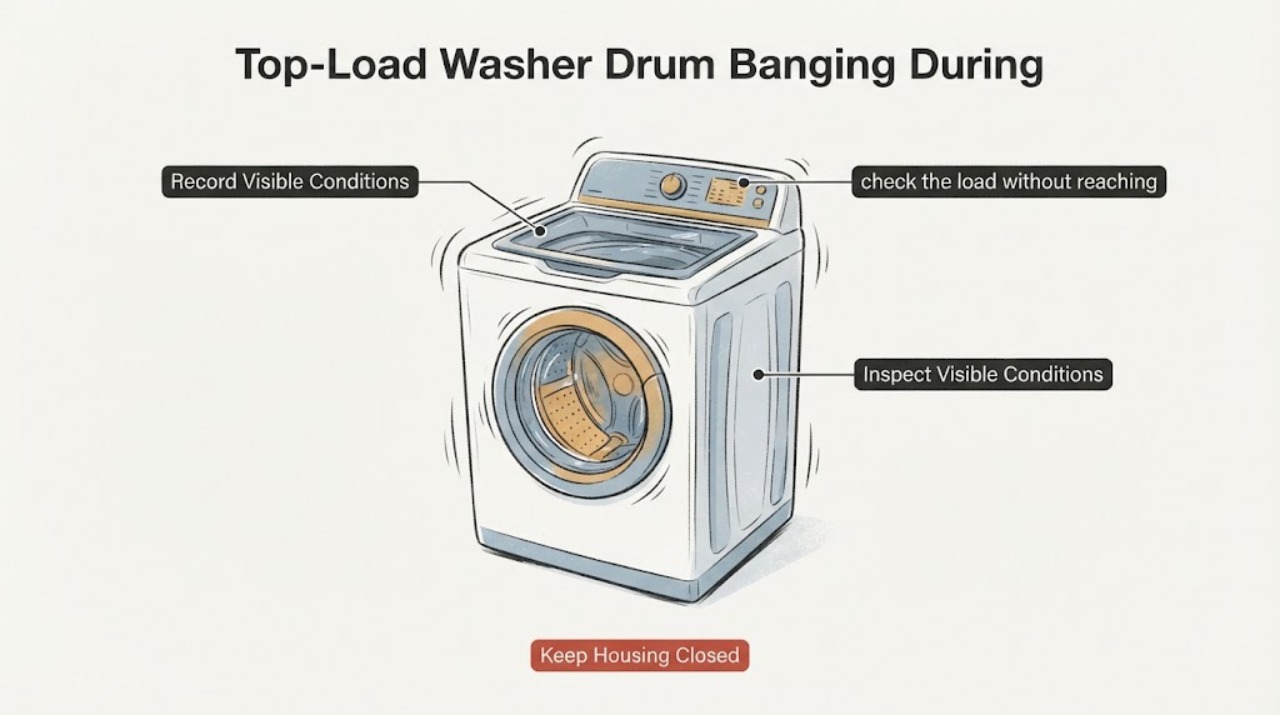
Stop the cycle with the washer's normal control and wait until the basket and tub have completely stopped. From a safe position, record the complete model and serial information, whether the sound occurs during sensing, agitation-to-spin, slow or intermediate spin, or final high spin, and whether the tub visibly contacts the cabinet or the sound comes from the rear or control area.
Expected result: The noise is a single clunk at a transition, repeated impacts during spin, a rear-cabinet tap, a control-area metallic sound, or the source cannot be located safely.
Next step: Continue only with the matching external check below. If the washer is moving violently, the cabinet is being damaged, or the source cannot be observed without reaching near moving parts, stop using it and arrange service.
Stop if: Do not open the lid while the basket is moving, reach into the tub, remove panels, or run a service-diagnostic test as an owner confirmation.
Why this matters
Why: Amana says a transition clunk can be normal, while an off-balance tub can hit the cabinet and hoses can strike the rear cabinet. The source and timing determine which check is useful; they do not by themselves prove a worn part.
-
Check 2
With the washer stopped, inspect only the outside: check that all four feet are firmly on the floor, rock the cabinet diagonally by hand, verify that the washer is level front-to-back and side-to-side, and look for the drain or inlet hoses or nearby brooms, racks, hangers, or other objects that can touch the cabinet. Secure or move only an accessible external item without opening the appliance.
Expected result: The cabinet rocks, a foot is not firmly planted, a hose or nearby object has a clear impact mark or gap to the cabinet, or the outside is stable and clear.
Next step: Correct one obvious external leveling, hose-routing, or surrounding-object issue according to the model's installation guidance, then monitor normally. If the washer remains level and the impact returns, do not keep adjusting or repeatedly testing it; continue to the load distinction and service branch.
Stop if: Do not lift or move a washer alone, remove rear covers, loosen internal fasteners, or place hands near the tub or drive area.
Why this matters
Why: Amana links an unlevel washer to excessive spin noise and vibration, and identifies hoses or nearby household objects as possible sources of banging. A stable, clear exterior makes those explanations less likely but does not diagnose the internal suspension or drive system.
-
Check 3
After the basket is stopped, check the load without reaching under the agitator or wash plate. Loosen tightly packed clothing, distribute items in loose heaps around the basket, remove a few items if overloaded, and avoid a single bulky or absorbent item unless the exact manual permits that load. Check visible pockets and the basket for loose coins, buttons, or other objects.
Expected result: The load is tightly packed, shifted to one side, a single heavy item is present, a loose object is visible, or the load and basket are clear and evenly arranged.
Next step: Use the normal cycle or the model's documented drain/spin function once and observe from outside. If banging persists with a balanced load, stop further test cycles and arrange qualified diagnosis rather than buying a part by appearance.
Stop if: Do not hold the tub, restrain the load while spinning, run the washer with the lid open, or reach between the basket and tub to retrieve an object.
Why this matters
Why: Amana documents that an uneven load can move the basket, reduce spin speed, and make the tub hit the cabinet; it also notes that loose objects can cause clunks. If a safe redistribution removes the symptom, a load condition is more likely than a worn part. If the same impact occurs with a balanced load, the load is not a sufficient explanation.
-
Check 4
Compare the sound after the one permitted external correction: note whether it occurs only at the agitation-to-spin transition, only with a particular load, or repeatedly during slow/intermediate spin even when the washer is level and the load is balanced. Note whether the sound seems to come from the controls area, gearcase area, or the tub striking the cabinet; do not remove covers to improve localization.
Expected result: The sound disappears after redistribution or leveling, is a brief transition clunk, or repeats on the same spin phase with a balanced load and stable cabinet.
Next step: For a repeatable balanced-load impact or a model-matched control-area noise, stop using the washer and give the technician the exact model, serial range, phase, sound location, load condition, and external checks. Do not select a suspension, gearcase, shifter, splutch, or ACU part without model-specific diagnosis.
Stop if: The service pointer's diagnostic mode is for qualified service; do not enter it, probe live wiring, or replace a control or drive component yourself.
Why this matters
Why: A resolved load or installation condition is different from a repeatable mechanical or control symptom. Amana's service pointer shows that, for certain listed NTW models, intermediate-spin noise can be confused with gearcase noise and may instead involve an ACU triac; if noise remains in service diagnostic mode, gearcase, shifter, or splutch troubleshooting is required.
-
Check 5
Before arranging repair, photograph the rating plate and any visible cabinet or floor marks, and write down whether there was a recent move, installation, overload, leak, electrical event, or change in the sound. Keep the lid closed and the washer out of service if the impact is recurring or severe.
Expected result: The model matches one of the service pointer's named NTW families, the model is different or unknown, or there is visible damage, water, smoke, burning odor, hot plug, repeated breaker operation, or uncontrolled movement.
Next step: Arrange Amana or qualified appliance service and provide the model, serial, sound timing and location, load and leveling observations, and photos. Use qualified electrical help for a damaged or repeatedly tripping supply; use emergency procedures for active smoke or fire.
Stop if: Do not continue running the washer to reproduce the impact, remove the cabinet, test live circuits, bypass the lid lock, or substitute a generic part.
Why this matters
Why: A model match may let a qualified technician consult the limited Amana service pointer, but it still does not establish the failed part. A different or unknown model requires its own manual and diagnosis. Damage, water, heat, or electrical symptoms are safety boundaries rather than ordinary noise checks.
Use your observations
Decision map
Find the observation that best matches what you see, then follow the next safe action.
-
PATH 01Next step
What you see
Banging appears only with a tightly packed, shifted, single bulky, or absorbent load and stops after the items are redistributed or reduced.
Do this next
Follow the exact manual's loading guidance and avoid repeating the problematic load. Arrange service if the same impact occurs with ordinary balanced loads.
Why this path and its safety boundary
Why it matters: The result is consistent with the load-balance path Amana documents; it does not show that a suspension rod or drive part is worn.
-
PATH 02Next step
What you see
The washer rocks, a foot is not firmly planted, or an inlet/drain hose or nearby object clearly strikes the cabinet, and the noise improves after one safe external correction.
Do this next
Keep all feet in firm contact, secure accessible hoses as the model permits, and keep objects clear. Escalate if the cabinet still moves or the tub continues to hit after the correction.
Why this path and its safety boundary
Why it matters: An installation or external-contact condition explains the immediate noise better than a confirmed internal worn part.
-
PATH 03Next step
What you see
The washer is level and the load is balanced, but the basket or tub repeatedly bangs the side walls during slow or intermediate spin, or the sound recurs at the same phase.
Do this next
Keep the washer out of service and arrange qualified appliance repair. If the exact model is one of the Amana NTW families listed in the service pointer, give that document and the sound location to the technician; do not use its service-diagnostic procedure yourself.
Why this path and its safety boundary
Why it matters: The user-level load and installation explanations are less likely. An internal mechanical or control diagnosis is needed, but the symptom does not identify one worn component.
-
PATH 04Next step
What you see
There is violent movement, a cabinet or floor is being damaged, water is leaking, the plug or outlet is hot or damaged, a breaker trips repeatedly, or there is smoke or a burning odor.
Do this next
Stop using the washer. Isolate power only from a safe dry position when there is no immediate danger, keep clear of damaged areas, and obtain qualified appliance or electrical service; use emergency response for active smoke or fire.
Why this path and its safety boundary
Why it matters: This is an appliance, water, electrical, or fire-safety stop path, not a situation for further spin testing or part identification.
Helpful context
Understand the symptom
Why slow-spin banging does not name one part
A side-wall impact can be produced by the basket moving out of balance, a washer that rocks, or something outside the tub striking the cabinet. Amana also describes a clunk as the drive system changes between agitation and spin. Those paths have different next steps, so a photograph of a similar washer or a generic parts listing cannot establish that a suspension component, gearcase, or other part is worn.
The model boundary matters
The opened Amana service pointer names NTW4516F, NTW4605E, NTW4655E, NTW4705E, and NTW4755E model families, with engineering or color digits and a stated serial range. It concerns an intermediate-spin noise that can come from the controls area and be confused with gearcase or transmission noise. Do not transfer that internal diagnostic or its parts list to an unconfirmed Amana model.
Only after diagnosis
Potential parts
- model-specific gearcase, shifter, splutch, or appliance control unit
Amana's opened service pointer lists these as possible causes only for named NTW model families and says qualified service must use diagnostic mode and the technical manual to separate them. It does not prove that any one part is worn on an unknown Amana top-load washer.
Confirm the complete model, engineering or color digits, serial range, and technician diagnosis before ordering. Do not substitute a generic suspension, gearcase, shifter, splutch, or control part.
When checks do not resolve it
Need a professional?
Contact Amana or qualified appliance service for recurring side-wall impacts with a balanced load, noise at the same spin phase, cabinet damage, uncontrolled movement, or any need to identify an internal mechanical or control cause. Contact qualified electrical help for a hot or damaged cord/outlet or repeated breaker trips, and use emergency response for active smoke or fire.
Safety scope: Owner checks are limited to stopping the cycle normally, waiting for movement to end, recording the model, checking the load, visible basket objects, external hoses, surrounding objects, and leveling from outside. Do not reach into a moving or stopped tub gap, remove panels, enter service diagnostics, probe live wiring, bypass the lid lock, or replace drive, suspension, or control components.
Have this ready
- Provide the complete model and serial, engineering or color digits if present, market, approximate age, sound recording if safe, phase and speed when it occurs, whether the tub or cabinet moves, load type and balance, leveling result, hose/object checks, recent move or installation, and any leak, odor, heat, smoke, or electrical history.
Common questions
FAQ
Is a worn suspension rod the likely cause of an Amana top-load washer banging during slow spin?
Not from this symptom alone. Amana first points to load distribution, leveling, hoses, nearby objects, and normal drive transitions. For a limited list of NTW models, Amana's service pointer lists several possible mechanical or control causes; it does not confirm a suspension rod or any other one part.
Can I keep running the washer to see whether the banging gets better?
Do not keep repeating spin tests. Stop the cycle normally, wait for all movement to end, make one safe external load or leveling correction, and arrange service if the impact returns with a balanced load or the washer moves violently, leaks, or shows an electrical or burning warning.
What can I check without opening an Amana washer?
Record the exact model and timing, redistribute or reduce the load after movement stops, check visible pockets or basket objects, verify all four feet and cabinet stability, and look for hoses or nearby objects striking the cabinet. Do not reach into the tub gap, remove panels, enter service diagnostics, or touch wiring.
Why does the Amana service pointer not tell me which part to buy?
It is model- and serial-range-specific and describes a diagnostic split for intermediate-spin noise. The document lists gearcase, shifter, splutch, and ACU triac possibilities, then sends the technician to service diagnostics and the technical manual. The same code or sound on another Amana model may have different documentation.
Read the exact guide
Official sources
- Knocking or Thumping - NoiseAmana Product Help · Opened Amana's top-load washer noise page. It covers spin impacts from an off-balance load, external hose contact, nearby objects, drive-system transitions, and all-four-feet leveling; it is user-level guidance and not a universal parts diagnosis.
- Sounds: Clunk or Clunking Noise During SpinAmana Product Help · Opened Amana's clunking-noise support page. It distinguishes an unbalanced or overloaded load, foreign objects, normal drive-system clunks, and leveling; it does not establish a worn part for an unidentified model.
- Service Pointer - W11520474 - Rev A - Top Load Washers Noise During SpinAmana / Whirlpool Corporation · Opened the official service pointer. It is a professional service notice, not a homeowner procedure. For the listed Amana models it describes intermediate-spin noise that may be confused with gearcase noise and lists mechanical failure, gearcase, shifter, splutch, or ACU triac possibilities; it requires service diagnostics and a technical manual.
- TOP-LOADING HIGH EFFICIENCY WASHER - USE AND CARE GUIDEAmana / Whirlpool Corporation · Opened the Amana-hosted use-and-care guide. It provides model-specific safety limits against reaching into a moving tub or repairing parts without documented instruction, plus vibration, balance, noise, and service-boundary guidance. It is not a universal manual for every Amana washer.
- Vibration or Out of Balance loadsAmana Product Help · Opened Amana's top-load vibration page. It explains the observable signs of an out-of-balance load, bulky-item loading limits, loose loading, and the all-four-feet leveling check.
Community feedback
Share a repair observation
Share a plain-text repair observation. Accepted observations are published automatically; this page may take a moment to update.