
On this page
Start here
Quick answer
For an Amana NFW5800DW0 front-load washer, do not assume F3 E1 means a drain-pump failure. Amana's official F3 E1 front-load washer page gives a five-minute control power cycle and service path but does not define a drain component. The opened NFW5800DW family Use & Care Guide identifies F9 E1 as a drain-pump-system error, F8 E1 as a water-supply error, and says an unlisted F# E# display is a system error; it does not assign a drainage meaning to F3 E1. First record exactly when F3 E1 appears and whether water remains, then inspect only the visible drain-hose/standpipe arrangement, detergent/suds history, load, and water-supply symptoms. Keep the washer off if there is a leak, pooled water near electrical parts, a damaged cord, unusual heat or smell, or a door that cannot safely open. Do not enter service mode, remove panels or pump parts, perform electrical tests, force the door, or borrow a Whirlpool or other Amana code meaning.
Before you begin
Safety first
- The owner's checks are limited to recording the exact display and timeline, observing water and door behavior without forcing it, checking visible hose routing and household backup, and reviewing load/detergent facts. Do not enter service mode, remove panels or pump parts, disconnect plumbing under pressure, perform electrical tests, tilt the washer, bypass the door lock, or reach into the drain system.
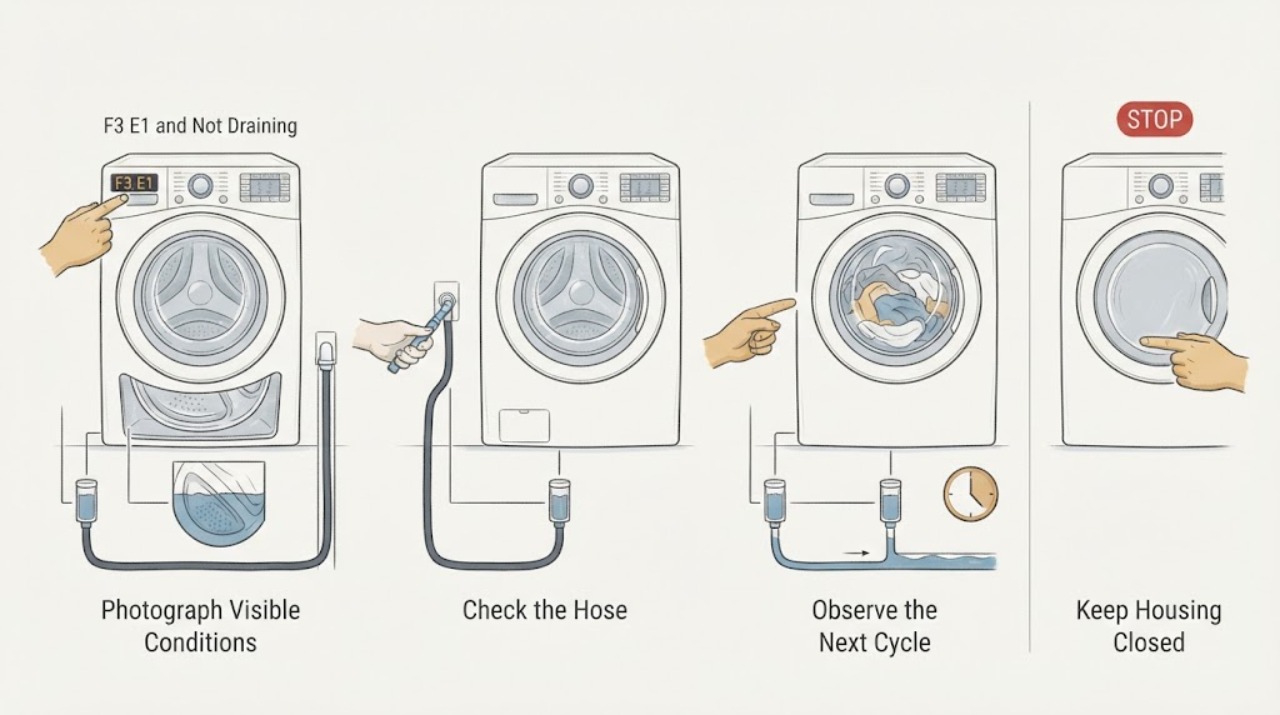
Work through in order
Diagnostic checks
Use only checks that match the exact appliance or system and its official guide.
-
Check 1
Before any reset or further cycle, photograph or transcribe the display exactly as F3 E1, including spacing and whether the characters alternate. Record the complete rating-plate model and serial information, market, selected cycle, and the point at which the display appeared: fill, wash, drain, or spin.
Expected result: F3 E1 is clear and repeatable, the characters may instead be F8 E1 or F9 E1, the model suffix differs, or the stage cannot be recalled.
Next step: Keep the display photo and timeline for service and use only the exact NFW5800DW0 documentation for any later user step.
Stop if: Do not enter a diagnostic mode, use a hidden button sequence, or copy a code interpretation from another washer platform.
Why this matters
Why: Amana documents F3 E1 as a front-load washer page without a component definition, while the matching family guide assigns different meanings to F8 E1 and F9 E1. A different display or suffix can change the applicable instructions.
-
Check 2
Leave the washer off if water is pooled near the cord or outlet, a hose is actively leaking, the cord or plug is damaged or hot, there is a burning or electrical smell, or the door will not open normally. Keep clear of wet electrical areas and do not force the door; close the water faucets from a dry, safe position if an active leak makes that necessary.
Expected result: The washer is dry and cool with no active leak or electrical sign, or pooled water, leak, heat, smell, damage, or an unsafe locked-door condition is present.
Next step: For any hazard, keep the washer isolated and arrange qualified appliance service; use appropriate electrical or emergency help for a hot, damaged, smoking, or arcing supply condition.
Stop if: Do not reconnect power, run another cycle, pull the machine through wet flooring, or reach into the drum or pump area to release the door.
Why this matters
Why: A safety condition takes priority over F3 E1 and over a five-minute reset. Remaining water can also make the door stay locked; forcing it can create a second hazard.
-
Check 3
With the washer off and without disconnecting plumbing, inspect only the visible drain hose where it meets the standpipe or laundry tub. Note a kink, pinch, crushed section, hose inserted unusually far, a taped or sealed opening, visible backup, or a hose end routed unusually high; do not pull the washer out or dismantle the drain connection.
Expected result: The visible hose route is obstructed or sealed, the household standpipe or tub is backing up, or the visible arrangement looks normal.
Next step: Correct only a plainly visible hose-position issue permitted by the exact installation guide. For backup or a clear route with recurring F3 E1, stop and arrange appliance or household plumbing service as appropriate.
Stop if: Do not disconnect a pressurized hose, remove pump covers, insert tools into the drain path, or open the washer cabinet.
Why this matters
Why: The NFW5800DW guide lists hose placement, a clogged or high hose, and a sealed standpipe as possible reasons for not draining or spinning. A clear visible route does not prove the pump, pressure system, or control is good or bad.
-
Check 4
Record the water pattern without starting another cycle: was the tub visibly full, nearly empty, or empty but the load still wet; did the washer fill normally; did it reach a spin; and did water return from the household drain after the washer stopped? Keep the door closed if water level or locking makes opening unsafe.
Expected result: Water remains in the tub, the tub is empty but clothes are wet, the machine never filled normally, or water backs up from the household drain.
Next step: Give the pattern and cycle stage to the service provider. Do not use F3 E1 as a substitute for the observed water-level and timing evidence.
Stop if: Do not force the door, scoop from the machine interior, tilt the washer, or run a cycle solely to watch the water level.
Why this matters
Why: Water left in the tub supports a drain-path symptom; an empty tub with wet clothes can instead reflect a slower spin or load issue; failure to fill points toward a supply branch; household backup points outside the appliance. None of these observations identifies a specific internal part.
-
Check 5
Review the last load and detergent information without adding products or restarting: note whether only HE detergent was used, whether the amount was measured, whether there was visible foam, whether the load was a single heavy item or tightly packed, and whether the selected cycle used a slower spin.
Expected result: There were excessive suds, non-HE or excess detergent, a single absorbent item, a tightly packed load, or a normal detergent/load history.
Next step: Record the load and detergent facts. If F3 E1 recurs or the washer retains water, arrange service even if a later load looks better.
Stop if: Do not add defoamer or other chemicals, use a non-HE product, overfill the drum, or repeat cycles to force a result.
Why this matters
Why: The family guide says suds can slow or stop draining or spinning and that a single or unbalanced load can leave items wetter. These are performance clues, not proof that F3 E1 is a detergent, pump, motor, or pressure-sensor code.
-
Check 6
Prepare a service handoff with the exact model and serial label, F3 E1 photo, cycle and stage, water remaining or absent, visible drain routing, supply and household-drain observations, detergent/load history, and any leak, smell, heat, or door-lock event. State that no service-mode or cabinet inspection was performed.
Expected result: The event record is complete, or the model suffix, market, code characters, water state, or cycle stage is still uncertain.
Next step: Keep the washer off if F3 E1 returns, water remains, or any safety condition exists, and have an Amana-qualified servicer verify the exact platform before diagnosis.
Stop if: Do not authorize a drain pump, pressure switch, control, hose, or other part solely because F3 E1 appeared.
Why this matters
Why: The provider can distinguish a documented drain symptom from an unverified display meaning only when the timeline and identity are complete. Missing information is not a reason to select a pump or sensor from F3 E1.
Use your observations
Decision map
Find the observation that best matches what you see, then follow the next safe action.
-
PATH 01Next step
What you see
Water is pooled near electrical parts, an active leak or damaged cord is visible, there is unusual heat or smell, or the door cannot be handled normally.
Do this next
Keep the washer isolated, close the water supply from a safe dry position if needed, and arrange qualified appliance service; escalate a smoking, arcing, or fire condition appropriately.
Why this path and its safety boundary
Why it matters: This is a water or electrical safety branch, not an ordinary F3 E1 reset case.
-
PATH 02Next step
What you see
The display is confirmed as F3 E1 on NFW5800DW0, the tub retains water, and the visible hose or household drain has a kink, seal, backup, or other plainly visible routing problem.
Do this next
Correct only the plainly visible routing issue allowed by the installation guide, or call a plumber for household backup; call appliance service if F3 E1 or retained water remains.
Why this path and its safety boundary
Why it matters: The manual-supported evidence favors an external drain-installation or household-drain branch, while F3 E1 itself remains an unresolved system-code indication.
-
PATH 03Next step
What you see
The tub is empty but the load remains wet, or the washer stopped before a normal spin with a single heavy, tightly packed, or sudsy load.
Do this next
Record the load, detergent, and cycle facts and arrange service if F3 E1 repeats or the washer will not complete normally; do not keep rerunning it to prove a theory.
Why this path and its safety boundary
Why it matters: This pattern is more consistent with spin/load or suds-related performance than with proven retained water, but it does not define F3 E1 or exclude a system fault.
-
PATH 04Next step
What you see
The washer did not fill normally, or the display is actually F8 E1 rather than F3 E1.
Do this next
Use only the exact model guide for visible supply checks and provide the confirmed characters to service if the issue remains.
Why this path and its safety boundary
Why it matters: The NFW5800DW guide assigns F8 E1 to a water-supply error. That is a different branch from the F3 E1 display and should not be merged with a drain-pump interpretation.
-
PATH 05Next step
What you see
F3 E1 returns with a clear visible drain route, normal supply history, and no load or suds explanation, or the code persists after a provider-approved control reset.
Do this next
Keep the washer out of service as needed and have a qualified Amana servicer verify the exact NFW5800DW0 platform and perform the controlled diagnosis.
Why this path and its safety boundary
Why it matters: The opened Amana sources do not expose a user-level F3 E1 component meaning for this exact platform. A recurring unexplained display with a drainage symptom needs model-specific service rather than a guessed pump, pressure sensor, or control.
Helpful context
Understand the symptom
What F3 E1 does—and does not—establish
Amana's F3 E1 page is specifically for front-load washers and says to cycle power to the control for five minutes, then contact service if help is still needed. It does not identify a pump, hose, pressure sensor, or water-level component. The matching NFW5800DW family guide gives separate labels to F8 E1 (water supply) and F9 E1 (drain pump system), and treats other F# E# displays as system errors. That distinction matters: the report of water remaining is a real symptom to investigate, but F3 E1 alone should not be translated into a pump diagnosis.
Use the water and timing pattern to separate branches
For the NFW5800DW family, the owner guide points to drain-hose routing, a blocked or poorly placed standpipe, excess HE detergent and suds, load balance, and small items at the drain-system boundary when a load stays wet. It also distinguishes water-supply symptoms from drain symptoms. Record whether the washer filled normally, whether the drum ever spun, whether water remains at the end, and whether F3 E1 appeared at fill, wash, drain, or spin. Do not use that record to infer an internal pump or pressure-sensor failure; use it to give the correct evidence to service.
When checks do not resolve it
Need a professional?
Contact Amana or a qualified appliance servicer for recurring F3 E1, retained water, an unexplained no-drain symptom, or any mismatch between the display and the NFW5800DW0 documentation. Contact a plumber for a household standpipe or tub backup. Use emergency or qualified electrical help for fire, smoke, arcing, hot wiring, or water near energized parts.
Safety scope: The owner's checks are limited to recording the exact display and timeline, observing water and door behavior without forcing it, checking visible hose routing and household backup, and reviewing load/detergent facts. Do not enter service mode, remove panels or pump parts, disconnect plumbing under pressure, perform electrical tests, tilt the washer, bypass the door lock, or reach into the drain system.
Have this ready
- Provide the complete NFW5800DW0 model and serial label, market, F3 E1 display photo, cycle and stage, water state, door state, visible drain-hose and standpipe observations, fill behavior, load and detergent history, and every leak, odor, heat, or power event.
Common questions
FAQ
Does F3 E1 mean the drain pump is bad on an Amana NFW5800DW0?
Not from the opened Amana sources. The NFW5800DW family guide assigns F9 E1 to a drain pump system error, while the F3 E1 support page gives a reset/service path without a component definition. Treat the retained water as a separate symptom and do not order a pump from F3 E1 alone.
What is the difference between F3 E1, F8 E1, and F9 E1?
Amana's front-load F3 E1 page does not define a component. The NFW5800DW family guide identifies F8 E1 as a water-supply error and F9 E1 as a drain-pump-system error. Confirm the characters and exact model before applying any meaning.
Can I reset the washer for five minutes?
Amana's F3 E1 page describes disconnecting the washer from power for five minutes, but do not use that step when there is pooled water near electrical parts, an active leak, damaged or hot wiring, unusual smell, smoke, or an unsafe door. In the present not-draining scenario, preserve the safety state and arrange service if the code or retained water remains.
Read the exact guide
Official sources
- F3 E1 - Front Load Washer - Product HelpAmana · Official Amana front-load washer page opened directly. It gives a control reset and service route but does not define F3 E1 as a drain-pump or pressure-sensor fault and is not a substitute for the exact model guide.
- Manuals and GuidesAmana · Official Amana manuals page opened to confirm that model-number lookup is the route for exact documents and identity verification.
- Owner's ManualAmana / Whirlpool Canada · Official manufacturer-hosted NFW5800DW family manual opened for the assigned NFW5800DW0 platform. It covers the family rather than spelling the final suffix in the PDF title; the complete rating-plate identity remains controlling.
Community feedback
Share a repair observation
Share a plain-text repair observation. Accepted observations are published automatically; this page may take a moment to update.