
On this page
Start here
Quick answer
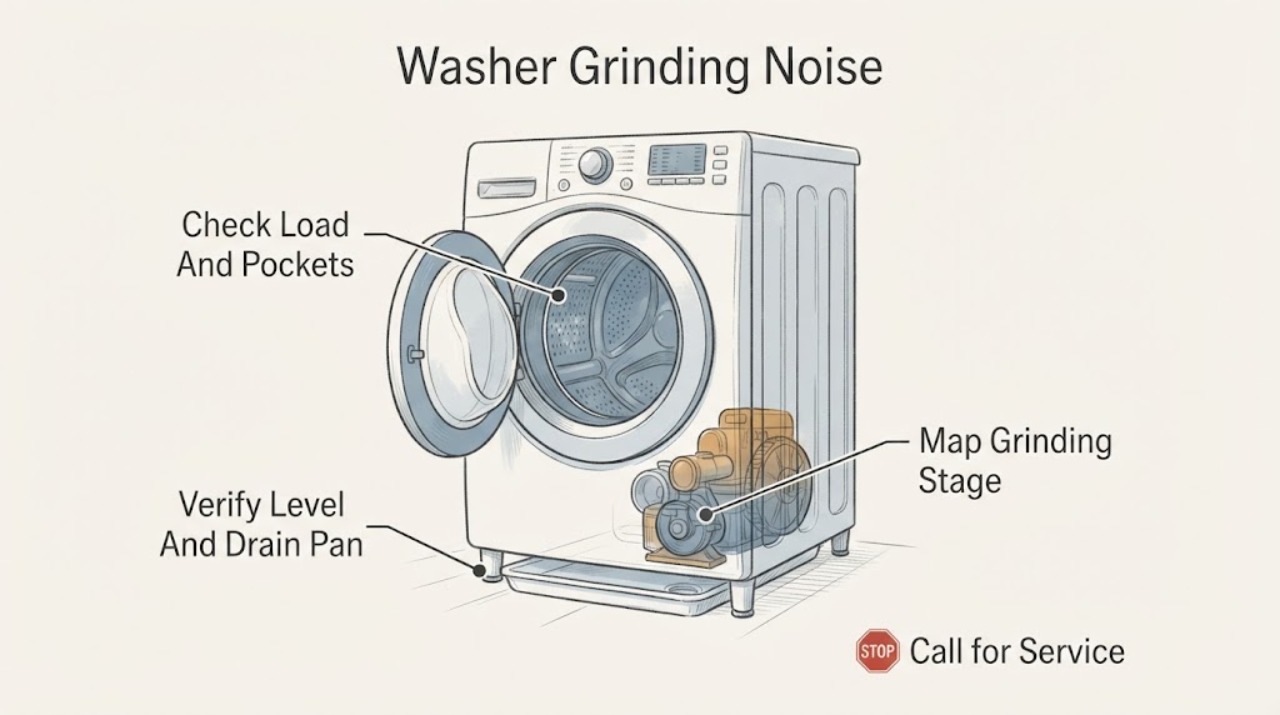
First note whether the sound occurs during agitation/wash, spin, draining or a change between modes, and whether the washer is top-load or front-load. Amana says some motor or gear sounds during agitation and spin are normal on newer drive systems, while a grinding/rubbing sound can become louder with an overloaded load or an unlevel washer. Stop the cycle and check pockets, redistribute or reduce the load, and verify that all feet are firmly on the floor. If a drain pan is installed, check from outside whether the tub bottom could be rubbing it. A pump hum during Drain/Spin can be normal, but an object suspected in the pump or between the basket and tub, a persistent harsh grind, hot-rubber odor, smoke, water leak or repeated failure needs Amana or qualified service. Do not reach under a moving basket, remove panels or diagnose a gearcase, bearing or motor from sound alone.
Work through in order
Diagnostic checks
Use only checks that match the exact appliance or system and its official guide.
-
Check 1
Record whether the grinding occurs during wash/agitation, spin, a mode transition or draining, and identify whether the washer is top-load or front-load.
Expected result: The sound is brief and stage-specific, or it persists across stages or occurs with a functional symptom such as poor draining.
Next step: Use the load and level checks below and keep model-specific procedures conditional. Do not name an internal part from the sound alone.
Why this matters
Why: Stage-specific motor, gear or pump sounds can be normal on some Amana designs; persistent harsh noise needs the safer fault path.
-
Check 2
Stop the washer, empty pockets and inspect the accessible basket/tub area; reduce an overloaded load and redistribute heavy items loosely and evenly.
Expected result: The load was tightly packed or unbalanced, a loose item is visible, or no accessible cause is found.
Next step: Correct only the accessible load or item and use the normal cycle. If an object may be inside the pump or between basket and tub, stop and arrange service rather than reaching into the mechanism.
Why this matters
Why: Overload or imbalance can make the basket strike and intensify grinding-type noise; a visible object can explain a contact sound, while no visible cause does not clear the pump or basket.
-
Check 3
From outside the washer, check that every foot is firmly on the floor and the cabinet does not rock; if a drain pan is installed, inspect it for damage or a possible tub-bottom contact without reaching under a running machine.
Expected result: The washer rocks, a foot is not firmly seated, or a drain pan is damaged/positioned where the tub could rub it; alternatively, the installation appears stable and clear.
Next step: Level the washer only through the normal accessible feet/manual instructions. Do not move an integrated appliance or remove panels as a noise experiment; use service if the noise remains.
Why this matters
Why: Amana says an unlevel washer can worsen noise and that a pan can rub the tub bottom on applicable front-load installations; a stable installation leaves the internal source unresolved.
-
Check 4
If the sound occurs during Drain/Spin, note whether water fully leaves the tub and whether the sound ends when draining ends; do not disassemble the pump.
Expected result: The washer drains completely with a normal pump hum, or water remains/pump runs without completing the drain.
Next step: For incomplete draining or a suspected inaccessible object, stop using the washer and arrange qualified service. Do not reach under the basket or test the pump live.
Why this matters
Why: A pump hum can be normal during water removal; standing water or an ongoing drain sound can indicate an obstruction or fault that is not safe to identify by sound alone.
-
Check 5
Record the model, washer type, cycle stage, load size, level/drain-pan result, draining result and any odor, leak or error before contacting Amana service.
Expected result: Grinding persists with a balanced level load, appears with an empty basket, prevents normal draining/spinning or accompanies hot-rubber odor, smoke, leak, breaker trip or visible damage.
Next step: Keep the washer off and arrange Amana or qualified appliance service. Isolate power from a safe location for smoke, arcing, hot wiring or other electrical danger; do not restart to reproduce it.
Why this matters
Why: The remaining possibilities include model-specific drive, basket, pump or control work that cannot be diagnosed safely from an audio description.
Use your observations
Decision map
Find the observation that best matches what you see, then follow the next safe action.
-
PATH 01Next step
What you see
The sound occurs only during wash/agitation or spin, is brief, and the washer otherwise completes the cycle.
Do this next
Check load size, balance and leveling, then monitor for a change in loudness, duration or performance rather than replacing a drive part from the sound.
Why this path and its safety boundary
Why it matters: Amana says newer drive systems can make motor or gear sounds during those portions of the cycle; the timing alone does not prove a failed component.
-
PATH 02Next step
What you see
A tightly packed or uneven load, loose pocket item or unlevel foot is found and the sound changes after the accessible correction.
Do this next
Use smaller, evenly distributed loads and keep the washer level. Arrange service if the grinding returns with a normal load or occurs with an empty basket.
Why this path and its safety boundary
Why it matters: The noise is consistent with load, contact or installation conditions that Amana identifies as noise contributors.
-
PATH 03Next step
What you see
The sound occurs during Drain/Spin and the washer either drains normally or leaves water/pump noise running.
Do this next
If draining completes, record the stage and monitor. If water remains, the pump runs continuously or an object may be inaccessible, stop and arrange service without opening the pump.
Why this path and its safety boundary
Why it matters: Amana describes pump hum during draining as possible normal operation, but an object in the drain system can slow draining and require service.
-
PATH 04Next step
What you see
Grinding persists after the load and level checks, occurs with an empty basket or comes with hot-rubber odor, smoke, a leak, breaker trip or failed spinning/draining.
Do this next
Keep the washer off and arrange Amana or qualified service. Do not open panels, bypass protection, test live circuits or select an internal part from the noise.
Why this path and its safety boundary
Why it matters: The condition is outside a safe generic user diagnosis and may involve an internal drive, basket, pump or electrical system.
Helpful context
Understand the symptom
Identify when the grinding occurs
Record whether the sound happens during wash/agitation, spin, a transition between agitation and spin, or draining. Amana says newer drive systems can make motor or gear sounds during wash and spin, and a drain pump can hum during Drain/Spin. A brief stage-specific sound is different from a harsh grind that continues with no load or returns with a leak, odor or failure to drain. Because the exact model is missing, use the model's manual before applying a front-load or top-load procedure.
Check the load and foreign objects safely
Stop the washer before opening the lid or door. Empty pockets and look only at the accessible basket and tub area for a coin, button, zipper or other loose item. Reduce an overloaded load and redistribute heavy items in a loose, even arrangement. Amana says a tightly packed or unbalanced load can make the basket strike or create excess noise; if an item may have entered the pump or space between the basket and tub, do not reach into the mechanism.
Verify the washer is level and clear externally
Check from outside that all feet are firmly on the floor and the washer does not rock. Amana says an unlevel washer can worsen noise and vibration. If a drain pan is fitted below a front-load washer, inspect it without reaching under a running machine: Amana notes that the tub bottom can rub a pan, especially with heavy or bulky loads. Do not pull an integrated or full washer out as a casual noise test.
Interpret a sound during draining
If the sound occurs only while water is being removed, listen for the normal pump hum described by Amana and check whether the washer completes draining. A small item can slow draining if it reaches the pump or the space between basket and tub, but the manual does not make that an instruction to dismantle the pump. Stop and arrange service for standing water, a pump that continues without completing the cycle or an inaccessible object.
Escalate persistent or hazardous grinding
Arrange Amana or qualified appliance service when the grinding remains after the load and leveling checks, occurs with an empty basket, prevents draining or spinning, or comes with hot-rubber odor, smoke, a leak, a breaker trip or visible damage. Provide the model, top-load/front-load type, cycle stage, load size, whether the sound changes with water removal and any visible drain-pan or foot issue. Do not open panels, test live circuits or order a motor, gearcase, bearing or pump based on sound alone.
When checks do not resolve it
Need a professional?
Arrange Amana or qualified appliance service when grinding persists after load and leveling checks, appears with an empty basket, a suspected object is inaccessible, draining or spinning fails, or odor, smoke, leak, breaker trip or visible damage occurs.
Common questions
FAQ
Is a grinding sound from an Amana washer always a failed part?
No. Amana says some motor or gear sounds occur during agitation and spin, while an overloaded or unlevel washer can sound louder. The cycle stage, load, leveling and whether the washer completes draining or spinning should be checked first.
Can a drain pump make a grinding or humming sound?
Amana says a pump can hum continuously during Drain/Spin as water is removed. If water remains, the sound continues without completing the drain or a small item may be inside the drain system, stop and arrange service rather than disassembling the pump.
Should I run the washer empty to test the grinding?
Do not repeatedly run a washer that has a harsh or worsening grind, odor, leak or electrical symptom. First stop it and check the accessible load and level. An empty-basket test is not a substitute for service when an internal object or drive fault is possible.
Why does the exact Amana model matter?
Amana has top-load and front-load designs with different drive, pump, drain-pan and access arrangements. Use the model manual for any filter, panel or installation step and do not assume another washer's noise diagnosis or part fit.
Read the exact guide
Official sources
- TOP-LOADING HIGH EFFICIENCY WASHERAmana · Official Amana owner manual for a top-loading high-efficiency washer family; used for conditional guidance on leveling, foreign objects, pump/drain symptoms and power isolation, not for an unconfirmed exact model.
- Humming or Whirling - Noise - Product Help | AmanaAmana · Official Amana top-load support distinguishing motor/agitation, spin and drain-pump sounds; used only for the conditional top-load/drain branch.
- Sounds: Spraying, Splashing, or Sloshing noise - Product Help | AmanaAmana · Official Amana top-load washer support used for cycle-stage sound changes, load redistribution, level checks and pocket inspection.
- Grinding or Rubbing Noise - Washer - Product Help | AmanaAmana · Official Amana support page scoped to the grinding/rubbing noise topic and new-style/front-load washer guidance; load, level and drain-pan steps are used with that scope made explicit.
Community feedback
Share a repair observation
Share a plain-text repair observation. Accepted observations are published automatically; this page may take a moment to update.