
On this page
Start here
Quick answer
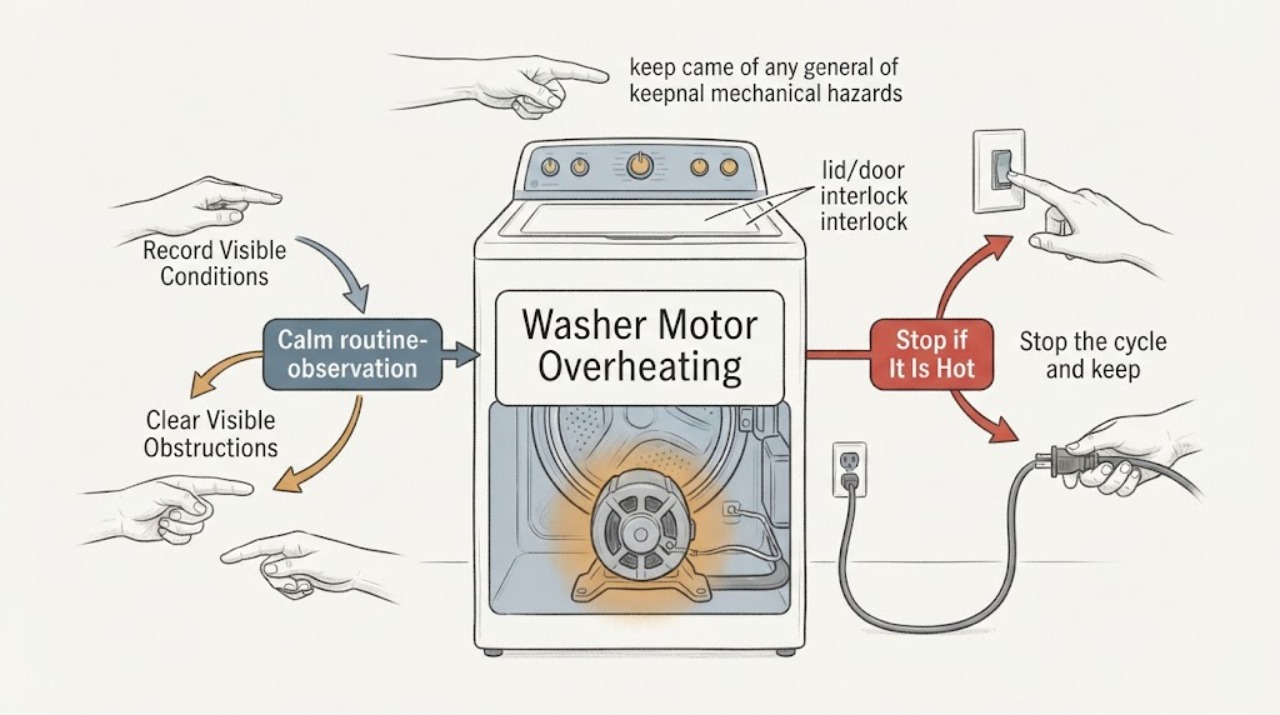
A hot Amana washer motor is not a diagnosis you can confirm safely from the outside. Stop the cycle, remove the load only when the basket or tub has stopped and the lid or door can be opened normally, and let the appliance cool without repeatedly restarting it. Check the exact model manual for its overload-protector behavior, then reduce an overloaded or tangled load, redistribute an unbalanced load, and confirm the washer is on the correctly grounded supply without an extension cord. Amana manuals describe an overload protector that can stop the motor and either reset after cooling or require service if it stops again. If the motor stops repeatedly, the breaker or GFCI trips, there is a burning odor, smoke, damaged wiring, or abnormal mechanical noise, stop using the washer and arrange qualified service rather than testing the motor or ordering a part.
Work through in order
Diagnostic checks
Use only checks that match the exact appliance or system and its official guide.
-
Check 1
Stop the cycle and keep hands away until the basket or tub has stopped. If the washer is hot, smells burnt, smokes, sparks, leaks onto electrical areas, or has tripped a breaker/GFCI, disconnect power only from the normal accessible disconnect if safe and leave it out of service.
Expected result: The washer cools without a hazard, or there is an odor, smoke, sparking, water near electrics, damaged cord, or a protective-device trip.
Next step: For a no-hazard stop, continue with the load and model checks below after the appliance is cool. For any hazard sign, arrange qualified appliance/electrical service and do not restart it.
Stop if: Never bypass the lid lock or restart while smoke, burning odor, sparking, or exposed damage is present.
Why this matters
Why: Cooling after one stop does not establish a failed motor. Any fire, shock, water, or repeated electrical-protection sign makes further test cycles unsafe.
-
Check 2
Record the exact model and when the stop occurs: wash/agitation, drain, or spin. Note whether the tub was packed, the load was gathered on one side, the lid or door was opened repeatedly, and whether the washer later restarts only after cooling.
Expected result: The stop follows a heavy or tangled load, severe imbalance, repeated lid openings, or a particular cycle stage, or it happens with an ordinary load and recurs.
Next step: If the load was heavy or uneven, correct it once after the washer is safe to open and use the exact model’s load guidance. If the stop recurs with a normal load, stop testing and seek service.
Stop if: Do not keep running cycles to “see how hot” the motor becomes.
Why this matters
Why: Amana documentation describes overload and imbalance conditions that can interrupt motor or spin operation, but the same symptom can also require service. A recurring stop under ordinary conditions is not explained by load alone.
-
Check 3
With the appliance stopped and safe to access, remove excess items and redistribute the remaining load evenly. Confirm the washer is level from the outside and that the lid or door closes and latches without visible obstruction or damage.
Expected result: A smaller, balanced load completes without the stop, or the motor still stops or the lid/door will not latch normally.
Next step: If the corrected load completes, keep within the model’s load guidance. If the motor stops again or the latch remains abnormal, stop using the washer and request service.
Stop if: Do not hold a lid switch closed, force a lock, or reach into a moving tub.
Why this matters
Why: An overloaded or off-balance load can cause instability, reduced spin, or a protective stop. A latch problem can prevent safe operation; neither result proves a motor component has failed.
-
Check 4
Check the external electrical supply only: use the grounded three-prong connection specified by Amana, confirm no extension cord is in use, and inspect the household breaker or GFCI indication. Reset a protective device only once if there is no odor, smoke, water, or visible damage.
Expected result: The supply is restored and the washer operates, the breaker/GFCI trips again, or the supply appears normal but the motor still stops hot.
Next step: If a safe one-time reset restores power, monitor without overloading and stop at the first recurrence. If it trips again or the motor stops again, leave the washer disconnected and contact a qualified technician/electrician as appropriate.
Stop if: Do not use an adapter or extension cord, bypass a GFCI, or probe live wiring.
Why this matters
Why: Amana identifies supply, breaker/GFCI, and grounding conditions as relevant to no-power operation. A repeated trip or a normal supply with a recurring hot stop needs professional diagnosis rather than repeated resets.
-
Check 5
Consult the exact Amana owner manual for the model’s overload-protector and reset behavior. If it specifies a cool-down or control reset, follow that published instruction once only after all safety conditions are normal; do not borrow a reset time or button sequence from another model.
Expected result: The manual documents a normal overload reset and the washer remains normal after a corrected load, or the protector stops the motor again / the symptom remains unexplained.
Next step: For a repeat stop, unusual noise, hot electrical smell, or any need to open the cabinet, stop using the washer and provide the technician the model and recorded conditions.
Stop if: Do not open the cabinet, remove the motor, replace a capacitor, or test internal wiring as a consumer step.
Why this matters
Why: Some Amana manuals describe automatic recovery after cooling, while also directing service when the protector stops the motor again. The difference is model-dependent and does not identify the failed internal part.
Use your observations
Decision map
Find the observation that best matches what you see, then follow the next safe action.
-
PATH 01Next step
What you see
The motor stopped once after a visibly heavy or uneven load and there was no odor, smoke, electrical trip, or damage.
Do this next
Let the washer cool, reduce and redistribute the load, and follow the exact manual’s normal restart guidance once. Stop if the symptom returns.
Why this path and its safety boundary
Why it matters: The documented overload/imbalance conditions are plausible, but the event is not proof that the motor is healthy or failed.
-
PATH 02Next step
What you see
The protector or motor stops again with a normal load, or the washer repeatedly becomes hot before stopping.
Do this next
Stop using the washer and arrange qualified service with the model, cycle stage, load, and recurrence details.
Why this path and its safety boundary
Why it matters: Amana manuals direct service when the overload protector stops the motor again; the cause cannot be narrowed to a motor, belt, capacitor, or control from this symptom.
-
PATH 03Next step
What you see
The breaker/GFCI trips again, the cord is damaged, or there is smoke, burning odor, sparking, or water near electrical parts.
Do this next
Leave the washer out of service, isolate power only from a safe normal disconnect, and contact a qualified appliance technician or electrician.
Why this path and its safety boundary
Why it matters: This is an electrical or fire/shock risk rather than a routine load adjustment.
-
PATH 04Next step
What you see
The washer will not operate because the lid or door does not close or lock, or the tub is still moving when access is attempted.
Do this next
Wait for all movement to stop, clear only visible external obstructions, and request service if the latch/lock remains abnormal.
Why this path and its safety boundary
Why it matters: Amana uses the lid/door interlock as a safety condition; forcing or bypassing it could expose a moving basket.
Helpful context
Understand the symptom
Treat “overheating” as a symptom, not a failed-part diagnosis
A washer that stops, hums, or feels hot may have activated an overload protector, encountered a heavy or unbalanced load, lost power, or developed a fault that cannot be identified without service testing. The task has no model or measured temperature, so do not assume the motor, capacitor, belt, control, or drive system is defective. Note when the symptom occurs—wash, drain, or spin—and whether the tub was heavily loaded, packed to one side, or accompanied by a breaker trip, odor, smoke, or unusual noise.
What Amana manuals say about overload protection
Amana’s published washer manuals describe an internal overload protector that stops the motor when an overload is detected. One guide lists a load that is too heavy, too many appliances on the line, low voltage, or repeatedly opening and closing the lid as possible overload conditions; another electronic top-load manual says its protector resets after about three minutes and directs the user to stop using the washer and call service if it stops the motor again. Because Amana controls and models vary, use the exact manual for the model label and do not treat a timing statement from another model as universal.
External checks only
After the washer has stopped and cooled, check the load and the visible lid or door area. Remove some items or redistribute them if the basket was overloaded or uneven, and make sure the lid or door closes and latches normally. Check that the power cord is in a grounded three-prong outlet and that no extension cord is being used; if the household breaker or GFCI has tripped, do not repeatedly reset it. These checks can separate a load or supply condition from a recurring motor-stop symptom, but they cannot prove which internal part is hot.
Stop-use boundary
Do not reach under a moving basket, bypass the lid lock, remove panels, measure live motor wiring, add lubricant, or keep restarting a motor that stops hot. Smoke, a burning smell, melted plastic, a damaged cord, water near electrical parts, a repeat breaker/GFCI trip, or repeated protector trips is a service condition. Give the technician the full model number, cycle stage, load description, time until the motor stopped, and any visible or audible warning.
When checks do not resolve it
Need a professional?
Call qualified service when the motor or overload protector stops again, the washer overheats with a normal load, the breaker/GFCI trips again, the lid/door interlock is damaged, or diagnosis would require opening the cabinet, testing live wiring, or replacing an internal component.
Common questions
FAQ
Does an Amana washer motor normally stop when it gets hot?
Some Amana manuals describe an internal overload protector that stops the motor during an overload and may reset after cooling. The behavior and timing are model-dependent; a protector that stops the motor again is a service condition.
Can an overloaded washer make the motor overheat?
Amana documentation lists an overly heavy load as an overload condition, and Amana also warns that an unbalanced or overloaded load can affect spin performance. Reduce and redistribute the load only after the washer has stopped safely; do not use this as proof of a motor fault.
Should I keep restarting the washer until the motor cools?
No. Do not repeatedly restart a washer that stops hot. A one-time, model-documented overload recovery may be allowed after the appliance is safe, but repeated stops require service.
Can I test or replace the Amana motor myself?
Not from this symptom alone. Internal motor, capacitor, belt, control, and wiring checks are model-specific and can expose electrical or moving-part hazards. Provide the exact model and symptom history to a qualified technician.
Read the exact guide
Official sources
- Amana Electronic Control Top Loading Washer Owner’s ManualAmana Appliances · Official Amana electronic top-load manual; used only for its documented overload-protector and repeat-stop service boundary
- Washer Not Draining or Spinning? Troubleshooting GuideAmana Product Help · Amana Product Help article covering common washer drain/spin conditions; not a motor-part diagnosis
- No Power - WasherAmana Product Help · Amana Product Help article for top-load washer no-power checks; exact model instructions still control
- Lid Locking on a Top Load High Efficiency WasherAmana Product Help · Amana Product Help guidance for top-load high-efficiency washers; features vary by model
- Amana Washer Use & Care GuideAmana / Maytag Appliances Sales Co. · Official Amana washer guide Form Y81896 A / Part 2206664; no exact model was supplied, so overload details are presented as family/document-scoped examples
Community feedback
Share a repair observation
Share a plain-text repair observation. Accepted observations are published automatically; this page may take a moment to update.