
On this page
Start here
Quick answer
On an Amana NTW4650YQ0 that remains in wash or agitation after its inlet valve was replaced and water supply was restored, treat the valve change as repair history, not proof that the valve was the cause. First record whether the washer is still filling, sensing, actively agitating, waiting to drain, waiting for the lid lock, or has already drained but will not advance. Check only accessible faucets, hose routing, visible leaks, the outside of the lid latch, and the household drain; keep the lid closed whenever the basket can move. If water is present but the level is not being recognized, the washer repeatedly stops after agitation, it cannot drain, or the lid lock is unreliable, stop resetting and request a written diagnosis covering the water-level sensing, drain, lid-lock, wiring, and control paths. Do not open the cabinet, run the washer with the lid defeated, make live measurements, or replace another part by guesswork.
Before you begin
Safety first
- This is outside-only troubleshooting for a top-load washer. Keep the lid closed whenever the basket can move; never bypass the lid lock, run the machine with the lid switch defeated, remove a hose or pump part from a full tub, open cabinet panels, or test live wiring. Disconnect power only by a safe, normal user-accessible method and only when doing so does not put you near water, smoke, sparks, or other danger.
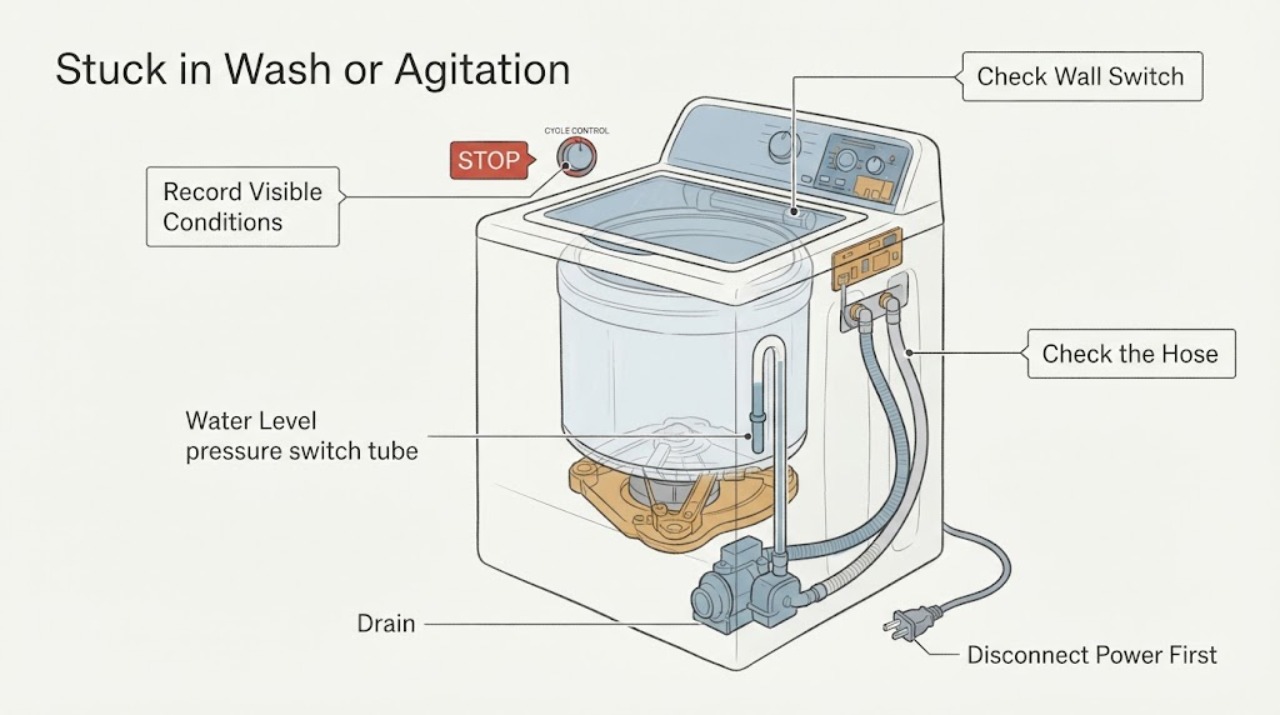
Work through in order
Diagnostic checks
Use only checks that match the exact appliance or system and its official guide.
-
Check 1
Stop the washer through its normal control and write down the exact point at which it appears to stop: filling, sensing, wash/agitation, draining, spinning, or waiting for the lid to lock. Record the selected cycle, any flashing light or code, whether the basket is moving, whether water is entering or standing, and whether the lid appears locked. Keep the lid closed whenever movement is possible.
Expected result: The washer is merely in a short sensing or fill pause, is agitating continuously, has water but no timer progress, has finished agitation with standing water, or is waiting for a lid-lock condition.
Next step: Use the observed phase to choose one matching check below and stop if the machine shows a leak, burning odor, smoke, sparking, violent movement, or an unsafe lock behavior.
Stop if: Do not open the lid while the basket moves, defeat or hold the lid switch, or restart repeatedly just to watch the symptom.
Why this matters
Why: These observations represent different decision paths. Amana documents normal sensing and staged pauses, but a wash indication with no expected water-level change, standing water at the drain stage, or an unreliable lock points away from a simple load complaint. The prior valve replacement does not identify which path is failing.
-
Check 2
Because the inlet valve has already been replaced, verify the restored supply only from outside: confirm both accessible household faucets are fully open, the hoses are not kinked or crushed, the connections show no leak, and the selected cycle is not still waiting for a supply condition. Do not disconnect a pressurized hose or remove an inlet screen.
Expected result: A faucet is closed, a hose is restricted, a connection leaks, water enters normally, or water enters but the wash indication remains and the washer does not recognize a level change.
Next step: Correct only an accessible faucet or routing problem and resume once through the normal control. If water enters but the same wash-stage stop returns, record that result and arrange service for the sensing/control path instead of replacing another valve blindly.
Stop if: Keep the washer out of service for a leak, a hose that cannot be safely isolated, or any need to access energized wiring.
Why this matters
Why: Amana lists open faucets, hose/screen restrictions, and drain-hose installation among causes of a wash-stage indicator. If external supply is restored and water visibly enters, that makes a supply-only explanation less likely; it does not prove that the replacement valve, water-level sensing, wiring, or control is good.
-
Check 3
With the washer stopped and the lid closed, distinguish active agitation from a cycle that is waiting for a level or timing decision by noting whether the tub level changes, the wash indicator changes, the timer or remaining-time display advances, and the cycle eventually attempts drain. Do not lean over the opening or run the machine with the lid switch bypassed.
Expected result: The agitator moves but the indication and time do not advance, the washer pauses and then advances normally, the water level never reaches the expected state, or the washer completes wash but never begins drain.
Next step: Record the exact timing and indicator pattern for service. Do not select a component until a qualified technician matches the symptom to the NTW4650YQ0 documentation and test results.
Stop if: Do not perform a live voltage, continuity, pressure, or lid-switch test, and do not run an open-lid observation.
Why this matters
Why: A moving agitator is not proof that the complete wash phase is healthy. A recurring stop with water present or no detected level change keeps water-level sensing, pressure/air-path information, or control interpretation in the branch; a wash-to-drain stop points toward drain sequencing or control rather than automatically back to the inlet valve. Amana also notes that low-water cycles and load conditions can change agitation behavior.
-
Check 4
If the tub contains water when the washer should advance, inspect only the accessible drain hose and household standpipe or sink for a kink, crushing, incorrect insertion, or visible backup. Keep hands, tools, and clothing away from the tub and pump area; do not remove a hose or filter from a full tub.
Expected result: The external drain path is blocked or kinked, the household drain is backing up, the hose routing is clear but water remains, or the tub is empty and the washer still stops at the same point.
Next step: Correct one plainly visible external routing problem and use the normal drain/resume control once only if the machine is safe. If water remains or the same stop recurs, keep it out of service and request qualified diagnosis.
Stop if: Do not open panels, reach into the pump, tip a water-filled washer, or keep running full cycles with standing water.
Why this matters
Why: Amana identifies drain-hose and household-drain conditions as reasons a washer may retain water or fail to spin. A clear external path with retained water makes an internal drain, sensing, wiring, or control diagnosis more likely; an empty tub with no phase advance shifts attention away from a drain blockage.
-
Check 5
Inspect the visible lid-latch area with the washer stopped. Remove only lint, clothing, or detergent residue that is plainly accessible, and confirm the lid closes without force. Do not press, tape, hold, or bypass the lock to make the cycle run.
Expected result: The lid closes and locks normally, a visible obstruction prevents latching, the lock clicks but the cycle still does not advance, or the lock will not engage or release after movement stops.
Next step: Remove only the visible obstruction and use the normal control once. If the lock remains unreliable or the washer cannot safely unlock, disconnect power only through a safe user-accessible method and arrange service.
Stop if: Never bypass the lid lock or reach inside while the basket can move.
Why this matters
Why: The lid lock is a safety gate for operation. A clean, closed lid that still produces a repeat stop keeps the lock, its wiring, or the control in the service branch; it does not identify a replacement part. Amana's owner guidance says the lid may remain locked until movement has stopped and an unlock command is accepted.
-
Check 6
Document the inlet-valve repair as part of the service history: what symptom led to the replacement, whether the old valve was tested, what exact replacement was installed, whether connectors and hose routing were disturbed, whether water flow changed, and whether the washer completed any cycles afterward. If the machine is safely inactive and has no leak, odor, abnormal heat, or standing water, use only the exact model's documented pause/cancel or one approved power-cycle step; do not repeatedly reset it.
Expected result: The washer completed a cycle once and then repeated the stop, never changed behavior after the valve replacement, or now shows a different phase or indicator.
Next step: Ask the service provider for a written diagnosis that states the observed phase, the test result supporting each proposed part, the checks of connectors and hoses affected by the valve work, and what result would confirm the repair. Do not authorize another part solely because it has not yet been replaced.
Stop if: Do not remove panels, test energized terminals, enter an undocumented diagnostic routine, or run the washer with safety devices defeated.
Why this matters
Why: A recurrence after a repair can expose a separate sequence, sensing, drain, lid-lock, wiring, or control problem, or an installation/connection issue; it cannot by itself prove which component failed. A single successful cycle also does not prove the repair is durable.
Use your observations
Decision map
Find the observation that best matches what you see, then follow the next safe action.
-
PATH 01Next step
What you see
After the valve replacement, both faucets are open and water enters, but the wash indication or timer remains unchanged and the tub level is not recognized.
Do this next
Keep the washer out of service after the one safe external check and request a model-matched diagnosis with the exact phase and repair history.
Why this path and its safety boundary
Why it matters: The unchanged symptom makes a simple closed-faucet or missing-supply explanation less likely. The next service branch is water-level sensing or its air path, wiring/connectors affected by the repair, or the control's interpretation—not an automatic second inlet-valve replacement.
-
PATH 02Next step
What you see
The washer agitates, but the control never advances to drain or the same wash-stage stop recurs after a normal pause/cancel attempt.
Do this next
Stop repeating cycles and give a technician the selected cycle, elapsed time, indicator behavior, water level, and whether the valve repair changed anything; do not prescribe a control board or sensor without a supporting test.
Why this path and its safety boundary
Why it matters: Agitation alone does not show that the phase-completion conditions are being met. This pattern makes timing, level feedback, control, or sequence logic more relevant than a supply diagnosis, while the Amana guidance still requires the exact cycle behavior to be considered.
-
PATH 03Next step
What you see
The wash portion appears complete but water is standing, the external drain path is clear, or the washer hums without lowering the water level.
Do this next
Keep the lid closed, avoid opening a full-tub hose or pump area, and arrange qualified service. Protect the floor and remove standing water only by a safe user procedure from the exact model documentation.
Why this path and its safety boundary
Why it matters: A clear household path with retained water makes an internal drain or a drain-related sensing/control fault more likely than the already-replaced inlet valve. Continued cycles can worsen a leak or leave the load waterlogged.
-
PATH 04Next step
What you see
The lid will not reliably lock or unlock, or the user would need to defeat the lock to see whether agitation is continuing.
Do this next
Do not operate the washer; use only a safe normal power disconnect when no hazard is present and request qualified repair.
Why this path and its safety boundary
Why it matters: The safety interlock is now the stop condition, not an invitation to observe an open basket. An unreliable lock can involve the latch, wiring, or control and cannot be safely narrowed by bypassing it.
-
PATH 05Next step
What you see
The washer has no leak, odor, abnormal noise, standing water, or lock problem, but it repeats the same wash/agitation stop after one matching external check and one model-approved recovery attempt.
Do this next
Leave the washer out of service and request a written, model-specific diagnosis before authorizing another component.
Why this path and its safety boundary
Why it matters: A repeat at the same phase is useful diagnostic evidence, not a reason to keep resetting or guessing at parts. The inlet-valve repair history should be tested against the full sequence and any affected connectors.
Helpful context
Understand the symptom
A new inlet valve can restore water flow without resolving the condition that prevents a cycle from advancing. On the Amana NTW4650YQ0 topic, the useful distinction is what the control is waiting for: the Amana support guidance says a wash indicator can remain on when the expected water-level change is not detected, while its agitation guidance treats load and cycle behavior separately. That makes the time and phase of the stop more valuable than the fact that a valve was just changed.
Do not use an open lid to watch the basket or keep trying replacement parts. A closed-lid, outside-only observation can show whether water enters, remains in the tub, drains, or reaches a lock-related pause. If the same point recurs after one normal user-level recovery attempt, give the technician the complete model, the exact phase, the water state, the indicator behavior, and the inlet-valve work already performed.
Only after diagnosis
Potential parts
- water-level sensing or pressure-sensing path
Consider this class only if water enters normally but the control does not detect the expected level or repeatedly holds the washer in wash/sensing, and a qualified diagnosis supports that result.
Confirm the exact NTW4650YQ0 model, regional documentation, and the technician's test result before ordering; do not infer fit or failure from the symptom alone. - drain pump or drain-path component
Consider this class only when the wash phase is complete, water remains, the accessible drain path is clear, and service testing supports an internal drain fault.
Verify exact model fitment and the cause of the drain symptom with the manufacturer or qualified technician; a clear hose does not by itself prove a failed pump. - lid-lock assembly or related wiring
Consider this class only if the lid cannot reliably lock or release after visible obstructions are removed and a technician confirms an interlock-path fault.
Do not bypass the lock or assume a universal part; confirm the exact model and connector fit through the applicable Amana documentation. - cycle-control or main control component
Consider this class only after supply, level feedback, drain, lid-lock, load, and affected connectors have been checked and a qualified diagnosis shows the control is not advancing the sequence.
A stuck cycle does not establish a failed control. Confirm the exact model, revision, and test evidence before any control replacement.
When checks do not resolve it
Need a professional?
Stop using the washer and arrange qualified appliance service immediately for a leak, burning or electrical odor, smoke, sparking, repeated breaker trips, violent movement, an unsafe or defeated lid lock, a full tub that will not drain, or any need to open panels or make live measurements. If there is no immediate hazard, service is still appropriate when the NTW4650YQ0 repeats the same wash/agitation stop after one matching outside-only check and one exact-model recovery step. Give the provider the complete model, selected cycle, exact stopped phase, water state, displayed light or code, whether water entered and drained, lid-lock behavior, and the inlet-valve replacement details.
Have this ready
- Provide the full NTW4650YQ0 model, serial or product label if available, selected cycle, exact point of stoppage, water level, indicators, lid-lock behavior, drain result, time to stop, and the date and details of the inlet-valve replacement.
Common questions
FAQ
Does replacing the inlet valve prove it is no longer the cause?
No. It is a repair event that must be correlated with water entry, level detection, cycle timing, and connector checks. If water now enters but the washer still stops in wash or agitation, do not assume another valve or a control board is the answer.
Is continuous agitation always a failed motor or actuator?
No. A moving agitator does not prove that the control has received the level, timing, drain, or lid-lock conditions needed to advance. Record whether the indicator and timer change and have the exact sequence diagnosed before choosing a part.
Can I open the lid to watch what is happening?
Do not defeat the lid lock or run the washer with the lid switch bypassed. Use outside-only observations and the normal pause or cancel control; arrange service if the lock is unreliable or the cycle remains stuck.
Read the exact guide
Official sources
- Not Agitating - WasherAmana · Opened Amana Product Help page for top-load washer agitation concerns. It does not publish a model-specific NTW4650YQ0 fault tree, so it supports only the documented load, cycle-selection, and service distinctions.
- Why Your Washer Won't SpinAmana · Opened Amana's official washer troubleshooting article for external drain, standing-water, load, and lid-lock distinctions; it is symptom-level guidance and not a model-specific NTW4650YQ0 service procedure.
- Wash Light On or FlashingAmana · Opened Amana Product Help page for a top-load washer whose wash light remains on or flashes. It is not presented as the exact NTW4650YQ0 service manual; use it for the documented water-level, supply, and drain-path distinctions only.
- Top Load Washer Use and Care GuideAmana · Opened official Amana top-load washer guide for general user-level phase and safety behavior. It is not claimed as the exact NTW4650YQ0 manual; model-specific controls remain controlling.
Community feedback
Share a repair observation
Share a plain-text repair observation. Accepted observations are published automatically; this page may take a moment to update.