
On this page
Start here
Quick answer
On the Amana NTW4605EW0, F8E1 means the washer is not detecting the expected incoming water. Because the failure is reported only with Cool or Cold, first compare that symptom with any known-working Warm or Hot fill and inspect the cold-side supply path: the cold valve must be fully open, the hose must be connected to the cold port and free of kinks, and any flow-limiting device can matter. Amana says both hot and cold hoses must be connected for proper operation, and its top-load guidance notes that Cool and Cold can still use some warm water for temperature control. Do not infer a failed inlet valve or control board from F8E1 alone; if the external checks are normal or the code returns, arrange service.
Work through in order
Diagnostic checks
Use only checks that match the exact appliance or system and its official guide.
-
Check 1
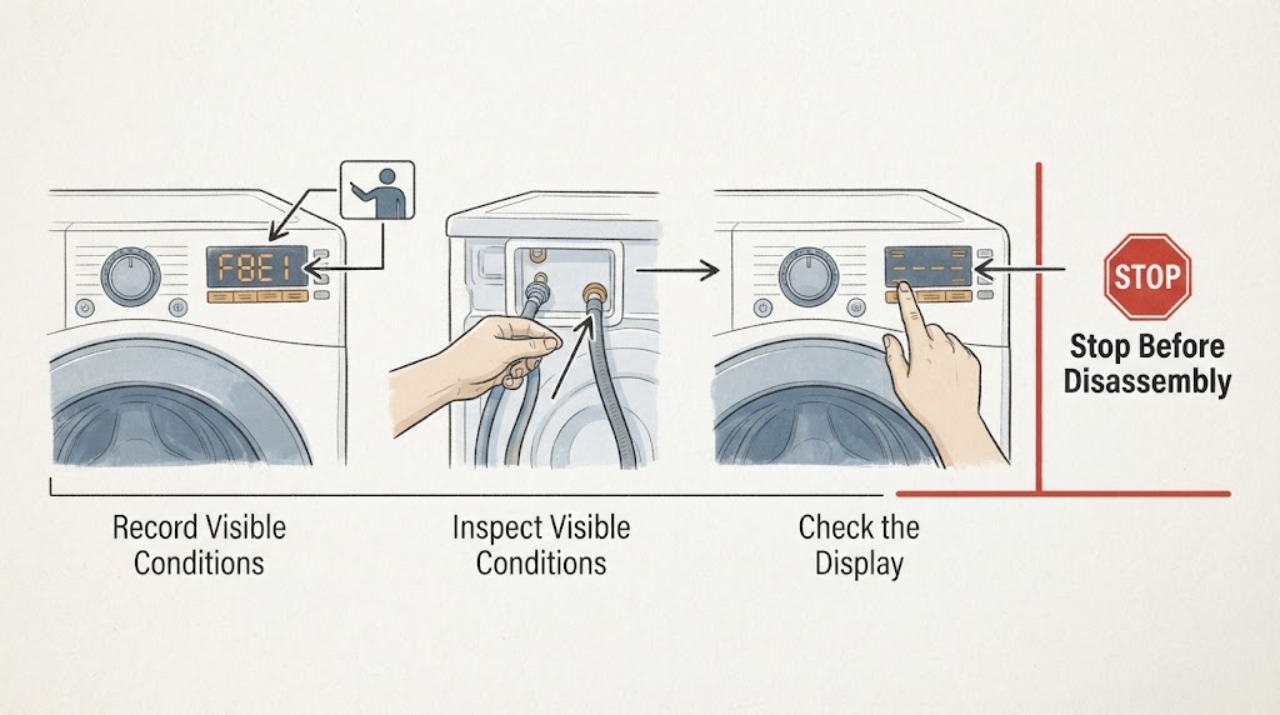
Record the complete display as F8E1 or F8 E1, the selected temperature, the cycle stage, whether any water entered the tub, and whether the failure happened immediately or after a partial fill.
Expected result: The code may appear at the start of Cool or Cold, after a small amount of water enters, or after a fill that is followed by a low-water condition; Warm or Hot may be known to work or may also fail.
Next step: Use the selected temperature and fill timing to guide the external checks below, and preserve the exact display for service rather than repeatedly clearing it.
Why this matters
Why: A Cool/Cold-only failure is a different first branch from a washer that cannot fill on any temperature, while a partial fill followed by F8E1 keeps drain siphoning or restricted flow in consideration.
-
Check 2
Without disconnecting a pressurized hose, look at both household supply valves and the visible hose routing. Confirm the cold valve is fully open, the cold hose is on the cold connection, both hoses are attached, and neither hose is kinked, crushed, or visibly damaged.
Expected result: The cold valve may be partly closed, the cold hose may be kinked or crossed, one hose may be absent, or both visible paths may look normal.
Next step: Correct only an obvious, dry, external valve or routing issue. Do not open the cabinet or remove a hose while water is pressurized; if the code remains, move to service rather than guessing a valve replacement.
Why this matters
Why: A closed or restricted cold path fits a Cool/Cold-only fill failure. A normal exterior does not prove that the inlet screen or internal inlet valve is clear.
-
Check 3
Check whether an anti-flood or other flow-control device is installed in the water line, and inspect the visible connections for leakage or a restricted-looking fitting without opening the device.
Expected result: The washer may be directly connected, or an added device may be present; there may be no leak, a damp connection, or active water escaping.
Next step: If a connection is leaking, close the affected household valve and stop using the washer. Do not bypass or modify a flow-control device; have the installation or appliance checked if the Cool/Cold failure persists.
Why this matters
Why: Amana warns that anti-flood devices can reduce pressure and the amount of water entering the appliance. Active leakage changes this from a fill diagnosis to a water-damage safety issue.
-
Check 4
Use the symptom history to compare temperature selections without repeatedly running cycles: note whether Warm or Hot previously filled, whether Cool or Cold has ever filled, and whether the selected cycle is one that permits that temperature option.
Expected result: Warm/Hot may fill while Cool/Cold fails, all selections may fail, or the washer may only add water after sensing and then stop with F8E1.
Next step: Do not convert this comparison into a part order. If the exact external supply is sound or F8E1 returns at the same stage, provide the temperature pattern and code timing to qualified appliance service.
Why this matters
Why: Only the first pattern increases suspicion of a cold-side supply or temperature-selection path; all-temperature failure points to a broader supply, connection, or fill-detection problem. Cool is not guaranteed to be identical to tap-cold because the washer can blend some warm water.
-
Check 5
If the tub receives water but the level falls away or F8E1 follows a partial fill, inspect the visible drain-hose installation from outside for a sealed standpipe connection, an incorrectly routed hose, or a hose pushed too far into the drain; do not pull a wet hose or tilt the washer.
Expected result: Water may enter briefly and then disappear, the drain hose may be taped or sealed into the standpipe, or the drain path may look correctly installed while the washer still loses fill.
Next step: Make only the model-approved external routing correction. If the tub still will not retain water, stop and arrange qualified service; do not enter service mode or disassemble the pump or cabinet.
Why this matters
Why: Amana includes incorrect drain-hose installation among F8E1 checks because siphoning can prevent the washer from retaining the detected fill level. A clear external drain path with recurring F8E1 still needs diagnosis rather than a pump or control-board guess.
Use your observations
Decision map
Find the observation that best matches what you see, then follow the next safe action.
-
PATH 01Next step
What you see
Warm or Hot has filled normally, but Cool and Cold both fail at the fill stage with F8E1 and no leak is visible.
Do this next
Verify the cold valve, hose connection, kink, and any flow-control device from outside. If those checks are normal or the code returns, stop and have the inlet path and controls diagnosed by a technician.
Why this path and its safety boundary
Why it matters: The cold-side household valve, cold hose routing or restriction, or a temperature-selection water path is more useful as the first branch than a general control-board diagnosis; the exact failed part remains unproven.
-
PATH 02Next step
What you see
Cool, Cold, Warm, and Hot all fail to fill, or F8E1 appears immediately regardless of selection.
Do this next
Confirm both household valves are open and both hoses are attached without disconnecting pressurized lines. If the display persists, arrange service rather than naming an inlet valve or control board.
Why this path and its safety boundary
Why it matters: A broader water-supply, connection, lid/start sequence, or fill-detection problem is more likely than a Cool/Cold-specific comparison can establish.
-
PATH 03Next step
What you see
Water enters briefly, then the level drops or the code appears after a partial fill.
Do this next
Inspect only the visible drain-hose routing and standpipe connection. Correct an obvious installation issue only when safe; persistent symptoms require qualified service.
Why this path and its safety boundary
Why it matters: Drain-hose installation or siphoning must be separated from an insufficient-supply condition before internal parts are considered.
-
PATH 04Next step
What you see
A hose or connection is leaking, the floor is wet, the washer smells electrically hot, the cord or outlet is damaged, smoke or sparks appear, or the breaker trips repeatedly.
Do this next
Stop the cycle, close the affected water valve when safe, keep clear of electrical hazards, and obtain urgent qualified appliance or electrical help. Do not reset repeatedly or run another cycle.
Why this path and its safety boundary
Why it matters: Continuing a fill test could create water damage, shock, or fire risk, and F8E1 is no longer the priority.
-
PATH 05Next step
What you see
The external checks are normal but F8E1 returns at the same stage, or the washer will not accept controls after the code.
Do this next
Stop troubleshooting at the user level and give service the exact model, code format, temperature selection, fill timing, and the results of the visible checks.
Why this path and its safety boundary
Why it matters: The remaining cause may be behind the inlet connection or in the washer's sensing/control path, but the display does not identify which component failed.
Helpful context
Understand the symptom
F8E1 is a fill-detection result, not a part number. Amana's official top-load guidance points first to the household water supply, both inlet valves, hose routing, and flow restrictions. The Cool/Cold-only pattern is the useful extra clue here: if Warm or Hot fills normally, the cold-side supply path becomes the first comparison, but the code still cannot identify an inlet valve or control board by itself.
Do not expect Cool to behave exactly like tap-cold water. Amana explains that temperature control regulates incoming water and that some warm water may be added during a cold- or cool-water wash. A washer that does not fill at all, shows F8E1, or begins filling and then loses the level needs the same careful distinction between a supply restriction and a drain-installation problem.
When checks do not resolve it
Need a professional?
Arrange qualified appliance service when F8E1 returns after the safe external water checks, the washer fails on all temperature selections, the cold path looks normal but Cool/Cold still will not fill, water enters and then disappears, or the control remains unresponsive. Stop immediately for an active leak, smoke, sparks, burning or electrical odor, damaged cord or outlet, or repeated breaker operation.
Read the exact guide
Official sources
- F8E1 - Error Code - Product Help | AmanaAmana · The opened Amana page defines F8 E1 as the washer not detecting the correct amount of incoming water, requires both hot and cold hoses for proper operation, and lists supply, hose, inlet-screen, flow-device, and drain-hose checks. This family-level evidence is applied to the assigned top-load model NTW4605EW0 without claiming an unshown model-specific service procedure.
- Top Load Washer Quick Start GuideAmana · The opened Amana guide explains that wash-temperature control regulates incoming hot and cold water and that some warm water may be added during Cool or Cold. It is used for the temperature-selection behavior of assigned model NTW4605EW0, without asserting an exact model-specific option matrix.
- Error Codes in Top Load HE Washers - Product Help | AmanaAmana · The opened Amana top-load table lists LF, Lo FL, or F8 E1 as taking too long to fill and says both hot and cold water must be supplied. It is family-level evidence for NTW4605EW0, not a claim that every top-load platform is identical.
Community feedback
Share a repair observation
Share a plain-text repair observation. Accepted observations are published automatically; this page may take a moment to update.