
On this page
Start here
Quick answer
A cool or cold Amana wash does not necessarily mean that only visibly cold water will enter. Amana says the washer may add hot water to reach its target temperature, and that both hot and cold hoses generally need to be connected and turned on for proper operation. First note whether the tub is truly dry, filling slowly, filling with mixed-temperature water, or filling and draining at the same time. Check both faucets, hose routing and kinks, any flood-prevention device, the accessible inlet screens and drain-hose installation. Do not assume the inlet valve has failed: if supply, hose, screen and drain checks are correct but filling still fails, use the exact model manual and arrange service.
Before you begin
Safety first
- Turn water off before disconnecting hoses, catch residual water, reopen slowly and check for leaks. Do not open the console, probe energized wiring, bypass water sensing or replace an inlet valve based on cold-cycle behavior alone.
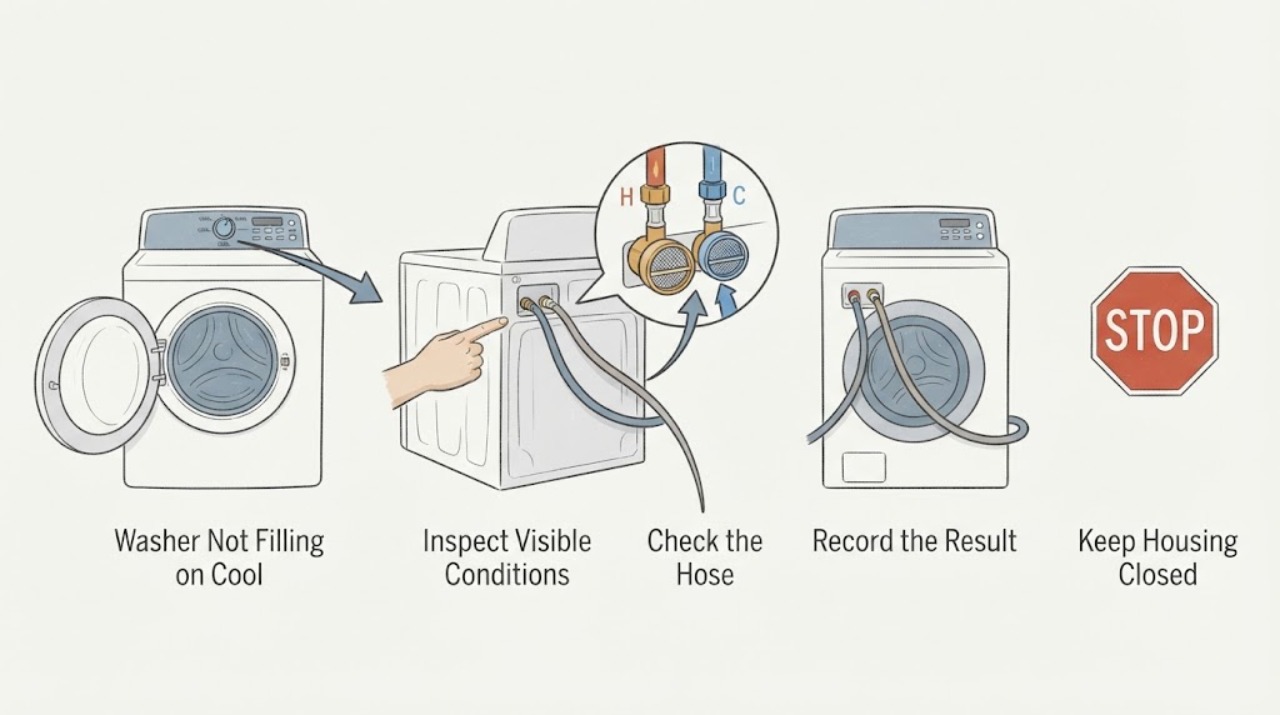
Work through in order
Diagnostic checks
Use only checks that match the exact appliance or system and its official guide.
-
Check 1
Run the affected cool or cold selection only long enough to observe whether water enters, alternates temperature, pauses while sensing, or immediately drains; note the cycle and load.
Expected result: Water enters but is not always cold, the fill pauses, the tub remains dry, or water enters and drains away.
Next step: For mixed-temperature or paused filling without a warning, continue to supply checks. For a dry tub or fill-and-drain behavior, check faucets, hoses and drain installation before considering service.
Why this matters
Why: Amana says temperature control may add hot water to a cold target and that water use varies by cycle; a dry tub or simultaneous drain indicates a different supply or installation path.
-
Check 2
Confirm both hot and cold faucets are fully open, both hoses are attached to the correct washer inlets, and neither hose or flood-prevention device restricts flow.
Expected result: A faucet is closed, a hose is kinked/misconnected, only cold water is connected, or supply routing is normal.
Next step: Correct only the external supply condition with water turned off as needed, then check for leaks. If routing is normal, continue to the screens and drain path; do not diagnose the inlet valve yet.
Why this matters
Why: Amana says both supplies generally need to be connected and pressurized, even for a cold-water wash, and kinks or flood devices can reduce flow.
-
Check 3
Shut off the water, disconnect the inlet hoses with a bucket ready, and inspect the washer inlet screens; clean visible film or particles without removing or disturbing the screens.
Expected result: The accessible screens are visibly restricted, or they are clear and the washer still has no fill.
Next step: Reinstall hoses, reopen water slowly and check for leaks. If the screens are clear and the symptom persists, use the model manual or service rather than opening the valve assembly.
Why this matters
Why: Amana identifies mineral or debris restriction at the inlet screens as an external fill problem; clear screens do not prove a valve failure.
-
Check 4
Check that the drain hose is secured at the correct depth with an air gap, is not kinked or clogged, and that the selected cycle's expected water use is understood.
Expected result: The drain hose is too deep, taped/sealed, kinked or clogged, or the installation is correct and the cycle still appears not to fill.
Next step: Correct only the external drain installation according to the model instructions. If the hose is correct, do not add water manually; proceed to model-specific support.
Why this matters
Why: Amana says incorrect drain-hose installation can siphon water while filling, and cycle/load selection changes the amount and timing of water use.
-
Check 5
Stop troubleshooting and record the full model, affected cycle, display/light pattern, supply observations and leak status if both supply and drain checks pass but filling remains abnormal.
Expected result: The washer remains dry or slow to fill after external checks, shows a recurring water-supply alert, leaks, or requires console/valve access.
Next step: Use the exact manual or schedule qualified Amana service. Do not probe live wiring, disassemble the console or replace the inlet valve based only on cold-cycle behavior.
Why this matters
Why: The remaining possibilities may involve a valve, pressure sensor, control or another model-specific condition; the symptom does not identify one component.
Use your observations
Decision map
Find the observation that best matches what you see, then follow the next safe action.
-
PATH 01Next step
What you see
The tub receives water on a cool/cold selection, but the incoming stream is sometimes warm or mixed-temperature.
Do this next
Compare the result with the model's expected temperature range and continue only if water is actually absent, excessively slow or accompanied by a warning.
Why this path and its safety boundary
Why it matters: Amana says the washer may add hot water to reach the target cold-wash temperature and senses temperature at the tub.
-
PATH 02Next step
What you see
A faucet is closed, a hose is kinked/misconnected, a flood-prevention device restricts flow, or an inlet screen is visibly blocked.
Do this next
Correct the accessible supply condition with water safely isolated, reinstall and check for leaks, then retest the cycle once.
Why this path and its safety boundary
Why it matters: The washer has an external water-supply restriction that can explain slow or absent filling.
-
PATH 03Next step
What you see
Water enters but disappears down the drain, or the cycle pauses/uses less water than expected while sensing.
Do this next
Correct the external drain installation and consult the model manual for cycle behavior. Do not add water manually or bypass sensing.
Why this path and its safety boundary
Why it matters: Amana identifies drain-hose siphoning and cycle/load-dependent water use as possible explanations; this does not establish an inlet-valve failure.
-
PATH 04Next step
What you see
Both supply hoses/faucets, screens, drain installation and expected cycle behavior are correct, but the washer still does not fill or shows a recurring water-supply alert.
Do this next
Arrange Amana service with the model and observations. Do not open the console or test/replace internal parts from the symptom alone.
Why this path and its safety boundary
Why it matters: The accessible evidence is insufficient to distinguish a valve, sensor, control or other model-specific fault.
Helpful context
Understand the symptom
Start by separating a temperature expectation from a fill failure. Amana says most washers use separate hot and cold inlets, sense temperature at the tub, and may alternate or add warm water even when Cold is selected. A tub that receives mixed-temperature water can therefore be operating as designed. A tub that stays dry, fills very slowly, or fills and immediately drains needs a supply and installation check before anyone suspects an inlet valve.
Observe what the cool or cold cycle actually does
Record whether water enters at all, whether it feels warmer or cooler at different points, whether the fill pauses while sensing, and whether the water drains away during filling. Amana publishes approximate ranges for temperature selections and says the first water can be cold regardless of the selected temperature; it also says water use varies by cycle and load. Do not judge fill by the water level of an older machine or by temperature at the faucet alone.
Check both water supplies and external hoses
Make sure both hot and cold faucets are fully open and both hoses are connected to the correct inlets. Inspect the hoses for kinks, crushing or a flood-prevention device that may restrict flow. Amana says a cold-water-only installation can affect performance because some washers are designed to add hot water for a cold-wash target. Do not reroute or replace hoses without shutting off the water and following the installation instructions.
Check inlet screens and the drain path safely
If the supply is available, turn the water off before disconnecting a hose, place hose ends in a bucket, and inspect the accessible inlet screens without removing or disturbing them. Clean visible film or particles only as Amana describes. Also check that the drain hose is not kinked, clogged, sealed with tape or inserted too far into the standpipe; siphoning can make a washer appear not to fill. Reopen water slowly and check for leaks.
Use the model-specific service boundary
If both supplies, hoses, screens and drain installation are correct but the washer still will not fill on the affected cycle, the evidence does not select an inlet valve, pressure sensor or control. Record the model, cycle, display or light pattern and whether any water enters, then use the exact Owner's Manual or schedule service. Do not open the console, probe energized wiring or replace a valve from this symptom alone.
When checks do not resolve it
Need a professional?
Schedule Amana service when both supplies, external hoses/screens and drain installation are correct but the washer still will not fill, or immediately for a leak, damaged hose, electrical hazard or recurring water-supply alert. Do not diagnose or replace the inlet valve without model-specific evidence.
Safety scope: Turn water off before disconnecting hoses, catch residual water, reopen slowly and check for leaks. Do not open the console, probe energized wiring, bypass water sensing or replace an inlet valve based on cold-cycle behavior alone.
Have this ready
- Full model number, top-load/front-load type, selected cycle and load, whether any water enters, observed temperature pattern, faucet/hose/screen status, drain-hose placement, display/light pattern, water pressure concern and leak history.
Common questions
FAQ
Why does my Amana washer add warm water on a cold cycle?
Amana says the washer may add hot water to reach the target temperature for cold-wash performance, and it senses temperature at the tub rather than only at the incoming valve. Mixed-temperature water is therefore not by itself proof of a fault.
Do both hot and cold hoses need to be connected for an Amana cold wash?
Amana says both hot and cold supplies generally need to be connected and turned on for proper operation, even when a cold wash is selected. A cold-only installation can affect performance and may require model-approved plumbing changes.
Could a drain hose make an Amana washer look like it is not filling?
Yes. Amana says a drain hose that is too deep, sealed or incorrectly installed can siphon water while the washer fills. Check the external drain installation before assuming a water inlet component has failed.
Read the exact guide
Official sources
- Not Filling or Long Fill - WasherAmana Product Help · Opened the official Amana top-load support page. It supports faucet/hose checks, drain-hose installation, cycle-dependent water usage, sensing behavior and service routing. It is scoped to top-load guidance and is not used to identify an internal valve failure.
- Checking the Fill Hoses if the Washer is not FillingAmana Product Help · Opened the official Amana Product Help page. It explains that both hot and cold supplies generally need to be connected, that a selected cold wash may add hot water, and that kinked hoses or visible inlet-screen debris can restrict filling. It does not diagnose an inlet valve for an unspecified model.
- Not Filling or Filling Slowly - Front Load WasherAmana Product Help · Opened the official Amana front-load support page. It supports fully open hot/cold valves, correct hose connections, anti-flood-device awareness, external inlet-screen cleaning and drain-hose installation checks. It is scoped to front-load guidance and does not diagnose the inlet valve.
- Wash Light On or FlashingAmana Product Help · Opened the official Amana page. It supports external checks for both faucets, inlet-screen debris and drain-hose depth when water level does not change; it is not used to infer a control or valve failure without a model.
- What is an F20 or FH Error Code on a Front Load WasherAmana Product Help · Opened the official Amana page. It is used only for its general supply-path evidence and its explicit cold-wash/hot-water explanation; the task has no F20/FH code, so no code meaning is assigned to the article.
- Getting Cold Water when Warm or Hot was SelectedAmana Product Help · Opened the official Amana temperature-selection page. It provides approximate selection ranges, explains separate hot/cold inlets and tub sensing, and states that cold selections can bring warm water to reach the target temperature. It is used to distinguish expected temperature behavior from no fill.
Community feedback
Share a repair observation
Share a plain-text repair observation. Accepted observations are published automatically; this page may take a moment to update.