
On this page
Start here
Quick answer
For the Amana NTW4516FW3 top-load washer, a cold-water tap that does not supply water is a direct first check for F8E1: Amana defines F8E1 as the washer not detecting the expected incoming water and says both hot and cold valves should be open with both hoses connected. Treat that known supply failure separately from a later F7E5. Amana's consumer F7E5 page gives a five-minute power disconnect as a possible control reset but does not assign F7E5 to a shifter, valve, motor, or control board. With the washer stopped and the floor dry, turn off the water before touching a hose, photograph the complete codes and timing, and inspect only visible faucet, hose, lid, and drain conditions. Do not run the washer with the cold supply unavailable, enter service mode, bypass the lid lock, open the cabinet, perform live tests, or order a valve, shifter, or control from the combination of codes. If the cold tap itself is not working, use a plumber or property maintenance for the household supply; if F8E1 persists after supply is restored or F7E5 returns, arrange qualified appliance service.
Work through in order
Diagnostic checks
Use only checks that match the exact appliance or system and its official guide.
-
Check 1
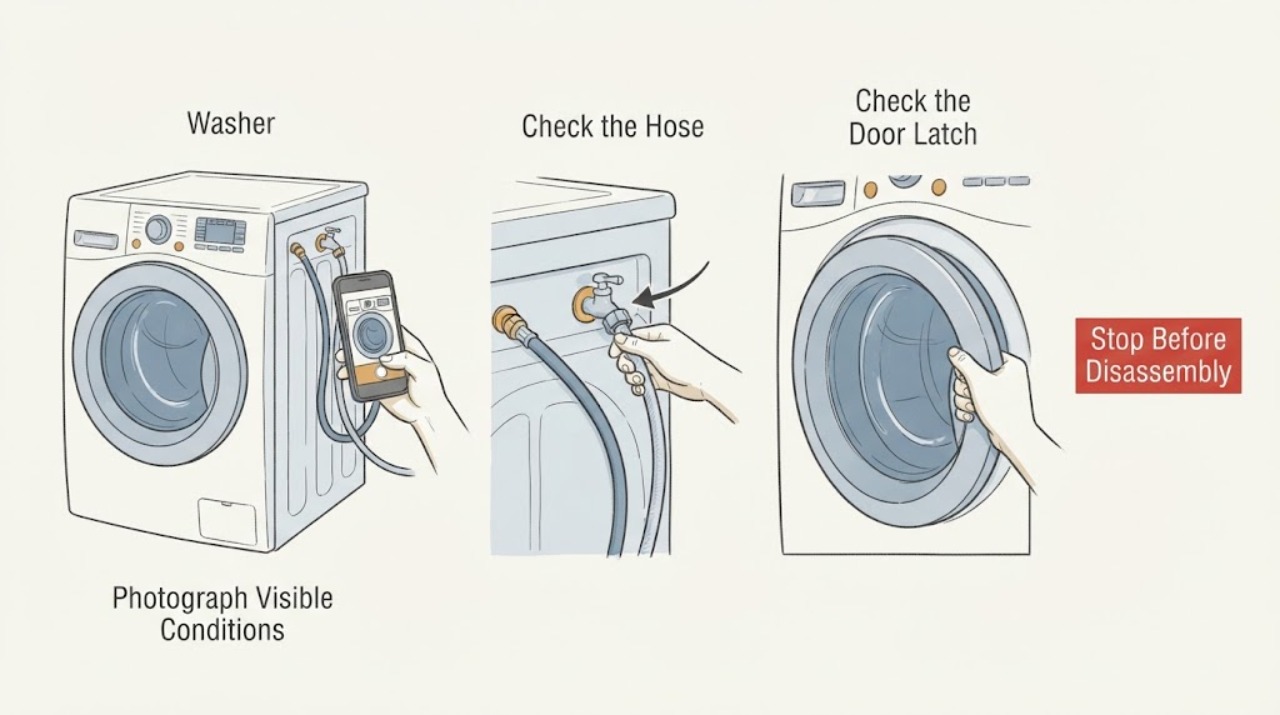
From outside the stopped washer, photograph the complete display exactly, including spacing or alternating code groups, and confirm the rating label reads NTW4516FW3. Record which code appeared first, what the washer was doing, whether the lid locked, and whether F7E5 appeared only after the cold-water failure.
Expected result: The model is NTW4516FW3 and the sequence is F8E1 during filling followed by F7E5, the suffix or code differs, or the timing is unknown.
Next step: Keep the washer off while the cold supply is unavailable. If the label or display differs, use the matching Amana literature; otherwise retain the photos and timing for service without entering diagnostics.
Why this matters
Why: Amana publishes separate consumer paths for F8E1 and F7E5, and the owner page identifies the base model without proving every suffix uses an identical sequence. A changed identity or code must not inherit this interpretation.
-
Check 2
Stop the washer and turn off the household water supply before touching any supply connection. From a safe, dry position, check whether the cold faucet handle is intentionally closed or visibly damaged and whether the cold inlet hose has an obvious kink, pinch, or disconnection; do not loosen a pressurized hose or pull the machine out.
Expected result: The cold tap does not deliver water, the cold hose is visibly kinked or disconnected, both supply valves appear open, or water is present on the floor.
Next step: Leave the washer off. Have the household cold-water issue handled by a plumber or property maintenance; correct only a plainly visible, safe hose position after water is off. For any leak or wet electrical area, isolate power only from a safe dry location and arrange service.
Why this matters
Why: Amana defines F8E1 as the washer not detecting the correct incoming water and specifically calls for both hot and cold supplies and non-kinked hoses. A failed household cold tap is evidence about the supply, not proof of a washer valve or control failure. Floor water is a stop condition.
-
Check 3
Once the cold supply is confirmed by the household provider and the washer remains stationary, compare the hot and cold hose labels and visible routing, and note whether the lid closes and latches normally. Do not bypass the lid lock, open the console, remove hoses to test flow, or perform a live electrical check.
Expected result: The cold supply is restored but the hose routing or connections are wrong, the lid does not latch, or the visible setup is normal while F8E1 remains.
Next step: Correct only a clear, dry, user-accessible routing or lid obstruction. If F8E1 remains after the supply is genuinely restored, stop further cycles and arrange qualified appliance service.
Why this matters
Why: Amana lists both hose connection/flow conditions and lid/control behavior as relevant to washer operation. A normal visible setup with recurring F8E1 moves the problem beyond the safe supply check; it does not select an inlet valve, pressure sensor, or board.
-
Check 4
If the washer is dry, stationary, the cold supply is restored, and no lid, water, or electrical hazard is present, treat F7E5 as a separate later event. Do not interpret it from the F8E1 history; write down the cycle stage, basket movement, lid state, and whether the machine stopped before or after the display changed.
Expected result: F7E5 appears only after the water issue, F7E5 appears by itself, or F7E5 returns after the machine has normal water supply.
Next step: Do not use service mode or run a diagnostic cycle. If F7E5 recurs, preserve the event record and arrange qualified appliance service rather than replacing a shifter or control based on the code pair.
Why this matters
Why: Amana's consumer F7E5 page documents a control power reset but does not state that the code means a shifter, motor, valve, or control-board failure. Timing can separate the water-supply event from a later unresolved control or cycle event without naming a component.
-
Check 5
Only after the cold supply is restored and only when there is no leak, tripped breaker, damaged cord, or other hazard, use Amana's documented F7E5 consumer reset once: disconnect washer power for five minutes, reconnect it, and observe without bypassing the lid or forcing a cycle.
Expected result: The codes clear and a normal cycle can be selected, F8E1 returns because cold water is still unavailable, F7E5 returns, or the washer behaves erratically.
Next step: Stop repeated resets and keep the washer off if either code returns or the controls act abnormally. Give service the exact model, code order, cold-tap status, timing, lid state, and reset result; do not open the cabinet or test wiring.
Why this matters
Why: Amana describes five-minute power removal as a possible control reset, not a repair. A returning F8E1 remains a water-supply/flow detection problem; a returning F7E5 needs service because the consumer page does not establish a component cause.
Use your observations
Decision map
Find the observation that best matches what you see, then follow the next safe action.
-
PATH 01Next step
What you see
The cold household tap does not deliver water, or the cold supply is intentionally shut off while F8E1 is displayed.
Do this next
Keep the washer off and have the cold-water supply repaired by a plumber or property-maintenance provider. Do not keep cycling the washer or order an inlet valve.
Why this path and its safety boundary
Why it matters: This directly matches Amana's F8E1 incoming-water decision and places the immediate fault outside the washer until supply is restored.
-
PATH 02Next step
What you see
The cold supply is restored, both hoses are correctly routed with no visible kink, but F8E1 returns during filling.
Do this next
Stop further cycles and arrange qualified appliance service with the exact model, F8E1 photo, supply status, and checks already completed. Do not use service mode or perform live tests.
Why this path and its safety boundary
Why it matters: The external supply check did not resolve the washer's incoming-water detection; Amana's public guidance does not let the code alone distinguish valve, screen, pressure, sensing, wiring, or control causes.
-
PATH 03Next step
What you see
F7E5 appears only after the cold-water failure or after a cycle has already stopped, while the cold supply issue is documented separately.
Do this next
Do not infer a shifter, motor, valve, or control-board failure. Preserve the sequence and arrange service if F7E5 returns after supply is normal; do not keep restarting the washer to reproduce it.
Why this path and its safety boundary
Why it matters: The timing supports two recorded events rather than one proven combined component fault. Amana's F7E5 consumer page provides no component identity.
-
PATH 04Next step
What you see
Water is on the floor, the cord or outlet is wet or damaged, the breaker trips, the lid lock is abnormal, or the washer moves or behaves erratically.
Do this next
Stop using the washer. Keep away from wet electrical areas, isolate water or power only from a safe dry location, and arrange qualified appliance or electrical service. Do not bypass the lid or retest.
Why this path and its safety boundary
Why it matters: This is a water, electrical, mechanical, or lid-safety stop condition, not a normal error-code reset branch.
Helpful context
Understand the symptom
Separate the cold-water failure from the two codes
Amana's F8E1 page describes a water-intake detection problem and tells the owner to confirm both hot and cold supplies, hose connections, hose condition, and visible drain-hose installation. That makes a cold faucet that does not work an actionable household-supply finding. It does not prove an inlet valve or pressure sensor failed. Amana's separate F7E5 consumer page does not publish a component meaning; it offers only a five-minute power disconnect and service if the issue persists. Record F8E1 first and F7E5 only as the later display/event, rather than treating the pair as one component diagnosis.
The cold tap is a household-supply boundary
The exact Amana owner page identifies the NTW4516FW family as a top-load washer and exposes model-specific support entry points, but the public page does not supply a full-suffix repair diagnosis. If the cold-water tap or household branch does not deliver water, correct that supply through a plumber or property-maintenance route before blaming the washer. Do not disconnect pressurized hoses, move the appliance, or keep starting cycles to see whether a second code changes.
When checks do not resolve it
Need a professional?
Use plumbing or property maintenance for a cold household tap that does not deliver water. Arrange qualified Amana appliance service when F8E1 returns after the cold supply is restored, F7E5 recurs, the code order is unclear, the lid or controls behave abnormally, or the washer has a leak, tripped breaker, damaged cord, or unsafe movement. Do not enter service mode, bypass the lid lock, open the cabinet, or perform live tests.
Common questions
FAQ
Does F8E1 plus F7E5 prove the inlet valve or shifter is bad?
No. Amana defines F8E1 as insufficient detected incoming water and lists supply and hose checks. Its consumer F7E5 page only documents a five-minute power reset and service path; it does not establish a shifter, valve, motor, or control-board diagnosis.
Should I keep running the washer if the cold-water faucet is not working?
No. Keep the washer off while the cold supply is unavailable. Have the household supply repaired, then check only safe visible hose and lid conditions. Repeated cycles can add confusing later symptoms without proving a washer component failure.
Can I reset F7E5 after restoring the cold water?
Amana documents disconnecting power for five minutes as a possible F7E5 control reset. Do it at most once, only when the washer and electrical area are dry and safe. If F8E1 or F7E5 returns, stop resetting and arrange service.
What should I tell the technician?
Give the full NTW4516FW3 model, the exact order and timing of F8E1 and F7E5, the fact that the cold tap was not working, the hose and lid observations, and the result of any single permitted reset. Do not remove panels or select parts from the codes.
Read the exact guide
Official sources
- F7E5 - Error CodeAmana Product Help · Amana top-load washer F7E5 consumer reset and service guidance, including the NTW4516FW3 symptom path
- NTW4516FW | AmanaAmana · Amana NTW4516FW3 top-load washer owner-support identity; the full NTW4516FW3 suffix must be confirmed on the appliance label
- Error Codes or Flashing Lights - Top Load WasherAmana Product Help · Amana top-load washer error-code index listing F8E1 and F7E5 for the NTW4516FW3 support path
- F8E1 - Error CodeAmana Product Help · Amana top-load washer F8E1 incoming-water detection guidance, including the NTW4516FW3 symptom path
Community feedback
Share a repair observation
Share a plain-text repair observation. Accepted observations are published automatically; this page may take a moment to update.