
On this page
Start here
Quick answer
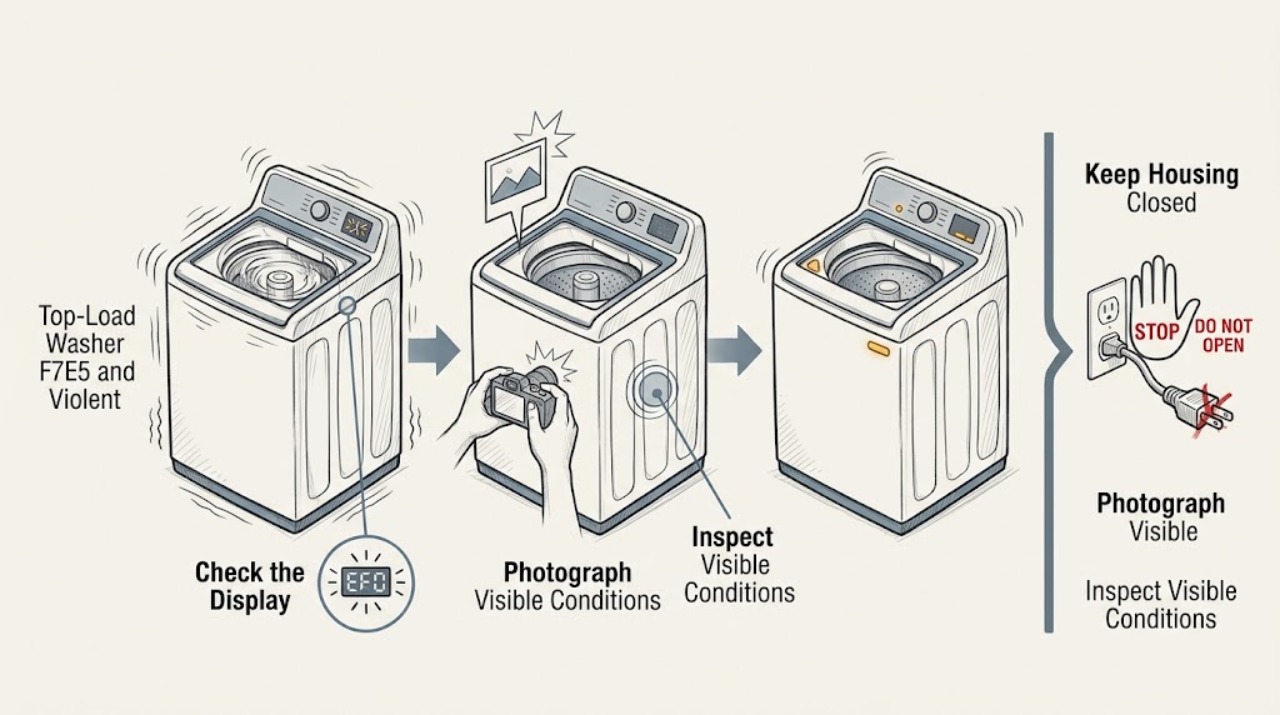
Amana has an official F7E5 Product Help page under Top Load Washer, but that public page does not define F7E5 as one universal part failure; it only describes a five-minute control power cycle and service if help is still needed. Because the complete model is missing, do not transfer a meaning from another Amana platform or service sheet. More importantly, a tub that bangs or the machine that moves violently is a stop-use condition: switch it off, keep hands out of the tub, and do not hold it in place while it runs. Once it is fully stopped and safe, record the exact display and model, check only the visible level/floor and load condition, and look for standing water or an obvious external drain issue without moving or tilting the washer. If F7E5 returns, final spin is still unavailable, water remains, or the violent movement recurs, leave the washer disconnected when safe and arrange qualified appliance service. Do not inspect a drive, shifter, suspension, belt, or control inside the cabinet.
Before you begin
Safety first
- Owner checks are limited to stopping the washer safely, recording the full model and display, observing the installed position, load distribution, standing water, and visible hose condition with power isolated. Do not move or tilt the washer, brace it while running, reach into the tub during motion, remove panels, access a pump or drive, enter diagnostics, or select a motor, shifter, suspension, belt, sensor, or control from F7E5.
Work through in order
Diagnostic checks
Use only checks that match the exact appliance or system and its official guide.
-
Check 1
If the washer is currently moving or banging, press its normal stop/pause control only if you can do so without approaching moving parts; otherwise keep clear and disconnect power only from a safe, dry, accessible position. Wait until all motion has stopped before touching the lid or load.
Expected result: The washer stops normally, continues moving, has shifted, or shows a leak, smoke, burning odor, damaged cord, or exposed wiring.
Next step: Keep the washer out of service. For smoke, sparks, active leaking, or immediate electrical danger, leave it isolated and obtain emergency/electrical help as appropriate; do not restart to collect more evidence.
Stop if: Do not hold the washer in place, open the lid while the basket moves, reach into the tub, or stand over a moving machine.
Why this matters
Why: Uncontrolled movement or an electrical/water warning is more urgent than clearing F7E5. A machine that has shifted may have strained hoses or damaged the floor even if the code disappears.
-
Check 2
After the washer is completely stopped, photograph the full display and rating label, including every F7E5 character, model number, serial number, and any suffix. Record whether the code appeared during attempted final spin, after earlier intermittent failures, or with water still in the tub.
Expected result: The complete model is found and the display is exactly F7E5, or the model/code remains incomplete or differs from F7E5.
Next step: Use the exact owner's manual for the recorded model and give the technician the timing and movement history. If identity is incomplete, keep the machine stopped rather than applying another platform's code meaning.
Stop if: Do not remove a panel or search inside the cabinet for a model or hidden diagnostic code.
Why this matters
Why: Amana's top-load error index lists F7E5, but Amana's public help structure is model-specific and the F7E5 page itself does not provide a universal cause. A different display cannot safely be mapped to F7E5.
-
Check 3
With power isolated and the washer left in its installed position, inspect only the visible floor and cabinet relationship: look for obvious leaning, rocking, a loose visible foot, contact with a wall or cabinet, or a shifted machine. Do not pull the washer out or tilt it to reach hidden feet or the rear.
Expected result: The washer is visibly tilted/rocking or has shifted, the floor or cabinet contact is abnormal, or the visible installation looks stable.
Next step: If movement or contact is unsafe, leave the washer in place and arrange installation/appliance service rather than trying to level it under load. If it looks stable, continue only with stopped-load and water observations; do not run it.
Stop if: Do not shim a loaded washer, crawl underneath, move it while connected, or operate it while someone braces it.
Why this matters
Why: An installation or floor condition can amplify an unbalanced load, but a stable exterior does not rule out an internal fault. The observation cannot identify a drive, basket, or suspension part.
-
Check 4
Only with the lid open after all motion has stopped, note whether clothing is tightly packed, tangled, or concentrated on one side. Remove or redistribute laundry by hand while the washer is unpowered; do not reach into a tub that could restart and do not run a test after violent banging.
Expected result: The load is clearly oversized or one-sided, the load is small but bulky, or the load is reasonably distributed and the tub is empty of water.
Next step: Keep the redistributed load out of service until the installation and code are reviewed. If clothing is soaked, use safe external drainage/service guidance rather than forcing a spin cycle.
Stop if: Do not restart to see whether redistribution fixed the problem, run a spin while holding the lid, or put hands near the moving basket.
Why this matters
Why: Load imbalance can explain a failed final spin and banging, but it does not prove that the F7E5 code or severe movement is only a load issue. A repeat with a reasonable load needs service.
-
Check 5
Observe water status without disconnecting hoses: note standing water in the tub, a visible leak, an obvious kink in the accessible drain hose, or a dry tub after the failed spin. Do not remove a wet hose, open the pump area, or tilt the washer to drain it.
Expected result: Water remains, the drain hose is visibly kinked, a leak is present, or the tub is empty and the only symptom is failed spin with banging.
Next step: For standing water or a leak, keep the washer off and arrange service; close the supply if needed. For a dry tub and recurring movement/code, provide the external observations to a technician without further testing.
Stop if: Do not reach into the pump, remove panels, force a drain, or operate a leaking or unstable washer.
Why this matters
Why: Retained water can prevent or interrupt final spin and changes the service path, while a leak is a stop-use condition. A dry tub with violent movement leaves balance, installation, and internal drive/suspension causes unresolved.
-
Check 6
Do not use the five-minute power-cycle suggestion on Amana's generic F7E5 page as a test while the washer has violently banged or shifted. Once a qualified person confirms the appliance is stable and there is no water/electrical hazard, the exact model manual may permit one ordinary reset; record whether the code returns without running an unsafe spin test.
Expected result: The code clears but the washer has not been proven stable, the code returns, or the washer remains unable to reach final spin.
Next step: Keep the washer out of service after violent movement and arrange qualified appliance service with the complete model, code, load, water status, and movement history. Do not infer a part from the reset result.
Stop if: Do not repeat resets, run another spin to confirm the result, enter diagnostics, or open the cabinet.
Why this matters
Why: Amana says a control reset can sometimes solve F7E5, but a cleared display does not repair or rule out a balance, installation, or mechanical safety problem. A returning code or persistent no-spin condition is service-level.
Use your observations
Decision map
Find the observation that best matches what you see, then follow the next safe action.
-
PATH 01Next step
What you see
The washer moved violently, banged against its surroundings, has shifted, or shows a leak/electrical warning.
Do this next
Leave the washer off, isolate power only if safe, close the water supply if leaking, and arrange qualified appliance/installation service. Use emergency procedures for smoke, sparks, or active fire.
Why this path and its safety boundary
Why it matters: This is a stop-use safety path, not a normal balance-correction test. Further operation could worsen damage or expose a hose/electrical hazard.
-
PATH 02Next step
What you see
The washer is fully stopped, the load is visibly one-sided or oversized, there is no water/electrical hazard, and the complete model is still missing.
Do this next
Record the load and model label, keep the washer out of service because violent banging already occurred, and have service verify installation and the correct model-specific F7E5 guidance.
Why this path and its safety boundary
Why it matters: The load is a plausible contributor to the failed spin, but Amana's F7E5 page does not establish that load balance is the code's universal meaning and the platform cannot be identified.
-
PATH 03Next step
What you see
The washer is level and dry, the load was reasonable, F7E5 returns or final spin remains unavailable, and no external hose or installation issue explains the event.
Do this next
Stop troubleshooting and arrange qualified Amana appliance service with the complete identity, exact display, cycle stage, and movement record. Do not run another confirmation cycle.
Why this path and its safety boundary
Why it matters: The safe external checks did not resolve the condition. An internal drive, sensing, basket, suspension, wiring, or control issue remains possible, but the code and symptom cannot select one part.
-
PATH 04Next step
What you see
The complete model or display is unavailable, or the characters are not exactly F7E5.
Do this next
Preserve the label/display record and request service or obtain the exact owner's manual. Do not transfer F7E5, F7E6, F7E7, or another platform's instructions.
Why this path and its safety boundary
Why it matters: Amana's public error-code resources are model-family specific; without identity, the code meaning and reset cannot be safely established.
Helpful context
Understand the symptom
Violent movement changes the order of operations. Amana's public F7E5 page confirms that the code belongs to a top-load washer support path, but it does not explain which mechanism is at fault. With no model number, a code table or technician document for another platform is not reliable. The immediate decision is whether the washer can be left safely in place, not which drive or suspension part to buy.
A few seconds of banging can damage the floor, hoses, cabinet, or washer and can turn an ordinary balance event into a safety incident. Do not restart it to reproduce F7E5, brace it by hand, open the lid while it is moving, tilt it, or reach below the tub. Use only stopped, external observations and hand the complete record to a qualified technician.
When checks do not resolve it
Need a professional?
Contact qualified Amana appliance service for violent movement, recurring F7E5, a no-spin condition after the safe external observations, retained water, or any unstable installation. Treat smoke, sparks, active leaks, exposed wiring, or a repeated electrical trip as immediate safety escalation.
Safety scope: Owner checks are limited to stopping the washer safely, recording the full model and display, observing the installed position, load distribution, standing water, and visible hose condition with power isolated. Do not move or tilt the washer, brace it while running, reach into the tub during motion, remove panels, access a pump or drive, enter diagnostics, or select a motor, shifter, suspension, belt, sensor, or control from F7E5.
Have this ready
- Provide the complete model and serial, exact F7E5 display, top-load configuration, cycle stage, time in service, prior intermittent symptoms, movement/banging duration, whether the tub was wet, load details, visible level/shift, hose observations, and any hazard history.
Common questions
FAQ
What does F7E5 mean on an Amana top-load washer?
Amana has a Top Load Washer F7E5 help page, but its public content gives a five-minute control power-cycle step and service escalation rather than a universal component meaning. The complete model is needed before applying a platform-specific interpretation.
Could a badly unbalanced load cause the banging and no final spin?
It can be a plausible contributor, but banging does not prove that balance is the only cause. Because this washer moved violently, stop using it and limit checks to the stopped load and visible installation; do not restart to confirm.
Should I run the five-minute reset for F7E5?
Amana publishes that reset on its F7E5 page, but it is not a reason to restart a washer that has banged or shifted violently. Keep the appliance out of service and use the model-specific manual or qualified service; a cleared code would not prove the washer is safe.
Can F7E5 tell me whether to replace the motor or suspension?
No. The public Amana F7E5 page does not select a motor, shifter, suspension, basket, or control, and the model is missing. Give service the exact label, display, load, water status, and violent-movement history instead.
Read the exact guide
Official sources
- F7E5 - Error CodeAmana Product Help · Official Amana Top Load Washer F7E5 support page. It publishes only a five-minute control power cycle and service escalation; it does not establish one universal internal part or cause for every Amana platform.
- Error Codes or Flashing Lights - Top Load WasherAmana Product Help · Official top-load error-code index. It lists F7E5 among model-family codes and links owners to model manuals; it does not provide a universal F7E5 diagnosis in the absence of a complete model.
Community feedback
Share a repair observation
Share a plain-text repair observation. Accepted observations are published automatically; this page may take a moment to update.