
On this page
Start here
Quick answer
Stop using an Amana NTW4516FW3 that only agitates or spins when the cabinet is leaned about 45 degrees. Do not lean it again as a test or treat the tilted position as a repair. If the machine is currently tilted, keep it off and have safe help return it upright and level; do not move it alone if it is unstable, wet, or pulling on hoses. The exact-model literature identifies F7E1 as a basket-speed fault, F7E5 as a shifter fault, F8E1 as no fill or long fill, and F5E1 as a lid-switch fault. Those codes span drive, lid, and water-level-related checks, so their combination does not prove that one part has failed. Preserve the exact code order, cycle stage, and what changed when the washer was tilted, then arrange qualified appliance service before another cycle.
Before you begin
Safety first
- Do not operate the washer while tilted, unstable, leaking, or showing electrical damage. Do not enter service mode, bypass the lid safety circuit, open the cabinet, reach under the machine, or perform live electrical tests. Disconnect power only when the plug is reachable without moving the appliance and the area is dry; otherwise have a professional isolate power.
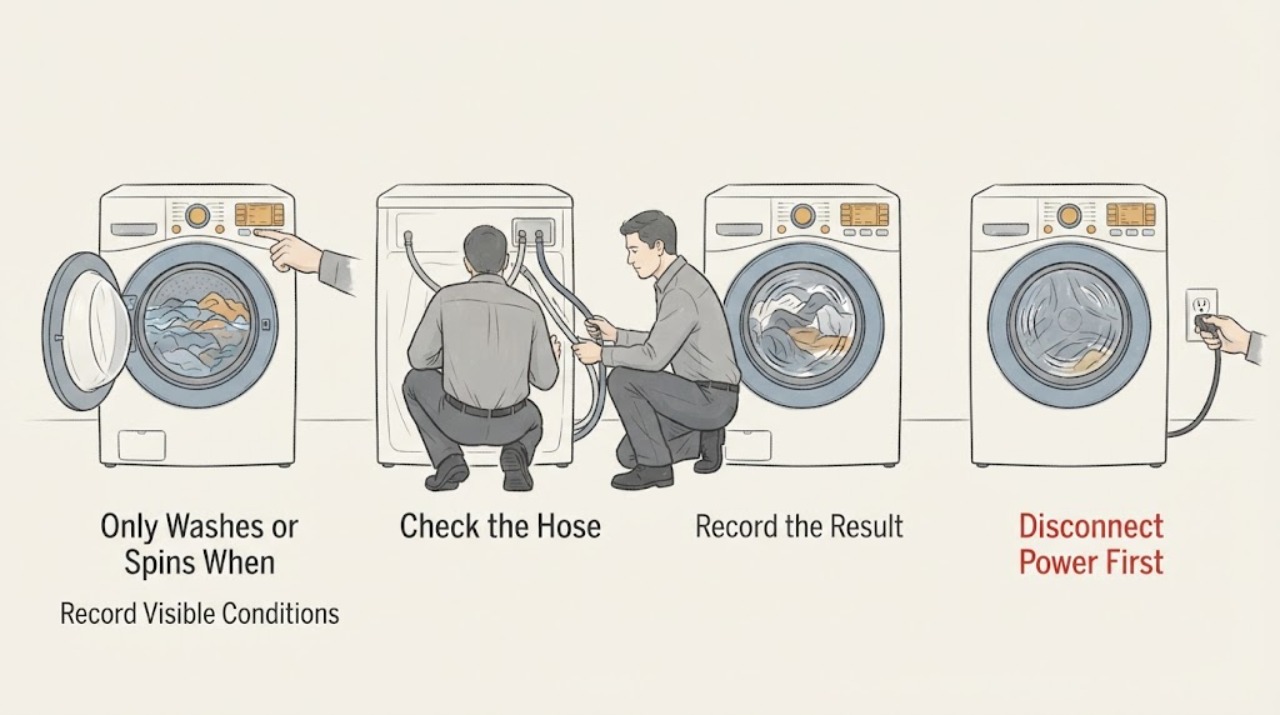
Work through in order
Diagnostic checks
Use only checks that match the exact appliance or system and its official guide.
-
Check 1
Stop the washer and do not start another cycle, lean one side, lift the cabinet, or use the tilted position to see whether it will agitate or spin. If it is currently tilted, keep hands and feet clear of pinch points and have an installer or qualified service person return it upright and level; do not move it alone when it is unstable, wet, or pulling on hoses.
Expected result: The cabinet rocks, remains tipped, has pulled or kinked hoses, has water underneath, or shows a damaged cord, plug, lid, or base.
Next step: Leave the washer off. If the floor and plug are dry and the plug can be reached without moving the machine, disconnect power; otherwise have the professional isolate power and inspect the installation before repositioning it.
Stop if: No restart, solo repositioning, cabinet removal, or operation while the appliance is tilted or unstable.
Why this matters
Why: The orientation-dependent behavior is an abnormal mechanical and safety condition, not evidence that a particular motor, shifter, belt, lid lock, or control is the failed part.
-
Check 2
Use any code photo or display record already available and write the complete characters exactly, including spaces, the order in which F7E1, F5E1, F8E1, and F7E5 appeared, the selected cycle, and whether each appeared during filling, lid lock, agitation, spinning, or stopping. Do not enter service diagnostics or clear the record just to reproduce the symptom.
Expected result: F7E1 or F7E5 clusters around agitation or spin, F5E1 appears when the lid is closing or locking, F8E1 appears during filling, or the order and stage are unknown.
Next step: Give the code order, timing, and the 45-degree observation to the service provider; ask them to use the NTW4516FW3/W10740573 path rather than a generic Amana or Whirlpool code chart.
Why this matters
Why: The matching tech sheet separates basket-speed, shifter, lid-switch, and fill faults. A documented sequence can show whether one event preceded the others, while an unknown sequence cannot safely be turned into a single-part diagnosis.
-
Check 3
Only after the washer is upright, level, stable, and powered off, look from outside at the lid and strike, the hot and cold supply valves, visible inlet hoses, and the visible drain-hose route. Check only for an open lid, an object blocking closure, a closed valve, a visibly kinked hose, or a plainly abnormal drain-hose position; do not disconnect a pressurized hose or reach under the washer.
Expected result: The lid cannot close normally, a valve is closed, a hose is crushed or kinked, the drain hose is visibly misrouted, or all visible paths look normal.
Next step: Correct only an obvious external position issue without moving the washer or opening it, then keep the machine off and give the observation to qualified appliance service. Do not run a cycle to prove the correction.
Why this matters
Why: These observations can support the F5E1 or F8E1 branches, but a normal exterior does not rule out an internal lid, pressure, valve, drive, or control problem. F7E1 and F7E5 still require model-specific diagnosis.
-
Check 4
With the machine left in its safe upright position and without removing panels, photograph or describe any visible cabinet shift, foot movement, lid misalignment, hose strain, water marks, scraping, or new noise that was noticed before the machine was stopped. Do not reach beneath the basket or touch moving or electrical parts.
Expected result: There is visible displacement or leakage, the lid no longer meets its strike normally, the washer has a new scrape or knock, or there is no visible change after the tilt event.
Next step: Attach the photos and timeline to the service request and ask for a stable, level inspection before any controlled diagnostic operation. Do not order a motor, shifter, belt, lid lock, valve, or control from the code combination alone.
Why this matters
Why: A visible change after the orientation event is useful damage and installation evidence, but no visible change does not clear the drive, lid, water-level, wiring, or control systems.
Use your observations
Decision map
Find the observation that best matches what you see, then follow the next safe action.
-
PATH 01Next step
What you see
The washer is still tilted or rocks, or there is active water, a pulled hose, damaged electrical hardware, smoke, sparking, or a burning odor.
Do this next
Keep the washer off and clear. Do not reposition it alone or restore power; arrange qualified appliance service, with electrical or emergency help as appropriate for the hazard.
Why this path and its safety boundary
Why it matters: This is an immediate stability, water, fire, or electrical branch. Continuing to run the washer would add risk and would not produce a trustworthy diagnostic result.
-
PATH 02Next step
What you see
After the machine was stopped, the recorded sequence places F7E1 or F7E5 around agitation or spin, especially when the cabinet was level, but the lid and visible supply paths are normal.
Do this next
Do not tilt the washer again, enter service mode, or replace a drive part by elimination. Give the code order and the orientation timeline to a qualified appliance technician for a level, power-isolated inspection.
Why this path and its safety boundary
Why it matters: F7E1 is a basket-speed fault and F7E5 is a shifter fault on this platform. The pair narrows the service path to drive-speed and shift-position evidence, but it does not distinguish a motor, belt, capacitor, shifter, harness, mechanical obstruction, or control without the model's service diagnosis.
-
PATH 03Next step
What you see
F5E1 appears when the lid is closing or locking, or the lid/strike no longer meets normally after the washer was moved or tilted.
Do this next
Keep the lid and machine at rest, remove only an obvious external obstruction, and have service inspect the lid, strike, lock, cabinet alignment, and related wiring without bypassing the safety interlock.
Why this path and its safety boundary
Why it matters: The tech sheet defines F5E1 as a lid-switch fault and notes that the control may not sense the strike or the lid opening and closing correctly. A changed lid alignment is a useful observation, not proof that the lock assembly alone is defective.
-
PATH 04Next step
What you see
F8E1 is recorded during filling, or the washer has an unexpected water level while the supply valves and visible hoses are being checked from outside.
Do this next
Do not run the tipped or unstable machine and do not disconnect a pressurized line. Keep the supply closed if there is leakage, document the water level and hose routing, and have qualified service evaluate the fill and pressure system.
Why this path and its safety boundary
Why it matters: F8E1 is the exact-platform no-fill or long-fill code. The tech sheet lists supply valves, low flow, hose screens, drain-hose siphoning, and pressure-sensing conditions as possible paths; the code does not prove a valve or pressure sensor is bad.
-
PATH 05Next step
What you see
The washer is returned to level and the codes are no longer visible, but it has not completed a safe, professionally defined inspection after operating only while tilted.
Do this next
Keep the washer out of service until the installation and affected systems have been checked. Provide the prior code order and tilt history even if the panel now appears normal.
Why this path and its safety boundary
Why it matters: A cleared display does not establish that the washer is repaired. The tilt-dependent symptom remains an unresolved condition, and stored faults may not remain visible indefinitely.
Helpful context
Understand the symptom
Why the 45-degree behavior changes the decision
A washer that changes from not moving to washing or spinning only after it is leaned is not showing a normal reset condition. Leaning can alter the relationship between the cabinet, lid area, hoses, and drive assembly, but the observation cannot identify which area is at fault. Because this machine has already produced codes from more than one code family, keep it stopped and use the orientation change only as a reason for professional inspection, never as a repeatable user test.
What the four codes mean on this platform
For the NTW4516FW3 literature path, F7E1 means the control cannot determine basket speed or sees speed changing too quickly; F7E5 means it cannot determine shifter position; F8E1 means the water level is not changing as expected or filling is taking too long; and F5E1 means the lid switch is not being sensed correctly. These definitions narrow the evidence to collect, but they do not authorize cabinet access, a service-mode test, or a part replacement by code alone.
When checks do not resolve it
Need a professional?
Arrange qualified Amana or appliance service before another cycle when the washer has needed to be leaned to move, any of the four codes returns, it cannot be restored level safely, the lid alignment changed, water remains, or the cause would require internal access. Use electrical or emergency help for smoke, active sparking, or a dangerous outlet or cord.
Safety scope: Do not operate the washer while tilted, unstable, leaking, or showing electrical damage. Do not enter service mode, bypass the lid safety circuit, open the cabinet, reach under the machine, or perform live electrical tests. Disconnect power only when the plug is reachable without moving the appliance and the area is dry; otherwise have a professional isolate power.
Have this ready
- Provide NTW4516FW3, the rating-label details, the exact code strings and order, selected cycle, stage of each code, whether water was present, what was observed while level, and when the washer was first found to operate only when leaned.
Common questions
FAQ
Can I keep the washer tilted if that is the only way it spins?
No. That is an unsafe operating condition and not a valid workaround. Keep it off, have it returned upright and level with safe assistance, and arrange inspection rather than repeating the tilt.
Do F7E1 and F7E5 mean I should replace the shifter?
No. On this platform F7E1 concerns basket speed and F7E5 concerns shifter position, but the exact tech sheet lists several possible drive, wiring, mechanical, and control paths. The codes do not prove one replacement part.
Is F8E1 unrelated to the spin problem?
It is a different code family: the exact-model table describes no fill or long fill. Its presence may reflect a separate fill or water-level condition or a related sequence, but it should not be merged into a drive diagnosis without the order and cycle stage.
What if the codes disappear after the washer is put level?
A blank or normal-looking panel does not prove that the tilt-dependent problem is gone. Keep the prior code history and have the washer inspected before resuming normal operation.
Read the exact guide
Official sources
- Repair Part List - W11294739 - Rev AWhirlpool Corporation · The opened official parts-list PDF names NTW4516FW3 (White) and lists W10740573 as its Tech Sheet.
- Tech Sheet - W10740573 - Rev BAmana · This is the Amana-hosted W10740573 tech sheet named for NTW4516FW3 in the official parts list; use its top-load washer table for this exact model path.
Community feedback
Share a repair observation
Share a plain-text repair observation. Accepted observations are published automatically; this page may take a moment to update.