
On this page
Start here
Quick answer
Separate the two symptoms first: agitation is the back-and-forth wash action, while spinning is the faster end-of-cycle water-removal action. If the washer agitates but clothes remain wet, check the selected spin setting, load balance, level, drain hose and any standing water. If it never agitates, check the selected cycle, lid or door closure and whether an unbalanced load is causing the washer to pause or reduce movement. Use only the external checks supported by the matching Amana guide; do not infer a motor, actuator, belt or transmission failure from the symptom alone. Repeated failure after those checks needs model-specific service.
Before you begin
Safety first
- Do not open the cabinet, reach into a moving basket or pump, bypass the lid/door interlock or perform live electrical tests. Stop use for leaks, smoke, burning odor or electrical damage.
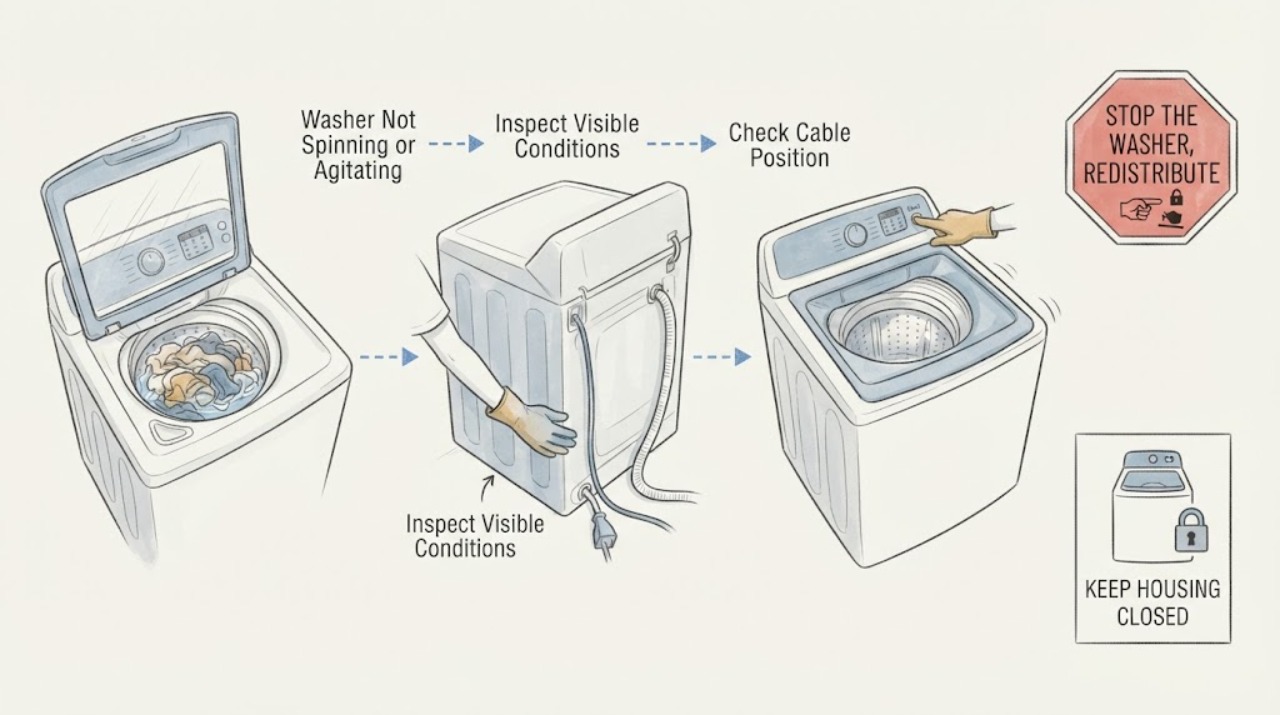
Work through in order
Diagnostic checks
Use only checks that match the exact appliance or system and its official guide.
-
Check 1
Observe one cycle and record whether the failure occurs during wash agitation, during the final spin, or in both phases; also note wet clothes, loud vibration, a paused cycle, an open/locked lid or door, and standing water.
Expected result: Only agitation is weak, only spin is weak, both phases fail, or the phase cannot be identified; standing water and wet clothes are present or absent.
Next step: Follow the matching agitation or spin branch below; do not use a spin symptom alone to name an internal drive part.
Why this matters
Why: Agitation and spin have different user-level causes. Amana links poor agitation to cycle/water-level and balance concerns, while its spin guidance adds spin selection, drain, level and power checks.
-
Check 2
Check the selected cycle and spin setting against the load and the exact owner manual; use a cycle intended for bulky/bedding loads when applicable, and use an appropriate spin or Drain & Spin option when more water removal is needed.
Expected result: Low/No Spin, Delicate/Hand Wash or another reduced-speed setting was selected; a bulky load used an unsuitable cycle; or the settings match the load.
Next step: Correct the setting only within the model's available cycles and clothing-care limits, then reassess the same load pattern; if the result persists, continue to balance and drain checks.
Why this matters
Why: Amana says some cycles intentionally spin more slowly, and an incorrect cycle or low-water setting can reduce agitation or leave more water in clothing. A correct setting does not rule out balance or drain problems.
-
Check 3
Stop the washer, redistribute a tightly packed or single bulky load, and check that the washer is level and stable on the floor before another normal cycle.
Expected result: The load was uneven/overloaded, the washer rocks or is visibly unlevel, or the load and level appear correct.
Next step: Reduce or redistribute the load and correct only the external leveling condition described by the manual. If a balanced, level load still will not spin, do not infer a failed drive component; continue to the drain/door checks and service boundary.
Why this matters
Why: Amana identifies imbalance and leveling as causes of vibration, reduced spin speed, longer cycles and wet clothes; a significant imbalance can make the washer stop spinning to self-correct.
-
Check 4
If water remains in the tub, inspect the accessible drain hose and standpipe for a kink, clog or incorrect installation; do not reach into the pump or open the cabinet.
Expected result: The hose or drain is visibly restricted or incorrectly positioned, or water remains despite a clear accessible drain path.
Next step: Correct only the documented external hose/standpipe condition and use the matching installation guidance. If water remains or the drain issue returns, stop repeated cycles and arrange service.
Why this matters
Why: Amana states that a washer may not spin adequately when it cannot pump water out. A clear external drain path narrows the problem but does not identify an internal pump or control fault.
-
Check 5
Before retrying, confirm the lid or door is fully closed and latched, controls are responding, and no power interruption occurred during the cycle; stop if there is leaking, smoke, burning odor or electrical damage.
Expected result: The lid/door was not latched, the control or lock indicator is abnormal, power failed during spin, or an unsafe symptom is present.
Next step: Close and latch the lid/door and restart only the model-approved cycle when there is no hazard. For repeated lock/control failure or any unsafe symptom, keep the washer off and arrange qualified service.
Why this matters
Why: Amana's guides identify a closed lid/door as a safety condition for movement and a power failure as a reason full spin may not resume. Leaks, smoke or electrical damage require service rather than repeated tests.
Use your observations
Decision map
Find the observation that best matches what you see, then follow the next safe action.
-
PATH 01Next step
What you see
The washer agitates but finishes with wet clothes and no standing water, especially after Low/No Spin, Delicate/Hand Wash or a bulky load.
Do this next
Use the model-appropriate spin/cycle setting, redistribute the load and confirm the washer is level; reassess before requesting internal repair.
Why this path and its safety boundary
Why it matters: The selected spin behavior or load distribution is more likely than a proven internal motor or transmission failure.
-
PATH 02Next step
What you see
The washer shakes or makes loud noise during spin, and the basket/load is uneven or the appliance rocks.
Do this next
Stop, redistribute or reduce the load and correct the external leveling condition. If the pattern returns with a balanced level load, schedule service.
Why this path and its safety boundary
Why it matters: Amana associates this pattern with imbalance or leveling, which can reduce or stop spin to protect the load and appliance.
-
PATH 03Next step
What you see
Water remains in the tub when spinning should begin or the cycle ends.
Do this next
Inspect the accessible drain hose and standpipe for the documented restrictions. If they are clear or water returns, stop repeated cycles and arrange service.
Why this path and its safety boundary
Why it matters: The drain path may be preventing the washer from completing normal spin; a standing-water symptom does not identify the pump or control board.
-
PATH 04Next step
What you see
The washer will not agitate or spin after the matching cycle, balance, level, drain and lid/door checks, or it shows a leak, smoke, burning odor or electrical damage.
Do this next
Keep the washer off for unsafe symptoms and provide the model number, phase that failed, load/cycle, standing-water status, drain findings, lock/door behavior and power history to Amana service.
Why this path and its safety boundary
Why it matters: The public Amana guidance has reached its user-level boundary; a specific internal component cannot be diagnosed safely from this symptom alone.
Helpful context
Understand the symptom
“Not spinning or agitating properly” combines two different parts of a washer cycle. Agitation happens during washing and may vary with cycle and water level. Spin happens later and is affected by spin selection, load distribution, leveling, drain completion and power interruptions. Record which phase fails before changing settings or assuming a part is broken.
Use the symptom at the end of the cycle
A loud or shaking spin with wet clothes points first toward balance, load size or level. Standing water points toward the drain path. A low or no-spin selection can leave water in a normal load, while a delicate cycle may intentionally spin more slowly. These observations guide safe external checks; none identifies a motor, belt or transmission by itself.
Keep checks outside the cabinet
Redistribute or reduce the load, verify the cycle and spin setting, confirm the washer is level, inspect the accessible drain hose, and make sure the lid or door is fully closed. Do not open the cabinet, reach into a moving basket or perform live electrical tests. If the same failure returns with a balanced load and clear external path, use model-specific service.
When checks do not resolve it
Need a professional?
Safety scope: Do not open the cabinet, reach into a moving basket or pump, bypass the lid/door interlock or perform live electrical tests. Stop use for leaks, smoke, burning odor or electrical damage.
Have this ready
- Full Amana model number, top-load or front-load design, phase that failed, selected cycle and spin setting, load type/size, vibration or error indication, standing-water level, drain-hose findings, lid/door lock behavior and any power interruption or unsafe symptom.
Common questions
FAQ
What is the difference between not agitating and not spinning?
Agitation is the wash movement during the cycle; spin is the later water-removal phase. Amana's checks differ: cycle/water level and balance affect agitation, while spin setting, balance, drain, level and power history affect spin.
Why are my clothes wet if the washer spins?
Low or No Spin and delicate cycles intentionally remove less water. An unbalanced or bulky load, a level problem, standing water or a drain restriction can also reduce spin performance.
Can a wrong cycle make an Amana washer agitate poorly?
Yes. Amana says a low-water cycle may not provide the water level needed for proper agitation, while bulky loads may need their designated cycle. Use the exact owner manual and do not add water as a generic fix.
When should I stop troubleshooting and book service?
Book service when the washer still will not agitate or spin after the matching external checks, or immediately for a leak, smoke, burning odor, electrical damage or repeated lid/door lock failure.
Read the exact guide
Official sources
- Not Agitating - Washer - Product HelpAmana Product Help · Amana's top-load washer help page; it supports balance, cycle/water-level and service branches for not-agitating symptoms, not a specific internal-part diagnosis.
- WHY YOUR WASHER WON'T SPINAmana · Amana consumer article; it supports balance, HE detergent/suds, drain hose, settings, power-failure and lid-lock symptom branches.
- Washer Not Draining or Spinning? Troubleshooting Guide - Product HelpAmana Product Help · Amana product-help guide; it supports lid/door, balance, spin selection, suds and accessible drain-path checks without proving an internal component.
- Not Turning, Tumbling, or Spinning - Front Load Washer - Product HelpAmana Product Help · Amana's front-load washer help page; it supports conditional low/no-spin, delicate, HE detergent/suds, bulky, balance, level and drain checks.
- Not Spinning - Washer - Product HelpAmana Product Help · Amana's top-load washer help page; it supports load balance, spin selection, bulky load, drain, level and power branches.
Community feedback
Share a repair observation
Share a plain-text repair observation. Accepted observations are published automatically; this page may take a moment to update.