
On this page
Start here
Quick answer
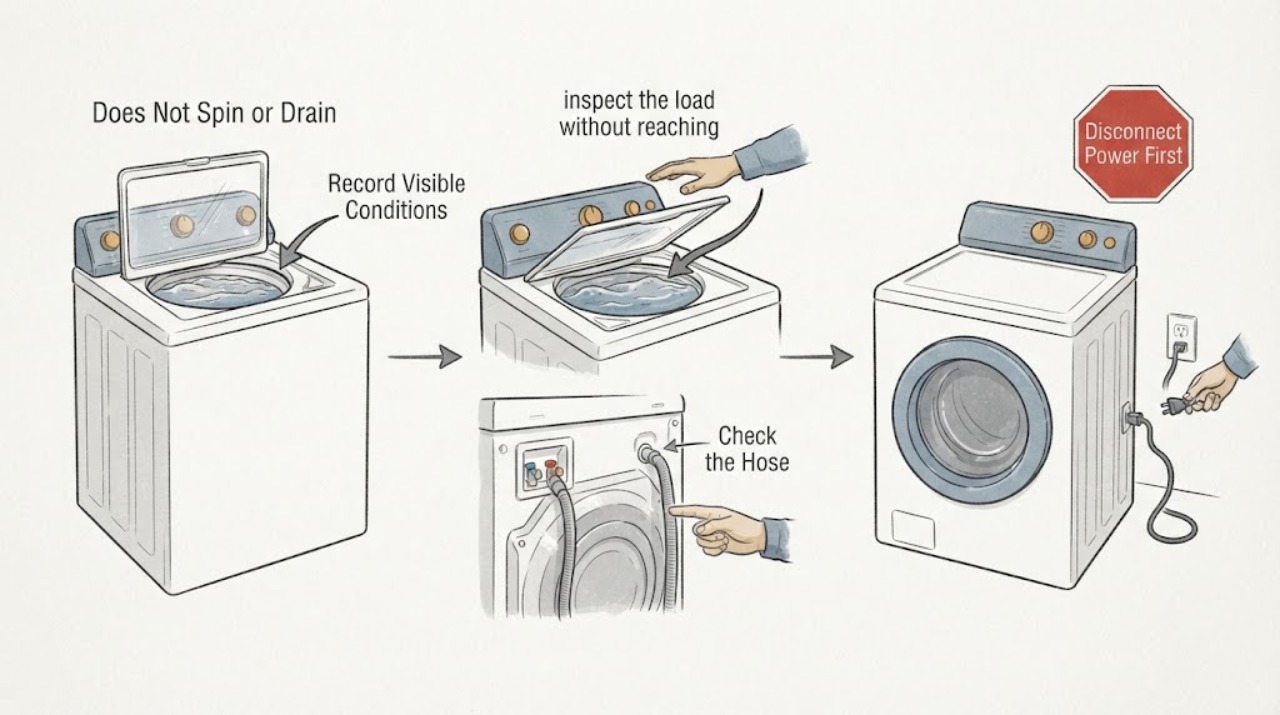
The Amana NTW4516FW3 is a top-load washer with a dual-action agitator, and its Normal, Heavy or Bulky, Delicates, Rinse & Spin, and Drain & Spin behavior is not interchangeable. Delicates intentionally uses a slower spin and can leave more water in the load; a tightly packed or single heavy item can also prevent a proper spin. First record whether the basket contains standing water or the clothes are simply wetter than expected, then note the selected cycle, spin/indicator lights, lid-lock state, and whether the washer makes a drain sound. With the washer stopped and the floor dry, check both visible water faucets and hoses, the drain hose for kinks or an incorrect outlet position, and the load distribution. Amana's top-load guidance says both hot and cold supplies must be available, and its drain guidance warns that a restricted or incorrectly routed drain can keep the washer from draining or spinning. Do not assume a pump, lid lock, actuator, or transmission is bad from a heavy or delicate load alone. If a single carefully supervised, model-appropriate Rinse & Spin or Drain & Spin test repeats the failure, or if there is a leak, electrical odor, unusual noise, or a locked lid with water present, stop and arrange service.
Before you begin
Safety first
- Do not reach into a moving basket, bypass or force the lid lock, disconnect a water-filled hose, open the console or cabinet, remove the pump or actuator, probe live wiring, or keep running cycles after a leak, violent movement, burning odor, or abnormal noise. Disconnect power only through a safe accessible method before any service work; user-level observations should remain external and dry.
Work through in order
Diagnostic checks
Use only checks that match the exact appliance or system and its official guide.
-
Check 1
Read the model and serial label without moving the washer and record the exact cycle, soil or water-level setting, and point where it stops. Note whether the tub is empty but the clothes are wet, whether water is standing, whether the spin indicator remains on, whether the lid is locked, and whether the failure is limited to Normal, Heavy or Bulky, or Delicates.
Expected result: Only Delicates leaves extra water, Heavy or Bulky fails with a tightly packed load, all cycles stop with water present, or the selected cycle and water state are unclear.
Next step: Keep the washer stopped until the basket has fully stopped. Record the label and indicators, then follow the matching load, lid, water-supply, or drain observation; do not reach into a moving basket or start by buying a part.
Why this matters
Why: Delicates is designed for slower spin, while standing water or a spin indicator after about ten minutes points toward a drain-path condition. A load-dependent result is a branch to compare cycle/load behavior, not proof of a pump, lid lock, actuator, or transmission fault.
-
Check 2
With the washer stopped, inspect the load without reaching under the lid while anything is moving. If the load is tightly packed, a single bulky item, or gathered to one side, reduce or redistribute it only after the lid is safely unlocked. Confirm that Delicates or a low/no-spin setting was not selected when the goal is maximum water removal.
Expected result: The basket was tightly packed, a single bulky item was washed, the load was unbalanced, or Delicates/low spin was selected; alternatively, a loose balanced load still leaves standing water.
Next step: For a safe, dry washer, correct the load or select the model-recommended cycle once and monitor one normal attempt. If water remains or a balanced load repeats the stop, stop testing and arrange service.
Why this matters
Why: Amana says load distribution and cycle spin speed can reduce water extraction, and Delicates intentionally retains more water. Standing water in the basket is different: it keeps the issue in the drain path even if the load is balanced.
-
Check 3
From a dry position, verify that both household water faucets are open, both inlet hoses are attached to the washer and faucets, and neither hose is visibly kinked or crushed. Do not loosen a pressurized hose, remove inlet screens, or open the console.
Expected result: One faucet is closed, a hose is kinked or leaking, the hoses are reversed or one is missing, or both visible supplies appear normal but the washer still fails only on selected loads.
Next step: Correct only an obvious dry external faucet or hose-position issue and allow one model-appropriate attempt. For a leak, damaged hose, no-fill recurrence, or uncertain connection, close the supply if safely reachable and arrange service.
Why this matters
Why: Amana's top-load guidance says both hot and cold water must flow to the inlet valve and lists kinks, clogged screens, or reversed hoses as supply problems. A normal visible supply does not prove an inlet valve or control failure, but it makes a simple hose setting less likely.
-
Check 4
Inspect the visible drain hose and its outlet without pulling the washer forward. Look for a kink, crushing, a loose connection, a hose end taped or sealed to the standpipe, an outlet that is too high, or a visible household drain blockage. Use the exact installation instructions for the model before changing height or insertion; do not disconnect a water-filled hose.
Expected result: The hose is kinked or crushed, the outlet is sealed or routed incorrectly, the household drain backs up, water drains slowly, or the visible route appears correct while the tub remains full.
Next step: Correct only an obvious external routing issue and supervise one drain or rinse-and-spin attempt if the floor and connections are dry. Stop for a backup, leak, standing water, or a pump that only hums and request appliance or plumbing service.
Why this matters
Why: Amana identifies drain-hose installation, kinks/clogs, household plumbing, and excessive standpipe height as possible reasons a washer cannot pump out and therefore will not spin. The exact community case also found drain-outlet placement worth checking, but did not prove an internal part.
-
Check 5
Check the lid indicator and the washer's pause state from outside. If the lid was opened during the cycle, allow movement to stop, close the lid fully, and use only the normal Start/Pause control once. Do not bypass, tape, or force the lid lock and do not reach into the basket.
Expected result: The lid was open or not locking, the lid indicator flashes, the washer is paused during sensing or a normal phase, or the lid appears closed and the same drain/spin failure returns.
Next step: Resume only the model-documented pause state once when no hazard is present. If the lid cannot safely lock/unlock, water remains, or the failure returns, leave the washer off and arrange qualified service.
Why this matters
Why: Amana says the washer will not run or fill with the lid open and can pause during certain phases; its top-load error guidance separately identifies lid-lock and load-balance states. A correctly closed lid with recurring water or spin failure moves the issue beyond a simple lid position.
-
Check 6
If the washer is stable, dry, and free of unusual noise or electrical symptoms, run at most one empty or lightly loaded model-appropriate Rinse & Spin or Drain & Spin comparison, without detergent. Watch only from outside for fill, drain discharge, basket movement, indicator changes, and any standing water; do not enter diagnostics or repeatedly reset the washer.
Expected result: The comparison completes, fails with the tub empty, drains only after a visible hose correction, fails only with a heavy or delicate load, or leaves water and a spin indication.
Next step: Save the exact cycle, load, water state, indicator, and result for service. If the test fails or the issue repeats, stop using the washer rather than repeating cycles or opening panels.
Why this matters
Why: A successful empty comparison makes load distribution or cycle selection more plausible, while failure with an empty basket or persistent standing water keeps a drain, lid, control, or drive fault unresolved. It still does not select a replacement pump, lock, actuator, or transmission.
Use your observations
Decision map
Find the observation that best matches what you see, then follow the next safe action.
-
PATH 01Next step
What you see
Delicates leaves the load wetter but the tub is empty, while a balanced Normal load completes and no drain indication remains.
Do this next
Use the cycle recommended for the fabric and select Drain & Spin only when extra water removal is appropriate. If the same load becomes wet with standing water or the problem spreads to an empty comparison, arrange service.
Why this path and its safety boundary
Why it matters: The pattern fits the intentionally slower Delicates spin or the selected low-spin behavior more than a total drain failure.
-
PATH 02Next step
What you see
Normal completes but Heavy or Bulky or Delicates stops before spin/drain, especially with a tightly packed, single, or bulky load.
Do this next
Use a loose, balanced load, the recommended cycle, and measured HE detergent for one supervised attempt. If a balanced load or empty Rinse & Spin still fails, leave the washer off and request service.
Why this path and its safety boundary
Why it matters: Load distribution, selected spin speed, or detergent suds is more plausible than a cycle-specific part failure. A load that cannot balance can extend or reduce spin and leave clothes wet.
-
PATH 03Next step
What you see
The tub remains full, the spin indication stays on, the pump hums without discharge, or the household drain backs up.
Do this next
Keep water away from electrical parts, correct only visible external drain routing, and stop for trapped water or a leak. Use appliance service for the washer and plumbing service for a backed-up household drain.
Why this path and its safety boundary
Why it matters: A drain route, siphon, blockage, pump, or water-level sensing problem can prevent spin; the symptom does not identify which internal component failed.
-
PATH 04Next step
What you see
Both water supplies are not available, a hose is kinked or reversed, or the washer stops at fill/rinse before the basket becomes wet.
Do this next
Correct only a safe, obvious external supply setup and make one normal attempt. If the supply is normal or the no-fill condition returns, arrange model-specific service.
Why this path and its safety boundary
Why it matters: The top-load guidance treats both hot and cold supply, hose routing, and inlet screens as visible fill requirements. A supply symptom does not justify ordering an inlet valve.
-
PATH 05Next step
What you see
The empty or lightly loaded comparison fails in the same way, the lid will not safely lock, the washer makes abnormal noise, or the issue persists after the visible checks.
Do this next
Stop using the washer and request qualified Amana/appliance service. Give the provider the full model and serial, cycle/load comparison, water state, indicator lights, hose observations, and any unusual sound; do not open the cabinet or run an unverified diagnostic sequence.
Why this path and its safety boundary
Why it matters: A machine-level lid, drain, sensing, control, or drive problem remains possible, and the exact failed component cannot be determined from this symptom or from a community suggestion.
Helpful context
Understand the symptom
Normal, heavy, and delicate loads can produce different results
Amana's product page identifies the NTW4516FW as a top-load dual-action-agitator washer and specifically says the Delicates cycle uses a slower spin. Amana's troubleshooting guidance also says low-spin cycles remove less water and that tightly packed, single, bulky, or unbalanced loads can reduce spin speed. Therefore, clothes that are wetter after Delicates are not automatically evidence of a failed drain pump. A Heavy or Bulky load that fails while a loose, balanced Normal load completes is a useful comparison, but it still does not identify a part.
The exact NTW4516FW3 case makes drain routing worth checking early
An opened Reddit post identifies NTW4516FW3 and describes a brand-new washer that filled and agitated, completed one Normal load, but did not spin or drain on Heavy or Delicate. A reply focused on the drain outlet and siphoning, and the owner said that explanation made sense; the thread does not document a confirmed final repair. Treat it as an observation prompt, not proof that the pump or control is defective: compare the visible drain-hose installation with Amana's official guidance before ordering anything.
When checks do not resolve it
Need a professional?
Provide the complete NTW4516FW3 label and serial, the cycle and load type that failed, whether the basket was empty or held water, lid and spin indicators, both water-supply observations, drain-hose/outlet position, detergent type and amount, and whether one empty or lightly loaded Rinse & Spin or Drain & Spin comparison completed.
Safety scope: Do not reach into a moving basket, bypass or force the lid lock, disconnect a water-filled hose, open the console or cabinet, remove the pump or actuator, probe live wiring, or keep running cycles after a leak, violent movement, burning odor, or abnormal noise. Disconnect power only through a safe accessible method before any service work; user-level observations should remain external and dry.
Have this ready
- Tell the provider that Normal, Heavy or Bulky, and/or Delicates behaved differently, whether the washer is new or under warranty, whether the failure began after an installation change, and whether the exact drain-hose route was corrected. Include any error-light pattern and the point where the cycle stopped.
Common questions
FAQ
Is it normal for Delicates to leave more water in the Amana NTW4516FW3 load?
Delicates uses a slower spin than the high-speed cycles, so garments can retain more water. That is different from standing water in the tub or a spin/drain indication that returns across cycles.
Why would Normal work while Heavy or Delicate does not?
A tightly packed, single, bulky, or unbalanced load can reduce spin, and Delicates intentionally uses a lower spin. If an empty or balanced comparison also fails, look at the visible drain, lid, and water-supply paths and arrange service rather than assuming the load caused everything.
Should I replace the drain pump because the washer will not spin?
No. Amana lists drain-hose installation, household plumbing, load balance, spin selection, lid state, water supply, and suds before an internal diagnosis. Confirm standing water and the visible drain route, then have service test the machine before selecting a part.
Can I use a diagnostic mode or multimeter to find the fault?
Do not use an unverified service sequence or test live wiring as a first step. Record the cycle, load, water state, indicators, and safe external hose/lid observations; qualified service can perform model-specific electrical and component testing.
Read the exact guide
Official sources
- Amana 3.5 cu. ft. Top Load Washer NTW4516FW Specification SheetAmana · Opened Amana's official specification PDF for the NTW4516FW product family. It supports the top-load agitator identity and the listed Normal, Delicates, Drain & Spin, Rinse & Spin, Bulky/Sheets, and other cycle boundaries; it does not diagnose a failed component.
- Error Codes in Top Load HE Washers - Product Help | AmanaAmana · Opened Amana's official top-load HE error guidance. It supports checking both water supplies, lid state, drain indication, balance, power interruption, and suds. It does not map an unreported code to a component or provide an unverified diagnostic sequence for this article.
- Washer Not Draining or Spinning? Troubleshooting Guide | AmanaAmana · Opened Amana's official washer troubleshooting guide. It supports visible drain-hose, standpipe, load, spin, suds, and service branches at symptom level. It does not authorize accessing hidden components or prove a pump/drive fault on NTW4516FW3.
- Problems with Brand New Amana High Efficiency Washing MachineReddit r/appliancerepair · Opened exact Reddit permalink. The post identifies NTW4516FW3 and reports Normal completing while Heavy or Delicate failed before spin/drain. The comments discuss drain-hose routing and siphoning; the final repair is not confirmed, so the case is used only to prioritize observation and not to diagnose a part.
- Not Turning, Tumbling, or Spinning - Front Load Washer - Product Help | AmanaAmana · Opened Amana's official Product Help article. Its low/no-spin, Delicate, detergent, load-balance, leveling, and drain-hose explanations are used only as symptom-level guidance; front-load-specific dimensions and controls are not transplanted to this top-load model.
- 3.5 cu. ft. Top-Load Washer with Dual Action Agitator White NTW4516FWAmana · Opened Amana's official NTW4516FW product page. It identifies the base model family and directly supports the top-load dual-action agitator, Delicates slower spin, Extra Rinse, Deep Water Wash, and cycle-feature boundaries. The complete NTW4516FW3 suffix remains necessary for service or part selection.
Community feedback
Share a repair observation
Share a plain-text repair observation. Accepted observations are published automatically; this page may take a moment to update.