
On this page
Start here
Quick answer
An Amana washer that keeps draining does not automatically need another control board. First distinguish a documented drain routine from continuous siphoning: Amana says some washers can run the pump for about 8 to 10 minutes after a failed fill or related condition, while an incorrectly routed drain hose can let water flow out continuously. With the washer stopped and the area safe, inspect the visible hose routing, air gap, kinks, drainpipe height and water-supply state against the exact model manual. Do not tape or seal the hose, open the cabinet, or replace another part from the symptom alone.
Before you begin
Safety first
- Keep the washer off for overflow, leaks near electrical parts, smoke, sparks or damaged wiring. Do not open the cabinet, remove a pump or valve, electrically test a component, or replace another board from the symptom alone.
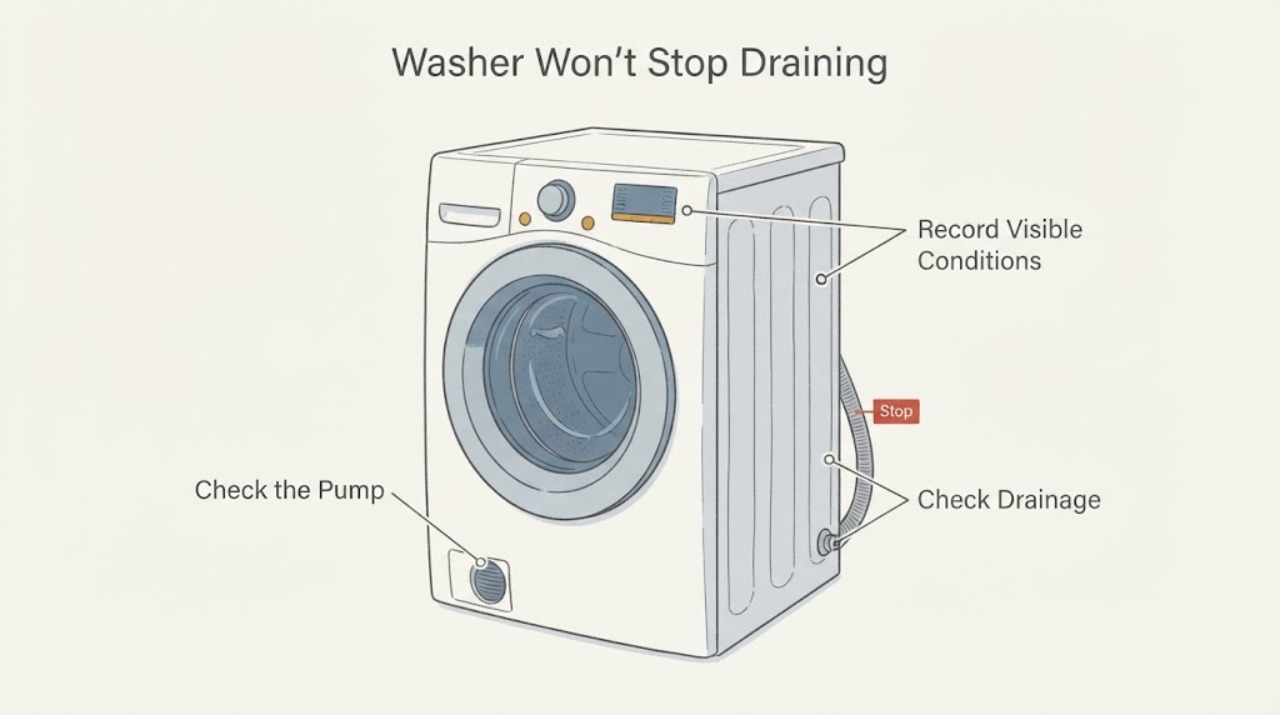
Work through in order
Diagnostic checks
Use only checks that match the exact appliance or system and its official guide.
-
Check 1
Stop the washer if water is rising, leaking onto electrical parts, or the pump cannot be stopped safely. From a dry position, close the hot and cold water valves if accessible and disconnect power only without touching wet or damaged electrical hardware. Do not continue a cycle to reproduce the symptom.
Expected result: There is active overflow/leakage or the washer is safely isolated with no visible hazard.
Next step: For active smoke, sparks or electrical damage, leave the area and use local emergency procedures. Otherwise keep water and power isolated and arrange qualified service if the leak or overflow is not clearly external.
Why this matters
Why: Active water near electrical parts is a stop condition; a safely isolated washer can be evaluated using external hose and timing observations.
-
Check 2
Record whether the pump runs for a finite period of roughly 8 to 10 minutes after a failed fill, an F8 E1/LO FL-type condition, or a washer that was powered before water was connected. Do not press controls repeatedly during a documented drain routine.
Expected result: The pump stops after the documented routine, or it continues beyond that period and the washer remains unresponsive.
Next step: If the routine ends, check the water supply and hose routing before restarting. If it does not end or an error returns, keep the washer off and arrange service rather than replacing another board.
Why this matters
Why: Amana documents a temporary drain routine on some models; a continuing pump after that window is not explained by the generic routine alone and needs model-specific evaluation.
-
Check 3
With the washer off and the hose accessible, inspect only the visible drain path: the hose is not kinked or crushed, is not taped or sealed into the standpipe, has an air gap, and is not inserted farther than the exact model installation guide permits. Do not pull panels or disconnect a pressurized hose.
Expected result: The hose is too deep, sealed, kinked, low or otherwise incorrectly routed, or the visible routing matches the exact manual.
Next step: Correct only the external routing described by the exact model guide. If it matches the guide and draining continues, leave the washer isolated and call qualified service.
Why this matters
Why: Amana identifies excessive insertion, a missing air gap and an insufficient drain height as siphoning conditions; a correct-looking external hose does not prove an internal pump or control fault.
-
Check 4
If the symptom is actually fill-and-drain, verify from a safe position that both household water valves are open and the inlet hoses are not visibly kinked. Do not remove inlet hoses, test valves electrically, or infer a failed sensor from the pump sound.
Expected result: The water supply was closed/restricted, or both supplies are open and the washer still fills and drains.
Next step: Restore only a clearly closed external valve if the area is dry and safe. If the symptom continues, keep the washer out of service and give service the exact model, code and timing.
Why this matters
Why: Amana says a washer that does not detect incoming water can enter a drain routine; an open supply with continuing symptoms leaves the cause unresolved.
-
Check 5
Record the full Amana model and serial, top-load or front-load configuration, displayed code, whether water is entering, the drainpipe height and hose routing, how long the pump runs, and the fact that a control board was already replaced. Do not order another board, pump or valve from the title alone.
Expected result: The identity and timeline are complete, or the model and drain installation cannot be confirmed safely.
Next step: Use the full model to retrieve the matching manual and provide the record to qualified Amana service. If the installation cannot be inspected without moving the washer or opening it, let the technician do so.
Why this matters
Why: Amana's drain dimensions and routines vary by product family, and the prior board replacement does not identify the remaining cause.
Use your observations
Decision map
Find the observation that best matches what you see, then follow the next safe action.
-
PATH 01Next step
What you see
The pump runs for roughly 8 to 10 minutes after a failed fill or F8 E1/LO FL-type condition, then stops.
Do this next
Check the hot and cold water supply and the exact model's installation requirements before another normal cycle; arrange service if the routine repeats with proper supply.
Why this path and its safety boundary
Why it matters: Amana documents this as a temporary drain routine on some models, not proof that the control board failed.
-
PATH 02Next step
What you see
Water flows out continuously while filling, and the drain hose is too deep, sealed, kinked or below the model's required drain height.
Do this next
Correct the hose routing only against the exact Amana installation guide, preserving the air gap; do not tape the hose to the standpipe.
Why this path and its safety boundary
Why it matters: The visible installation can create siphoning, allowing water to leave as it enters.
-
PATH 03Next step
What you see
The drain hose matches the exact manual, water supplies are open, and the pump runs beyond the documented routine or ignores controls.
Do this next
Keep the washer isolated and arrange qualified Amana appliance service. Do not replace another control board or open the cabinet based on the sound alone.
Why this path and its safety boundary
Why it matters: The public family guidance does not identify a remaining pump, control, pressure-sensing or valve failure from this symptom.
-
PATH 04Next step
What you see
Water is leaking, rising, or reaching electrical connections while the washer drains.
Do this next
Close the water supply and isolate power from a safe position; keep the washer out of service and arrange qualified appliance service.
Why this path and its safety boundary
Why it matters: This is a water and electrical safety stop condition beyond routine hose troubleshooting.
Helpful context
Understand the symptom
Separate a drain routine from siphoning
Amana documents two different experiences that can sound like a washer that will not stop draining. Some models enter a drain routine for about 8 to 10 minutes after they do not detect water entering, and the controls may not accept input during that routine. Separately, a hose that is too far into the standpipe, sealed to the pipe, or installed with an incorrect drain height can create siphoning and let water leave continuously. The elapsed time and visible water movement matter before any part is blamed.
Use the exact Amana installation requirements
Amana's opened support pages do not use one universal drain height across all washer families. They consistently call for an air gap, a loose-but-secure hose, no tape sealing the drain opening, and a hose that is not kinked or inserted too far. Use the model's installation guide for the height and insertion limit instead of copying a number from another Amana washer.
A replaced board does not settle the cause
The title reports that a control board was replaced, but the opened Amana guidance does not say that continuous draining proves a board failure or that another board should be installed. If the hose, water supply and documented drain-routine timing do not explain the symptom, stop external troubleshooting and give the exact model, code and timeline to qualified service.
When checks do not resolve it
Need a professional?
Arrange qualified Amana appliance service when the pump runs beyond the model-documented routine, the controls remain unresponsive, the hose and water supply are correct, or any internal pump, valve, sensor, wiring or control inspection would be required. Stop immediately for overflow or water near electrical parts.
Safety scope: Keep the washer off for overflow, leaks near electrical parts, smoke, sparks or damaged wiring. Do not open the cabinet, remove a pump or valve, electrically test a component, or replace another board from the symptom alone.
Have this ready
- Provide the complete Amana model and serial, top-load/front-load type, displayed code, water-supply state, hose insertion and height, whether an air gap exists, pump runtime, fill-versus-drain behavior, and details of the prior board replacement.
Common questions
FAQ
Does replacing the control board prove it caused the nonstop draining?
No. Amana's opened guidance describes drain routines, water-supply conditions and hose siphoning, but it does not say this symptom proves a board failure. Keep the replaced-board history for service and do not install another board by guesswork.
How long can an Amana washer normally run its drain pump?
Amana documents an approximately 8-to-10-minute drain routine for some conditions and models. The exact behavior is model-dependent; a pump that continues beyond the matching manual's routine needs service rather than repeated resets.
Can a drain hose cause continuous draining even when the pump is fine?
Yes. Amana identifies excessive hose insertion, a sealed hose, insufficient drain height and missing air space as siphoning conditions. Use the exact model installation guide because Amana's published height requirements differ by product family.
Should I open the washer to inspect the pump or pressure sensor?
Not from this evidence. Keep the checks external and model-specific; if correct hose routing, water supply and documented timing do not explain the symptom, arrange qualified service instead of opening the cabinet or testing live components.
Read the exact guide
Official sources
- Front Load Washer Installation ChecklistAmana Product Help · Opened Amana's official front-load installation checklist. It provides that family page's hose insertion and standpipe height guidance, water-supply checks, grounded outlet boundary and electrician escalation. It also says to use the exact installation guide for the model.
- Front Load Washer Door Will Not OpenAmana Product Help · Opened Amana's official front-load support page. It covers a continuously running drain pump, hose insertion and an 8-to-10-minute routine for certain F8 E1 or LO FL conditions. It is used only as a front-load family branch, not as a universal rule.
- Washer Leaks and Other Washer Water IssuesAmana · Opened Amana's official washer water-issues article. It covers general Amana washer drainage symptoms and explicitly describes continuous siphoning and an 8-to-10-minute drain routine for some conditions. It does not identify a component for an unspecified model.
- drn - Error CodeAmana Product Help · Opened Amana's official drain-code page. It describes F9 E1 as a long-drain condition and supports external checks for hose insertion, hose-end height and kinks/clogs. It is not used to claim that an unspecified washer displays this code.
- Continuously Fills / Fills and Drains - WasherAmana Product Help · Opened Amana's official top-load support page. It supports external checks for hose insertion, air gap, loose-but-secure connection and a 30-inch minimum standpipe on that page's product scope. It is not used to transfer that height to an unidentified front-load model.
Community feedback
Share a repair observation
Share a plain-text repair observation. Accepted observations are published automatically; this page may take a moment to update.