
On this page
Start here
Quick answer
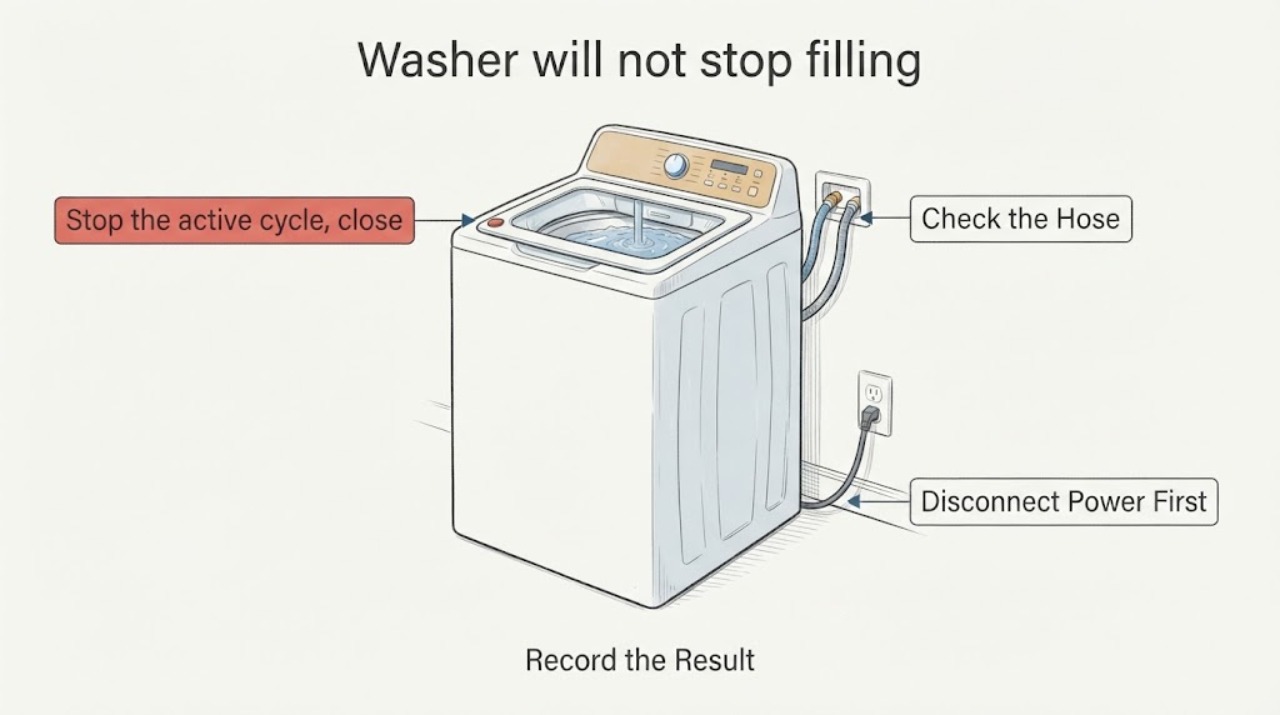
If an Amana washer is actively taking in water without stopping, stop the cycle, close both household water faucets, and disconnect power only when it is safe to do so; do not keep running it to test a suspected valve. Amana’s safety guidance says to disconnect power and turn off the water supply to avoid flooding, and its fill troubleshooting shows that a low or badly installed drain hose can siphon water out while the washer fills. After the water is isolated, inspect the drain-hose routing from outside and identify whether the washer is top-load or front-load. Do not diagnose or replace an inlet valve without the exact model and qualified service guidance.
Before you begin
Safety first
- Treat continuous filling as a water and electrical safety issue. Stop the cycle, close the household faucets, disconnect power only when safely accessible, and do not restart the washer, open the cabinet, remove an energized hose, perform live tests, bypass controls, or guess an internal valve.
Work through in order
Diagnostic checks
Use only checks that match the exact appliance or system and its official guide.
-
Check 1
Stop the active cycle, close both hot and cold water faucets, and disconnect power only if the plug or disconnect is dry and safely accessible.
Expected result: Water flow stops when the household faucets are closed, or water continues because the washer was left connected; alternatively there is an active leak or water level near overflow.
Next step: Leave both faucets closed and the washer disconnected. Do not reopen the water or restart a fill test.
Stop if: If water is still entering with the faucets closed, move away from the appliance and arrange urgent qualified service; do not open the cabinet or attempt a valve repair.
Why this matters
Why: Isolating the supply prevents further flooding; Amana’s safety guidance also calls for power disconnection during non-use, and a washer with uncontrolled water should not be left operating.
-
Check 2
From outside the isolated washer, inspect the drain hose where it enters the standpipe or laundry tub; do not pull hoses or access the rear while the washer is energized or under pressure.
Expected result: The drain hose extends too far into the standpipe, is taped/sealed to it, lacks an air gap, or the drain outlet is below the model’s required height; alternatively the hose has the model-approved routing.
Next step: Keep the water closed and have the drain routing corrected only to the exact installation instructions; do not restart the washer merely to prove the siphon is gone.
Stop if: If the drain routing is correct but the event was a true fill with no drain flow, keep the washer isolated and proceed to model-specific service.
Why this matters
Why: Amana identifies these installation conditions as siphoning paths that can remove water while the washer fills, creating an apparent never-ending fill.
-
Check 3
Identify whether the appliance is a top-load or front-load model and use the matching Amana guide for the drain-height and hose-routing requirements.
Expected result: The task washer is top-load, front-load, or the style/model cannot be confirmed from the rating label; the applicable guides use different standpipe-height requirements.
Next step: Record the complete model number and follow only its owner or installation guide when correcting the hose. Keep water and power isolated until then.
Stop if: Do not assume the model family from appearance; obtain the rating-label information or use qualified service.
Why this matters
Why: Amana’s top-load continuous-fill page specifies a minimum 30-inch standpipe, while its front-load page specifies 39 inches; applying one figure to the other design would be unsafe.
-
Check 4
Use the already-observed cycle behavior to separate staged sensing fills from uncontrolled filling, without powering the washer again: note whether the washer was in Auto Sensing or Bulky and whether the water level rose, paused, or drained away.
Expected result: The washer had been adding water in short stages with pauses and load movement, or water was entering while the tub level stayed low because it drained away; alternatively water was rising continuously toward overflow or entering while a cycle was not running.
Next step: If it was staged sensing or siphoning, keep the washer isolated and use the exact model guide before any controlled use. Do not classify the pattern as a failed valve from timing alone.
Stop if: If the tub was truly filling toward overflow or filling while idle, leave the supply closed and arrange qualified service; do not repeat the observation.
Why this matters
Why: Amana says Auto Sensing and some Bulky cycles can repeat small fills and pauses, while drain siphoning can keep the level low. Water rising continuously or entering while off is not explained by normal staged sensing.
-
Check 5
Give the service provider the model number, washer style, whether water entered while off, whether the tub level rose or drained away, hose routing, and any active light or code.
Expected result: The service record distinguishes continuous fill, fill-and-drain siphoning, and normal staged fill; alternatively the event cannot be separated from the available information.
Next step: Keep both water faucets closed until the model-specific service or repair is complete.
Stop if: Provide the raw observations and do not authorize a guessed part replacement or repeated powered testing.
Why this matters
Why: These observations determine whether the next investigation is installation-related or an internal control/fill-system diagnosis; they do not prove a particular valve or sensor.
Use your observations
Decision map
Find the observation that best matches what you see, then follow the next safe action.
-
PATH 01Next step
What you see
The washer was filling while the drain hose was low, deeply inserted, taped, or otherwise sealed, and the water level stayed low or drained away.
Do this next
Keep the faucets closed, correct the hose only under the exact model installation instructions, and arrange service if the condition cannot be confirmed without restarting the washer.
Why this path and its safety boundary
Why it matters: The pattern is consistent with siphoning rather than proof that the inlet valve is stuck open.
-
PATH 02Next step
What you see
The washer was in Auto Sensing or a Bulky cycle and water was added in stages with pauses and load movement.
Do this next
Do not add water or run another test while the active-filling concern is unresolved; use the exact model cycle guide after the water-safety isolation is complete.
Why this path and its safety boundary
Why it matters: Amana documents this as possible normal sensing behavior on applicable models, so the timing alone does not establish a fault.
-
PATH 03Next step
What you see
Water entered while the washer was not running, the tub rose continuously toward overflow, or the faucets cannot stop the flow.
Do this next
Keep the supply closed and power disconnected when safely accessible, avoid cabinet access, and arrange urgent qualified service.
Why this path and its safety boundary
Why it matters: This is an uncontrolled water condition with flooding risk, and the public guidance does not justify naming an inlet valve or other internal component.
Helpful context
Understand the symptom
Treat an active, uncontrolled fill as a flooding risk. Stop the cycle if the controls respond, close both hot and cold supply faucets, and disconnect power only from a dry, accessible connection. Do not leave the washer powered or keep restarting it to see whether a valve releases. Amana’s safety instructions pair water shutoff with power disconnection to reduce flooding risk.
A washer can appear to fill continuously when water is entering and immediately leaving through a siphoning drain hose. Amana’s guidance says the hose must not extend too far into the standpipe, must not be sealed with tape, and must have the required standpipe height. The exact height is different in the top-load and front-load guides, so use the matching model instructions.
Some Amana cycles add water in stages. Automatic sensing and bulky cycles may fill, pause, move the load, and fill again while estimating the required level. That normal pattern is different from water continuing into an overflowing tub or from water flowing into the tub while the machine is off. Once the water is isolated, use the observed pattern and exact model for service; do not guess an inlet valve, pressure sensor, or control fault.
When checks do not resolve it
Need a professional?
Use the exact Amana model manual for hose routing and any model-specific cancellation. Request qualified service for uncontrolled fill, filling while off, overflow risk, correct drain routing with persistent filling, or any internal component diagnosis.
Safety scope: Treat continuous filling as a water and electrical safety issue. Stop the cycle, close the household faucets, disconnect power only when safely accessible, and do not restart the washer, open the cabinet, remove an energized hose, perform live tests, bypass controls, or guess an internal valve.
Common questions
FAQ
What should I do first if an Amana washer will not stop filling?
Stop the cycle, close both hot and cold water faucets, and disconnect power only when safely accessible. Do not keep running the washer to test a suspected valve; leave it isolated and arrange service if the flow is uncontrolled.
Can a drain hose make a washer seem to fill continuously?
Yes. Amana says a hose inserted too far, sealed to the drain, or connected to a drain below the required height can siphon water out while the washer fills. The correct dimensions differ between top-load and front-load models.
Is it normal for an Amana washer to add water more than once?
Some Auto Sensing and Bulky cycles use a series of fills and pauses while sensing the load. That is different from a tub rising toward overflow or water entering while the washer is off.
Should I replace the water inlet valve?
Not from this symptom alone. First isolate water and power, separate siphoning from true uncontrolled filling, and provide the exact model and observations to qualified service. The public Amana guidance does not establish a universal valve diagnosis for an unmodelled washer.
Read the exact guide
Official sources
- How to Cancel a Cycle - WasherAmana · Opened Amana Product Help page. It says the model-dependent Start/Pause or Power/Cancel control can cancel a cycle and drain water; it is not a direction to repeat a fill test.
- Using Auto Sensing Cycle - WasherAmana · Opened Amana Product Help page. It says applicable models may use a series of small fills while sensing the load and that more water than expected can be normal.
- Wash Light On or FlashingAmana · Opened Amana Product Help page. It distinguishes a water level not changing from a supply or drain installation issue and directs owners to shut off water before hose inspection.
- Continuously Fills / Fills and Drains - Front Load WasherAmana · Opened Amana Product Help page for front-load washers. It documents the same siphoning mechanism but a front-load-specific minimum standpipe height and model scope.
- Continuously Fills / Fills and Drains - WasherAmana · Opened Amana Product Help page for top-load washers. It identifies excessive drain-hose insertion, sealed drain connections, and a low standpipe as siphoning conditions; its minimum standpipe height is top-load-specific.
- Not Filling or Long Fill - WasherAmana · Opened Amana Product Help page. It documents supply-line and drain checks, model-dependent water-level options, and staged Bulky-cycle fills; it is used for observed behavior and does not support an internal valve diagnosis.
- Water Levels by Cycle - WasherAmana · Opened Amana Product Help page. It explains that sensing spins, pauses, load movement, and repeated fills can occur while the washer determines the water level; this is not transferred to every model without the exact manual.
- Safety and Installation InstructionsAmana · Opened the official Amana safety and installation PDF. It instructs users to disconnect power and turn off the water supply during non-use to avoid flooding; it is used for the safety boundary, not for a model-specific fault diagnosis.
- Leaking Inside the Tub - WasherAmana · Opened Amana Product Help page. It tells owners to turn off the water valve while the washer is not being used and waiting for service.
Community feedback
Share a repair observation
Share a plain-text repair observation. Accepted observations are published automatically; this page may take a moment to update.