
On this page
Start here
Quick answer
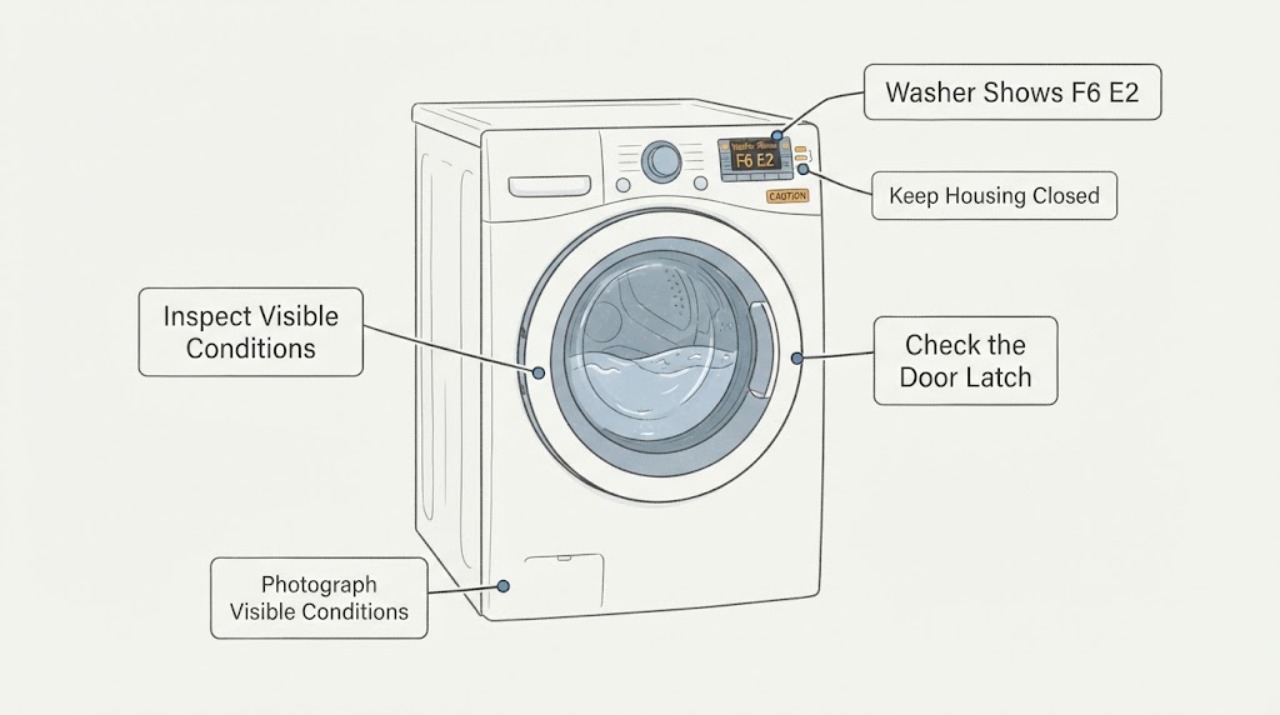
On an Amana NFW5800HW front-load washer, do not force the door when it remains locked after an F6 E2 display. First record the exact characters, cycle stage, whether water is visible, whether the door or glass is hot, and whether the drum is still moving. Amana's door guidance says a front-load door can stay locked while water level or temperature is high or while the washer is tumbling or spinning, and it may take several minutes to stop before unlocking. Amana's specific F6 E2 page gives one user reset: disconnect power for five minutes, then reconnect it. If your earlier unplugging was shorter than five minutes, complete that reset only once when there is no water, heat, motion, leak, smoke, or electrical hazard; do not keep power-cycling. F6 E2 is not the same as F5 E2, which Amana lists as a door-not-locking code, and the F6 E2 page does not identify a failed lock, pump, or control component. If water remains, the washer is hot or moving, the code persists after the documented reset, or the door still will not unlock once the safe conditions have cleared, leave it out of service and arrange qualified appliance service.
Before you begin
Safety first
- Owner checks are limited to reading the exact model and display, observing water/heat/motion and visible hazards from outside, waiting for the documented stop state, and performing the one five-minute F6 E2 power reset when safe. Do not pry the door, bypass the interlock, remove panels, reach into the pump or lock area, enter service mode, test live wiring, or select a part from the code alone.
Work through in order
Diagnostic checks
Use only checks that match the exact appliance or system and its official guide.
-
Check 1
Stop interacting with the controls and observe the washer from a dry position. Record whether the drum is moving, whether the door glass or nearby water appears hot, whether water is visible in the drum, whether the control responds, and whether there is a leak, smoke, burning smell, sparking, or a damaged cord.
Expected result: The drum is moving, the glass or water is hot, water is standing in the drum, the controls are unresponsive, or a leak, smoke, burning smell, spark, or cord damage is present; alternatively, the drum is stopped and the washer is cool and dry.
Next step: Do not pull the door, reach into the drum, or bypass the lock. Keep clear of smoke, sparks, or hot/damaged electrical areas; if water is leaking and it is safe to do so, close the household water valves. Arrange qualified service for retained water, a persistent lock, or any safety symptom.
Stop if: Never force the door while the drum is moving, the glass is hot, water is present, or the appliance has a leak, smoke, burning odor, sparking, or electrical damage.
Why this matters
Why: Motion, high temperature, or retained water can be a protective reason for keeping a front-load door locked. A leak or electrical/fire symptom makes continued operation unsafe. A stopped, cool, dry washer is the only state in which the low-risk documentation step can be considered.
-
Check 2
Photograph the display before clearing anything and copy the characters exactly as shown, including spacing or a possible 5-versus-6 distinction. Note the selected cycle, load, and whether F6 E2 appeared during filling, washing, tumbling, draining, spinning, or at startup; keep the complete NFW5800HW model label for service.
Expected result: The display is exactly F6 E2, it is actually F5 E2 or another code, or the characters are unclear and the cycle stage is unknown.
Next step: Use the exact NFW5800HW manual/Product Help entry for the recorded code. If the display cannot be identified, preserve the photo and do not choose a lock, pump, or control part from an approximate code.
Stop if: Do not repeatedly clear the display before recording it, enter service mode, or apply a code-clearing sequence taken from another Amana platform.
Why this matters
Why: Amana's code meanings are model- and code-specific. F5 E2 is listed as a door-not-locking code, whereas the F6 E2 page supplies a reset path without naming a failed component. A similar-looking code cannot safely inherit the other code's diagnosis or steps.
-
Check 3
If the washer is stopped, cool, dry, and there is no visible hazard, wait for the documented stop/drain period and use only the normal owner control described for the exact model, such as the manual's pause/cancel instruction. Do not pry the door or use a cord, tool, hidden release, or substitute method to defeat the latch.
Expected result: The door unlocks after the drum stops and the safe conditions clear; the door remains locked despite a stopped, cool, empty-looking washer; or water, heat, or motion returns.
Next step: If the door opens safely and F6 E2 has cleared, do not assume the underlying issue is repaired; monitor only as directed by the manual and stop for a repeat. If the door stays locked or a hazardous condition returns, leave the washer disconnected and arrange service.
Stop if: Do not open the door against resistance, reach through a gap, remove panels, or bypass the door interlock.
Why this matters
Why: A door that releases after the protective conditions clear is consistent with normal safety interlock behavior. A lock that remains after those conditions are gone is not proof of a particular part failure, but it does require model-specific service diagnosis.
-
Check 4
Apply Amana's F6 E2 reset only once if the earlier unplugging lasted less than five minutes and the washer is cool, stopped, dry, and free of electrical or water hazards: disconnect the washer from power for five minutes, then reconnect it. If the prior disconnect already lasted at least five minutes, do not repeat it just to make the door release.
Expected result: The F6 E2 display clears and the door releases after the documented reset; the code or lock remains; or the appliance immediately shows a different code or unsafe symptom.
Next step: If the lock or F6 E2 persists after the one documented reset, stop and arrange qualified Amana/appliance service. If it clears, do not run repeated confirmation cycles; use the washer only when it is dry, stable, cool, and code-free, and stop immediately for recurrence.
Stop if: Do not keep unplugging and reconnecting, operate with a leak or burning odor, or open the cabinet to inspect a lock, pump, wiring, or control.
Why this matters
Why: The five-minute disconnect is Amana's documented consumer action for F6 E2, not a component diagnosis. Clearing the code once is evidence of a changed control state only; it does not establish that a recurring lock, drain, temperature, or wiring problem is gone.
-
Check 5
Prepare a service handoff without disassembling the washer: provide the NFW5800HW model label, the display photograph, cycle and load, whether water was present, the door/glass temperature, whether the drum was moving, how long the power was disconnected, and what happened afterward.
Expected result: The lock or code persists, water cannot be safely cleared, the washer is unresponsive, or the symptom repeats at the same cycle stage; alternatively, the display clears once and the washer remains normal.
Next step: Keep the washer out of service for a persistent lock, retained water, repeat code, or any safety warning. Ask qualified service to verify the exact model, door-lock state, water/drain condition, and controls before authorizing a component; do not attempt internal diagnosis.
Stop if: Do not run a service diagnostic sequence, test live wiring, remove the front panel, or order a replacement part based only on F6 E2.
Why this matters
Why: A persistent or recurring F6 E2/no-unlock event needs a technician to determine the actual cause; the public F6 E2 page does not justify naming a lock, pump, or control part from the code alone. A complete state and timing record is more useful than a guessed part number.
Use your observations
Decision map
Find the observation that best matches what you see, then follow the next safe action.
-
PATH 01Next step
What you see
The door is locked while water is visible, the glass or water is hot, or the drum is tumbling, spinning, or still draining.
Do this next
Keep hands and tools away from the door, wait for the documented stop/cool/drain period, and escalate if the condition does not clear safely. Do not force or bypass the lock.
Why this path and its safety boundary
Why it matters: Amana documents these as conditions that can delay front-load door unlocking; this observation does not prove a broken latch.
-
PATH 02Next step
What you see
The display is F5 E2 rather than F6 E2, or the characters cannot be distinguished reliably.
Do this next
Preserve a photo, confirm the complete model, and follow the exact code entry for that model. If the code remains unclear, request qualified service rather than trying multiple code sequences.
Why this path and its safety boundary
Why it matters: Amana lists F5 E2 as a door-not-locking code; F6 E2 has a separate Product Help entry and should not inherit F5 E2's meaning or a guessed lock-part diagnosis.
-
PATH 03Next step
What you see
The washer was stopped, cool, dry, and free of visible hazards, and the prior power disconnect was shorter than five minutes.
Do this next
Disconnect power for five minutes, reconnect once, and observe without forcing the door. If the display or lock persists, stop and arrange service; do not repeat the cycle.
Why this path and its safety boundary
Why it matters: The prior action did not complete Amana's one documented F6 E2 reset duration; completing five minutes once is the limited user-level reset supported by the specific page.
-
PATH 04Next step
What you see
F6 E2 or the locked door persists after the documented reset, with no remaining water, heat, or motion, or the same event returns during a later cycle.
Do this next
Leave the washer out of service and arrange qualified Amana/appliance service with the model, code photo, cycle stage, water/heat/motion observations, and reset duration. Do not force the release or open the cabinet.
Why this path and its safety boundary
Why it matters: The issue is not resolved by the only documented consumer reset. The available Amana F6 E2 page does not identify a component, so a lock, drain, control, wiring, or another cause cannot be selected safely from the outside.
-
PATH 05Next step
What you see
There is standing water or a leak, smoke, burning odor, sparking, a hot/damaged cord, repeated breaker operation, or the drum remains active while the door is locked.
Do this next
Keep clear and stop using the washer. If safe from a dry position, close the water valves and isolate power without touching damaged parts; use appropriate emergency or electrical help for smoke, fire, or immediate electrical danger, and qualified appliance service for the washer.
Why this path and its safety boundary
Why it matters: This is a water, mechanical, electrical, or fire-safety stop condition, not a normal code-clearing branch.
Helpful context
Understand the symptom
The assigned appliance is the Amana NFW5800HW, a 4.3-cu.-ft. front-load washer. The exact display matters: Amana's front-load table lists F5 E2 for a door that is not locking properly, while the separate F6 E2 help page gives a reset instruction but does not say that a particular lock, pump, or control board has failed. Do not convert F6 E2 into F5 E2 or into a parts diagnosis.
A locked door during or just after a cycle can be a protective state. Amana says the door may not unlock immediately when the water level or temperature is high or the washer is tumbling or spinning; the washer may need up to several minutes to stop spinning or draining. The safe path is to observe from outside, let the hazardous state clear, use only the model-directed reset once, and escalate a persistent lock rather than prying the door or bypassing the interlock.
When checks do not resolve it
Need a professional?
Request qualified service for a persistent or recurring F6 E2/no-unlock event, retained water, an unresponsive control, a door that remains locked after safe conditions clear, or any diagnosis requiring access to the lock, drain system, wiring, motor, or control. Use emergency or qualified electrical help for smoke, fire, sparks, damaged power equipment, or repeated breaker trips.
Safety scope: Owner checks are limited to reading the exact model and display, observing water/heat/motion and visible hazards from outside, waiting for the documented stop state, and performing the one five-minute F6 E2 power reset when safe. Do not pry the door, bypass the interlock, remove panels, reach into the pump or lock area, enter service mode, test live wiring, or select a part from the code alone.
Have this ready
- Provide the exact Amana NFW5800HW model label, display photograph, selected cycle, load, time and stage of the code, whether water was visible, whether the door/glass was hot, whether the drum was moving, any leak or electrical warning, and the exact duration and result of the power disconnect.
Common questions
FAQ
Does F6 E2 prove that the Amana washer door lock has failed?
No. Amana's specific F6 E2 page documents a five-minute power disconnect and reconnect, but it does not name a failed component. A locked door can also be held while water level or temperature is high or the drum is tumbling or spinning. Do not order a lock from F6 E2 alone.
Is F6 E2 the same as F5 E2 on an Amana front-load washer?
No. Amana's front-load error table lists F5 E2 as the door-not-locking code. F6 E2 has its own Product Help entry and should be recorded exactly rather than treated as F5 E2 or another similar display.
I already unplugged the NFW5800HW. Should I keep trying?
No. If the earlier disconnect already lasted five minutes, repeating it is not the next supported step. If it was shorter, complete the documented five-minute disconnect once only when the washer is stopped, cool, dry, and free of electrical or water hazards. Persistent F6 E2 or a locked door needs qualified service.
Can I open the door with a tool or bypass the lock to remove clothes?
No. Do not pry the door, reach through a gap, remove panels, or defeat the interlock. Wait for motion, heat, and water hazards to clear; if the door remains locked or water is retained, keep the washer out of service and arrange qualified help.
Read the exact guide
Official sources
- 4.3 cu. ft. Front Load Washer with Large Capacity - NFW5800HWAmana · Directly confirms the assigned Amana NFW5800HW model and front-load product identity; it does not provide an F6 E2 component diagnosis.
- Amana Owner's ManualsAmana · Supports retrieving the exact NFW5800HW manual before applying any model-specific control instruction.
- F6 E2 - Front Load WasherAmana Product Help · Directly supports the F6 E2 consumer reset instruction; it does not define a failed component or authorize internal repair.
- Front Load Washer Door Will Not OpenAmana Product Help · Supports the state-first observation branch for the assigned front-load washer; it does not authorize bypassing the interlock or opening the cabinet.
- Error Codes in Front Load WashersAmana Product Help · Supports the distinction between F5 E2 and other front-load code entries; it is used to avoid transferring F5 E2's door-lock meaning to F6 E2.
- Amana NFW5800HW Dimension GuideAmana · Confirms the assigned model's electrical identity and supports keeping electrical work outside the owner troubleshooting boundary.
Community feedback
Share a repair observation
Share a plain-text repair observation. Accepted observations are published automatically; this page may take a moment to update.