
On this page
Start here
Quick answer
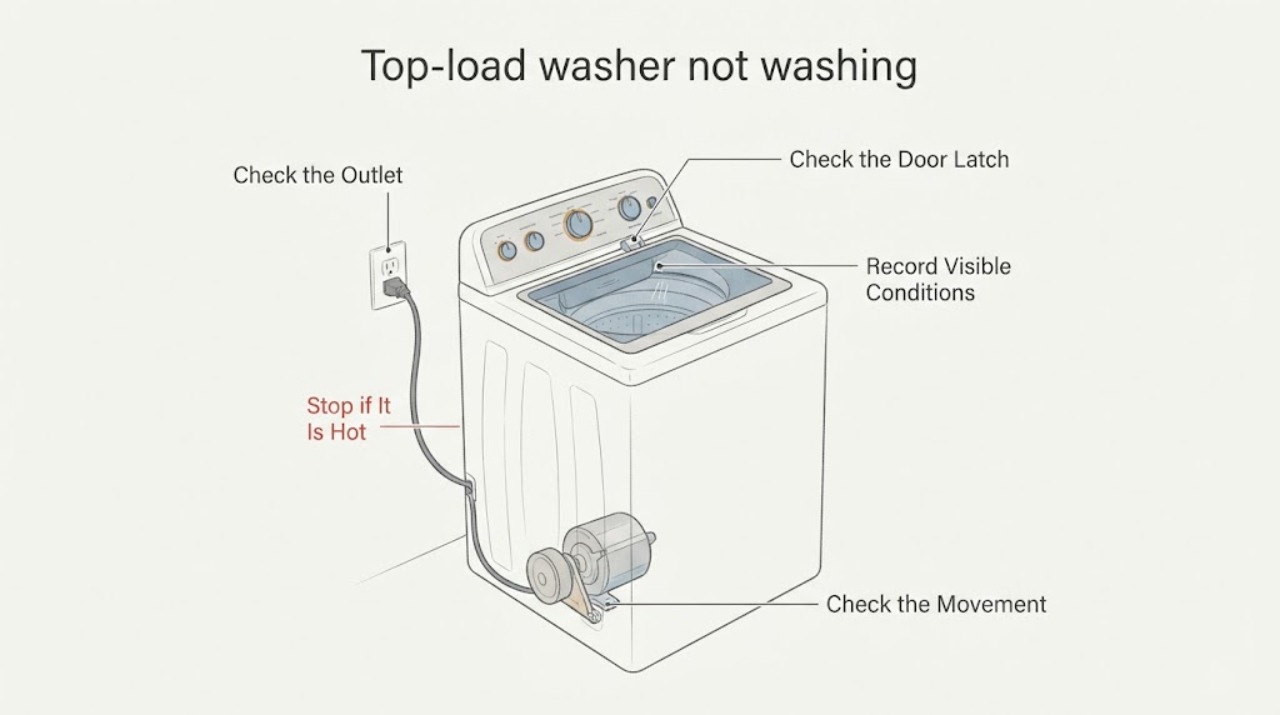
First decide what “not washing” means: the controls do not start, the lid does not lock, the washer does not fill, the basket or washplate does not move, or the clothes finish dirty. Amana's top-load guidance says a closed lid is required for many models to fill, wash, drain, rinse and spin, and the startup sensing sequence can include a click, a brief basket movement and pauses. A low-water high-efficiency cycle can also look inactive or leave part of the load above water; the washer senses the load and adds water for movement. Check power and Control Lock, lid closure, both water faucets and hose connections, the selected cycle, detergent and loose loading. If it still will not fill or move, an error returns, the lid will not lock, or there is a leak, smoke or burning odor, stop testing and arrange model-specific Amana service.
Work through in order
Diagnostic checks
Use only checks that match the exact appliance or system and its official guide.
-
Check 1
Identify whether the washer has no display or response, a flashing light/error, a locked or unlocked lid, water in the basket, basket/washplate movement, or dirty clothes after the cycle finishes. Record the exact model label before using model-specific instructions.
Expected result: The controls do not respond, the lid will not latch, the washer fills but does not move, or the cycle completes but cleaning is poor.
Next step: Use the matching check below and the exact owner's manual. If an error persists or the drum never moves, stop repeated cycles and request Amana service.
Why this matters
Why: These observations separate power/lock, fill, agitation and cleaning-performance paths. A symptom label alone does not identify a failed motor, actuator, belt or control.
-
Check 2
Check that the washer is plugged into a grounded three-prong outlet, the breaker or GFCI has not tripped, and Control Lock is not active. Do not use an extension cord or repeatedly reset a breaker that trips again.
Expected result: The display is restored or controls unlock, or power and controls remain normal but the wash action is absent.
Next step: Correct only the external power or lock condition. If the breaker trips again, call an electrician; if controls work but the washer still will not fill or move, continue with lid and water checks or service.
Why this matters
Why: Amana lists power connection, a tripped protective device and Control Lock as reasons controls may not respond. Normal controls do not prove the wash mechanism is operating.
-
Check 3
Close the lid fully and observe the start sequence without opening it during sensing. Check the latch area for clothing, packing material or detergent buildup; do not bypass or hold the lid-lock mechanism.
Expected result: The lid clicks and locks, the basket briefly turns and sensing continues, or the lid does not latch and the cycle will not advance.
Next step: Remove only a visible obstruction and clean the accessible contact area as the model instructions allow. If the lid still will not lock or the code returns, leave the washer unused and arrange service.
Why this matters
Why: Amana says the startup self-test can include a click and slight basket movement, while many models will not fill or wash with the lid open. A failed latch state blocks the cycle but does not name the defective lock part.
-
Check 4
Check that both hot and cold faucets are open, hoses are connected to the correct supplies, and accessible hoses are not kinked. Do not remove hose connections with water pressure on.
Expected result: The washer does not fill, fills slowly, hoses are reversed or kinked, or water supply appears normal while the cycle remains inactive.
Next step: Correct an obvious external connection or kink with the water turned off. If the washer still will not fill or a fill code appears, use the exact model support path rather than probing the valve.
Why this matters
Why: Amana says both supplies must flow to the inlet valve for proper operation; reversed or restricted hoses can affect washing and rinsing. Normal external supply does not prove the internal valve or screens are good.
-
Check 5
Verify the selected cycle matches the fabric and load, and note the water level after the sensing sequence. Do not add water just because the clothes are not fully submerged, and do not use a deep-fill cycle unless the exact model and load call for it.
Expected result: The washplate or agitator moves with a low-water cycle, or the clothes remain still because the cycle is wrong, the load is tightly packed or the washer never begins agitation.
Next step: Use the exact cycle guide and load loose heaps evenly around the washplate. If the basket never moves after a proper start and fill, stop and request service rather than forcing the mechanism.
Why this matters
Why: Amana says sensed low water can be normal and necessary for movement. It also says a low-water cycle can make clothes struggle to agitate if the cycle is wrong, while extra water can float clothes and reduce agitation.
-
Check 6
Use only HE detergent and measure it for the load size and soil level. Load clothes loosely and evenly; do not pack the basket or add detergent directly on top of the load unless the exact instructions allow it.
Expected result: The washer has excess suds, the load is tightly packed, or the load is loose with correct detergent but clothes remain dirty.
Next step: Correct the detergent/load setup for a later cycle and use the model-recommended cleaning cycle if buildup is suspected. If mechanical movement is absent or cleaning remains poor, arrange service.
Why this matters
Why: Amana says non-HE or excess detergent can create suds that reduce performance, and clothes must move freely for cleaning. Persistent poor cleaning with correct loading and detergent is not proof of an agitator or motor fault.
-
Check 7
After safe external checks, note whether the washer drains, spins and completes the cycle, and record any flashing lights or error code. Do not open the cabinet or bypass the lid lock to watch the mechanism.
Expected result: The cycle completes normally after correction, or a drain/spin failure, persistent code, leak, smoke, burning odor or no-motion condition remains.
Next step: Keep the washer off for a leak, smoke, burning odor or unsafe wiring. Give Amana service the model, code, phase and observations; do not continue repeated cycles.
Why this matters
Why: An incomplete cycle can be caused by lid, fill, drain, balance or control conditions. Amana's error guidance warns that codes vary by model and directs service when basic actions do not clear them.
Use your observations
Decision map
Find the observation that best matches what you see, then follow the next safe action.
-
PATH 01Next step
What you see
The display is blank or controls do not respond, or Control Lock is lit.
Do this next
Check the grounded connection and protective device once, unlock according to the model controls, and call an electrician if a breaker/GFCI trips again. Arrange Amana service if the controls remain dead.
Why this path and its safety boundary
Why it matters: The immediate path is external power or control lock, not an agitation diagnosis.
-
PATH 02Next step
What you see
The washer clicks and briefly moves during sensing, then fills with only part of the load submerged.
Do this next
Keep the lid closed and allow the selected cycle to proceed. Check cycle/load choice if cleaning is poor, but do not add unapproved water or restart sensing by opening the lid.
Why this path and its safety boundary
Why it matters: Amana describes that startup sensing and low-water operation as normal for many top-load HE models; incomplete submersion alone does not mean it is not washing.
-
PATH 03Next step
What you see
The washer has water and a closed lid but the washplate or agitator never moves, or the correct cycle still leaves clothes untouched.
Do this next
Stop the cycle and arrange model-specific service; do not bypass the lid lock or reach into the moving mechanism.
Why this path and its safety boundary
Why it matters: This is a repeatable no-agitation symptom beyond the documented sensing appearance. The available no-model sources cannot identify the failed drive or control part.
-
PATH 04Next step
What you see
The machine will not fill, shows a fill code, leaks, trips power, smokes, smells burnt or stops with a persistent error.
Do this next
Turn off water or power when safe, keep the washer out of service and provide the exact model and code to qualified Amana service. Do not repeat resets or open panels.
Why this path and its safety boundary
Why it matters: The symptom is a supply, electrical, safety or model-specific fault boundary rather than a generic “not washing” setting issue.
Helpful context
Understand the symptom
Define the failure before naming a part
“Not washing” can describe no power, an unlocked lid, no fill, no agitation, a cycle that pauses during sensing, or clothes that remain dirty after a completed cycle. Amana's product-help tree treats these as different concerns. The top-load washer may briefly click, move the basket and pause while sensing, and a low-water cycle may leave clothes partly above the water while still operating as designed. Record which event actually occurs before considering service.
Use external checks and keep the model boundary visible
Amana's public guidance supports checking power, Control Lock, lid closure, water supply, cycle selection, load distribution and HE detergent. It does not establish a universal agitator, washplate, motor or control-board diagnosis for an unidentified Amana washer. Use the exact owner's manual for cycle availability and any reset or access procedure.
When checks do not resolve it
Need a professional?
Arrange Amana service if the lid will not lock, the washer fills but never agitates, a fill/drain/error condition persists, the cycle will not complete, or there is a leak, smoke, burning odor or electrical fault.
Common questions
FAQ
Is it normal for an Amana top-load washer to show only a little water?
For many top-load HE models, yes. Amana says the washer senses load size and adds the amount of water needed for clothes to move, so the load may not be fully submerged. Use the correct cycle and do not add water unless the exact manual says to.
Why does the washer click and move briefly but then seem to stop?
Amana says the startup self-test can click, briefly turn the basket, and pause while sensing. Keep the lid closed during sensing. If the washer never proceeds to fill or wash, check the lid and water supply, then request service if it remains stuck.
Could detergent make the washer seem like it is not washing?
Yes. Amana says non-HE or excess detergent can create suds that reduce washer performance, while a tightly packed load cannot move freely. Use measured HE detergent and load clothes loosely; persistent no-motion needs service.
Read the exact guide
Official sources
- Not Draining - Washer - Product HelpAmana · Opened Amana support article; supports excess-suds, load-balance and wet-load interpretations without diagnosing a pump or motor.
- Error Codes in Top Load HE Washers - Product HelpAmana · Opened Amana error-code article; it explicitly says codes may vary by model and supports documenting codes and using the exact owner's manual/service path.
- Not Cleaning Clothing - Product HelpAmana · Opened Amana support article; supports water supply, cycle selection, HE detergent, load distribution and Clean Washer checks.
- Water Levels by Cycle - Washer - Product HelpAmana · Opened Amana support article; supports low-water sensing, partial submersion, cycle-specific water levels and model-dependent cycle availability.
- Top Load Washer - Product HelpAmana · Opened Amana's top-load support hub; it confirms the relevant operation, cycle, fill, agitation, draining, error and noise branches and directs users to model-specific manuals.
- Lid Not Latching - Washer - Product HelpAmana · Opened Amana support article; supports lid closure, startup self-test and sensing behavior, while noting model variation.
- No Power - Washer - Product HelpAmana · Opened Amana support article; supports grounded outlet, breaker/GFCI and Control Lock checks plus electrician/service boundary.
- Not Agitating - Washer - Product HelpAmana · Opened Amana support article; supports out-of-balance and cycle/water-level checks without identifying an internal part for an unmodeled washer.
Community feedback
Share a repair observation
Share a plain-text repair observation. Accepted observations are published automatically; this page may take a moment to update.