
On this page
Start here
Quick answer
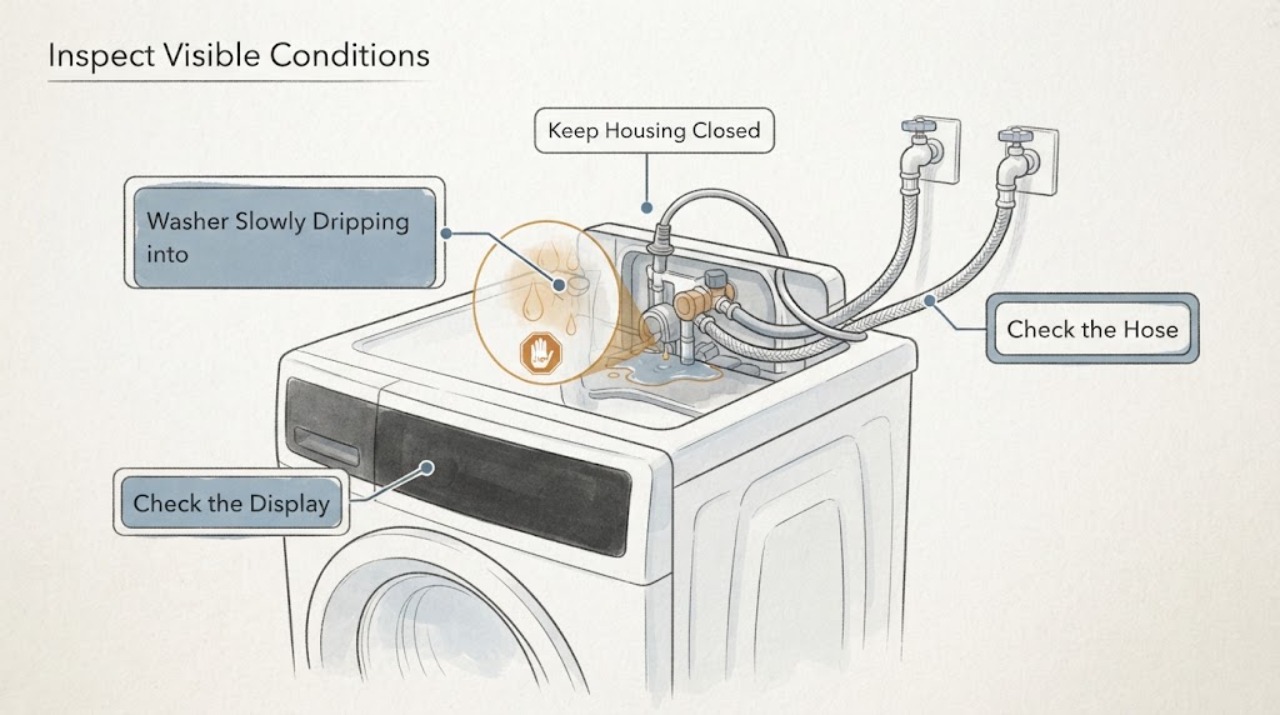
A small amount of water entering an Amana washer while it is switched off is not a normal wash-cycle fill to troubleshoot by starting another cycle. Close the household hot and cold washer valves, keep the washer unused while you arrange service, and check only for an obvious hose kink, loose connection or visible leak from outside. Amana's own guidance for water leaking inside the tub is to turn off the water valve while the washer is not being used and wait for service. During an active cycle, some Amana top-load models can pause and add water in stages, especially on Bulky, but that does not explain a steady drip while the washer is off. Do not guess an inlet-valve part or remove the console.
Work through in order
Diagnostic checks
Use only checks that match the exact appliance or system and its official guide.
-
Check 1
Check the control panel and cycle state without starting a new load: confirm the washer is powered off rather than paused, sensing, delayed or still completing a cycle.
Expected result: Water appears only during an active cycle or continues to enter while the controls are off and the washer is not being used.
Next step: If it is truly off, stop using the washer and close the household hot and cold supply valves before the next check.
Why this matters
Why: Staged filling or a Bulky-cycle pause can be normal during an active cycle; a continuing off-cycle drip is the separate leaking-inside-tub symptom covered by Amana's service guidance.
-
Check 2
Close both household water valves serving the washer, then observe the tub and the rear connections from outside for a short period without removing hoses.
Expected result: The drip stops after the supply valves are closed, or water continues / the source is not visible.
Next step: Leave the valves closed while the washer is unused and arrange Amana or qualified appliance service. Do not reopen the valves to repeat the test.
Why this matters
Why: Stopping after the supply is shut off confirms that household water is feeding the condition; it does not identify which internal or external component is responsible. Continued or unclear water needs prompt service and spill protection.
-
Check 3
Inspect the visible hot and cold hoses and faucet/washer connections for kinks, bulges, damp fittings or water tracking down the hose; do not loosen a pressurized connection.
Expected result: A hose is kinked or visibly leaking at a connection, or the hoses and connections are dry while water had entered the tub.
Next step: Keep the supply valves closed. Photograph the wet location for service; replace or reconnect a hose only when the water is off and the exact fitting procedure is known, otherwise arrange service.
Why this matters
Why: Amana identifies hose routing, supply and inlet-screen checks as external fill troubleshooting, while a dry exterior with tub filling leaves the source unresolved and should not be converted into a part diagnosis.
-
Check 4
If the washer had recently run, look for visible water at the drain hose or standpipe and confirm the drain hose has not been pushed too far down or sealed shut; do not move a wet machine by yourself.
Expected result: Water is returning or spilling from the drain path, or the tub is gaining water from the supply side while the drain path is dry.
Next step: Correct only a plainly visible routing issue according to the model installation instructions. For an off-cycle tub drip, keep the supply closed and request service.
Why this matters
Why: Incorrect drain-hose installation can cause siphoning or poor draining during operation, but it does not by itself prove why a switched-off tub is receiving a slow supply drip.
-
Check 5
Record when the drip occurs, the tub water level, whether it is hot or cold, the valve position, any panel lights or error messages, and the full model number before contacting service.
Expected result: The drip is repeatable with the washer off, or it occurs only during a particular active cycle or water-level stage.
Next step: Provide the observations and photos to Amana service. Do not open the control panel or order an inlet valve, pressure switch or control based only on the symptom.
Why this matters
Why: A repeatable off-cycle drip is the strongest reason to preserve the stopped-use/service boundary; an active-cycle-only fill pattern may be normal for that model or may need model-specific troubleshooting.
Use your observations
Decision map
Find the observation that best matches what you see, then follow the next safe action.
-
PATH 01Next step
What you see
Water appears only while an active cycle is sensing or filling, then stops when the cycle reaches its next stage.
Do this next
Use the correct cycle and exact model manual. If water enters while the washer is off, switch to the leak branch below.
Why this path and its safety boundary
Why it matters: This can be consistent with staged filling, including the pauses described for some Bulky cycles, rather than a stopped-washer leak.
-
PATH 02Next step
What you see
A slow drip continues into the tub after the washer is off and not being used.
Do this next
Close the washer's household water valves, leave them closed, protect the floor and arrange service. Do not diagnose or replace an internal part from the drip alone.
Why this path and its safety boundary
Why it matters: Amana treats water leaking inside the tub as a service condition and advises closing the water valve while the washer is unused.
-
PATH 03Next step
What you see
The visible leak is at a faucet, hose or rear connection and stops when the household valve is closed.
Do this next
Keep the water off, document the connection and arrange repair or service if the fitting, hose or washer inlet connection is damaged.
Why this path and its safety boundary
Why it matters: The external water supply connection is a plausible source, but the connection must be inspected without pressure and without assuming the washer itself is at fault.
-
PATH 04Next step
What you see
Water continues, the source is unclear, the floor is wet, or the washer shows electrical, overflow or repeated error symptoms.
Do this next
Stop using the washer, keep water off, disconnect power only when safe and accessible, protect the area and obtain qualified service promptly.
Why this path and its safety boundary
Why it matters: The situation has a flooding or electrical risk that cannot be safely narrowed by another cycle or by opening the cabinet.
Helpful context
Understand the symptom
Separate normal active filling from a stopped-washer drip
An Amana washer may add water in stages while it senses a load, and some Bulky cycles can pause during filling. A slow stream or drip that continues after the control is off is a different observation. First verify that the washer is truly not in a delayed, paused or still-running cycle; then treat water entering the tub while unused as a leak condition, not as a reason to keep starting cycles.
Protect the room before checking hoses
Close the household water valves for the washer before inspecting anything near the rear connections. Look from outside for a kinked hose, a loose connection, dampness at the faucet or washer fitting, or water coming from the drain path. Do not loosen a pressurized hose or open the cabinet to identify a component.
A persistent drip needs model-specific service
If the drip stops after the supply valves are closed, leave them closed while waiting for service. If water remains or the source is unclear, keep the area dry and arrange qualified help. The symptom alone does not prove a failed inlet valve, pressure switch, control or any particular replacement part.
Common questions
FAQ
Is a slow drip into the tub normal when an Amana washer is off?
No. Active cycles can fill in stages, but Amana treats water leaking inside the tub while the washer is not being used as a service condition and advises turning off the water valve while waiting for service.
Should I leave the washer's water valves open to see if the drip gets worse?
No. Close the household hot and cold valves and leave them closed while the washer is unused and waiting for service. Do not repeat the test by starting another cycle.
Could the drain hose cause water to appear in the tub?
Incorrect drain-hose installation can cause siphoning or poor draining during operation, so its visible routing is worth checking. It does not prove the cause of a steady supply drip into a switched-off tub.
Can I replace the water inlet valve myself?
The drip does not establish that the valve is the failed part, and no model was supplied for fitment or procedure. Keep the water off and arrange model-specific service rather than opening the cabinet or ordering a guessed part.
Read the exact guide
Official sources
- Wash Light On or FlashingAmana · Used for external checks when water is present while a wash cycle is not running: supply, inlet screens, leaks after hose work and drain-hose placement. It does not diagnose a fill valve or other internal component.
- Checking the Fill Hoses if the Washer is not FillingAmana · Used only for safe external hose and supply observations: shut off water before hose work, catch residual water, check kinks and inspect screens without disturbing them. It does not establish the cause or fit of an internal part for an unspecified model.
- Not Filling or Long Fill - WasherAmana · Used to distinguish active-cycle staged filling and Bulky-cycle pauses from an off-cycle drip, and for visible drain-hose routing checks. It does not authorize applying a cycle behavior to every Amana model.
- Leaking Inside the Tub - WasherAmana · Exact Amana support page for the assigned stopped-washer tub-drip symptom. It supports closing the water valve while the washer is unused and waiting for service; it does not identify an internal part or model-specific repair.
Community feedback
Share a repair observation
Share a plain-text repair observation. Accepted observations are published automatically; this page may take a moment to update.