
On this page
Start here
Quick answer
Stop a violent cycle and wait until the basket is still. Redistribute a tightly packed or single bulky load, then check that all four feet make firm contact and the washer does not rock. If the machine is newly installed or moved, use the model's installation instructions to confirm that shipping materials were removed. Also check externally for hoses or a drain pan rubbing the cabinet. If it still walks or vibrates with a correctly loaded, level washer, stop repeated runs and arrange appliance service.
Work through in order
Diagnostic checks
Use only checks that match the exact appliance or system and its official guide.
-
Check 1
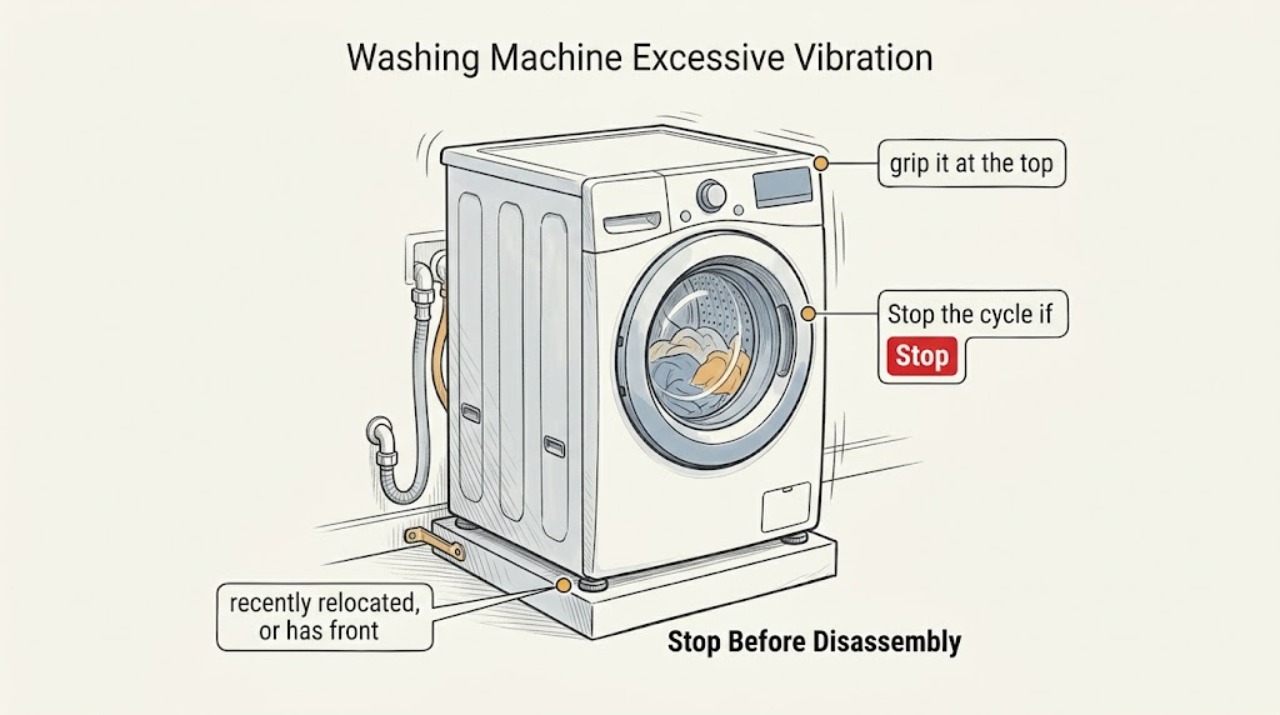
Stop the cycle if the washer is walking or shaking violently, wait for the basket to stop, then loosen and redistribute the clothing; remove an obviously excessive load and do not run one bulky item by itself.
Expected result: The load is tightly packed, contains one heavy or absorbent item, or is unevenly gathered on one side; after redistribution the basket spins more steadily or the vibration remains.
Next step: Run only a supervised normal test with a loose, balanced load after the basket is stable; stop again if the washer walks.
Stop if: Stop if the cabinet strikes nearby objects, the washer moves toward an edge, water leaks, or the cycle cannot safely be stopped.
Why this matters
Why: A load-dependent symptom indicates an out-of-balance condition; persistent vibration with a reasonable, evenly distributed load points toward installation, floor, or mechanical diagnosis.
-
Check 2
With the washer idle, grip it at the top and rock it gently front-to-back and side-to-side; verify that all four feet contact the floor and use the model's installation instructions to adjust them if it rocks.
Expected result: The washer rocks or a foot is not firmly planted, or it remains stable with all four feet in contact.
Next step: Level the appliance as directed for the model, then secure any foot lock or jam nut specified by those instructions and repeat the gentle stability check.
Stop if: Stop if moving or tipping the washer could strain hoses, power connections, a pedestal, or a drain pan.
Why this matters
Why: Rocking means the washer is not stabilized; a stable cabinet shifts attention to the load, floor, hoses, shipping hardware, or internal service condition.
-
Check 3
If the washer is new, recently relocated, or has front loading, compare the installation to the exact model instructions and confirm that required shipping materials were removed; do not remove an unidentified fastener by guesswork.
Expected result: The washer was recently installed or moved and shipping materials may remain, or the installation guide confirms they were removed.
Next step: Follow the model-specific removal procedure or ask the installer or a qualified technician to correct it, then recheck leveling before another test.
Stop if: Stop if removal requires opening panels, lifting the appliance unsafely, or disconnecting plumbing or electrical connections.
Why this matters
Why: Shipping hardware is intended to hold a front-load drum during transport and can cause excessive movement if left in place; an old, unchanged symptom is less likely to be explained by a recent installation oversight.
-
Check 4
With the washer idle, look for a flexing or uneven floor, a drain pan touching the tub area, inlet or drain hoses knocking the rear cabinet, or a pedestal that is loose; correct only an obvious external hose contact using the supplied restraint and the model instructions.
Expected result: The cabinet or pedestal contacts another surface, a hose taps the cabinet, the floor flexes, or the installation is clear and firm.
Next step: Remove the external contact or have the installation corrected, then run one supervised balanced test; arrange service if vibration persists.
Stop if: Stop if the floor is sagging, a pedestal is unstable, the drain pan is cracked, or correcting the condition requires structural work or appliance lifting.
Why this matters
Why: A contact or flexible support can create noise and amplify movement even when the wash load is balanced; a clear, rigid installation makes a persistent vibration more significant.
-
Check 5
Arrange qualified appliance service when the washer continues to shake or walk after a balanced load, correct leveling, confirmed shipping-material removal, and clear external contacts; provide the model, cycle, load, and checks already performed.
Expected result: The vibration is repeatable with an ordinary balanced load, or the washer shows rubbing, grinding, leakage, cabinet damage, or a new abnormal sound.
Next step: Keep the washer out of high-speed cycles until it is assessed and give the technician a short description or recording of when the movement starts.
Stop if: Stop operation if water reaches electrical parts, the cabinet is damaged, the machine moves toward an edge, or there is smoke or a burning smell.
Why this matters
Why: A repeatable symptom after external corrections needs model-specific inspection of the basket, suspension, drive, or installation rather than a guessed replacement part.
Use your observations
Decision map
Find the observation that best matches what you see, then follow the next safe action.
-
PATH 01Next step
What you see
Vibration occurs mainly during spin and is strongest with a single bulky item or a tightly packed load.
Do this next
Arrange qualified service and follow the exact model guidance.
Why this path and its safety boundary
Why it matters: Stop, redistribute the load loosely, avoid a single bulky item, and run one supervised balanced test.
-
PATH 02Next step
What you see
The washer rocks diagonally or one or more feet are not firmly on the floor.
Do this next
Arrange qualified service and follow the exact model guidance.
Why this path and its safety boundary
Why it matters: Level the washer and secure its feet as directed by the model installation instructions before testing again.
-
PATH 03Next step
What you see
The vibration began after installation or relocation of a front-load washer.
Do this next
Arrange qualified service and follow the exact model guidance.
Why this path and its safety boundary
Why it matters: Confirm shipping materials were removed using the exact installation instructions; do not run high-speed cycles until this is resolved.
-
PATH 04Next step
What you see
The machine is level but the floor flexes, the pedestal is loose, or the drain pan or cabinet makes contact.
Do this next
Arrange qualified service and follow the exact model guidance.
Why this path and its safety boundary
Why it matters: Correct the external installation condition according to the model instructions or have it assessed; structural or lifting work belongs to a qualified professional.
-
PATH 05Next step
What you see
An inlet or drain hose taps or rubs the rear cabinet during operation.
Do this next
Arrange qualified service and follow the exact model guidance.
Why this path and its safety boundary
Why it matters: Secure or reposition the hose only externally using the supplied restraint and keep it clear of kinks; escalate if the contact returns or a hose is damaged.
-
PATH 06Next step
What you see
The washer is correctly loaded and level, shipping materials are removed, and vibration persists or includes grinding, rubbing, leakage, or damage.
Do this next
Arrange qualified service and follow the exact model guidance.
Why this path and its safety boundary
Why it matters: Stop repeated testing and arrange qualified appliance service for model-specific diagnosis.
Helpful context
Understand the symptom
The cycle and load tell you where to start
Vibration that appears during spin, especially with one heavy or bulky item, points first to load distribution rather than a failed motor. Amana notes that an off-balance load can cause loud noise, shaking, reduced spin speed, longer cycles, and wet clothes. Stop a severe event, let the basket stop, and redistribute the load loosely before testing again.
Installation faults can look like an internal failure
A washer that rocks, has a foot off the floor, still has front-load shipping materials, or sits on a flexing surface can move even with an ordinary load. Check these conditions externally and follow the exact model's installation instructions. If correct loading and leveling do not change the symptom, professional diagnosis is the safe next step rather than repeated high-speed tests.
Safety boundary
Stop conditions
- The washer moves toward an edge, strikes nearby objects, or shakes violently enough to threaten people or property.
- Water leaks into or near electrical connections, the cabinet is damaged, or there is smoke or a burning smell.
- A floor, pedestal, drain pan, or hose condition cannot be corrected safely without lifting or dismantling the appliance.
- Vibration persists with a balanced load after leveling and installation checks.
- Diagnosis would require opening the cabinet or replacing internal suspension, basket, drive, or control components without model-specific instructions.
Only after diagnosis
Potential parts
Only if the model instructions and inspection show that a foot cannot maintain firm floor contact or its lock cannot secure the level position.
Only if an exposed inlet or drain hose is confirmed to be knocking against the cabinet and the model's supplied restraint is missing or damaged.
When checks do not resolve it
Need a professional?
The washer still vibrates or walks after load redistribution, leveling, and shipping-material checks., The movement is accompanied by grinding, rubbing, leakage, cabinet damage, or a new abnormal sound., The floor, pedestal, drain pan, or plumbing installation is unstable or requires lifting or structural correction., An internal basket, suspension, drive, or control fault is suspected., The washer is newly installed and the shipping-material status cannot be confirmed safely.
Common questions
FAQ
Why does my Amana washer vibrate only during spin?
Spin vibration commonly follows an uneven or oversized load, especially a single bulky item, but an unlevel washer can produce the same symptom. Redistribute the load, then check the four feet and floor stability.
How do I know if my Amana washer is level?
With the washer idle, rock it gently from the top in both directions. It should not rock, and all four feet should make firm contact; use the model installation instructions for adjustment and foot-lock details.
Could shipping bolts cause excessive vibration?
Yes, on a front-load washer shipping materials secure the drum during transport and must be removed after installation. Confirm the exact procedure in the model installation instructions rather than removing unidentified hardware.
When should I stop using the washer?
Stop if it walks violently, strikes objects, leaks, shows cabinet damage, or develops smoke or a burning smell. If ordinary external checks do not resolve repeatable vibration, arrange qualified service instead of continuing high-speed tests.
Read the exact guide
Official sources
- Washer is Vibrating, Walking or Moving - Product Help | AmanaAmana · Supports general Amana washer checks; exact adjustment steps remain model-specific.
- Vibration or Out of Balance loads - Product Help | AmanaAmana · Supports spin-cycle imbalance, loose loading, bulky-item, level, and four-foot checks for top-load models.
- Washer Walking and/or Vibrating - Front Load Washer - Product Help | AmanaAmana · Supports shipping-material, four-foot, leveling, load, bulky-item, pedestal, and service boundaries for front-load models.
- Troubleshooting Washer Noises | AmanaAmana · Supports external hose and drain-pan contact checks and the distinction between unbalanced, unlevel, and service-requiring noise; it is not a model-specific parts diagnosis.
Community feedback
Share a repair observation
Share a plain-text repair observation. Accepted observations are published automatically; this page may take a moment to update.