
On this page
Start here
Quick answer
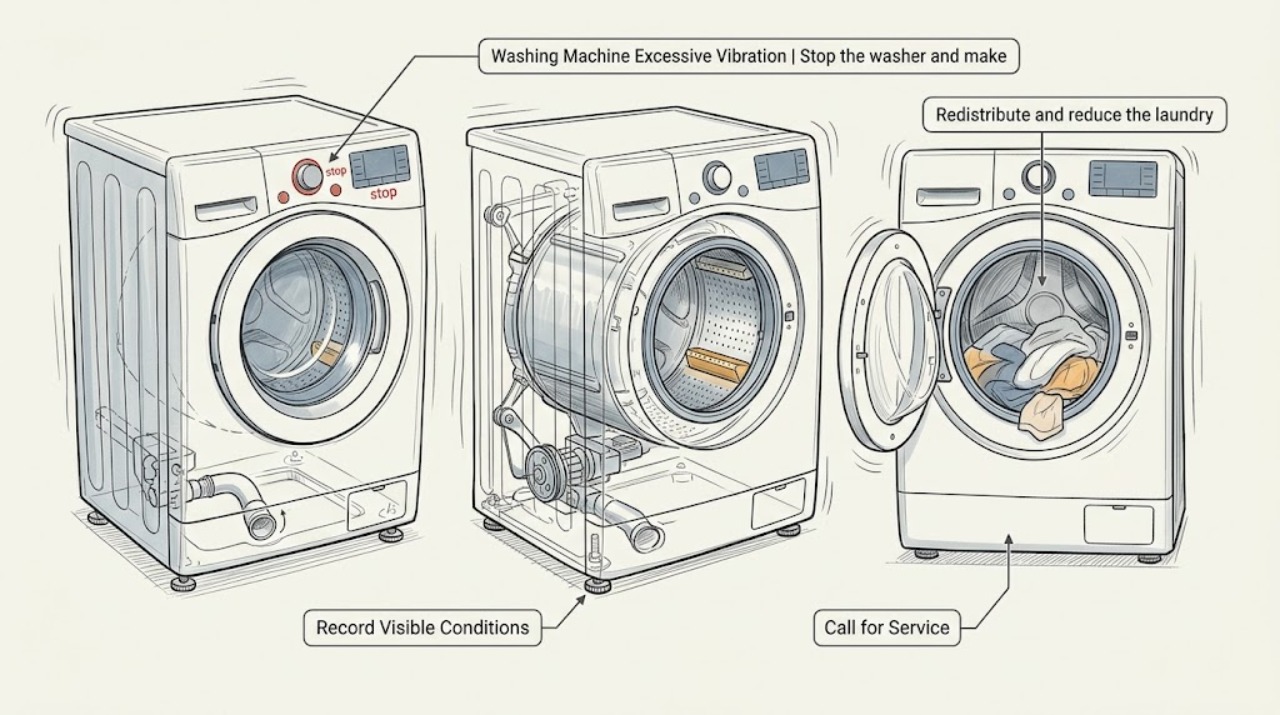
Pause the cycle and keep clear of a washer that is walking, striking its cabinet, leaking, or producing a burning smell. Once the drum has stopped and the floor is safe, identify whether the vibration occurs only during spin, rebalance and reduce the load, and check from the outside that the washer is level on a solid floor with all feet firmly down. A newly installed or recently moved machine also needs its transit-bolt status checked against the exact Bosch manual. If vibration persists after these external checks, or there is grinding, a damaged cord, repeated breaker tripping, or an error code, stop using the washer and arrange qualified service.
Work through in order
Diagnostic checks
Use only checks that match the exact appliance or system and its official guide.
-
Stop the washer and make the area safe
Press pause or cancel and wait until the drum has fully stopped. Keep people and pets clear, and do not put hands into the drum, restrain the cabinet, or pull the machine while it is moving. If the machine is walking, striking its cabinet, leaking, smoking, producing a burning smell, has a damaged cord, or repeatedly trips a breaker, isolate power only from a safe dry location and leave it out of service.
Expected result: The vibration is brief and the cabinet remains in place, or the washer moves, bangs, leaks, smells hot, exposes damaged wiring, or trips protection.
Next step: For any stop condition, do not restart to reproduce it; arrange qualified appliance service. If the washer is stable and dry after the drum stops, continue with external diagnosis.
Why this matters
Why: A brief balance correction can be investigated after stopping. Movement, impact, water near electricity, heat or odor, and repeated electrical protection trips are stop conditions rather than loading adjustments.
-
Record when and how the vibration starts
With the washer stopped, note whether the symptom occurs while filling, tumbling, draining, or accelerating into spin. Record whether it is a low hum, rhythmic thump, scraping or grinding sound, and whether the machine vibrates when empty or only with one type of load. Do not open the door or lean over the machine while the drum is rotating.
Expected result: The symptom occurs only at high spin speed, starts during ordinary tumbling, follows draining, appears with an empty drum, or is paired with grinding or scraping.
Next step: Use the timing to choose the load, installation, drain, or service branch. Do not remove panels or probe internal parts based on sound alone.
Why this matters
Why: Spin-only movement points first to load distribution, leveling, installation, or suspension; movement with an empty drum or a new grinding sound raises a mechanical concern. Drain-related symptoms can leave water in the drum and change the balance.
-
Redistribute and reduce the laundry load
After the drum is stopped and the door unlocks normally, spread the laundry around the drum. Combine appropriately sized items rather than washing one heavy blanket or a single dense item alone, and remove excess laundry if the drum is crowded. Close zippers and buttons on bulky covers as the model instructions require, then use a lower or appropriate spin setting for the fabric load.
Expected result: The washer becomes stable after the load is redistributed, or the same vibration returns with different loads and with an empty drum.
Next step: If redistribution resolves the symptom, use mixed, properly sized loads and do not exceed the manual's capacity. If it persists across loads, inspect the installation externally and plan service if that does not resolve it.
Why this matters
Why: A heavy item gathered on one side can create an imbalance; Bosch notes that the washer may reduce or skip spin and make repeated distribution attempts to protect itself. A repeatable empty-drum symptom is not explained by laundry placement.
-
Check the floor and leveling feet from the outside
Switch the washer off and disconnect power only from a safe dry location before inspecting it. From the outside, check that the washer sits on a firm, stable, reasonably level floor, that all feet contact the floor, and that the cabinet does not rock when gently tested without forcing it. Follow the exact manual to adjust the feet and tighten their lock nuts; do not move a heavy or stacked washer alone.
Expected result: The appliance rocks, one foot is visibly off the floor, the floor is soft or unstable, the lock nuts are loose, or the cabinet is stable and level.
Next step: Correct only the model-permitted external leveling adjustment and run a small supervised test with no one touching the machine. If it still vibrates or the floor cannot provide a stable base, stop and arrange service or an appropriate installation correction.
Why this matters
Why: An unstable installation can amplify normal spin forces and make the cabinet walk. A stable, correctly leveled exterior makes load, drain, suspension, or drive causes more likely.
-
Check for a recent installation or move
If the washer is new, was recently transported, or was relocated, compare its installation with the exact Bosch owner's manual. Bosch requires transport locks or bolts used for shipping to be removed before operation; do not guess their location, remove unknown fasteners, or dismantle a stacked installation. If the bolts may still be fitted, stop operating the washer until the manual-guided installation is corrected.
Expected result: Excessive vibration began immediately after installation or relocation, the transit-bolt status is unknown, or the machine had previously run quietly in the same location.
Next step: Use the model manual or a qualified installer to verify and correct the transit-bolt condition. Do not continue test cycles until an incorrect installation is resolved.
Why this matters
Why: Shipping restraints left in place can prevent the tub from moving as designed and cause severe movement. A symptom that starts without a move makes load, feet, drain, suspension, or drive causes more plausible.
-
Check for residual water and accessible drain clues
If clothes remain unusually wet, the washer stops before spin, or a drain-related message appears, switch the program off and disconnect power from a safe dry location. Once any water is cool enough to handle and the model manual permits it, inspect only the accessible drain hose, filter or pump area; protect the floor and use the manual's water-drain procedure. Never open a hot or pressurized filter path, put hands near a moving pump, or remove fixed covers.
Expected result: Water remains in the drum, the drain hose is kinked, a permitted accessible filter contains debris, or the washer drains normally but still vibrates.
Next step: Clear only an accessible obstruction as the exact manual allows and check for leaks before a cautious test. If water is hot, access is unsafe, the blockage is deep, or vibration remains, keep the washer out of service and call a technician.
Why this matters
Why: Bosch states that a blocked hose or pump can prevent draining, while an unbalanced load can reduce or skip spin and leave clothes wet. Normal draining with persistent movement points back to installation or mechanical causes.
-
Document the symptom and arrange service when external checks fail
Record the full model and serial information, load type and size, cycle stage, spin setting, error message, floor and foot condition, transit-bolt history, water left in the drum, and the sound or movement pattern. Do not open the cabinet, adjust suspension or drive parts, perform energized electrical measurements, or continue repeated high-speed tests.
Expected result: The washer vibrates with an empty drum, produces grinding or scraping, has a loose or damaged cabinet, leaks, repeatedly trips a breaker, or remains unstable after load and installation checks.
Next step: Keep the washer off and contact Bosch support or a qualified appliance technician with the recorded evidence. Follow the technician's instructions for safe access and do not bypass a safety or error condition.
Why this matters
Why: Persistent or empty-drum vibration can involve suspension, bearings, pulley, motor, drive, or control problems that require model-specific inspection. Repeated operation can increase damage or create a moving-machine hazard.
Use your observations
Decision map
Find the observation that best matches what you see, then follow the next safe action.
-
PATH 01Next step
What you see
The vibration is brief, occurs only with a particular load, and the cabinet does not walk or strike anything.
Do this next
Arrange qualified service and follow the exact model guidance.
Why this path and its safety boundary
Why it matters: If the washer remains stable with a balanced load, monitor future loads and follow the capacity and loading instructions in the exact manual.
-
PATH 02Next step
What you see
The machine was recently installed or moved, or it rocks, has a foot off the floor, or may still have shipping restraints.
Do this next
Arrange qualified service and follow the exact model guidance.
Why this path and its safety boundary
Why it matters: A corrected installation should be rechecked with a cautious load; persistent vibration after correction needs service.
-
PATH 03Next step
What you see
Water remains in the drum, clothes are soaking wet, or a drain fault accompanies the vibration.
Do this next
Arrange qualified service and follow the exact model guidance.
Why this path and its safety boundary
Why it matters: If the obstruction is safely cleared and the washer drains normally, reassess balance; an inaccessible blockage, leak, or recurring symptom needs service.
-
PATH 04Next step
What you see
The washer vibrates empty, walks severely, grinds, scrapes, leaks, smells hot, trips a breaker, or remains unstable after external checks.
Do this next
Arrange qualified service and follow the exact model guidance.
Why this path and its safety boundary
Why it matters: The washer remains out of service until suspension, drum, drive, control, electrical, or installation faults are assessed safely.
Helpful context
Understand the symptom
Separate a normal balance correction from a dangerous walk
A washer may pause or make a short adjustment while it distributes laundry before spin. Excessive vibration means the cabinet walks, bangs repeatedly, or transfers movement to the floor. Stop the cycle if the machine moves, the drum strikes the cabinet, a hose pulls tight, water appears, or an electrical or burning smell is present. Do not reach into a moving drum or open panels to diagnose the cause.
Use the exact model manual for installation details
Bosch washer designs differ by model and market. The manual controls the transit-bolt location, safe access to a drain filter, stacking configuration, and leveling procedure. External observations can narrow the cause, but they do not authorize removing covers, dismantling a stacked unit, or working on energized electrical parts.
When checks do not resolve it
Need a professional?
Request service for persistent or empty-drum vibration, suspected suspension or drive damage, inaccessible drain faults, incorrect installation that cannot be corrected safely, or any leak, odor, damaged cord, or repeated electrical trip.
Common questions
FAQ
Why does my Bosch washing machine vibrate only during spin?
Spin-only vibration most often starts with a load gathered on one side, an overloaded or single-heavy load, an unstable floor, or feet that are not level. Stop the drum, redistribute the load, then check the outside installation. If it still walks or vibrates empty, arrange service.
Can a Bosch washer be used if its transit bolts are still installed?
No. Bosch says transit bolts protect the washer during transport and must be removed before use. If the washer is new or was moved and the bolt status is unknown, keep it out of service and use the exact owner's manual or a qualified installer to verify the installation.
Should I hold a Bosch washer still when it starts shaking?
No. Pause or cancel the cycle and wait for the drum to stop; do not restrain a moving cabinet or reach into the drum. Walking, repeated impacts, leaks, hot or burning odor, a damaged cord, or breaker trips are reasons to keep it off and request service.
Can a blocked drain cause vibration or an interrupted spin?
A blocked hose or pump can prevent draining, while Bosch says a large load imbalance can reduce or skip spin and leave clothes wet. Power down safely and inspect only the accessible drain path permitted by the exact manual; stop if water is hot or access is unsafe.
Read the exact guide
Official sources
- Washing Machine Transit BoltsBosch Home Appliances · Bosch's official US transit-bolt guidance; it applies to new or transported Bosch washers and requires the exact owner's manual for removal instructions.
- 5050003581Bosch Home Appliances · Bosch installation documentation opened from Bosch's official document host; use only the model-matching leveling and installation instructions, not assumptions from another washer.
- Why are my Clothes Soaking Wet After Washing? How to ResolveBosch Home Appliances · Bosch's official US washer troubleshooting page; apply the drain, pump, imbalance, and hot-water precautions to the exact model's accessible features.
- Why is My Bosch Washing Machine Making Loud Noises?Bosch Home Appliances · Bosch's official US washer support page; use its load-balance, alignment, floor, leveling-foot, and escalation guidance for Bosch washers, while deferring to the exact model manual.
Community feedback
Share a repair observation
Share a plain-text repair observation. Accepted observations are published automatically; this page may take a moment to update.