
On this page
Start here
Quick answer
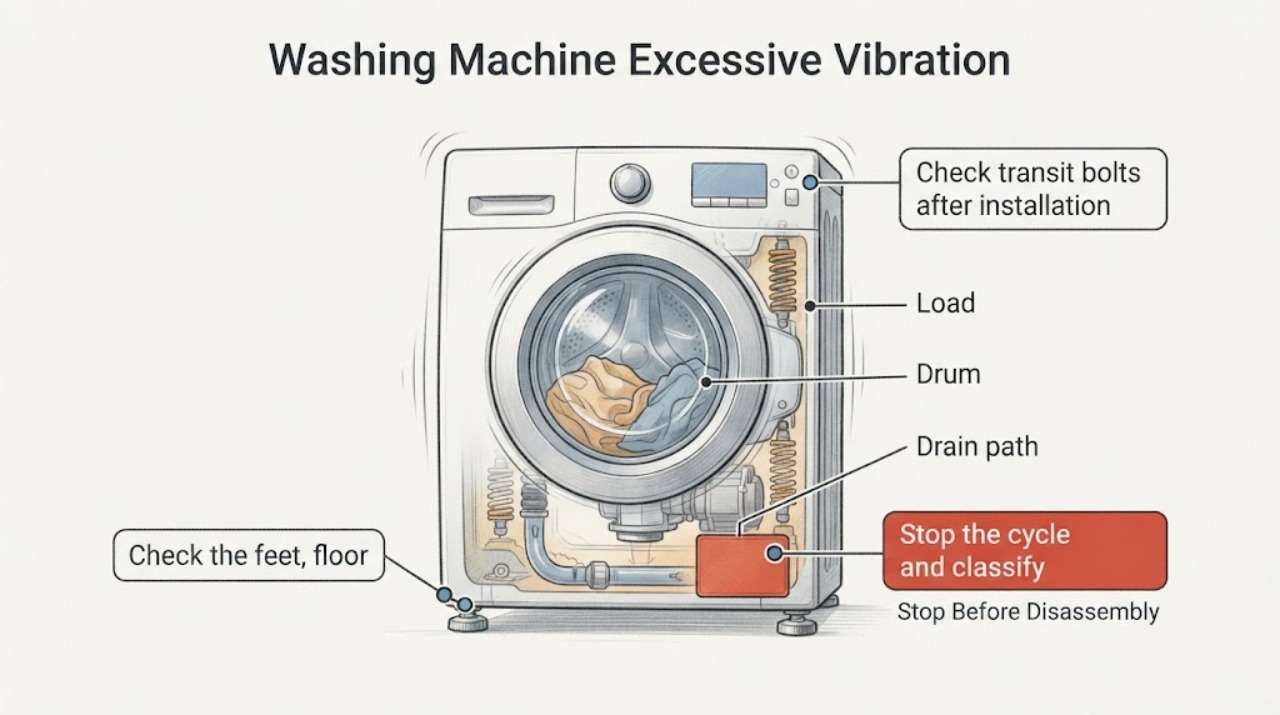
A Hoover washing machine that vibrates excessively during spin most often needs a load, installation, or floor check: a single bulky load can become unbalanced, all transit bolts must be removed after installation, and all feet must rest firmly on a stable level floor. The machine also needs clearance so its cabinet and plug are not touching surrounding objects, and a drain problem or foreign object can alter the spin. Stop immediately for violent walking, repeated banging, metal grinding, leaking water, a burning smell, smoke, sparks, overheating, or a breaker trip. Otherwise stop the programme, wait for the drum to stop, redistribute the load, and inspect only from safe access with power disconnected before any examination. If vibration returns with a balanced load and correct installation, keep the washer out of service and arrange qualified Hoover repair.
Work through in order
Diagnostic checks
Use only checks that match the exact appliance or system and its official guide.
-
Stop the cycle and classify the movement
Press Stop/Pause using the normal control and keep clear until the drum has fully stopped. From a safe position, record whether the machine only trembles at high spin, rocks in place, walks across the floor, repeatedly bangs, scrapes metal, or vibrates while empty; also note any water, smoke, odor, sparks, unusual heat, or breaker operation.
Expected result: The movement is violent or worsening, the machine walks or strikes nearby objects, a metal-on-metal sound is present, water is leaking, or there is smoke, burning odor, sparking, overheating, or a tripped breaker; or the washer simply makes a moderate spin movement with no hazard.
Next step: For violent movement or any leak, smoke, odor, sparks, overheating, or repeated trip, leave the washer unused and arrange qualified appliance or electrical service. Otherwise wait for the drum to stop completely before opening the door or checking the load.
Stop if: Do not hold the machine down, put hands near a moving drum, continue a banging cycle, or keep resetting a breaker.
Why this matters
Why: A violent movement or hazard can damage the washer, hoses, floor, or electrical system and is not a load-balancing experiment. Moderate movement without a hazard can be evaluated through the installation, load, and drain checks.
-
Check transit bolts after installation or a move
If the washer is new, was recently installed, or was moved, read the exact installation instructions and inspect the rear transport-restraint area only with the appliance switched off and disconnected from the mains. Use the manual to determine whether all required transit bolts, sleeves, rubber pieces, and blanking plugs are in their correct installation state; do not start the washer to test a suspected retained bolt.
Expected result: A transit bolt or packing piece remains installed, the installation state cannot be confirmed, the washer was moved without reinstalling restraints, or all restraints were removed as directed.
Next step: If a restraint remains or the rear cannot be inspected safely, keep the washer out of service and have the installer or qualified technician correct the installation. If all restraints are removed, continue to level and load checks without moving the heavy appliance unnecessarily.
Stop if: Do not move or tip the washer alone, work while it is plugged in, remove damaged restraints by force, or run it with transport hardware still fitted.
Why this matters
Why: Hoover says retained transit bolts clamp the suspension for transport and can cause excessive noise, movement, and possible damage during spin. An uncertain or damaged restraint installation is different from an ordinary unbalanced load.
-
Check the feet, floor, and surrounding clearance
With the programme stopped and power disconnected before any hands-on inspection, check from the front and sides that the washer sits on a stable, flat floor, all four feet contact the floor, the cabinet does not rock when observed from a safe stance, and no side or rear panel is pressed against a wall, cabinet, hose, or plug. Adjust feet only by the model's installation instructions and only when the appliance can be handled safely.
Expected result: The floor is uneven or soft, a foot is not firmly planted, a locknut is loose, the washer rocks when stationary, or a side, rear panel, hose, or plug is touching surrounding objects; or the installation is stable and clear.
Next step: Correct a safe, documented foot adjustment and clearance issue before another test, or have an installer correct an unstable floor or heavy appliance position. If the installation is stable, continue to the load and drain checks.
Stop if: Do not wedge the machine with improvised objects, drag it across the floor, lift it alone, kink hoses, or adjust feet while the washer is powered.
Why this matters
Why: Hoover's installation guidance links an unlevel appliance and unstable floor to vibration and noise, while its advice centre notes that contact with the cabinet or plug can amplify vibration. A stable, clear installation makes a load or mechanical cause more likely.
-
Redistribute a small or unbalanced load
After the drum stops and the door unlocks normally, separate clothing that has clumped together, loosen a single bulky item, and reload a moderate, evenly distributed load within the model's capacity. Avoid overloading, a lone heavy garment, or excess detergent; select a normal spin option and do not restart if any safety symptom from Action 1 remains.
Expected result: The load was a single bulky item, very small, overloaded, or visibly gathered on one side; the washer had excess foam or did not fully drain; or the load was reasonably distributed and the drum was empty of obvious water.
Next step: Run at most one supervised low-risk spin observation after correcting only the load, with people and objects clear of the machine. If the washer still moves, bangs, or produces an abnormal sound, stop and use the service branch.
Stop if: Do not reach into a moving drum, force the door, exceed the rated load, add weight to hold the machine down, or repeat high-speed tests after a failed rebalance.
Why this matters
Why: Hoover says its balance sensor can redistribute a load, reduce speed, or cancel spin to limit vibration, and its manuals identify excessive foam and incomplete drainage as reasons spin may be reduced or aborted. A balanced load that still causes severe vibration points away from clothing distribution.
-
Check visible foreign objects and drainage symptoms
With the washer off and disconnected, empty clothing pockets and inspect the visible drum, door glass, and gasket for coins, buttons, or other loose items. Check from ordinary access whether the drain hose is kinked or the household drain is backing up, and consult the exact manual before opening a filter; place no hand into a wet or inaccessible pump area.
Expected result: A loose object is visible, water remains in the drum, the drain hose is kinked or the household drain backs up, foam is excessive, or no visible object or drainage problem is present.
Next step: Remove only a loose visible item without tools, correct a safe hose-position problem, or have a plumber address a blocked household drain. If the filter or internal object cannot be reached through the model-approved procedure, arrange service rather than running a violent spin.
Stop if: Do not use sharp tools, dismantle the pump, open a filter while water can spill onto electrical parts, or reach under the appliance while it is connected.
Why this matters
Why: Hoover identifies foreign objects as a source of rattling or damage and incomplete drainage as a reason the machine may not spin normally. A clear visible drum and drain path do not rule out a suspension, bearing, or internal mechanical fault, but they remove two external causes.
-
Use one controlled observation, then escalate if vibration returns
Only when transit hardware, level/clearance, load, visible objects, drainage, and electrical safety are satisfactory, run one short normal spin observation while staying beside the machine without touching it. Watch for smooth acceleration, repeated balance attempts, reduced or canceled spin, walking, banging, rubbing, leakage, or abnormal odor.
Expected result: The washer spins smoothly and remains stable, or excessive vibration returns despite a balanced load and correct installation; an error appears; water does not drain; or any smoke, spark, burning smell, overheating, leak, or repeated trip occurs.
Next step: If vibration returns or any fault remains, cancel normally when safe, leave the washer unused, and arrange qualified Hoover repair. Provide the model, cycle, load, installation history, sound description, photos, and observations from each check.
Stop if: Stop immediately for violent movement, continuous impact, metal scraping, leaking water, smoke, burning odor, sparks, overheating, or breaker operation; do not run another spin test.
Why this matters
Why: A stable cycle after a load or installation correction supports that external cause. Recurring vibration with correct setup suggests suspension, bearing, drum, motor, or other mechanical trouble that requires diagnosis; a hazard ends testing immediately.
Use your observations
Decision map
Find the observation that best matches what you see, then follow the next safe action.
-
PATH 01Safety boundary
What you see
The washer walks, strikes objects, produces metal grinding, leaks, smokes, sparks, overheats, smells burnt, or trips the breaker.
Do this next
Stop the cycle, keep clear, and arrange qualified appliance service; use qualified electrical help when the supply or breaker is involved.
Why this path and its safety boundary
Why it matters: The movement or electrical/water symptom can cause injury or further damage and is not safe to diagnose by repeated operation.
Safety stop: Do not hold the machine, touch wet electrical parts, keep resetting the breaker, or restart it to reproduce the sound.
-
PATH 02Safety boundary
What you see
The machine is new or recently moved and one or more transit bolts, sleeves, or packing pieces remain installed or cannot be confirmed.
Do this next
Keep the washer out of service and have the installer or qualified technician verify and correct the transport-restraint installation before use.
Why this path and its safety boundary
Why it matters: The transport restraint can prevent normal suspension movement and cause severe vibration and damage during spin.
Safety stop: Do not run the washer, tip it alone, or force rear hardware while connected to power.
-
PATH 03Safety boundary
What you see
A foot is loose or off the floor, the washer rocks when stationary, the floor is unstable, or the cabinet, hose, or plug touches a nearby surface.
Do this next
Correct the documented leveling and safe clearance issue, or have the installer handle an unstable floor or heavy repositioning before testing again.
Why this path and its safety boundary
Why it matters: Installation stability or contact can amplify spin vibration independently of the laundry load.
Safety stop: Do not use improvised wedges, drag the appliance, kink hoses, or adjust feet while powered.
-
PATH 04Safety boundary
What you see
A bulky or small load clumps, the balance system repeatedly redistributes it, foam is excessive, or water remains because drainage is incomplete.
Do this next
Wait for the drum to stop, redistribute the load, correct only a safe visible drain-hose issue, and make one controlled observation.
Why this path and its safety boundary
Why it matters: The washer may reduce or cancel spin to protect the load and appliance, causing an unusual cycle or vibration pattern.
Safety stop: Stop for a blocked internal filter, recurring drain failure, violent movement, or any leak; do not repeat high-speed tests.
-
PATH 05Safety boundary
What you see
Transit restraints are removed, the washer is level and clear, the load and drainage are normal, but vibration, impact, or abnormal sound returns.
Do this next
Leave the washer out of service and arrange qualified Hoover repair with the model, video or sound description, cycle stage, and installation/load history.
Why this path and its safety boundary
Why it matters: An internal suspension, bearing, drum, motor, or other mechanical fault is possible and cannot be confirmed safely from the outside.
Safety stop: Do not remove panels, inspect moving parts while powered, or continue operating to see whether the fault worsens.
Helpful context
Understand the symptom
Separate ordinary spin movement from a safety problem
A high-speed spin can make more sound than washing, and Hoover's balance system may redistribute clothes, reduce spin speed, or cancel the spin when it detects an unbalanced load. That is different from a machine that walks across the floor, repeatedly slams the cabinet, scrapes metal, or vibrates with an empty drum. Stop the programme and observe the machine from a safe position before changing the load or installation.
Installation errors can produce severe vibration
A newly installed or recently moved washer deserves an installation check before repeated use. Hoover says transit bolts and their packing pieces must be removed before use, and its installation manual calls for all feet to be adjusted so the appliance is completely level on a stable, flat floor. Do not move a heavy machine alone or reach behind it while it is connected to power.
Drainage and foreign objects can change the spin result
A washer may reduce or abort spin when water has not drained, and a coin, button, or other loose item can rattle or damage the drum. Check only the visible and model-approved areas with the appliance stopped and isolated. A blocked filter, hose, or internal object that cannot be safely reached is a service issue, not a reason to run another high-speed test.
When checks do not resolve it
Need a professional?
Arrange qualified Hoover service when excessive vibration returns after the transit bolts, leveling, clearance, load, and drainage checks; when the washer vibrates with an empty or balanced drum; when it bangs, scrapes, walks, or leaves a fault; or when the suspected cause is inside the cabinet. Stop immediately for violent movement, continuous impact, metal friction, leaking water, smoke, burning odor, sparks, overheating, or a breaker trip. Do not run the washer with retained transport hardware or a damaged hose, plug, cabinet, or floor connection.
Common questions
FAQ
Why is my Hoover washing machine vibrating so much during spin?
Check for an unbalanced load, retained transit bolts, unlevel feet or floor, cabinet contact, incomplete drainage, or a foreign object. Stop for violent walking, banging, metal scraping, leaks, smoke, burning odor, sparks, overheating, or a breaker trip.
Can transit bolts cause excessive Hoover washer vibration?
Yes. Hoover says transport bolts left in place can cause excessive noise and movement and can damage the appliance. If the washer is new or recently moved, disconnect it and have the installation instructions or installer confirm that all required restraints were removed before use.
How do I know if the Hoover washer is unbalanced?
A single bulky item, a very small load, or clothing gathered on one side can make the balance system repeatedly redistribute the load, reduce spin speed, or cancel spin. Wait for the drum to stop, redistribute the load, and make no further test if the machine is walking or making an abnormal sound.
Can an unlevel floor make a Hoover washing machine move?
Yes. Hoover installation guidance calls for all feet to contact a stable, flat floor. Check the feet and surrounding clearance with power disconnected, and correct only the model-documented adjustment. Do not drag or lift a heavy washer alone.
When should I stop using a vibrating Hoover washer?
Stop when it walks, repeatedly bangs, scrapes metal, vibrates with a balanced or empty drum, leaks, smells burnt, smokes, sparks, overheats, or trips the breaker. Leave it unused and arrange qualified appliance or electrical service instead of repeating high-speed spin tests.
Read the exact guide
Official sources
- Have the transit bolts been removed?Hoover Advice Centre · Hoover washing-machine transit-bolt removal and excessive spin vibration guidance
- UMNEXI02Hoover · Hoover washing-machine anomaly guidance for drainage, unbalanced loads, detergent foam, transit hardware, foreign objects, and strong vibration
- 2-Installtion ENHoover · Hoover washing-machine installation, transport protection, leveling feet, stable floor, drain hose, and electrical connection guidance
- Noisy - Hoover Advice CentreHoover Advice Centre · Hoover washing-machine excessive noise, imbalance, transit bolts, leveling, clearance, and safe examination guidance
Community feedback
Share a repair observation
Share a plain-text repair observation. Accepted observations are published automatically; this page may take a moment to update.