
On this page
Start here
Quick answer
Start by deciding whether the problem is poor stain removal, detergent residue, dye transfer, or a machine that is not filling or moving the load normally. Amana's guidance points first to a correctly sized and sorted load that can move freely, the right cycle and fabric-safe temperature, and measured HE detergent. Confirm both water faucets are on and the hot and cold hoses are not reversed, then run the model's Clean Washer cycle if buildup or a changed water level is suspected. If a smaller correctly loaded test load with the proper detergent and cycle is still not cleaned, or the washer cannot fill, agitate/tumble, drain, or spin, stop treating it as a loading issue and arrange qualified appliance service.
Work through in order
Diagnostic checks
Use only checks that match the exact appliance or system and its official guide.
-
Check 1
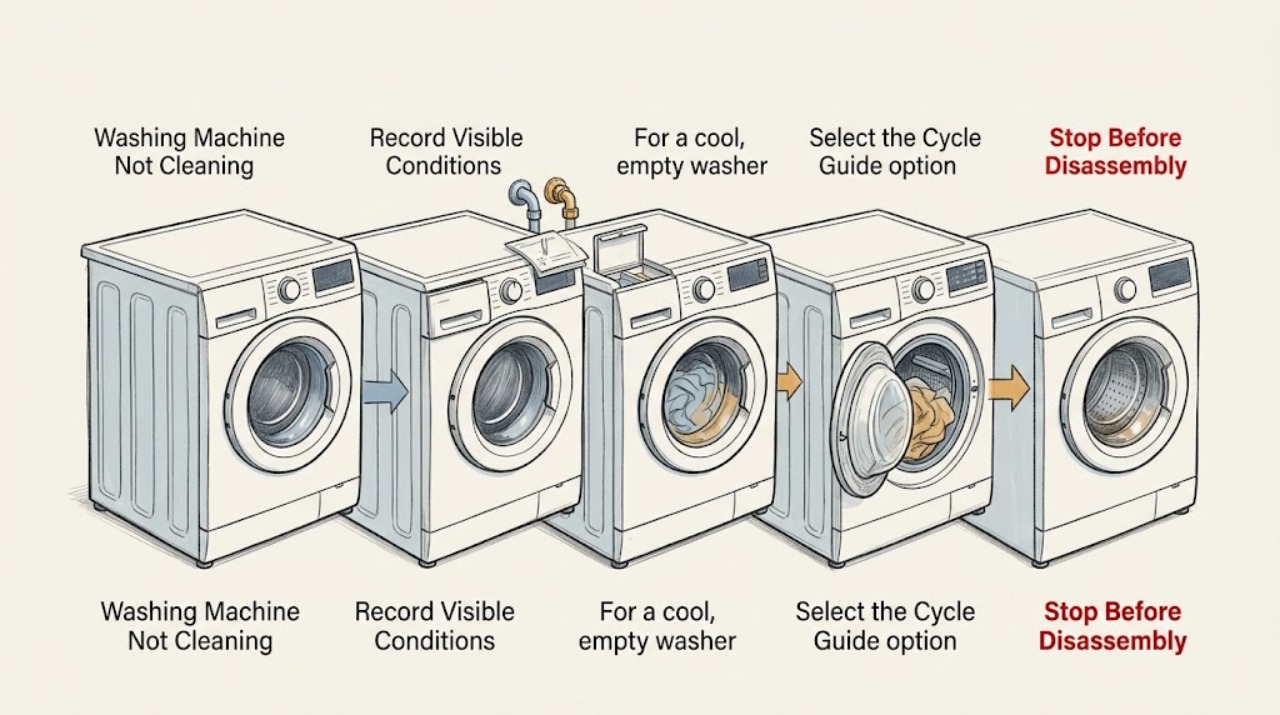
Inspect a representative load after the cycle and record whether the issue is visible soil or stains, white/dark detergent residue, dye transfer, odor, a wet load, or a cycle that never completes normally. Note whether all loads or only heavily soiled, bulky, or delicate loads are affected.
Expected result: The washer leaves soil, residue, discoloration, odor, excessive water, or a cycle/operation symptom.
Next step: Use the matching branch below and make one controlled test load after correcting the identified variable. Do not add more detergent or water at random.
Why this matters
Why: Soil removal points toward load, cycle, temperature, detergent, and water movement; residue points toward detergent amount/dissolution or dispenser use; wetness or incomplete operation can indicate fill, drain, suds, balance, or mechanical issues.
-
Check 2
For a cool, empty washer, make a smaller test load of similar, sorted fabrics. In a top-loader, place dry garments loosely and evenly around the washplate; in a front-loader, avoid tightly packing the drum. Do not add garments after the sensing/fill phase except as allowed by the model.
Expected result: The original load was tightly packed, unbalanced, mixed by color or fabric, or the smaller loose test load cleans better.
Next step: Continue with smaller, sorted loads and the model's recommended cycle. If the test load still does not move, fill, or clean normally, document the behavior for service rather than packing the washer tighter.
Why this matters
Why: Clothes need room to move so water and detergent can circulate. Overloading can reduce wash action and rinsing, while mixed colors can look dingy from dye transfer rather than soil.
-
Check 3
Select the Cycle Guide option that matches the fabric and soil level. Use the warmest wash temperature safe for the garment label when it is appropriate, and use a higher soil level or Extra Power option only if the model offers it and the fabric permits it.
Expected result: The load used a light/delicate cycle for heavy soil, an unsuitable temperature, or a cycle whose settings do not match the fabric; cleaning improves with a correctly matched cycle.
Next step: Keep the cycle matched to fabric and soil, following care labels. If correctly matched loads remain dirty while the machine otherwise runs, proceed to water and detergent checks, then service if the pattern persists.
Why this matters
Why: Amana describes each cycle as a combination of wash action, spin speed, and temperature, with soil level changing wash time. A cycle that protects delicate fabric may not provide the time or action needed for heavy soil.
-
Check 4
Check the accessible hot and cold faucets are fully open, the inlet hoses are connected to the matching hot and cold supplies, and the hoses are not kinked. Do not open the cabinet or remove the inlet valve; use the model installation instructions for any connection work.
Expected result: A faucet is closed, hot/cold hoses are reversed, a hose is kinked, an inlet screen may be blocked, or both supplies flow correctly but the washer still fills abnormally.
Next step: Correct only an obvious faucet or hose-position issue with the washer off and no leak. If fill remains abnormal, stop and arrange qualified service; do not probe the valve or alter plumbing.
Why this matters
Why: Incorrect temperature or insufficient fill changes detergent action, wash performance, and rinsing. A persistent fill problem after accessible checks can be an inlet valve, screen, pressure, or control fault.
-
Check 5
Use HE detergent when the model requires it and measure the amount for the load and detergent concentration. Load detergent, bleach, and fabric softener only into their model-designated dispensers or locations; never pour undiluted bleach or excess softener directly on garments.
Expected result: Non-HE detergent, excess detergent/suds, incorrect concentration setting, clogged/incorrect dispenser, or direct-to-clothing additives were used; residue or cleaning improves when the product and amount are corrected.
Next step: Run a correctly measured test load using the model's dispenser instructions. If excessive suds, residue, or dispenser failure continues, stop and arrange service rather than increasing dose or adding chemicals.
Why this matters
Why: Amana links excess suds to reduced spin and poor cleaning/rinsing, and links incorrect additive use to staining, graying, or fabric damage. A residue pattern is not evidence that the washer needs more detergent.
-
Check 6
If the washer has buildup, odor, a changed water level, or repeated residue, run the model's Clean Washer cycle empty with only the approved washer-cleaning product and procedure. Do not put clothes in this maintenance cycle.
Expected result: The washer has visible or reported buildup, the water level seems different from when new, or a Clean Washer cycle improves the next controlled load.
Next step: Repeat maintenance at the model-recommended interval and keep measuring detergent. If the washer still leaves soil or residue after maintenance and correct loading, proceed to service rather than running unlimited cycles.
Why this matters
Why: Amana says buildup from detergent and softener can affect performance and that the Clean Washer cycle can recalibrate factory-set water levels on applicable top-load models.
-
Check 7
Stop user troubleshooting when the washer cannot fill, agitate/tumble, drain, or spin normally; repeatedly shows a fault; leaks; trips power; produces grinding or burning odor; damages fabric; or fails to clean a smaller correctly loaded test load after water, cycle, and detergent checks.
Expected result: An operation, electrical, leak, mechanical, or persistent cleaning-performance fault remains.
Next step: Stop using the washer if there is a leak, burning odor, electrical hazard, or abnormal noise; otherwise arrange qualified appliance service. Provide model number, washer type, cycle, load size, detergent, water behavior, and the exact symptom.
Why this matters
Why: The cause may be an inlet valve, pump, drive or washplate/tumble system, pressure sensing, control, suspension, dispenser, or wiring issue that cannot be confirmed by changing detergent or load size.
Use your observations
Decision map
Find the observation that best matches what you see, then follow the next safe action.
-
PATH 01Next step
What you see
Clothes are dirty but the washer otherwise fills, moves, drains, and spins normally
Do this next
Reduce and sort the load, match cycle/soil level and fabric-safe temperature, and use measured HE detergent. Compare one controlled test load before considering a part fault.
-
PATH 02Next step
What you see
White or gray residue, excess suds, or poor rinsing appears on clothing
Do this next
Reduce detergent to the manufacturer's measured dose, use the required HE product, check concentration and dispenser placement, and reduce load size. Run an extra rinse only if the model permits it and the residue persists.
-
PATH 03Next step
What you see
A top-load washer leaves stains and the wash load barely moves
Do this next
Load dry garments in loose heaps evenly around the washplate and avoid adding water to force coverage. Amana says a partially uncovered load can be normal and that added water can reduce cleaning effectiveness.
-
PATH 04Next step
What you see
A front-load washer leaves stains or does not clean a tightly packed drum
Do this next
Use a smaller, loosely arranged load and the cycle/soil setting appropriate to the fabric. Use the model's Extra Power option only when available and suitable; persistent failure with a correctly loaded test load needs service.
-
PATH 05Next step
What you see
Wash or rinse temperature is wrong, fill is slow, or hot and cold hoses may be reversed
Do this next
With the washer off, confirm both faucets are open, hoses match their supplies, and no hose is kinked. If water flow or temperature remains abnormal, arrange qualified service rather than opening the inlet valve.
-
PATH 06Next step
What you see
The washer has buildup, odor, a changed water level, or repeated detergent residue
Do this next
Run the model-approved empty Clean Washer cycle and maintain the washer at the recommended interval. If a correct maintenance cycle and controlled load do not improve cleaning, use service.
-
PATH 07Next step
What you see
The washer will not fill, agitate/tumble, drain, or spin, or it leaks or smells electrically hot
Do this next
Stop using it and arrange qualified appliance service. Do not remove panels, bypass a lid/door lock, or repeatedly reset a breaker to continue washing.
Helpful context
Understand the symptom
Define what “not cleaning” looks like
A washer can leave true soil behind, redeposit detergent, transfer dye, or finish with wet clothes that only appear unclean. Separate the symptom before changing settings: compare the same type of garment, note residue or odor, and record whether the machine fills, tumbles or agitates, drains, and spins normally. That distinction prevents a detergent or load problem from being confused with a mechanical fault.
Top-load and front-load advice is not identical
Amana's top-load guidance says garments should be loaded in loose heaps around the washplate and should be able to move. Its front-load guidance likewise warns against tightly packing the drum and notes that cycle modifiers such as soil level, temperature, and optional extra power vary by model. Use the exact Cycle Guide and garment-care label instead of assuming that a low visible water level means the washer is malfunctioning.
More detergent is not more cleaning
Use only detergent labeled for the machine type and measure it according to the detergent directions, load size, soil level, and concentration. Amana says non-HE detergent or too much detergent can create excess suds, reduce spin performance, and cause poor cleaning or residue. Put products in the correct dispenser or location for the model rather than pouring them directly onto clothing.
Cleaning the washer is a maintenance step, not a parts diagnosis
Detergent, softener, and soil can build up inside the washer and redeposit on garments. Amana recommends a Clean Washer cycle for applicable models and describes it as both a cleaning and water-level recalibration step on its top-load guidance. Run only the cycle and cleaner procedure specified by the model manual; persistent poor results afterward need service.
Only after diagnosis
Potential parts
- water inlet valve or inlet screen
Consider only after qualified testing confirms abnormal fill, temperature, or flow and rules out closed faucets, reversed/kinked hoses, and household supply problems.
Valve and screen assemblies are exact-model and washer-type specific; they require safe water/electrical isolation and qualified installation. - detergent dispenser assembly
Consider only when a technician confirms a blocked, leaking, or failed dispenser after correct product placement and cleaning have been ruled out.
Dispenser layouts differ between front-load and top-load models and may require exact model fit. - washplate, agitator, or drum-drive component
Consider only when qualified testing shows insufficient wash movement or a drive fault with proper loading and cycle selection.
The correct assembly depends on washer type, model, revision, and drive design; do not infer fit from appearance. - water-level pressure sensor or control
Consider only after service diagnosis links incorrect fill level, repeated sensing behavior, or cycle interruption to the sensor/control circuit.
Sensor and control parts are model-specific and require qualified electrical diagnosis; recalibration is not proof of a failed part.
When checks do not resolve it
Need a professional?
Arrange qualified appliance service when a smaller, correctly loaded test load still is not clean after the cycle, water, detergent, and maintenance checks, or when the washer cannot fill, wash, drain, or spin normally. Stop immediately for a leak, burning or electrical odor, damaged cord, repeated breaker operation, severe vibration, or any need to bypass a lid/door lock or open the cabinet. Do not diagnose a pump, inlet valve, drive, pressure sensor, or control board by replacing parts without testing.
Common questions
FAQ
Why are my Amana washer clothes still dirty after washing?
Start with a smaller, sorted load that can move freely, the cycle and soil level suited to the fabric, the warmest safe temperature, and measured HE detergent. Confirm both water faucets and hose connections, then run the model's Clean Washer cycle if buildup or a changed water level is suspected. Persistent failure with normal wash movement needs service.
Can overloading make an Amana washer stop cleaning?
Yes. Amana says tightly packed clothing cannot move or rinse as effectively. Reduce the load and arrange items loosely—around the washplate in a top-loader or with space in the drum of a front-loader—then compare a controlled test load.
Why is my Amana washer leaving detergent on clothes?
Common supported causes include too much detergent, non-HE detergent where HE is required, incorrect concentration, cold water that does not dissolve some products well, a tightly packed load, or incorrect dispenser use. Measure the detergent, use the model's dispenser, reduce the load, and run a Clean Washer cycle when buildup is suspected.
Is it normal that a top-load Amana washer does not completely cover clothes with water?
Amana says the load may not be completely covered and that this can be normal and necessary for movement. Adding water can make cleaning less effective. If the washer's measured fill, movement, or cleaning remains abnormal with a correctly sized load, have it assessed.
Read the exact guide
Official sources
- Not Cleaning Clothing - Front Load WasherAmana Product Help · Official Amana front-load washer guidance; apply only the modifiers available on the exact model.
- Owner's ManualAmana · Official Amana owner's manual for a specific top-load platform; exact model manual controls any model-specific cycle or component detail.
- Preventing Detergent from Re-depositing on ClothingAmana Product Help · Official Amana washer tips; exact detergent and dispenser requirements remain model- and product-specific.
- Not Cleaning ClothingAmana Product Help · Official Amana top-load washer guidance; front-load controls and water behavior can differ, so use the exact model manual.
Community feedback
Share a repair observation
Share a plain-text repair observation. Accepted observations are published automatically; this page may take a moment to update.