
On this page
Start here
Quick answer
If an LG washing machine leaves clothes dirty, first decide whether the problem is poor clothing care or residue, odor, or buildup inside the machine. Check that the load is not too full and can move or become submerged, use a cycle and soil level suited to the fabric, and use the model-approved amount of HE detergent in the correct dispenser compartment. Clean a clogged dispenser and run Tub Clean only with an empty drum, the correct washer cleaner, and the exact model procedure. Check visible water and drain behavior without reaching into a wet or energized machine. Stop and arrange service for leaks near electrical parts, smoke, burning odor, repeated electrical trips, or a pump, valve, or control fault; never mix bleach and vinegar or combine cleaning chemicals.
Work through in order
Diagnostic checks
Use only checks that match the exact appliance or system and its official guide.
-
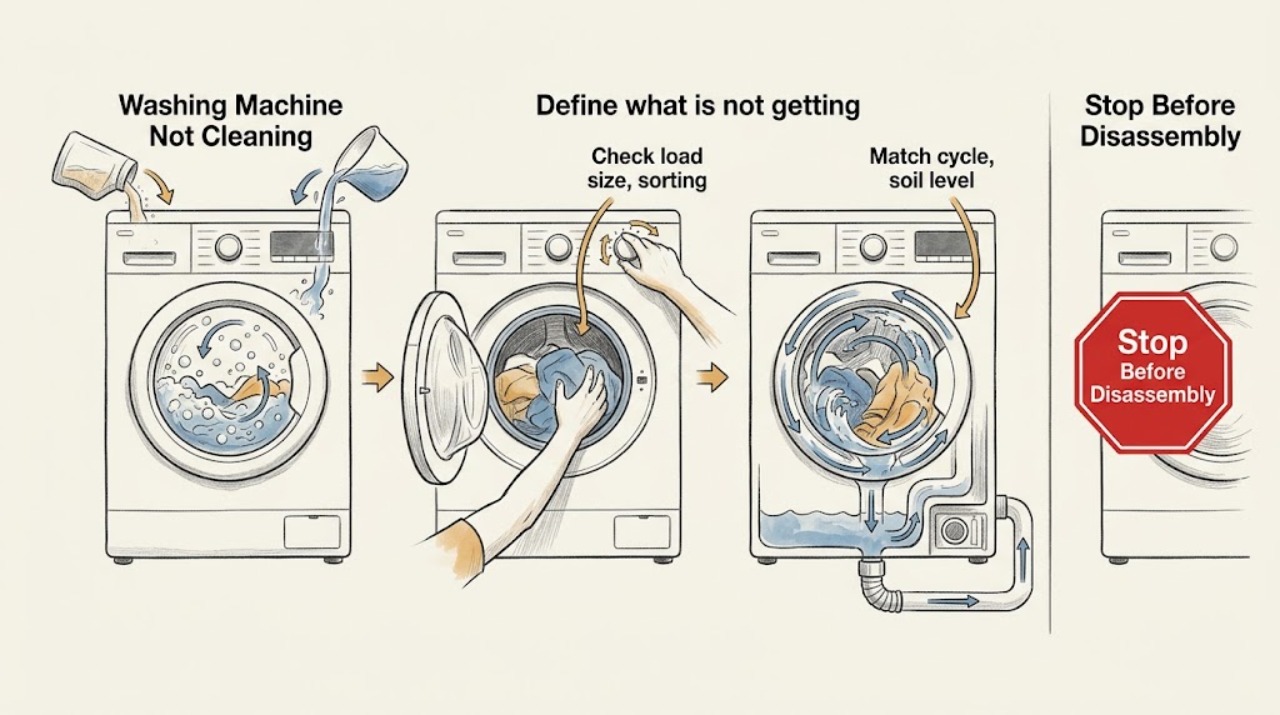
Define what is not getting clean
Inspect the finished load and the empty washer without starting another cycle. Record whether the issue is ground-in stains, general soil left behind, lint, detergent streaks, a musty odor, visible tub residue, or poor rinsing. Note whether the problem affects every load or only bulky items, cold washes, delicate cycles, or heavily soiled clothing.
Expected result: The clothing is dirty but free of residue, the clothing has detergent or lint residue, or the machine itself smells or shows buildup.
Next step: Use the matching load, detergent, dispenser, or Tub Clean branch below. If there is a leak, smoke, burning odor, electrical issue, or standing water near a connection, stop and use the safety branch instead of running another wash.
Why this matters
Why: Dirty clothing points first to load, cycle, water, and detergent interaction. Residue or odor points toward dispensing, dosage, water temperature, or tub maintenance. A single old stain may need pre-treatment and is not proof of washer failure.
-
Check load size, sorting, and movement
With the washer empty or not running, compare the load to the model guide. Separate heavy, lint-shedding, delicate, and heavily stained items as appropriate. For a top-load model, note whether bulky items can become submerged after filling; for a front-load model, leave room for the drum to tumble freely. Do not pack the drum tightly or add more items to an already full load.
Expected result: The load was tightly packed, bulky items floated above the water, mixed fabrics behaved differently, or the load had enough room and moved normally.
Next step: For the next safe wash, reduce or sort the load and choose a cycle that matches the fabric and soil. If properly sized loads remain dirty, continue to the cycle, detergent, water, and dispenser checks instead of adding more load or detergent.
Why this matters
Why: LG says an overloaded load may not wash properly, and clothing that is not fully submerged or cannot move freely can reduce washing performance. Heavy or set-in soil may need a more suitable cycle or pre-treatment rather than more detergent.
-
Match cycle, soil level, and water temperature
Record the cycle, soil level, wash temperature, options, and whether the load was delicate, bulky, or heavily soiled. Compare those choices with the garment care labels and the LG model guide. A short or gentle cycle may be appropriate for fabric protection but less thorough for heavy soil; use warm water only when allowed for the load and model.
Expected result: Speed Wash or Wool/Delicates was used for heavy soil, Normal was used for a demanding load, the soil level was low, or the water was unusually cold and detergent remained undissolved.
Next step: For a safe next wash, choose a suitable cycle and soil level and use the permitted temperature. If the same load remains dirty with an appropriate program, continue to detergent dispensing and water-flow checks; do not compensate by adding more detergent.
Why this matters
Why: LG explains that shorter or gentler cycles can clean less aggressively, while cold water can make detergent dissolve less completely. The correct adjustment depends on fabric and care instructions, not on selecting the hottest or longest setting for every load.
-
Verify HE detergent amount and compartment
With the washer off, check the detergent label and the model guide. Use HE detergent where LG requires it, measure the recommended amount, keep liquid below the dispenser MAX line, and place liquid or powder in the compartment designed for that form. Do not mix detergent types in one compartment or add more simply because clothes are dirty.
Expected result: The detergent was overfilled, non-HE, hardened, placed in the wrong compartment, or left behind in the tray; or the amount and compartment match the model guide.
Next step: Correct the amount and compartment for the next safe load. If detergent remains in the tray, proceed to the dispenser-cleaning action; if the washer also leaks or water does not enter the compartment correctly, keep it out of service and request diagnosis.
Why this matters
Why: LG links excess or unsuitable detergent and incorrect powder or liquid placement with poor dispensing, residue, overflow, and less effective washing. More detergent can leave more residue rather than improve soil removal.
-
Clean and reseat the dispenser
After turning the washer off and following the model guide, remove the detergent drawer or compartment only if it is designed for user removal. Rinse inserts with lukewarm water, brush away buildup, clean the accessible housing, wipe away moisture, and reinstall each insert in its correct position. Do not spray cleaner into the machine or force a stuck tray.
Expected result: Hardened detergent, residue, a blocked water entry, an incorrectly seated insert, or an overfilled compartment is found; or the dispenser is clean and correctly seated.
Next step: Keep the drawer clean and dry between washes and use the model-recommended dosage. If the dispenser still does not flush, leaks, or leaves detergent after a correctly loaded wash, stop using the washer and arrange service rather than forcing the water path.
Why this matters
Why: LG states that a clogged or incorrectly assembled dispenser can keep detergent from entering the tub and can cause residue or overflow. A clean tray with correct assembly makes a dispenser blockage less likely, but does not rule out an inlet or control problem.
-
Check visible fill and drain behavior
From a dry position, note whether the washer fills at the expected part of the cycle, whether the water level or flow appears abnormal, and whether water remains after drain. For a front-load model, do not open a drain filter with standing water unless the exact manual gives a safe procedure; never handle a wet plug or connection. Do not disconnect hoses while the machine is energized.
Expected result: The machine fills slowly or not at all, water leaks, the tub remains full, drainage is slow, or fill and drain behavior appears normal.
Next step: If water is leaking or near electrical parts, stop, keep power isolated, close accessible water valves from a dry position, and request service. If the tub remains full or flow is clearly abnormal, do not run another cycle; provide the timing and water state to a qualified technician.
Why this matters
Why: Insufficient water, a fill restriction, a leak, or incomplete drainage can reduce washing and rinsing even when the selected cycle is correct. The observation does not identify whether the cause is a valve, filter, hose, pump, pressure system, or control.
-
Use Tub Clean only for a machine-residue problem
If the empty washer has a musty odor, visible residue, or lint transfer, check that the model has Tub Clean and read its instructions. Empty the drum, use only the recommended washing-machine cleaner and dose, start the documented Tub Clean course, and ventilate the door and dispenser afterward. Do not add clothing, combine bleach with vinegar, use undiluted bleach when the guide prohibits it, or run a cleaning cycle when the washer leaks or has an electrical hazard.
Expected result: The Tub Clean course completes and residue or odor improves, the model lacks that course, the odor persists, or the cleaning cycle cannot complete.
Next step: Follow the exact model guide for recurring maintenance and leave the door or lid open to dry when appropriate. If residue, odor, leakage, abnormal noise, or an incomplete Tub Clean persists, request qualified service rather than adding stronger chemicals.
Why this matters
Why: LG describes Tub Clean as a way to remove detergent buildup and other residue, not as a substitute for correcting load, cycle, dosage, or water problems. A persistent odor or incomplete maintenance cycle can require service or a model-specific maintenance path.
-
Stop and arrange service when basic causes are excluded
Record the model number, front-load or top-load type, load and cycle, detergent and temperature choices, dispenser condition, fill and drain behavior, error code, and the exact symptom. Leave the washer out of service when properly sized loads, suitable settings, correct HE detergent, a clean dispenser, and safe maintenance do not restore performance, or when a leak, control, valve, pump, or sensor symptom remains.
Expected result: A qualified technician can inspect the washer safely, or an immediate water, chemical, fire, or electrical hazard remains.
Next step: For leaks near electricity, smoke, burning odor, arcing, repeated trips, chemical exposure, or a hot or damaged connection, stop immediately and use emergency or qualified help as appropriate. Do not open panels or perform live tests.
Why this matters
Why: Persistent poor cleaning can involve water level, temperature, inlet, drain, motor, sensor, dispenser, or control systems that cannot be identified from wash results alone. A safety hazard takes priority over cleaning performance.
Use your observations
Decision map
Find the observation that best matches what you see, then follow the next safe action.
-
PATH 01Next step
What you see
The load is too full, bulky items are not submerged or moving freely, or fabrics and soil levels are mixed in a way the selected cycle does not suit.
Do this next
Reduce and sort the load, choose a cycle and soil level suited to the fabric, and follow the care label on the next safe wash. Do not keep adding detergent to compensate.
-
PATH 02Next step
What you see
The washer uses Speed Wash or Wool/Delicates for heavy soil, a low soil level, or unusually cold water leaves detergent or soil behind.
Do this next
Use an appropriate Normal, Heavy Duty, Deep Wash, Soak, or temperature option only when the model and fabric permit it. If an appropriate cycle still cleans poorly, continue to dispenser and water checks.
-
PATH 03Next step
What you see
HE detergent is overfilled, non-HE, hardened, in the wrong compartment, above MAX, or left in the dispenser.
Do this next
Use the model-approved detergent type and amount, then clean and correctly reseat the dispenser. Persistent residue, overflow, or poor flushing requires qualified diagnosis.
-
PATH 04Next step
What you see
The empty washer has musty odor, lint transfer, visible tub residue, or a Tub Clean reminder, with no leak or electrical hazard.
Do this next
Run the model-specific Tub Clean course with an empty drum and the recommended cleaner only. Never mix bleach and vinegar; request service if odor, residue, or incomplete cleaning persists.
-
PATH 05Next step
What you see
Water enters slowly, leaks, remains in the tub, drains slowly, or the machine displays a fill or drain message.
Do this next
Do not run another cycle or handle a wet filter or connection. Keep power isolated when water is near electrical parts and arrange qualified appliance service.
-
PATH 06Next step
What you see
The dispenser, cycle, load, detergent, water, and Tub Clean checks are normal but clothes remain dirty or the washer has a persistent fault.
Do this next
Leave the washer out of service and provide the model, cycle, symptom, display, and observations to a qualified technician. Do not open panels or replace internal components from the wash result alone.
-
PATH 07Next step
What you see
There is smoke, a burning odor, arcing, repeated electrical trips, a hot or damaged connection, chemical exposure, or water contacting electrical equipment.
Do this next
Stop immediately. Move away from the hazard, isolate power only from a safe dry position if possible, and obtain emergency or qualified help. Do not restart the washer or add chemicals.
Helpful context
Understand the symptom
Not cleaning can mean stains remain, the load comes out with lint or detergent streaks, the washer smells musty, or residue from the tub transfers back onto clothes. Those symptoms use different checks. A load that is too large or on a gentle short cycle may need a setting change, while a dispenser or tub with buildup needs maintenance.
LG front-load and top-load washers do not have identical dispensers, filters, water levels, or menus. Use the complete model number and the matching owner's guide before removing a tray, cleaning a filter, selecting Tub Clean, or changing a temperature or soil setting.
Use only the amount and type of cleaner or detergent specified for the washer. Never combine bleach and vinegar, use undiluted bleach where the model guidance prohibits it, or add cleaning chemicals to a load of clothing.
Only after diagnosis
Potential parts
- detergent dispenser assembly or water inlet path
Only relevant if qualified diagnosis confirms that the dispenser is correctly used but water does not flush detergent into the tub or the dispenser leaks.
Confirm the exact LG model and diagnosis before any part decision. - water inlet valve or inlet filter
Only relevant when qualified checks link slow or abnormal filling to the inlet system rather than to a household supply or hose condition.
Do not disconnect hoses or service the inlet circuit while energized; verify the model first. - drain pump or drain filter system
Only relevant when qualified diagnosis links standing water, slow drain, or a drain error to the pump or filter system.
Standing water adds a flood and contact hazard; use the exact model procedure or qualified service. - water-level sensor or electronic control
Only relevant after load, detergent, dispenser, fill, drain, and maintenance causes are excluded and qualified testing identifies a sensing or control fault.
Do not infer an internal component failure from dirty clothing alone.
When checks do not resolve it
Need a professional?
Request qualified appliance service when appropriately sized loads, suitable cycles, correct HE detergent, a clean dispenser, and safe Tub Clean maintenance do not restore cleaning, or when fill, drain, valve, pump, sensor, control, or error symptoms remain. Stop immediately for leaks near electricity, smoke, burning odor, arcing, repeated trips, a hot or damaged connection, chemical exposure, or water contacting electrical equipment. Do not open panels, perform live tests, or mix cleaning chemicals.
Common questions
FAQ
Why are my clothes still dirty after an LG wash cycle?
Check load size and movement, cycle and soil level, water temperature, HE detergent amount, and dispenser flow. Bulky or heavily soiled items may need a more suitable cycle or Soak option. If appropriate settings do not help, request service.
Can too much detergent make an LG washer clean worse?
Yes. LG links excess or unsuitable detergent with undissolved residue, poor dispensing, buildup, and residue on clothing. Use the model-approved HE detergent and amount rather than adding more.
What should I do if detergent remains in the dispenser?
Turn the washer off, clean the drawer or compartment and its inserts with lukewarm water and a soft brush, then reseat the parts correctly. If it still does not flush or leaks, arrange qualified service.
Does Tub Clean fix clothes that are not getting clean?
Tub Clean helps when the machine has detergent buildup, residue, lint transfer, or a musty odor. It does not replace the correct load, cycle, detergent, water, or drain checks. Run it empty with the model-approved cleaner only.
Can I use bleach and vinegar together to clean my LG washer?
No. Never combine bleach and vinegar. Use only the cleaner and dosage specified by the LG model guidance, and stop if the washer leaks, has an electrical hazard, or cannot complete the maintenance cycle.
When should I stop using an LG washer that cleans poorly?
Stop for leaks near electrical parts, standing water at a connection, smoke, burning odor, arcing, repeated electrical trips, chemical exposure, severe noise, or a control, fill, or drain fault. Keep the washer out of service and arrange qualified help.
Read the exact guide
Official sources
- LG Washer - Clothing Not Clean ProperlyLG USA Support · LG washer clothing-care guidance based on standard models; actual settings and menus vary by model and region.
- LG Washer - How to Clean the Tub of Your LG Washing MachineLG USA Support · LG front-load and top-load maintenance guidance; the exact filter, drawer, and cycle steps vary by model.
- LG Washer – Troubleshooting Detergent Left in the DispenserLG USA Support · LG washer dispenser configurations described by the help article; compartments vary by model.
- [LG Washing Machine] Troubleshooting Laundry Detergent ResidueLG USA Support · LG washing machine residue guidance for front-load and high-efficiency models; details vary by product.
- [LG Top Load Washing Machine] How to Use Detergent, Fabric Softener, and BleachLG USA Support · LG top-load washer models covered by the help article; dispenser design and detergent rules vary by model.
- [LG Top Load Washing Machine] How to Clean the TubLG USA Support · LG top-load washer models and Tub Clean availability described by the help article; controls vary by model.
- LG Washer - Not Cleaning ProperlyLG USA Support · LG washer models covered by the help article; controls and options vary by front-load or top-load model.
- LG Washer - Dispenser MaintenanceLG USA Support · LG washer dispenser types described by the help article; removal and compartment layout vary by model.
Community feedback
Share a repair observation
Share a plain-text repair observation. Accepted observations are published automatically; this page may take a moment to update.