
On this page
Start here
Quick answer
If a Hisense washing machine finishes but the clothes are still dirty, first stop for any leak, wet electrical area, burning smell, smoke, unusual heat, sparks, or a breaker trip. With no hazard, compare the selected program and temperature with the care label and soil level, reduce an overloaded or tightly packed load, and use the detergent type and dose specified for that model and the detergent maker. Excess detergent can create foam and reduce washing effectiveness, while too little detergent, hardened powder, a blocked dispenser, restricted water inlet, poor drainage, or a dirty drum can leave soil or residue behind. Clean only the accessible dispenser, seal, drum, and filter as the manual permits, use an empty Drum Clean cycle if the model provides it, and arrange service if cleaning remains poor after these checks or the machine leaks, overheats, trips, or shows a persistent fault.
Before you begin
Safety first
- This article supports only dry, ordinary-access checks and manual-permitted cleaning. Do not open panels, test live circuits, work on the inlet valve, heater, motor, pump, wiring, door lock, or control, remove a hot or full filter, or re-energize a leaking or electrically hazardous appliance.
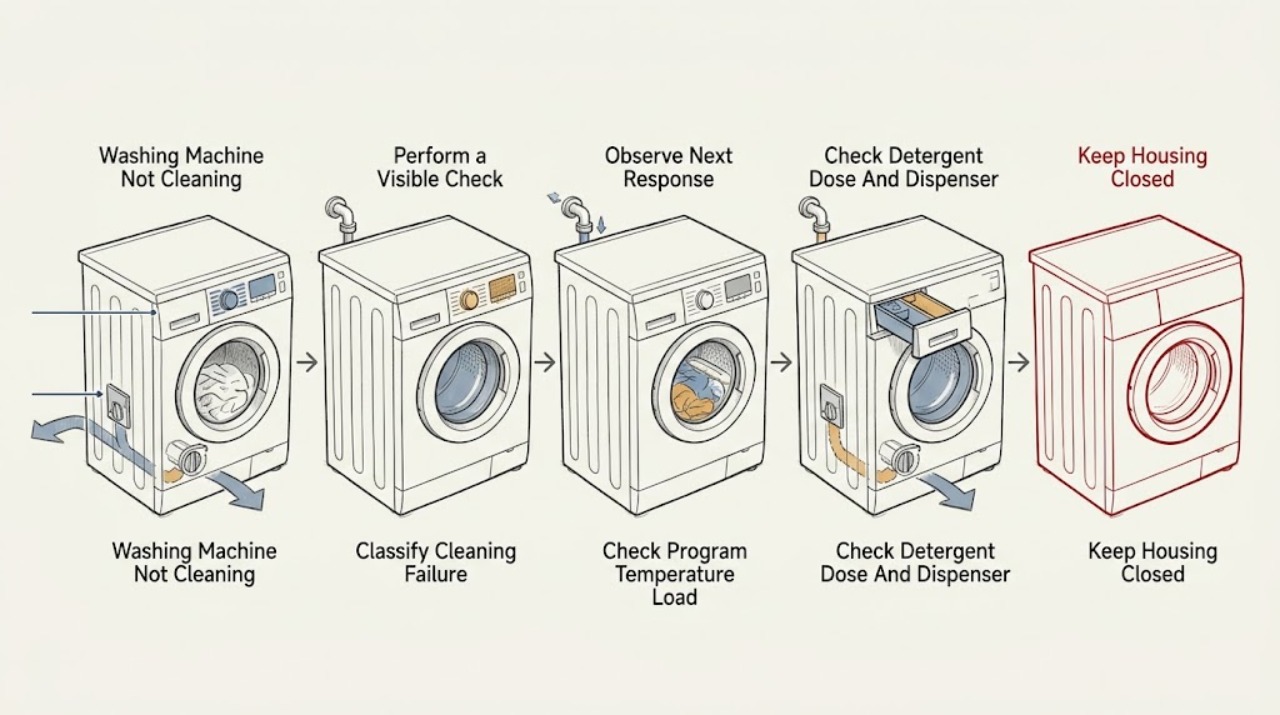
Work through in order
Diagnostic checks
Use only checks that match the exact appliance or system and its official guide.
-
Check 1
Do not start another cycle yet. Inspect the finished load and note whether the problem is unchanged soil, detergent streaks or powder, an odor, poor rinsing, standing water, a cycle that stopped early, or clothes that were unusually hot. Check the floor, hoses, plug, outlet, and control area from outside the machine.
Expected result: Record normal completion with dry external surfaces, visible detergent residue or foam, water left in the drum, an error or incomplete cycle, a leak, wet electrical area, burning smell, smoke, unusual heat, sparks, or a breaker event.
Next step: Keep the washer off and isolate it safely for any leak, wet electrical area, burning smell, smoke, heat, sparks, or repeated trip. If there is no hazard, continue with program, load, detergent, and maintenance checks.
Stop if: Do not run another cycle to test a leak, smoke, burning smell, unusual heat, sparks, wet controls, damaged cord, or repeated breaker trip.
Why this matters
Why: Residue or unchanged soil can follow program, load, dose, dispenser, water, or drum-hygiene conditions. Standing water or an incomplete cycle can point to inlet or drain problems. A leak near electrics, burning, smoke, overheating, sparks, or a trip is an immediate safety boundary rather than a cleaning adjustment.
-
Check 2
Sort the affected items by fabric, color, soil level, and care-label temperature. Compare the selected Hisense program, temperature, pre-wash or extra-rinse setting, and load size with the items; loosen folded laundry and leave enough room for circulation. Heavily soiled items should be treated or washed in a smaller suitable load without exceeding the label.
Expected result: Record a lightly soiled load on a short or low-temperature program, a tightly packed drum, mixed fabric or soil levels, a temperature or program mismatch, or an appropriately sized load on a suitable cycle that still emerges dirty.
Next step: Follow the care label and exact model program table, use a smaller correctly sorted load, and select pre-wash or an appropriate longer/higher-temperature program only where permitted. Do not use higher heat to compensate for a fault or fabric restriction.
Stop if: Do not exceed the garment label, overload the drum, wash items contaminated with solvents or flammables, or change settings while a machine is running if the model manual says they cannot be changed.
Why this matters
Why: Hisense states that cleaning depends on load type and amount, soil level, temperature, detergent, water conditions, and selected options. A short or gentle setting can be unsuitable for heavy soil, while overloading can reduce water and detergent distribution. A suitable load that remains dirty points to dose, water delivery, drum hygiene, or a machine fault.
-
Check 3
With the machine stopped, check whether the detergent matches the washer type and whether the amount follows the detergent label, soil level, water hardness, and the exact Hisense dispenser or auto-dose instructions. Inspect the drawer and compartments for hardened powder, residue, overflow, a blocked passage, or a drawer that was not fully closed; do not add extra detergent to an already foamy load.
Expected result: Record too much foam, detergent left on clothing, too little detergent, a hardened or blocked dispenser, an auto-dose setting that does not match the product, or a clean dispenser with correct dosing.
Next step: Clean and dry the accessible drawer according to the manual, correct the dose without guessing a fixed amount, and use an extra rinse only when the model and fabric allow it. Do not pour chemicals into a compartment unless the exact manual permits that product and program.
Stop if: Do not mix cleaners, use solvents, add unapproved corrosive products, exceed the dispenser's indicated level, or reach into moving parts.
Why this matters
Why: Hisense guidance says excessive detergent can create foam and impair washing efficiency, while insufficient detergent can leave laundry poorly cleaned; hardened powder can clog the detergent path. Correct dosing with a clean drawer shifts attention to program, water, drum, drainage, or service-level causes.
-
Check 4
After disconnecting power when the manual requires it and only with safe dry access, inspect the water supply tap, visible inlet hose, dispenser spray path, door seal, drum, accessible pump-filter cover, and drain hose for a kink, blockage, residue, foreign object, or standing water. Use a container and the model's emergency-drain procedure if the manual provides one; never remove a filter with a full hot or moving drum.
Expected result: Record weak or absent water entry, an inlet hose or filter concern, residue in the dispenser or seal, a dirty or odorous drum, a blocked pump filter or drain hose, standing water, a leak, or clear inlet and drain paths.
Next step: Correct only an accessible kink or cleanable residue as the exact manual permits, keep the machine off for a leak or unresolved standing water, and continue to Drum Clean only when the drum is empty and the machine is safe. Request service for repeated water faults, inaccessible blockages, or internal testing.
Stop if: Do not open a pump filter while water is hot or pressurized, pull hoses from a leaking connection, use tools inside the drum, or operate with a leaking hose or wet electrical area.
Why this matters
Why: Hisense error guidance associates inflow faults with the tap, pressure, pinched hose, or inlet filter and drainage faults with a pinched hose or clogged drain filter. A dirty drum or seal can transfer residue or odor. A clear path with poor cleaning suggests internal water-level, valve, heater, motor, pump, or control diagnosis.
-
Check 5
When the drum is empty, the exterior is dry, and there is no safety warning, run the model's Drum Clean or self-clean program only if the exact Hisense manual provides it. Use only the approved cleaner and amount, or no added product when the manual says so; leave the door and dispenser to dry afterward. Then document whether a suitable laundry load improves without repeating a hazardous test.
Expected result: Record a clean empty cycle and improved laundry, residue or odor that remains, an error, incomplete drain, leak, abnormal heat, burning smell, smoke, sparks, or a breaker trip.
Next step: Keep the washer off and arrange Hisense or qualified appliance service for persistent poor cleaning, repeated error or drain problems, leaks, abnormal heat, electrical symptoms, or any odor or smoke suggesting a fault. Provide the model, program, load, dose, water and drain findings, and cleaning result.
Stop if: Do not run Drum Clean with laundry, combine products, continue after a leak, burning smell, smoke, unusual heat, sparks, or a trip, or open the cabinet to pursue an internal cause.
Why this matters
Why: Hisense describes Drum Clean as a way to remove accumulated detergent residue and bacteria and advises regular cleaning of the drum, dispenser, seal, and pump filter. Improvement supports a maintenance or dosing cause but does not prove every component is sound. Recurrence after a correct maintenance cycle suggests water, heater, motor, pump, sensor, or control diagnosis.
Use your observations
Decision map
Find the observation that best matches what you see, then follow the next safe action.
-
PATH 01Safety boundary
What you see
The affected load was tightly packed, heavily soiled, mixed with unsuitable fabrics, or washed on a short, low-temperature, or otherwise unsuitable program.
Do this next
Sort and reduce the load, treat stains as the garment permits, and select the exact model's suitable cycle and temperature. Stop if the machine develops a leak, heat, odor, smoke, sparks, or a trip.
Why this path and its safety boundary
Why it matters: Load distribution, time, temperature, and care-label limits may explain poor cleaning without proving a washer component failure.
Safety stop: Do not overload or exceed care-label temperature.
-
PATH 02Safety boundary
What you see
There is excess foam, detergent streaking, incorrect dose, hardened powder, overflow, or residue in the drawer or dispenser path.
Do this next
Clean and dry the accessible drawer as the manual permits and correct dosing from the product and model instructions. Use an extra rinse only when allowed; request service if dosing and a suitable cycle do not resolve it.
Why this path and its safety boundary
Why it matters: Detergent amount, product type, auto-dose setup, or a blocked dispenser can reduce wash and rinse performance.
Safety stop: Do not add more detergent to a foamy load or mix cleaning chemicals.
-
PATH 03Safety boundary
What you see
Water entry is weak, the inlet hose or filter is restricted, water remains after the cycle, or the drain hose or pump filter is blocked or kinked.
Do this next
Keep the machine off for a leak or standing water and follow only the exact manual's safe hose, filter, and emergency-drain checks. Arrange service for recurring F01/F03-type behavior, inaccessible blockage, or an internal pump or valve fault.
Why this path and its safety boundary
Why it matters: The machine may not be delivering or removing enough water for the wash and rinse phases.
Safety stop: Do not open a full or hot filter, operate with a leaking hose, or reach into wet electrical areas.
-
PATH 04Safety boundary
What you see
The drawer, seal, or drum has detergent residue, dirt, odor, or visible buildup, and no immediate electrical or water hazard is present.
Do this next
Clean accessible surfaces, dry the door and drawer, and run the exact model's empty Drum Clean program when available. Stop and request service if the program produces abnormal behavior or the residue returns rapidly.
Why this path and its safety boundary
Why it matters: Machine residue can transfer back to laundry and reduce freshness or apparent cleaning performance.
Safety stop: Do not use solvents, corrosive products, mixed cleaners, or an unapproved high-temperature cycle.
-
PATH 05Safety boundary
What you see
A correctly sized, correctly sorted load with suitable program, temperature, detergent dose, clear accessible inlet and drain paths, and permitted maintenance still leaves clothes dirty.
Do this next
Keep the machine out of service if the result recurs and request Hisense or qualified appliance diagnosis. Provide the model, cycle, load, dose, water and drain observations, error codes, and maintenance result.
Why this path and its safety boundary
Why it matters: An internal water-level, inlet valve, heater, motor, pump, sensor, control, or concealed contamination problem is possible.
Safety stop: Do not open the cabinet, test live circuits, bypass a safety device, or keep running cycles solely to reproduce the failure.
-
PATH 06Safety boundary
What you see
There is a leak near electrics, wet plug or controls, burning smell, smoke, unusual heat, sparks, a damaged cord or outlet, or a breaker that trips again.
Do this next
Stop the program and isolate power and water only from a safe accessible position. Keep clear and obtain qualified appliance, electrical, or emergency help as appropriate; do not re-energize to confirm the cause.
Why this path and its safety boundary
Why it matters: The washer or household supply may present a shock, fire, water, or equipment hazard; cleaning troubleshooting must stop.
Safety stop: Do not touch wet electrical equipment, reset a breaker repeatedly, open the cabinet, or run Drum Clean.
Helpful context
Understand the symptom
Separate a cleaning result from a machine fault
Not-clean laundry can mean visible soil remains, detergent residue is left behind, a stale smell transfers to fabric, or the cycle never delivered enough water, heat, tumbling, or rinsing. Record which items are affected, whether the problem is new, and whether the program completed normally. A leak, water near electrics, burning smell, smoke, unusual heat, sparks, repeated breaker trips, or a persistent error changes this from a laundry adjustment into a stop-and-service situation.
Match the program to the load and soil
A short or low-temperature program may be appropriate for lightly soiled items but may not remove heavy soil. Hisense guidance says to follow the garment care label, separate by fabric and soil, use smaller loads for heavily soiled laundry, and use a pre-wash or suitable stain treatment when the fabric permits. Do not raise temperature beyond the care label or assume a premium setting can compensate for an overloaded drum.
Clean the machine without creating a chemical or electrical hazard
Detergent residue, fabric softener, dirt, and bacteria can accumulate in the dispenser, seal, and drum. Use the exact manual for removable parts and any Drum Clean program. Disconnect power before accessible cleaning where the manual requires it, keep water away from controls, and never combine cleaning chemicals or use solvents. A clean empty drum does not prove that an internal inlet, heater, motor, pump, or control fault is repaired.
Safety boundary
Stop conditions
- Stop immediately for a leak near electrical parts, wet plug or controls, burning smell, smoke, unusual heat, sparks, damaged cord or outlet, or a breaker that trips again.
- Do not continue cycles with standing water, a leaking hose, unresolved water fault, or a damaged door seal that allows water toward electrical parts.
- Do not mix cleaning chemicals, use solvents or corrosive products, or add an unapproved cleaner to the drum or dispenser.
- Do not open the cabinet, test live circuits, bypass a door or safety device, or reach into a moving, hot, or water-filled pump area.
- Do not exceed care-label temperature or overload the drum, and do not run Drum Clean with laundry unless the exact model manual explicitly allows it.
Only after diagnosis
Potential parts
- washing-machine detergent dispenser drawer or insert
Consider this category only when the exact model's drawer or insert is cracked, warped, missing, or cannot deliver detergent after safe cleaning.
Confirm the exact Hisense model and dispenser configuration before ordering; do not operate with a drawer that leaks toward controls. - washing-machine inlet hose or inlet filter component
Consider this category only after safe inspection or qualified testing confirms a damaged hose or inlet component is restricting water entry.
Confirm model and connection requirements; shut off water and use qualified service for valve or internal work. - washing-machine drain pump or pump filter component
Consider this category only when a qualified diagnosis confirms a failed pump or damaged filter after the accessible drain path is clear.
Confirm the exact model and water-handling configuration; do not open a hot or full pump area. - washing-machine door seal
Consider this category only when the exact model's seal is torn, deformed, or confirmed to be the source of a leak or contamination transfer.
Confirm model fit and have service address any leak near electrical parts before further operation.
When checks do not resolve it
Need a professional?
Arrange Hisense or qualified appliance service when clothes remain dirty after a suitable load, program, temperature, dose, accessible dispenser, inlet, drain, and permitted Drum Clean checks; when water entry or drainage faults recur; or when an error, leak, abnormal heat, electrical symptom, burning smell, smoke, sparks, or breaker trip occurs. Use qualified electrical or emergency help for a supply or fire hazard.
Safety scope: This article supports only dry, ordinary-access checks and manual-permitted cleaning. Do not open panels, test live circuits, work on the inlet valve, heater, motor, pump, wiring, door lock, or control, remove a hot or full filter, or re-energize a leaking or electrically hazardous appliance.
Common questions
FAQ
Why are my Hisense washer clothes still dirty after a complete cycle?
Check the program, temperature, load size, soil level, detergent dose, dispenser, water entry, drainage, and drum hygiene in that order. A short or unsuitable cycle, overloaded load, incorrect dose, restricted water path, or residue in the machine can all produce a poor result. Persistent failure after safe checks needs service.
Can too much detergent make a Hisense washing machine clean worse?
Yes. Hisense manuals warn that excess detergent can create foam and impair washing efficiency, while too little detergent can leave laundry poorly cleaned. Follow the detergent and exact model instructions rather than adding more when clothes remain dirty.
What temperature should I use when the wash is not cleaning?
Use the temperature and program allowed by each garment's care label and the model manual. Heavily soiled items may need a longer or warmer suitable program, but raising heat beyond the label can damage fabric and does not repair an inlet, drain, heater, or control fault.
How do I clean the washer when residue is making clothes dirty?
Clean the accessible drawer, seal, and drum as the exact manual permits, then run the model's empty Drum Clean or self-clean program if available. Use only the approved product and never mix cleaning chemicals or use solvents. Keep the washer off if cleaning reveals a leak or electrical hazard.
When should I stop using the Hisense washer?
Stop for a leak near electrical parts, wet plug or controls, burning smell, smoke, unusual heat, sparks, a damaged cord or outlet, repeated breaker trips, standing water that cannot be safely drained, or a persistent error. Keep it off and arrange qualified appliance, electrical, or emergency help as appropriate.
Read the exact guide
Official sources
- RECOMMENDATIONS FOR WASHING AND ECONOMIC USE YOUR WASHING MACHINEHisense Australia Pty Ltd · Hisense Australia user manual for HWFS7514S; exact controls, capacity, and programs vary by model.
- Washing machine - WFQA9014EVJM - HisenseHisense UK · Hisense UK product information for a specific washing-machine family; Drum Clean availability and operation vary by model.
- User Manual - HWFS1015EHisense Australia Pty Ltd · Hisense Australia user manual for HWFS1015E; error labels and reset behavior vary by model.
- User Manual - HWFS1015EHisense Australia Pty Ltd · Hisense Australia user manual for HWFS1015E; use the assigned machine's manual for exact settings.
Community feedback
Share a repair observation
Share a plain-text repair observation. Accepted observations are published automatically; this page may take a moment to update.