
On this page
Start here
Quick answer
When an Electrolux washing machine is not cleaning, first separate a cycle or load problem from a machine fault. Use a cycle suited to the fabric and soil, load the drum so clothes can move, use the correct high-efficiency detergent in the correct location and amount, and verify that both water supplies are open. If the washer leaves excess suds, does not drain, or shows a drain-related warning, the rinse and drain stages can also leave clothes dirty or coated. Persistent poor results after these checks, abnormal noise, a door or dispenser fault, or a washer that cannot fill, heat, or drain needs model-specific service.
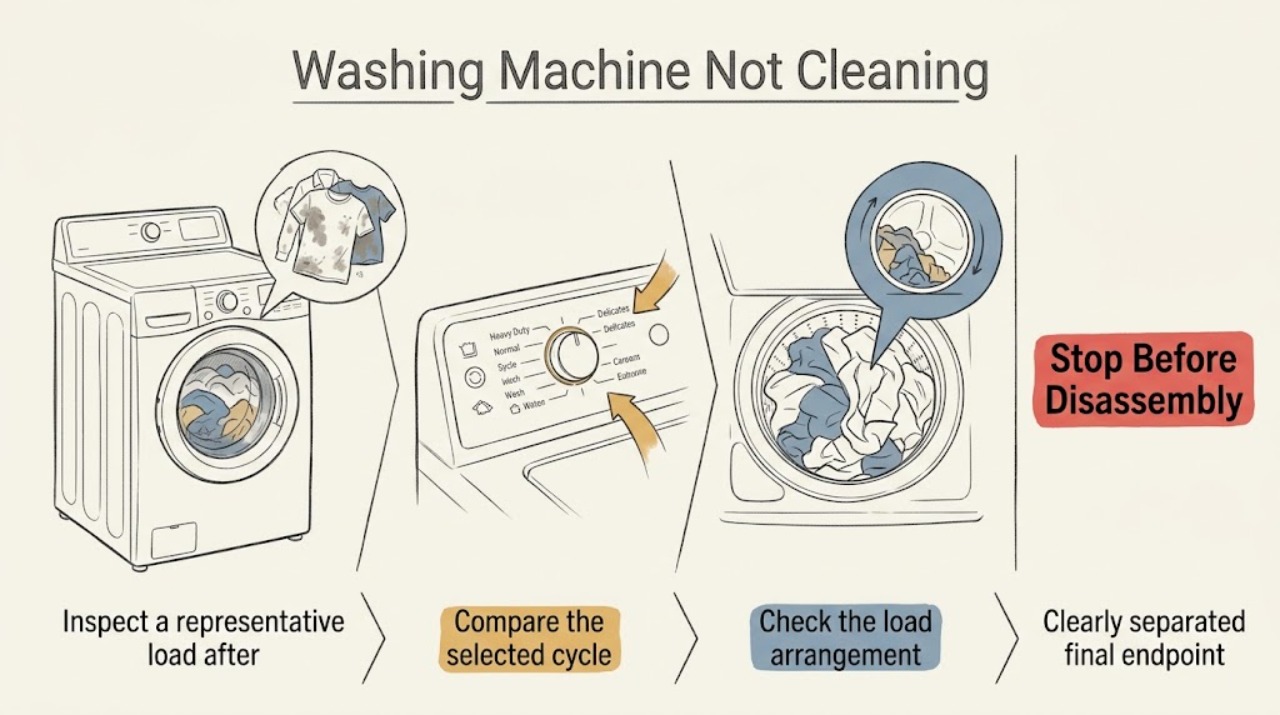
Work through in order
Diagnostic checks
Use only checks that match the exact appliance or system and its official guide.
-
Check 1
Inspect a representative load after the cycle and classify the result as unchanged soil, detergent film or heavy suds, poor rinsing, clothes that remain very wet, or a single stain. Note whether the whole load or only a few items are affected.
Expected result: The same failure appears across the load, or only one garment has a stubborn mark while the rest is clean.
Next step: Use the whole-load symptom to choose the checks below; handle an isolated stain according to the garment-care instructions rather than changing washer parts.
Why this matters
Why: A whole-load result points to cycle, load, detergent, water, rinse, or drain conditions. A single set-in stain does not by itself prove the washer is malfunctioning.
-
Check 2
Compare the selected cycle and options with the load. For heavily soiled, durable items choose the model's heavy-duty or deeper-soil option when available; use a normal cycle for normally soiled mixed loads and reserve a fast cycle for a small, lightly soiled load.
Expected result: The load is heavily soiled but was run on a short or delicate setting, or the selected cycle matches the fabric and soil level.
Next step: Run a correctly sized load on the model-appropriate cycle with the recommended options. If matching the cycle does not improve a whole load, continue with detergent and water checks.
Why this matters
Why: The quick-start guidance indicates that cycle and soil selection change the available wash action and time. A short cycle can be a poor match for a large or heavily soiled load without indicating a failed component.
-
Check 3
Check the load arrangement and size. Leave room for the garments to move, avoid packing the drum tightly, and separate items that require different cycle or fabric treatment instead of combining them into one compromise load.
Expected result: The drum was tightly packed or the load mixed heavy, delicate, and heavily soiled items, or the load has adequate room and a suitable fabric mix.
Next step: Re-test with a smaller, compatible load. If the smaller load is still uniformly dirty, move to detergent and water supply checks rather than repeatedly changing the load.
Why this matters
Why: Cleaning depends on water passing through the fibers and on the drum's mechanical movement. A crowded or mismatched load can prevent that action from reaching all surfaces even when the washer completes the cycle.
-
Check 4
Inspect the detergent setup against the exact model guide: use high-efficiency detergent, put powder or liquid in the main-wash cup without exceeding its fill line, and use a detergent pack only in the location supported by the model. Check for caked detergent or visible buildup in the dispenser.
Expected result: The detergent type, location, or amount is wrong, the dispenser is blocked with buildup, or the detergent setup matches the model guidance.
Next step: Correct the detergent setup and run a suitable test load. If the washer is full of suds, stop adding detergent and follow the oversudsing check before judging cleaning performance.
Why this matters
Why: Too little or misplaced detergent can leave soil behind, while excess detergent or the wrong type can create suds and residue that interfere with rinsing. A correct setup shifts suspicion to water entry, temperature, movement, or draining.
-
Check 5
Start a test cycle and listen for water entry. Verify that both hot and cold supply valves are open, the hoses are not kinked, and hot and cold hoses are connected to the matching washer inlets. Do not loosen a pressurized hose to test it.
Expected result: The washer does not fill normally, fills with the hoses reversed or restricted, or fills as expected.
Next step: Correct only an accessible valve, kink, or clearly reversed connection according to the model instructions. If a hose, connector, or inlet is damaged or the washer still does not fill, stop and arrange service.
Why this matters
Why: Electrolux says the washer will not function properly when water is off and that reversed or restricted hoses can prevent the intended wash conditions. Normal filling makes detergent, cycle, movement, and drain checks more relevant.
-
Check 6
Check for excessive suds, detergent residue, or a suds-related alert. If the model displays its oversudsing warning, use high-efficiency detergent and the correct amount; follow the model's instructions for an empty quick cycle that clears residual suds.
Expected result: The drum or clothing has persistent suds or residue, an oversudsing warning appears, or there are no unusual suds.
Next step: Correct detergent use and complete the model-supported clearing cycle before retesting. If suds return with correct detergent or the alert persists, arrange service rather than adding more products.
Why this matters
Why: Electrolux states that oversudsing can trigger additional rinses and that too much or unsuitable detergent can prolong the cycle and leave residue. No unusual suds shifts the diagnosis toward cycle choice, water, mechanical action, or draining.
-
Check 7
Observe the end of the cycle. Check whether the washer empties fully and whether clothes are unusually wet; on a front-load model, note any long-drain warning and inspect the visible drain hose for a kink or restriction without opening the pump housing.
Expected result: Water remains, clothes are very wet, the cycle takes unusually long to drain, or the washer drains and spins normally.
Next step: Correct only a visible hose restriction or installation issue. If the hose is clear but the washer still drains slowly or cannot empty, stop using it and arrange service for the drain system.
Why this matters
Why: Poor draining leaves soil-laden water or detergent in contact with clothes and can prevent the intended final rinse and spin. Electrolux identifies a restricted or kinked drain hose as a cause of slow pumping and a long-drain warning.
-
Check 8
Run one correctly loaded, correctly dosed test cycle and compare it with the original result. Note whether cleaning improves, remains uniformly poor, or is accompanied by abnormal noise, a door problem, failure to heat, or failure to complete the cycle.
Expected result: Cleaning improves after a setting, load, detergent, water, suds, or drain correction, or the same whole-load failure remains.
Next step: If the failure repeats, protect the clothing from repeated ineffective cycles and arrange qualified Electrolux appliance service with the recorded symptoms and any display message.
Why this matters
Why: Improvement supports a use, supply, or drain cause. A repeatable whole-load failure after those checks indicates that internal water flow, heating, drum movement, sensing, control, or another component needs diagnosis.
Use your observations
Decision map
Find the observation that best matches what you see, then follow the next safe action.
-
PATH 01Safety boundary
What you see
Only one garment has an unchanged mark while the rest of the load is clean.
Do this next
Treat it as a garment or set-in-stain question first and follow the garment-care instructions; do not diagnose a washer fault from one item.
Why this path and its safety boundary
Safety stop: Continue with cycle, load, detergent, and water checks for the whole load.
-
PATH 02Safety boundary
What you see
The selected cycle is too short or too gentle for the soil and fabric.
Do this next
Run a compatible load on the model's appropriate cycle, using a deeper-soil option only when the model provides it.
Why this path and its safety boundary
Safety stop: Check load size and arrangement.
-
PATH 03Safety boundary
What you see
Detergent is non-HE, misplaced, excessive, caked, or used in a compartment that the model does not support.
Do this next
Correct the type, location, and amount from the exact model guide; clear residual suds using the model-supported procedure.
Why this path and its safety boundary
Safety stop: Verify water entry and hose orientation.
-
PATH 04Safety boundary
What you see
The washer fills poorly, has reversed or kinked inlet hoses, or cannot drain fully.
Do this next
Correct only visible, user-safe supply or drain restrictions; arrange service for damaged hoses, inlet parts, a pump, or a persistent fill or drain failure.
Why this path and its safety boundary
Safety stop: Run one controlled test cycle and compare the whole-load result.
-
PATH 05Safety boundary
What you see
The same whole-load cleaning failure remains after the cycle, load, detergent, water, suds, and drain checks.
Do this next
Stop repeated ineffective cycles and schedule qualified service for internal water flow, heating, movement, sensing, or control diagnosis.
Why this path and its safety boundary
Safety stop: Continue normal use with the corrected cycle and detergent setup.
Helpful context
Understand the symptom
Decide what not cleaning means
Look at the result before changing parts. Food or body-oil marks left on every item suggest a cycle, detergent, water, or mechanical-action issue. One isolated, set stain may need fabric-appropriate pretreatment and may not indicate a washer failure. A sticky film or many suds points toward detergent use, while clothes that are still very wet or a cycle that stops before draining points toward the drain stage.
Electrolux settings are model dependent
Electrolux's quick-start guide assigns heavy-duty cycles to heavily soiled durable items, normal to light or normally soiled mixed loads, and fast wash to small lightly soiled loads. Options such as a deeper soil setting and a detergent-pack compartment are available only on select models. Use the controls and limits in the exact owner's guide for the washer.
Detergent and water must reach the load
Electrolux says high-efficiency detergent is formulated for proper cleaning and that powder or liquid detergent belongs in the main-wash cup without exceeding its fill line. A detergent pack may belong directly in the drum or in a dedicated compartment depending on the model. The washer also needs both water supplies available and correctly connected so the selected cycle can perform its wash and rinse stages.
Know when the problem is beyond a user check
Do not open the cabinet to test a heater, motor, pump, control, or wiring. If the washer cannot fill, cannot drain, repeatedly reports oversudsing, or produces abnormal noise during an empty cycle, record the symptom and arrange qualified service after the basic checks.
Safety boundary
Stop conditions
- Stop if water enters the cabinet, a hose or connector is cracked, or a leak cannot be contained safely.
- Do not loosen pressurized supply hoses, open electrical panels, or test internal heater, motor, pump, or control wiring as an ordinary user check.
- Stop repeated resets or cycles if a breaker trips, the washer smells overheated, or abnormal noise continues with an empty drum.
- Stop using the washer if it cannot fill, cannot drain, or repeatedly reports an oversudsing or other fault after the model-supported user checks.
- Arrange qualified service when a correctly loaded and dosed test cycle still leaves the whole load dirty.
When checks do not resolve it
Need a professional?
Call a qualified appliance technician when poor cleaning persists after one controlled cycle with the correct load, cycle, detergent, water supply, suds, and drain conditions, or when the washer leaks, fails to fill or drain, cannot complete a cycle, makes abnormal noise, or needs internal electrical, heating, pump, motor, or control diagnosis.
Common questions
FAQ
Why are my Electrolux clothes still dirty after washing?
Check the match between soil and cycle, drum loading, high-efficiency detergent type and placement, water entry, suds, and final draining. If an appropriate test load is still uniformly dirty, the washer may need service for an internal wash, heat, sensing, or control problem.
Can too much detergent make an Electrolux washer clean poorly?
Yes. Excess or unsuitable detergent can create heavy suds and residue, trigger extra rinses, and leave detergent on clothing. Use the model's recommended high-efficiency detergent and placement, without exceeding the dispenser's fill line.
Does a fast cycle clean heavily soiled clothes?
Electrolux's quick-start guidance describes fast wash for small, lightly soiled loads. A heavily soiled or large load needs the model's cycle intended for that soil and fabric instead.
Read the exact guide
Official sources
- Laundry Water Supply GuideElectrolux · Official Electrolux washer water-supply guidance; connection layout and requirements vary by model and installation.
- Laundry Washers - Detergent GuideElectrolux · Official Electrolux guidance for front-load and top-load washers; exact dispenser and detergent-pack behavior varies by model.
- Electrolux Washing Machine Technical Training ManualElectrolux · Official Electrolux technical document with general washing-process guidance; it is not a substitute for the exact owner's manual for any model.
- Laundry front loading washer displaying Error Code SU dS too many suds.Electrolux · Official Electrolux front-load washer guidance for the SU dS oversudsing condition; display behavior varies by model.
- Laundry front loading washer displaying Error Code E21 long pump out time.Electrolux · Official Electrolux front-load washer guidance for slow pumping and E21; a top-load model may use different messages and access points.
- Gen2 Washer Quick Start GuideElectrolux · Official Electrolux Gen2 washer guide; cycle names and options vary by model.
Community feedback
Share a repair observation
Share a plain-text repair observation. Accepted observations are published automatically; this page may take a moment to update.