
On this page
Start here
Quick answer
Start with the load and detergent before assuming a failed washer. Use the detergent type and measured amount specified for the exact GE model, avoid excess suds, load dry clothing loosely so it can move, and match the water level to the load. Keep the lid closed during the wash. If clothes have white residue, test for detergent buildup and use the model's rinse options; if water is low, the washer fills and drains together, or the cycle repeatedly ends with wet or dirty clothes, check accessible valves, hose routing, and drain setup. A confirmed water-supply problem, leak, burning or electrical smell, damaged cord, or persistent poor performance after correct loading and product use needs qualified service.
Before you begin
Safety first
- User checks are limited to reading the model manual, measuring detergent, correcting a dry loose load, checking accessible valves and visible hoses, and following visible cycle or rinse settings. Do not disconnect pressurized hoses, open energized panels, bypass lid or water sensors, operate through a leak or flood, or continue using a washer with smoke, burning odor, sparking, hot electrical parts, or violent movement.
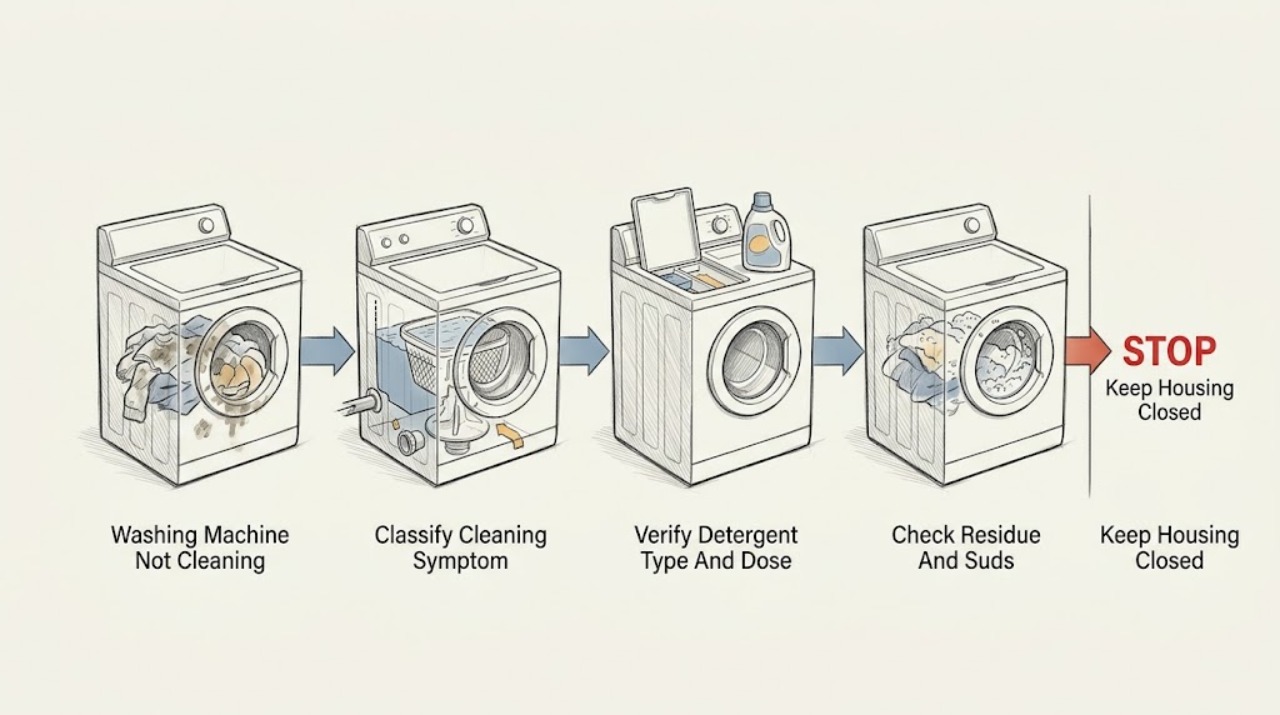
Work through in order
Diagnostic checks
Use only checks that match the exact appliance or system and its official guide.
-
Check 1
Compare a representative load before and after a complete cycle, and record whether the problem is visible soil or stains, detergent or white residue, a bad odor, lint transfer, or clothing that is still unusually wet; note the model, cycle, load size, and detergent product.
Expected result: Soil remains without residue, residue or suds remain, the load is wet, the washer leaves lint, or the symptom occurs only on one fabric or cycle.
Next step: Photograph the result and follow the matching detergent, loading, water, drain, or service check rather than changing several variables at once.
Stop if: Stop for a leak, smoke, burning or electrical odor, exposed wiring, hot cord or outlet, or abnormal violent movement.
Why this matters
Why: These symptoms point to different paths: stain treatment and wash movement, detergent and rinse balance, spin or drain performance, fabric sorting, or a model-specific cycle setting.
-
Check 2
Measure the detergent according to the exact GE model and product instructions, use HE detergent where the model requires or recommends it, and check that a dispenser insert or pod placement matches the model; do not add extra detergent to compensate for a dirty load.
Expected result: The load uses too much detergent, non-HE product, a misused dispenser or pod, or the measured product and placement are correct but cleaning remains poor.
Next step: Correct only the product or placement issue and run one suitable supervised load. If residue persists, continue to the buildup and rinse check; do not increase dose.
Stop if: Do not mix cleaners or chemicals, use untested flammable products, or reach into a moving washer to add product.
Why this matters
Why: GE says excess detergent can create oversudsing and residue, and its HE guidance explains that low-sudsing detergent is formulated for low-water washers. A correct measured dose shifts attention to load, water, cycle, or mechanical performance.
-
Check 3
If clothes have a white film or feel soapy, inspect the washer near the end of a safe cycle for visible suds and note whether the residue occurs across loads; if the model supports it, use its Deep Rinse, Extra Rinse, or Rinse & Drain option rather than adding more detergent.
Expected result: Suds remain near the end of the cycle, residue occurs without visible suds, or a correctly rinsed test load is residue-free.
Next step: For confirmed buildup, follow GE's model-appropriate no-detergent rinse guidance until suds are gone, then resume a measured dose. If the result does not improve, document the water and load checks for service.
Stop if: Do not pour undiluted chemicals into the washer, run repeated hot cycles on unsuitable fabrics, or open plumbing or panels to chase residue.
Why this matters
Why: GE identifies excess detergent, soft water, low water pressure, and overloading as common residue causes. Suds at the end support detergent buildup or overdosing; no suds with persistent residue requires model-specific water, product, or fabric investigation.
-
Check 4
For the next test, sort compatible fabrics, load dry items loosely around the basket, keep them below the model's retaining area, do not wrap them around an agitator or infusor, and choose the water level or sensing setting that matches the load.
Expected result: Clothes were packed down, overloaded, wrapped around the agitator or infusor, floated without turning over, or were sorted into a suitable loose load and still remain dirty.
Next step: Run one complete cycle with the corrected load and a measured detergent dose. If the result remains poor, continue to inlet, drain, and cycle checks.
Stop if: Do not exceed the model's capacity, force the lid open, or reach into the basket while the agitator or infusor is moving.
Why this matters
Why: GE says compacted or floating clothes may not turn over and clean effectively; too much water can reduce the detergent ratio, while too little can hurt rinsing and fabric movement. Persistence with a correctly loaded test reduces the likelihood of a simple loading error.
-
Check 5
With the washer off, verify that the accessible hot and cold supply valves are open, the visible inlet hoses are not kinked, and the washer fills with a normal-looking flow; do not disconnect a pressurized hose or dismantle the inlet valve.
Expected result: One valve is closed, a hose is kinked, filling is weak or delayed, both lines are supplied normally, or the washer displays a water-related error.
Next step: Correct only an accessible valve or hose kink, then run one supervised test. If flow remains weak or the problem returns with normal supply, request service for pressure and inlet diagnosis.
Stop if: Shut off water and stop for a leaking hose, flooding, damaged connection, or water near electrical parts.
Why this matters
Why: GE notes that low water pressure and incomplete water-line connections can reduce wash performance. A confirmed supply issue can prevent the correct wash and rinse ratio; normal visible supply with poor cleaning points to a different path.
-
Check 6
Inspect only the visible drain-hose routing and standpipe or sink placement against the exact GE installation instructions: the hose must not be inserted too deeply or sealed tightly, and the washer should not visibly fill and drain at the same time.
Expected result: The hose is too deep, sealed, unusually low, kinked, or the washer loses water while filling; alternatively, the routing is correct and the tub retains water through washing.
Next step: Correct only the accessible hose position according to the manual and run one supervised test. If the washer still fills and drains together or cleaning remains poor, stop and arrange service.
Stop if: Do not pull a hose from a flooded standpipe, open plumbing under pressure, or operate a washer that is leaking or flooding.
Why this matters
Why: GE says incorrect drain-hose placement can cause siphoning, remove water, reduce wash performance, and increase out-of-balance events. Correct routing removes a plumbing cause; a persistent problem points toward inlet, control, or mechanical diagnosis.
-
Check 7
For a safe comparison load, select a cycle and temperature approved for the fabric and soil level, pretreat stains when the care label permits, keep the lid closed, and avoid combining lint-producing and lint-collecting fabrics or fabrics needing different handling.
Expected result: The issue occurs only on a gentle or short cycle, stains were untreated or outside the cycle's capability, fabrics were incompatible, or a suitable cycle still produces poor cleaning.
Next step: Repeat once with the corrected cycle and documented load. Do not repeat indefinitely; preserve the model, settings, detergent, and before/after result if the failure remains.
Stop if: Follow garment care labels, never mix incompatible chemicals, and stop for unusual noise, leaks, overheating, or electrical symptoms.
Why this matters
Why: GE's wash-performance guidance separates stain pretreatment, load type, cycle selection, and lid closure from component failure. A suitable supervised comparison load that still fails supports service investigation.
-
Check 8
Stop user troubleshooting and arrange qualified service when correct detergent, loose loading, suitable water level, normal inlet flow, correct drain routing, and one supervised comparison cycle do not restore cleaning, or when the washer leaks, leaves water, or produces a safety symptom.
Expected result: The complaint remains repeatable across suitable loads, the washer cannot maintain water or movement, or a single user correction completely restores normal cleaning without recurrence.
Next step: Provide the technician with the model, fabric and soil, cycle, load size, detergent amount, water and drain observations, photographs, and exact point where performance fails.
Stop if: Do not operate a leaking, sparking, smoking, overheating, violently vibrating, or electrically unsafe washer while waiting for service.
Why this matters
Why: Persistent poor cleaning can involve water-level sensing, inlet flow, drain or siphon behavior, agitator or infusor movement, drive, controls, or another model-specific fault. The symptom does not justify guessing a part.
Use your observations
Decision map
Find the observation that best matches what you see, then follow the next safe action.
-
PATH 01Safety boundary
What you see
Clothes leave the washer visibly dirty but without a white film or persistent suds.
Do this next
Run one correctly loaded, correctly dosed comparison load, then check supply and drain behavior if it fails.
Why this path and its safety boundary
Why it matters: Start with load movement, water-to-load ratio, cycle selection, stain pretreatment, and inlet flow.
Safety stop: Stop for leaks, abnormal movement, hot/electrical odor, smoke, or a repeat failure after all safe checks.
-
PATH 02Safety boundary
What you see
Clothes have white residue, feel soapy, or suds remain near the end of the cycle.
Do this next
Measure less or model-appropriate HE detergent, correct loading, and use an available extra-rinse or rinse-drain option; clear buildup according to GE guidance.
Why this path and its safety boundary
Why it matters: Excess detergent, soft water, low pressure, overloading, or insufficient rinsing is more likely than a wash motor fault.
Safety stop: Do not add more detergent or mix chemical cleaners; request service if residue persists with correct product and supply.
-
PATH 03Safety boundary
What you see
The tub appears underfilled, filling is weak, a water-related error appears, or the water-to-load ratio is wrong.
Do this next
Check accessible hot and cold valves and visible hoses, then arrange pressure or inlet service if normal supply does not restore performance.
Why this path and its safety boundary
Why it matters: Insufficient inlet flow or an incorrect setting can prevent adequate wash and rinse movement.
Safety stop: Shut off water for a leak, damaged hose, flood, or water near electrical parts.
-
PATH 04Safety boundary
What you see
The washer fills and drains together, loses water during filling, or the drain hose is installed too deeply or too low.
Do this next
Correct visible hose routing using the exact installation instructions and run one supervised test; request service if the behavior remains.
Why this path and its safety boundary
Why it matters: Siphoning can remove wash water and reduce cleaning performance.
Safety stop: Do not operate through flooding or open a blocked or pressurized drain connection.
-
PATH 05Safety boundary
What you see
The washer ends with unusually wet clothes, interrupts spin, or repeatedly redistributes the load.
Do this next
Redistribute a stopped load and run the model's documented Drain & Spin once; investigate level, drain, and service paths if it recurs.
Why this path and its safety boundary
Why it matters: An out-of-balance or drain/spin issue can leave clothes feeling unclean even when wash action occurred.
Safety stop: Stop for cabinet strikes, walking, leaks, severe vibration, or a repeat with a balanced load.
-
PATH 06Safety boundary
What you see
Correct product, load, water, drain, and cycle checks do not improve cleaning, or the agitator/infusor, basket, or controls behave abnormally.
Do this next
Stop repeated testing and provide the technician with the exact model, settings, load, and before/after evidence.
Why this path and its safety boundary
Why it matters: A model-specific water-level, drive, movement, control, or sensor fault may require diagnosis.
Safety stop: Do not remove panels, bypass sensors, or replace a guessed part.
Helpful context
Understand the symptom
Poor cleaning is often a load or product mismatch
Before diagnosing a component, separate the symptom: visible soil remains, stains were never pre-treated, clothes are coated with residue, or the load is still wet and therefore feels unclean. GE's top-load guidance emphasizes measured detergent, loose loading, the correct water level, and a closed lid. Different models use different sensing and wash movements, so the Owner's Manual for the exact model controls the settings.
Water and detergent must work together
More detergent or more water is not automatically better. GE warns that excess suds can reduce cleaning, while too much water can lower the detergent ratio and too little can hurt rinsing and fabric movement. If residue appears, look for overdosing, low supply pressure, an overloaded tub, and the available Deep Rinse, Extra Rinse, or Rinse & Drain option before suspecting an internal fault.
Do not ignore filling, draining, or safety symptoms
A washer that fills and drains at the same time can lose the water needed for effective washing. Poor inlet flow, siphoning, an out-of-balance interruption, or a leak can also leave clothing dirty or wet. Check only accessible connections and settings. Stop for flooding, exposed electrical parts, a hot cord, burning odor, or repeated abnormal sounds, and do not open panels to chase a cleaning complaint.
When checks do not resolve it
Need a professional?
Safety scope: User checks are limited to reading the model manual, measuring detergent, correcting a dry loose load, checking accessible valves and visible hoses, and following visible cycle or rinse settings. Do not disconnect pressurized hoses, open energized panels, bypass lid or water sensors, operate through a leak or flood, or continue using a washer with smoke, burning odor, sparking, hot electrical parts, or violent movement.
Common questions
FAQ
Why are my clothes still dirty after washing in a GE washer?
Check detergent type and dose, loose loading, the water-to-load setting, cycle choice, stain pretreatment, and inlet flow. GE warns that overloading, excess suds, and incorrect water ratios can reduce cleaning. If a correctly loaded comparison load still fails, arrange service.
Can too much detergent make a GE washer clean worse?
Yes. GE says excess detergent can create oversudsing and residue, reducing wash or rinse performance. Measure the model-appropriate HE detergent and do not add more to fix a dirty load.
How full should a GE top-load washer be for good cleaning?
Load dry clothes loosely and match the water level to the load according to the exact model manual. Do not pack the basket, wrap clothes around the agitator or infusor, or use a setting that leaves clothes unable to move.
Can a drain hose make a GE washer leave clothes dirty?
Yes. GE says an incorrectly placed drain hose can siphon water from the washer, reducing wash performance. Check visible routing against the model installation instructions; do not operate through a leak or flooding.
When should I call service for a GE washer that is not cleaning?
Arrange qualified service when correct detergent, loading, water setting, inlet flow, drain routing, and one supervised comparison cycle do not restore cleaning, or sooner for leaks, flooding, abnormal movement, smoke, burning odor, sparking, or hot electrical parts.
Read the exact guide
Official sources
- Top Load Washer - Clothes Not Cleaning WellGE Appliances · GE top-load washer guidance; exact settings and wash mechanisms vary by model.
- Top Load Washer - Water Level and Load SizeGE Appliances · GE top-load guidance; use the exact model manual for the washer's load and water settings.
- Washer - HE DetergentGE Appliances · GE washer detergent guidance; exact dispenser and cycle requirements vary by model.
- Washer - Soap or White Residue in ClothesGE Appliances · GE washer guidance; water hardness, pressure, detergent, and rinse features vary by installation and model.
- Top Load Washer - Proper LoadingGE Appliances · GE top-load guidance; use the exact model manual for capacity and basket details.
- Top Load Washer - Wet Clothes ConcernsGE Appliances · GE top-load washer guidance; exact drain and leveling procedures vary by model and installation.
Community feedback
Share a repair observation
Share a plain-text repair observation. Accepted observations are published automatically; this page may take a moment to update.