
On this page
Start here
Quick answer
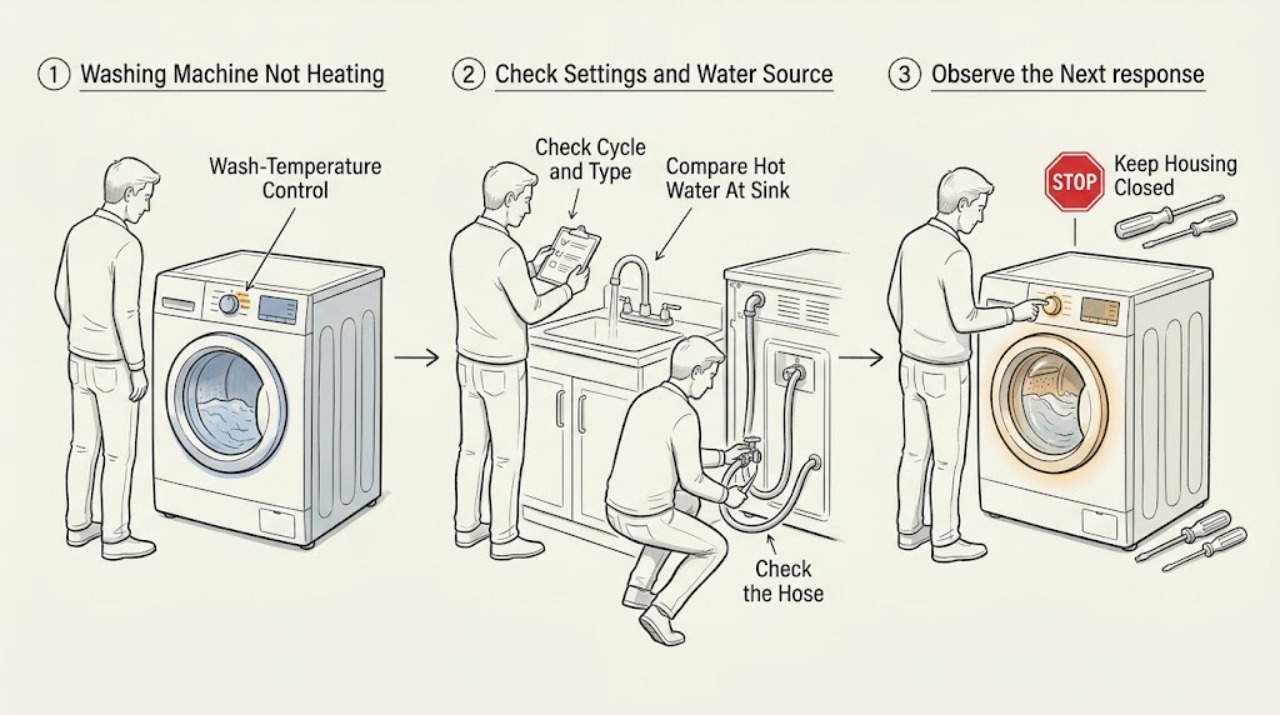
An Amana washing machine that is not heating may be receiving cooler incoming water rather than having an internal heater failure. First confirm the selected cycle and compare the hot and cold supply at the nearest sink, then inspect from outside whether the hot and cold inlet hoses are connected to the matching faucets, both supply faucets are available, and the hoses are not kinked. Amana says a washer can initially use cold water and regulate incoming water according to the cycle, and repeated loads can use the home's available hot water. If the selected cycle remains unexpectedly cold after the supply and hose observations, or a hose, inlet, control, or sensor would need internal access, stop and arrange qualified appliance service.
Before you begin
Safety first
- Observation only. No pressurized hose disconnection, inlet-screen removal, cabinet or console opening, live electrical testing, water-heater adjustment, or component replacement from symptoms alone.
Work through in order
Diagnostic checks
Use only checks that match the exact appliance or system and its official guide.
-
Check 1
Record the selected Amana cycle and temperature option, then note when the water feels cooler than expected: at the beginning of filling, throughout the wash, or only at the end. Use fabric-care labels to decide whether a warmer cycle is appropriate; do not infer a fault from a cold first fill alone.
Expected result: The cycle is intentionally cool; the washer starts with cold water then changes behavior; the water is cooler throughout a warm or hot cycle; or the selected option is unclear.
Next step: Photograph or record the control selection and compare one clearly warmer-rated cycle according to the owner's manual and fabric labels. If the behavior remains unexpected, continue with the supply observations rather than changing multiple controls at once.
Stop if: Stop if the control is damaged, the washer smells hot or burnt, water is leaking, or the cycle would require opening the console or cabinet.
Why this matters
Why: Amana says wash temperatures vary by cycle and that the washer may dispense cold water at the beginning of every cycle while sensing and regulating temperature. A cold first fill can therefore be normal, while a consistently cool result on a warmer selected cycle needs supply and control checks.
-
Check 2
At the sink nearest the washer, observe whether the household hot-water tap becomes hot before starting a load, and note the distance from the water heater and any recent high hot-water use. Avoid touching water that may be scalding and do not adjust the water heater.
Expected result: The nearby hot tap becomes hot normally; it remains cool; the washer is far from the water heater; or several loads were run close together.
Next step: Record the sink result, recent load sequence, and timing. If hot water is unavailable throughout the home, arrange plumbing or water-heater service; if the sink is hot but the washer fill is not, continue with hose orientation and flow observations.
Stop if: Stop for scalding water, a water-heater leak, gas odor, smoke, or any need to adjust gas, electrical, or water-heater controls.
Why this matters
Why: Amana notes that the distance from the water heater can affect startup water temperature and that multiple loads can use available hot water faster than it recovers. A cool nearby tap shifts concern toward the household hot-water supply rather than the washer alone.
-
Check 3
From behind or beside the washer, only where safely visible, compare the hose labels or color markings with the hot and cold wall faucets and look for sharp kinks, crushing, or obvious leaks. Do not pull the washer out, loosen a connection, or disconnect a hose.
Expected result: The hot and cold hoses match the faucets and are unobstructed; the hoses appear reversed; a hose is kinked or crushed; or a connection is wet or inaccessible.
Next step: Photograph the visible routing and leave the washer undisturbed if orientation is wrong, a hose is damaged, or a connection is wet. Arrange qualified appliance or plumbing service for correction; do not attempt a pressurized hose repair from this guide.
Stop if: Stop for active dripping, bulging hose material, a strained connection, standing water, a machine that would need to be moved, or unsafe access behind the washer.
Why this matters
Why: Amana identifies reversed hot and cold hoses as a cause of incorrect water temperature and identifies kinks as a restriction to fill flow. A wet or inaccessible connection is a leak or access issue, not a reason to tighten plumbing while the washer is connected.
-
Check 4
Look at the two household washer supply faucets and the visible hose path without turning a stuck handle or opening the washer. Note whether both hot and cold supplies appear available, whether either hose is pinched, and whether the washer fills normally or pauses with a water-related indication.
Expected result: Both supplies appear available and the fill is normal; one supply is closed or unavailable; a hose is pinched; or the washer does not fill or shows a fill-related light or message.
Next step: Record the faucet and fill pattern. If a faucet is stuck, a connection is leaking, or a fill indication persists, arrange qualified service; do not force valves, remove inlet screens, or disassemble the washer.
Stop if: Stop for a stuck or leaking faucet, flooding, a hose that may burst, exposed wiring near water, or any need to remove a hose or panel.
Why this matters
Why: Amana says both hot and cold sources must be connected and available for the washer to operate properly, and that a kink can restrict flow. A no-fill or water-level indication can therefore mimic a temperature problem, while normal fill with cool water points back toward cycle regulation or household hot-water availability.
-
Check 5
If the hot tap is available, hose routing is visibly correct, the selected cycle should use warmer water, and the washer still produces unexpectedly cool wash water, document the model, cycle, water-supply observations, load history, and any display or light indication. Do not open the console or attempt electrical or component testing.
Expected result: The cool-water symptom persists across appropriate cycles; it is intermittent; it began after installation or hose work; or an error, fill, or temperature indication appears.
Next step: Arrange Amana-designated or qualified appliance service and provide the recorded cycle, sink temperature pattern, hose routing, recent load history, model, and display behavior. Keep the washer unused if water is leaking or electrical safety is uncertain.
Stop if: Stop if diagnosis would require a panel, live test, valve disconnection, water spill, or access under or behind an unstable washer.
Why this matters
Why: The remaining possibilities can include a model-specific temperature-control, inlet-valve, sensor, wiring, or household hot-water issue, but the external symptom cannot identify a safe replacement component.
Use your observations
Decision map
Find the observation that best matches what you see, then follow the next safe action.
-
PATH 01Next step
What you see
The washer initially fills cold, the selected cycle is not intended to be hot, or the water temperature varies as the control regulates incoming water.
Do this next
Use the exact owner's manual and fabric-care labels to choose the intended cycle, then monitor whether the final wash result matches that cycle.
Why this path and its safety boundary
Why it matters: Amana describes these as possible normal temperature-control behaviors rather than proof of a failed heater.
-
PATH 02Next step
What you see
The nearest hot tap stays cool, the washer is far from the water heater, or many loads were run in a short period.
Do this next
Arrange plumbing or water-heater assessment if hot water is unavailable elsewhere; provide the load history and sink observation rather than changing the washer's internal parts.
Why this path and its safety boundary
Why it matters: The incoming household hot-water supply or recovery may be limiting the washer's fill temperature.
-
PATH 03Next step
What you see
Hot and cold hoses are reversed, a hose is kinked, one supply is unavailable, or a fill-related indication appears.
Do this next
Do not disconnect a pressurized hose or force a faucet. Photograph the condition and arrange qualified appliance or plumbing service.
Why this path and its safety boundary
Why it matters: The washer may not be receiving the expected hot-water source or enough fill flow to regulate the selected cycle.
-
PATH 04Next step
What you see
The hot supply and visible hose path are normal, but warmer cycles remain unexpectedly cool or the symptom recurs.
Do this next
Request qualified Amana appliance service with the model and complete observation log. Do not open the washer or perform live tests.
Why this path and its safety boundary
Why it matters: A model-specific inlet valve, temperature sensor, control, wiring, or related fault may need diagnosis; no single component is proven by the symptom.
-
PATH 05Next step
What you see
There is active leakage, flooding, water near electrical equipment, a hot or damaged cord, smoke, burning odor, shock, or a control that requires unsafe access.
Do this next
Stop, keep clear, avoid touching damaged equipment, and obtain qualified appliance, plumbing, or electrical help from a safe location.
Why this path and its safety boundary
Why it matters: The immediate water or electrical hazard takes priority over temperature troubleshooting.
Helpful context
Understand the symptom
A washer reported as “not heating” usually means the wash water is cooler than expected; it does not by itself prove that the machine contains or has lost a heating element. Amana describes temperature control as regulating incoming hot and cold water, and it notes that some cycles begin with cold water or use a cooler programmed temperature. The useful first split is cycle behavior versus a missing hot-water supply.
Keep this check external and low risk. Do not disconnect a water hose, reach into the inlet valve, remove screens, open the console, test live wiring, or alter the household water heater. A pressurized hose can leak, and model-specific controls and water-temperature logic vary across Amana washers.
Safety boundary
Stop conditions
- Stop for active leakage, flooding, standing water near electrical equipment, a bulging or strained hose, exposed wiring, smoke, burning odor, sparking, shock, or a hot or damaged cord.
- Do not disconnect pressurized hoses, remove inlet screens, open the console or cabinet, perform live electrical checks, or alter the household water heater or plumbing from this guide.
- Do not diagnose a failed inlet valve, sensor, control, or other component from water temperature alone; use the exact Amana manual or qualified service.
- If water is scalding or the washer is unstable or requires heavy movement to inspect, stop and arrange qualified help.
Only after diagnosis
Potential parts
- washer water inlet valve
Consider this category only after qualified diagnosis confirms that the washer is not admitting the expected hot or cold water through its inlet system.
Confirm the exact Amana model and fit information before ordering; inlet-valve access and water connections require safe service procedures. - washer temperature sensor or control
Consider this category only when professional testing links a persistent incorrect-temperature symptom to a sensor or control fault after supply checks are normal.
Match the exact model and electrical requirements with a qualified technician; do not select a control from a temperature symptom alone. - washer hot-water inlet hose
Consider this category only when inspection confirms a kinked, bulging, leaking, or damaged hose and service determines replacement is appropriate.
Confirm connection type, length, and model or installation requirements; hose replacement involves shutting off water and checking for leaks.
When checks do not resolve it
Need a professional?
Arrange qualified appliance or plumbing service for persistent cool wash water, a recurring or model-specific temperature indication, reversed or damaged hoses, a no-fill condition, or any need to access the inlet valve, sensor, control, or household water heater.
Safety scope: Observation only. No pressurized hose disconnection, inlet-screen removal, cabinet or console opening, live electrical testing, water-heater adjustment, or component replacement from symptoms alone.
Common questions
FAQ
Does an Amana washer always use hot water first on a warm or hot cycle?
Not necessarily. Amana says the washer may dispense cold water at the beginning of every cycle and then regulate incoming hot and cold water according to the selected program. Judge the full cycle against the exact owner's manual, not the first fill alone.
Can several loads make the washer's hot water seem to stop working?
Yes. Amana notes that repeated loads can use available household hot water faster than the water heater recovers, and a long run from the water heater can affect startup temperature. Check the nearest hot tap and record recent load history.
What should I check if the washer's water is cooler than selected?
Check the selected cycle, compare the nearby hot tap, and inspect the visible hot and cold hose routing for reversal, kinks, or leaks. Do not disconnect hoses or open the washer; arrange qualified service if the supply observations are normal or unsafe access is required.
Could a washer temperature problem be an inlet valve or sensor?
It could be, but the water-temperature symptom does not identify a compatible failed part. Supply, cycle logic, hose flow, inlet valve, sensor, and control faults need to be separated by the exact manual or qualified diagnosis.
Read the exact guide
Official sources
- Checking the Fill Hoses if the Washer is not Filling - Product HelpAmana · Supports the flow and supply branch because insufficient hot or cold fill can appear as a temperature or cycle problem; internal hose disconnection is intentionally excluded.
- Water Not Hot or Not Warm Enough - Product HelpAmana · Directly supports the assigned Amana washing-machine not-heating topic; the article preserves model-specific limits and does not assume an internal heater.
- Selecting the Correct Cycle for the Clothes being Washed - Product HelpAmana · Supports checking the selected cycle and matching hot/cold hoses without claiming that a particular cycle has one universal temperature across models.
- Getting Cold Water when Warm or Hot was Selected - Product HelpAmana · Supports the distinction between a normal first cold fill or cycle-regulated temperature and a persistent incorrect-temperature symptom.
- TroubleshootingAmana · The opened Amana manual supports the general distinction between water-supply and temperature symptoms; the assigned topic has no model, so no model-specific repair sequence is given.
Community feedback
Share a repair observation
Share a plain-text repair observation. Accepted observations are published automatically; this page may take a moment to update.