
On this page
Start here
Quick answer
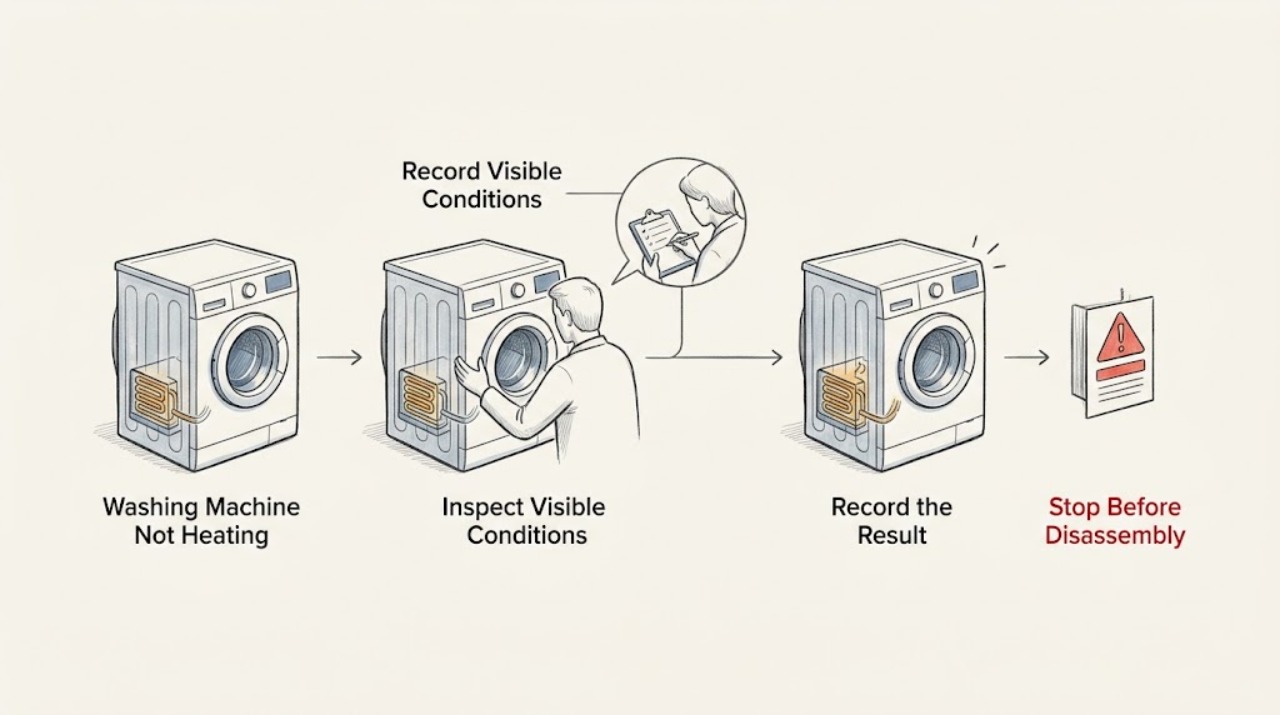
If a Bosch washing machine is not heating, first confirm that the selected programme actually requests warm water and that the washer fills and runs normally. Check the display for Bosch heating codes such as E19 or F19, which Bosch describes as heating time exceeded, and E20 or F20, which Bosch describes as unexpected heating. Do not touch the door or drain water to judge temperature because both can be hot. If a correct warm programme remains cold or a heating code returns, stop repeated cycles and arrange qualified Bosch appliance service; the heater, temperature sensor, wiring, or control may need a model-specific diagnosis.
Work through in order
Diagnostic checks
Use only checks that match the exact appliance or system and its official guide.
-
Check 1
Record the selected programme, temperature option, and any economy or cold setting before starting another test. Compare those settings with the Bosch owner manual and choose a manufacturer-approved warm programme only if the load and fabric allow it.
Expected result: If the selected programme is cold or low temperature, a cool load is expected; if a warm programme is selected but the washer never advances normally, the complaint may include a separate fill, door, or control issue.
Next step: If a correct warm programme completes with the expected result, no heater repair is indicated. If it remains cold, continue while observing the display and cycle behavior without touching hot water or the door.
Why this matters
Why: Temperature is programme-controlled, so the setting must request heat before the heating system can be judged.
-
Check 2
Run one appropriate warm programme with the washer empty or with a compatible small load, and observe the display from outside: note whether it fills, begins washing, progresses, and drains, without opening the door or handling water.
Expected result: Normal filling, tumbling, and draining with a persistently cold result isolates the complaint toward heating; failure to fill, a door fault, or a programme that stops early points to that separate issue first.
Next step: Follow the model manual for any displayed fill, drain, or door indication. If the rest of the cycle is normal but the warm result is absent, check for a heating code and arrange service if it repeats.
Why this matters
Why: Heating is one stage of a controlled wash sequence, and an upstream water, door, or control fault can prevent the heater stage from being reached.
-
Check 3
Read and record the exact error code or symbol before switching the washer off. Compare it with Bosch's washer error-code list; do not substitute a similar-looking code or assume that a generic reset repairs a heating fault.
Expected result: E19 or F19 indicates heating time has been exceeded in Bosch's list; E20 or F20 indicates unexpected heating. An unlisted code needs the exact model manual or Bosch service guidance.
Next step: Write down the code, programme, and when it appeared. If a heating code returns, stop repeated attempts and arrange qualified appliance service.
Why this matters
Why: The code changes the decision from a temperature-setting check to a model-specific heating or control diagnosis, and the E20 or F20 branch can require prompt service rather than another hot cycle.
-
Check 4
Check only the external water supply and drain path if the washer also pauses or stops: confirm the water tap is open, inlet hose is not visibly kinked, and the drain hose is not visibly blocked. Turn the tap off and disconnect power before removing any hose or filter, and beware of residual hot water.
Expected result: A supply or drain restriction can prevent a normal wash sequence, while clear external paths with normal fill and drain leave the no-heat symptom for model-specific diagnosis.
Next step: Use the exact Bosch manual for any filter or pump procedure. If the cycle remains normal but the requested warm programme stays cold, do not open the cabinet; move to service.
Why this matters
Why: A washer cannot reach or complete its heating stage reliably when water movement or a safety-controlled programme stage is interrupted.
-
Check 5
After one controlled observation, turn the programme selector to Off and record whether the washer stopped with a heating code, a cold result, an unusual smell, or a tripped electrical supply. Do not remove panels, bypass a thermostat or door lock, or test energized wiring.
Expected result: A repeated heating code or cold result on a correct warm programme supports an internal heater, temperature-sensing, wiring, or control fault; an electrical trip, smoke, or burning odor is an immediate stop condition.
Next step: Disconnect the washer when safe, keep the door closed if water may be hot, and arrange qualified service with the model number, programme, code, and observed sequence.
Why this matters
Why: The remaining diagnosis requires model-specific electrical and temperature checks that are not safe to infer from a symptom alone.
Use your observations
Decision map
Find the observation that best matches what you see, then follow the next safe action.
-
PATH 01Next step
What you see
The selected programme is cold or low temperature and no heating code is shown.
Do this next
Use the programme and temperature specified by the care label and Bosch manual; do not treat a cold result from a cold programme as a heater failure.
-
PATH 02Next step
What you see
The washer does not fill, does not lock the door, stops early, or shows a water or drain indication.
Do this next
Follow the exact model manual's external water, hose, door, or drain checks first. Do not open the cabinet or continue a cycle that leaves hot water trapped.
-
PATH 03Next step
What you see
E19 or F19 appears, or a correct warm programme repeatedly completes with a cold result.
Do this next
Stop repeated cycles and arrange qualified appliance service for a model-specific heating-system diagnosis.
-
PATH 04Next step
What you see
E20 or F20 appears, or the washer heats unexpectedly.
Do this next
Turn the programme off, avoid opening the door or draining hot water, disconnect power when safe, and arrange qualified service.
-
PATH 05Next step
What you see
There is smoke, a burning smell, a damaged cord, a repeated electrical trip, or a door or water temperature that seems unsafe.
Do this next
Stop immediately, disconnect power only if it is safe to do so, keep clear of hot water and wiring, and obtain qualified help. Do not bypass a safety device.
Helpful context
Understand the symptom
Confirm what not heating means
A cold load is not automatically a failed heater: a cold or low-temperature programme is supposed to use less heat, and a machine may pause while it controls temperature. Start by recording the programme and displayed temperature, then distinguish a programme that never requests heat from one that reports a heating fault. Bosch model controls and programme names vary, so the exact owner manual remains the authority for your machine.
Use the cycle behavior as evidence
A useful observation is whether the washer fills, tumbles, advances through the programme, and drains normally while the heating complaint appears. If the washer also has a water inlet, drain, door, or control problem, solve that branch first rather than condemning the heater. Bosch's troubleshooting material directs unresolved technical problems to an authorized servicer.
Avoid a hot-water test
Do not open the door during a running cycle, reach into the drum, or drain water merely to test temperature. Bosch washer safety documentation warns that the door and detergent solution can become very hot. Turn the programme off and disconnect power before any model-approved external inspection; do not open the cabinet or test live wiring.
Only after diagnosis
Potential parts
- heating element
Consider this part class only after a qualified diagnosis confirms that a correct warm programme reaches the heating stage but the element does not heat.
Confirm the complete Bosch model number and the model-specific parts information before selecting any component. - temperature sensor or control component
Consider this class only when model-specific testing supports a sensing or control fault rather than a programme, water, or door issue.
Do not infer fit or safety from the Bosch brand alone; use the exact model and qualified service information.
When checks do not resolve it
Need a professional?
Give the servicer the complete Bosch model number, the programme and temperature selected, whether filling, tumbling, and draining were normal, the exact error code, and when the no-heat symptom appeared. That information helps separate a programme setting or upstream water issue from the heater, temperature sensor, wiring, or control system.
Common questions
FAQ
Why is my Bosch washing machine not heating the water?
First confirm the programme requests warm water and that the washer fills, tumbles, and drains normally. If a correct warm programme stays cold or a heating code returns, stop repeated cycles and arrange qualified service.
What do E19 and F19 mean on a Bosch washing machine?
Bosch lists E19 and F19 as heating time exceeded. Record the code and programme, turn the washer off, and arrange model-specific service if the code returns.
What do E20 and F20 mean on a Bosch washer?
Bosch lists E20 and F20 as unexpected heating. Turn the programme off, avoid touching the door or draining hot water, disconnect power when safe, and arrange qualified service.
Can I replace the heating element myself?
Do not choose or replace it from the symptom alone. A heater, temperature sensor, wiring, or control fault needs model-specific diagnosis, and cabinet or energized electrical work should be left to a qualified technician.
Read the exact guide
Official sources
- Laundry Troubleshooting: Washer Error CodesBosch Home Appliances · Bosch washing machine heating-code interpretation; exact model manual governs any repair procedure
- Your washing machineRobert Bosch Hausgeräte GmbH · Bosch washing machine programme temperatures and safety guidance; verify the exact model manual
- Bosch Washing Machine Troubleshooting & Repair GuideBosch Home Appliances · Bosch washer external troubleshooting and service boundary; exact model instructions govern
Community feedback
Share a repair observation
Share a plain-text repair observation. Accepted observations are published automatically; this page may take a moment to update.