
On this page
Start here
Quick answer
A GE washing machine that seems not to heat may be receiving normal mixed-temperature water rather than failing: GE says many washers mix hot and cold water even when HOT is selected, and WARM depends on both incoming supplies. First confirm the selected cycle and compare the hot and cold supply hoses and valves without opening the appliance. If only one temperature path fails, the inlet screen or valve may be involved; if a model-specific Sanitize cycle fails to reach its intended temperature, follow that model's manual and arrange service rather than guessing at a heater or sensor. Stop for a hot electrical smell, steam or water escaping from an unsafe location, a damaged cord, a leak, or any need to access internal wiring.
Before you begin
Safety first
- This article covers ordinary user controls and external supply observation only. Do not open the washer, access energized wiring, bypass a lid or door interlock, disconnect a damaged or leaking hose, or continue operating a washer with a leak, odor, smoke, damaged cord, or uncontrolled heat.
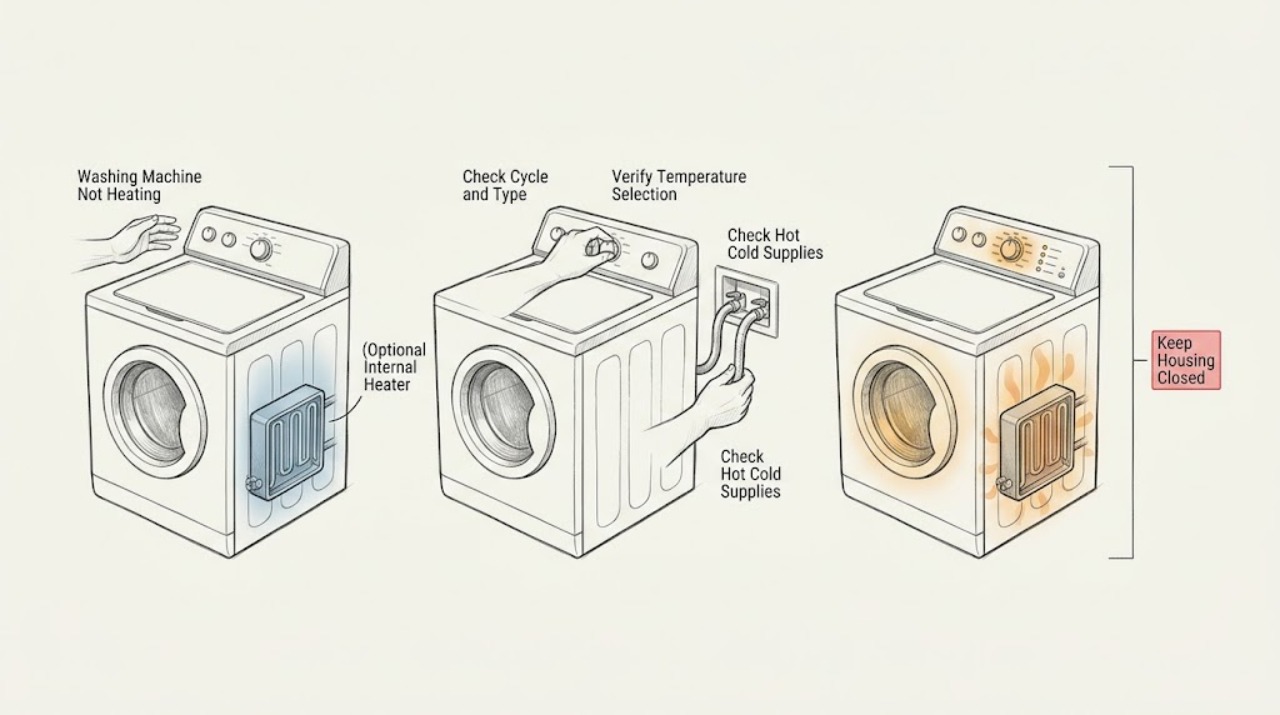
Work through in order
Diagnostic checks
Use only checks that match the exact appliance or system and its official guide.
-
Check 1
Record the GE washer model from its normal identification label or support app and note the exact cycle, temperature selection, load state, and point in the cycle at which the water seems cold.
Expected result: Note whether the complaint is on COLD, WARM, HOT, Sanitize, or another named cycle; whether the washer fills, agitates, and drains normally; and whether the display shows a fault or control lock.
Next step: Open the exact GE owner manual or support article for that model and compare its temperature behavior and cycle requirements before changing any setting.
Stop if: Stop for smoke, a burning or electrical odor, a damaged cord, water near electrical equipment, uncontrolled heat, or a leak that could reach the outlet or floor wiring.
Why this matters
Why: The cycle determines whether the washer is expected to use incoming hot water, a hot-and-cold mix, or an elevated-temperature function. Without the model and cycle, a cold-feeling fill cannot identify a failed heater.
-
Check 2
With the washer empty or loaded according to the manual, select the intended temperature and cycle using the normal controls; do not infer temperature from a short initial fill or from the feeling of wet fabric at the end of a long cycle.
Expected result: Record the selected setting, whether the control accepts it, whether the washer fills normally, and whether HOT or WARM behaves differently from COLD on a comparable cycle.
Next step: Proceed to the external supply and hose checks; use the model manual for any cycle-specific restrictions or lid/door conditions.
Stop if: Do not start a high-temperature or Sanitize cycle when the washer has a leak, damaged door or lid, abnormal odor, or an electrical fault indication.
Why this matters
Why: A mis-selected cycle or a normal hot-and-cold mix can explain the observation. A repeatable failure of only the hot selection points toward the hot supply path rather than an internal heating diagnosis.
-
Check 3
From the accessible rear connection area, verify that both household hot and cold supply valves are open and that each hose is connected to the washer inlet marked H or HOT and C or COLD; do not disconnect hoses or reach behind a moving or unstable washer.
Expected result: Record whether both valves are available, whether the hose markings match the washer inlets, and whether the problem follows the hot selection while cold water still fills.
Next step: If access is not ordinary and stable, leave the washer in place and arrange service; otherwise continue with the model-approved inlet-screen check only if the manual explicitly permits it.
Stop if: Stop for a leaking connection, corroded fitting, kinked or damaged hose, water on electrical parts, or any need to pull the washer across a wet floor.
Why this matters
Why: A closed valve or reversed hose can produce the wrong temperature without an internal heating failure. If only one side is absent despite correct external connections, the inlet screen or water-valve assembly becomes a service diagnosis.
-
Check 4
Run only the model's ordinary safe fill observation and compare whether cold water enters while hot-selected filling is absent, or whether both temperature selections fill but feel similar; do not remove the inlet screen unless the exact manual gives a safe procedure.
Expected result: Record fill behavior, flow interruption, unusual valve cycling, visible screen obstruction if already exposed by the manual procedure, and whether the household hot tap has normal hot supply.
Next step: Keep the appliance arrangement unchanged and give the technician the temperature comparison, supply result, and model; do not substitute a valve or screen based only on appearance.
Stop if: Stop if the washer leaks, the inlet connection moves, the water is unexpectedly scalding, the control behaves erratically, or an inspection would require opening the cabinet.
Why this matters
Why: A single missing temperature path can be consistent with an inlet screen or one side of the valve assembly; similar HOT and WARM behavior may be normal mixing or a household water-heater issue. A failed model-specific high-temperature cycle after supplies are confirmed needs service diagnosis.
-
Check 5
If the exact model includes Sanitize or another documented elevated-temperature cycle, check its manual requirements and run it only with a suitable, colorfast load and a safe, intact washer; do not use a higher setting as a heater test.
Expected result: Record whether the model indicates the cycle is active, whether the cycle completes, and whether the result differs from the manual's expected temperature behavior; do not rely on skin contact with water as a measurement.
Next step: Stop using the elevated-temperature cycle and request model-specific service if it aborts, remains cold, displays a fault, or produces unusual heat, odor, steam, or leakage.
Stop if: Stop immediately for scalding risk, steam escaping outside the normal dispenser or vent path, a hot electrical smell, smoke, a leak, or an abnormal cycle that will not stop through normal controls.
Why this matters
Why: Sanitize availability and temperature behavior vary by model. A failed documented cycle after correct supplies are confirmed supports service for the model's valve, sensor, control, or optional heating system, not a universal part conclusion.
-
Check 6
Before another load, classify the result as normal mixed-temperature operation, a hot-supply-only failure, a documented Sanitize or heat-function failure, or a safety or water fault.
Expected result: Record whether correcting a valve or hose setting changed the temperature, whether the same model-specific cycle still fails, and whether any leak, odor, control fault, or electrical symptom remains.
Next step: Arrange qualified GE appliance service with the model, cycle, selected temperature, supply and hose observations, display messages, and photographs of any safe external issue.
Stop if: Do not open the washer, handle internal wiring, bypass a lid or door interlock, repeatedly run a suspected faulty heater, or continue use with a leak, smoke, odor, damaged cord, or uncontrolled heat.
Why this matters
Why: Normal mixing can be left to the cycle and manual; a single missing inlet path or repeated high-temperature-cycle failure needs appliance diagnosis; a safety symptom requires the washer to remain out of service.
Use your observations
Decision map
Find the observation that best matches what you see, then follow the next safe action.
-
PATH 01Safety boundary
What you see
HOT or WARM fills with some cooler water, both supply valves and hose markings are correct, and the model manual describes temperature mixing.
Do this next
Use the temperature and cycle permitted by the manual, and address a household hot-water issue separately if the supply itself is not hot.
Why this path and its safety boundary
Why it matters: The observed temperature may be normal energy-saving operation rather than a failed washer heater.
Safety stop: Stop if the washer leaks, shows a fault, produces an odor, or behaves differently from the exact model documentation.
-
PATH 02Safety boundary
What you see
Cold selection fills but the hot selection does not, or the hot and cold hoses are reversed or the hot valve is closed.
Do this next
Correct only an obvious external valve or hose-label mismatch from a stable dry position; if the path remains absent, request model-specific service.
Why this path and its safety boundary
Why it matters: The issue is localized to the household hot supply, hose arrangement, inlet screen, or one side of the washer valve path.
Safety stop: Do not disconnect a leaking or corroded hose, open the valve body, or replace the inlet assembly without exact model guidance.
-
PATH 03Safety boundary
What you see
The exact model has a Sanitize or elevated-temperature cycle, supplies are correct, but that cycle remains cold, aborts, or displays a fault.
Do this next
Keep that cycle out of use and arrange qualified service with the model, cycle, supply result, and display or completion behavior.
Why this path and its safety boundary
Why it matters: A model-specific temperature-management, valve, sensor, control, or internal-heating issue is possible; the cycle's published time and temperature cannot be generalized across GE washers.
Safety stop: Stop all operation for steam outside the normal path, scalding risk, smoke, odor, a leak, uncontrolled heat, or a cycle that cannot be stopped normally.
-
PATH 04Safety boundary
What you see
Both washer inlet paths are connected correctly but the household hot supply is also cooler than expected at other fixtures.
Do this next
Have the household water-heating system assessed separately, and do not alter washer controls or disconnect a supply to compensate.
Why this path and its safety boundary
Why it matters: The washer may be receiving the temperature available from the home's water-heating system rather than failing to heat internally.
Safety stop: Stop for a water-heater leak, gas odor, combustion concern, scalding water, or any need to access fuel or electrical components.
-
PATH 05Safety boundary
What you see
The washer has a leak, burning or electrical odor, damaged cord, exposed wiring, erratic controls, repeated fault, or abnormal heat.
Do this next
Stop the cycle through normal controls if safe, keep the washer out of service, and contact qualified appliance service from a safe position; address any immediate water or electrical hazard through the appropriate emergency route.
Why this path and its safety boundary
Why it matters: The issue is outside ordinary temperature checks and may present electrical, water, or burn risk.
Safety stop: Do not open the cabinet, handle wiring, bypass a lid or door interlock, repeatedly reset power, or run another load to test the symptom.
Helpful context
Understand the symptom
Decide whether the issue is water temperature or a washer heating function
On many GE washers, the temperature you feel is the household water arriving at the washer, managed through the selected temperature setting and both inlet paths. GE says HOT can include cold water and WARM is a mixture, so a warm-but-not-scalding fill can be normal. A separate question applies when the exact model has Sanitize or another elevated-temperature cycle: only some models offer it, and the cycle's time and temperature are model-dependent. Identify the cycle and model before naming an internal heater, sensor, or valve as the cause.
Check both supplies before disturbing the machine
A closed hot valve, reversed hose connection, restricted inlet screen, or a failed half of the water-valve assembly can leave one temperature path missing while the washer still fills. GE directs owners to confirm both hot and cold supply valves, verify the hose markings, and compare which temperature selection works. These are external checks only. Do not pull the washer out, open its cabinet, or reach into the valve or wiring area as a first step, especially with water connected or power present.
Use the service boundary when a model-specific heat function fails
If the hot and cold supplies are correctly connected and available but a documented high-temperature cycle remains cold, or if a washer shows a control fault, leak, abnormal noise, burning odor, or electrical damage, the next decision is service. The result may involve an inlet valve, temperature sensor, control, or an internal heater on models that use one, but a generic part or temperature guess cannot establish compatibility. Keep the washer out of service when a safety symptom is present and give the technician the model, cycle, supply observations, and result.
Only after diagnosis
Potential parts
- washer water inlet valve assembly
Consider this only when correct hot and cold supplies are present but a qualified diagnosis finds one inlet path or valve side failing.
Valve ports, connectors, and temperature management vary by model; confirm the complete GE model before ordering. - washer temperature sensor
Consider this only when the exact model uses a sensor and qualified diagnosis links a recurring high-temperature-cycle failure to that sensor circuit.
Not every GE washer uses the same temperature-sensing arrangement; model-specific documentation and diagnosis are required. - washer internal heating element
Consider this only for a model documented to use an internal heater and after qualified diagnosis confirms the heater as the cause.
Some washers rely on incoming hot water or mixing rather than the same internal heater; never infer fit or failure from a cold fill alone.
When checks do not resolve it
Need a professional?
Safety scope: This article covers ordinary user controls and external supply observation only. Do not open the washer, access energized wiring, bypass a lid or door interlock, disconnect a damaged or leaking hose, or continue operating a washer with a leak, odor, smoke, damaged cord, or uncontrolled heat.
Common questions
FAQ
Why does my GE washer use cold water when HOT is selected?
GE says newer washers may add cold water to a HOT fill for energy-saving operation, so some cooler water can be normal. Confirm the exact cycle and model before treating the result as a failed heater.
What should I check when my GE washer's hot water is not working?
Confirm both household supply valves are open, verify the hoses match the washer's H and C markings, and compare HOT with COLD. If only one path remains absent, an inlet screen or valve may need model-specific service.
Does every GE washer have an internal water heater?
No conclusion can be made from the brand alone. GE says only selected washer models have a Sanitize cycle and that its temperature behavior varies by model. Use the exact owner manual before naming an internal heater or sensor.
Why is my GE washer's Sanitize cycle not heating?
First confirm the model includes Sanitize, the hot and cold supplies and hose routing are correct, and the cycle is selected as the manual describes. If the cycle stays cold, aborts, or shows a fault, stop using it and arrange model-specific service.
When should I stop using a GE washer that is not heating?
Stop for a leak, burning or electrical odor, smoke, a damaged cord, exposed wiring, abnormal heat, erratic controls, or water near electrical equipment. Do not open the washer or bypass a lid or door interlock; request qualified service.
Read the exact guide
Official sources
- Washer - Hot Water Not Working or Not Hot EnoughGE Appliances · Official GE Appliances washer support; exact temperature behavior varies by washer design and model.
- GIVE YOUR HOME THE ULTIMATE CLEAN WITH SANITIZE CYCLESGE Appliances · Official GE Appliances overview for supported laundry products; exact cycle operation remains model-specific.
- Washer - Sanitize CycleGE Appliances · Official GE Appliances support for washer models that include a Sanitize cycle; it does not establish behavior for models without that cycle.
- FAQs | WashersGE Appliances · Official GE Appliances washer FAQ; individual troubleshooting procedures depend on model.
- Washer - Water Temperature ConcernsGE Appliances · Official GE Appliances washer support; model-specific installation and service instructions control.
Community feedback
Share a repair observation
Share a plain-text repair observation. Accepted observations are published automatically; this page may take a moment to update.