
On this page
Start here
Quick answer
Cold clothes at the end of an AEG wash do not by themselves prove a heating fault because the final rinse is normally cold. Check that the selected programme is not a cold or low-temperature option, then run an empty Cotton cycle at a warm setting allowed by the model manual and check the outer door during the wash, before the rinse. If the door stays cold on that test, or the display shows E60, stop using the appliance and arrange qualified service; the heater and its controls require internal electrical diagnosis.
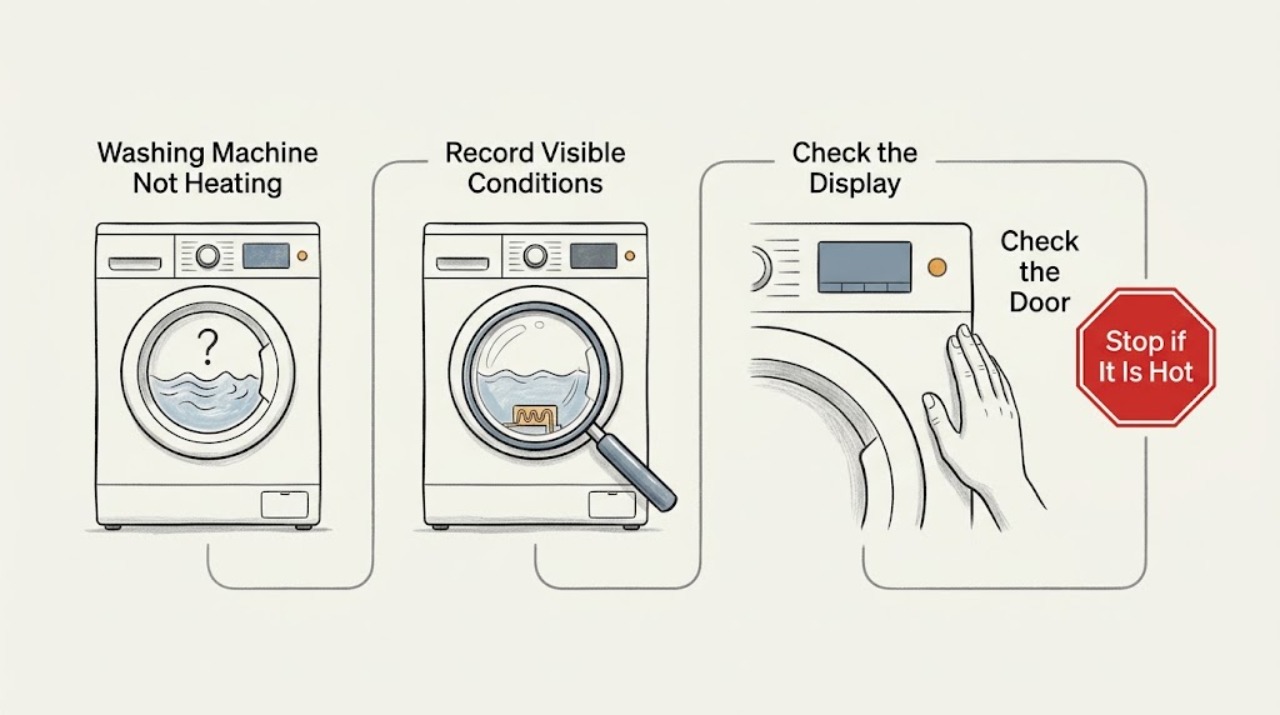
Work through in order
Diagnostic checks
Use only checks that match the exact appliance or system and its official guide.
-
Check 1
Record when the coldness is noticed: immediately after the final rinse, during the main wash, or throughout the whole cycle. Also record the selected programme, temperature indicator, and any displayed error code.
Expected result: Cold laundry only at the end is compatible with a normal cold rinse. A cold outer door during the main wash on a warm programme is a stronger sign of a heating problem. AEG identifies E60 as a possible heater fault indication.
Next step: If the clothes are only cold at the end, continue with the programme-setting check. If the door stays cold during a warm wash or an error code is present, continue once with the safe confirmation below, then escalate.
Why this matters
Why: This prevents a normal rinse temperature from being mistaken for a failed heater and gives service staff useful symptom timing.
-
Check 2
With the washer idle, select a programme and inspect the temperature indicator or cold-wash symbol. Make sure the setting is not explicitly cold and has not been reduced to a low temperature by an option button; use only settings suitable for the load and the model manual.
Expected result: A cold-wash symbol or low setting means the machine is being asked not to heat, so cold water can be expected. A clearly warm setting means the heating system should be assessed during the wash phase.
Next step: If the programme was cold, choose an appropriate warm setting and run one supervised test. If it was already warm, use the empty-drum heating check rather than repeatedly changing options.
Why this matters
Why: AEG notes that programme defaults differ and that the temperature can be reduced to a cold wash without a machine fault.
-
Check 3
Run one empty Cotton cycle at a warm temperature permitted by the model manual. Keep the door closed and, during the wash phase before the final rinse, check only whether the outside of the door becomes noticeably warm; do not open the door or touch water inside the drum.
Expected result: A warm outer door during the wash supports normal heating. If it remains cold on a correctly selected warm cycle, the heating system may not be operating. AEG recommends a service visit when this test stays cold.
Next step: If the door warms, the heater is likely working and the original symptom was programme or rinse related. If it stays cold, stop further user troubleshooting and provide the model and test result to a qualified appliance technician.
Why this matters
Why: The timing matters: a cold final rinse is normal, while no warmth during the main wash is the useful distinction.
-
Check 4
Watch the display during the test and write down the exact code, beeps, or flashing indicators without attempting to clear the fault repeatedly. Compare the code only with the model-specific AEG manual or support guidance.
Expected result: AEG associates E60 or a similar heating code with a possible heater fault. A different code can point to another system, so it should not be treated as proof that the heater failed.
Next step: For E60, a recurring fault, or a code you cannot identify, stop using the warm test and arrange qualified service. Do not open the cabinet to inspect the heater or wiring.
Why this matters
Why: An exact code changes the technician's diagnostic path and avoids replacing a part based only on cold laundry.
-
Check 5
Before any further cycle, look and listen for an active leak, burning smell, unusual electrical noise, repeated circuit interruption, or a damaged plug or cord. Keep the inspection external and do not move a heavy washer to reach hidden connections.
Expected result: Any of these signs increases the safety risk and is not a routine temperature-setting issue. No such sign does not prove that an internal heater is safe to repair yourself.
Next step: If any warning sign is present, stop using the washer and disconnect power only if the plug is safely reachable without touching water or damaged wiring; close the water supply for a leak if safely reachable, then call a qualified technician. Otherwise, escalate persistent no-heat after the single warm test.
Stop if: Stop immediately for burning smell, water near electrical equipment, damaged wiring, repeated tripping, or smoke.
Why this matters
Why: Heating faults involve mains-powered components; the user boundary ends before cabinet access or electrical measurement.
Use your observations
Decision map
Find the observation that best matches what you see, then follow the next safe action.
-
PATH 01Safety boundary
What you see
The laundry is cold only when the programme has finished, and the outer door warmed during the main wash.
Do this next
Treat the cold final rinse as normal. Review the programme and load instructions if cleaning results are poor, but do not replace a heater based on this symptom alone.
Why this path and its safety boundary
Safety stop: Continue to the setting and warm-cycle checks.
-
PATH 02Safety boundary
What you see
The selected programme shows a cold wash or an intentionally low temperature.
Do this next
Choose a suitable warm setting allowed by the model manual and run one supervised empty test.
Why this path and its safety boundary
Safety stop: Use the warm Cotton test to observe the door during the wash phase.
-
PATH 03Safety boundary
What you see
The door stays cold during the wash on a correctly selected warm programme, or E60 appears.
Do this next
Stop further user checks and arrange qualified appliance service. Do not remove panels or perform live electrical tests.
Why this path and its safety boundary
Safety stop: If the door warms, the heating system is operating and the original cold-at-end observation was likely normal or programme-related.
-
PATH 04Safety boundary
What you see
There is burning smell, smoke, water near electrical equipment, damaged wiring, or repeated circuit interruption.
Do this next
Stop immediately, isolate power only from a safe accessible point, close the water supply for a leak if safe, and call a qualified appliance technician or electrician as appropriate.
Why this path and its safety boundary
Safety stop: Do not keep running cycles to see whether the fault clears; arrange service for persistent no-heat after the single safe test.
Helpful context
Understand the symptom
First separate normal cooling from a heating fault
A washing machine may finish with cold laundry because the last rinse is normally cold. Modern programmes can also use lower temperatures than an older machine, and insulated door glass may feel less warm. Judge the heating system during the wash phase of a deliberately warm programme, not by the temperature of clothes at the end.
Keep the electrical boundary clear
The checks below use programme settings, observation, and external safety checks only. Do not remove panels, disconnect heater wiring, bypass a safety device, or test live voltage. If the washer trips protection, smells of burning, leaks, or shows signs of damaged wiring, stop using it and arrange professional help.
Only after diagnosis
Potential parts
- washing machine heating element
Consider this only after a qualified technician confirms that the heater is not operating and the selected programme was meant to heat.
Confirm the complete AEG model identification and have the technician verify the part before obtaining a replacement. - washing machine temperature sensor
Consider this only when a technician's diagnosis identifies a failed temperature-sensing component rather than a programme-selection issue.
Fitment and diagnosis are model-specific; do not substitute a sensor based only on cold laundry.
Common questions
FAQ
Why are my AEG washing machine clothes cold at the end?
The final rinse is normally cold, so cold laundry at the end does not prove a heater fault. Check for warmth during the main wash on a suitable warm programme instead.
How can I tell whether my AEG washer is heating?
Run one empty Cotton cycle at a warm setting allowed by the model manual and check the outside of the door during the wash, before the final rinse. Warmth supports normal heating; a cold door warrants service.
What does E60 mean on an AEG washing machine?
AEG identifies E60 as a possible heating-system fault indication. Record the exact code and arrange qualified service rather than removing panels or testing the heater yourself.
Read the exact guide
Official sources
- Washing machine does not heat up and does not display an error messageAEG · AEG washing machine programme temperature selection and no-heat checks
- The clothes are cold after washingAEG · AEG washing machine normal cold rinse and heating confirmation
- What are the most common washing machine faults and how do I fix them?AEG · AEG washing machine repair safety and professional-help boundary
Community feedback
Share a repair observation
Share a plain-text repair observation. Accepted observations are published automatically; this page may take a moment to update.