
On this page
Start here
Quick answer
Do not judge heating during a cold-fill, rinse, spin, economy, or early programme stage: many programmes use little or no heat at that point, and the machine may heat only after filling and beginning the main wash. First identify the model and programme, confirm the selected temperature is not cold or reduced, and observe whether the machine fills, tumbles, pauses, and completes the expected stage. Check the water supply, door, drain hose, filter, and any exact error code. Indesit lists F03 as a temperature-sensing fault, F07 as an electronic/heating-circuit fault, F08 as a heater fault, and F15 as a heater-control fault, but codes and procedures vary by model. Stop for scalding water, a leak near electrics, burning smell, smoke, arcing, or a repeated breaker trip; do not open panels or test the heater live.
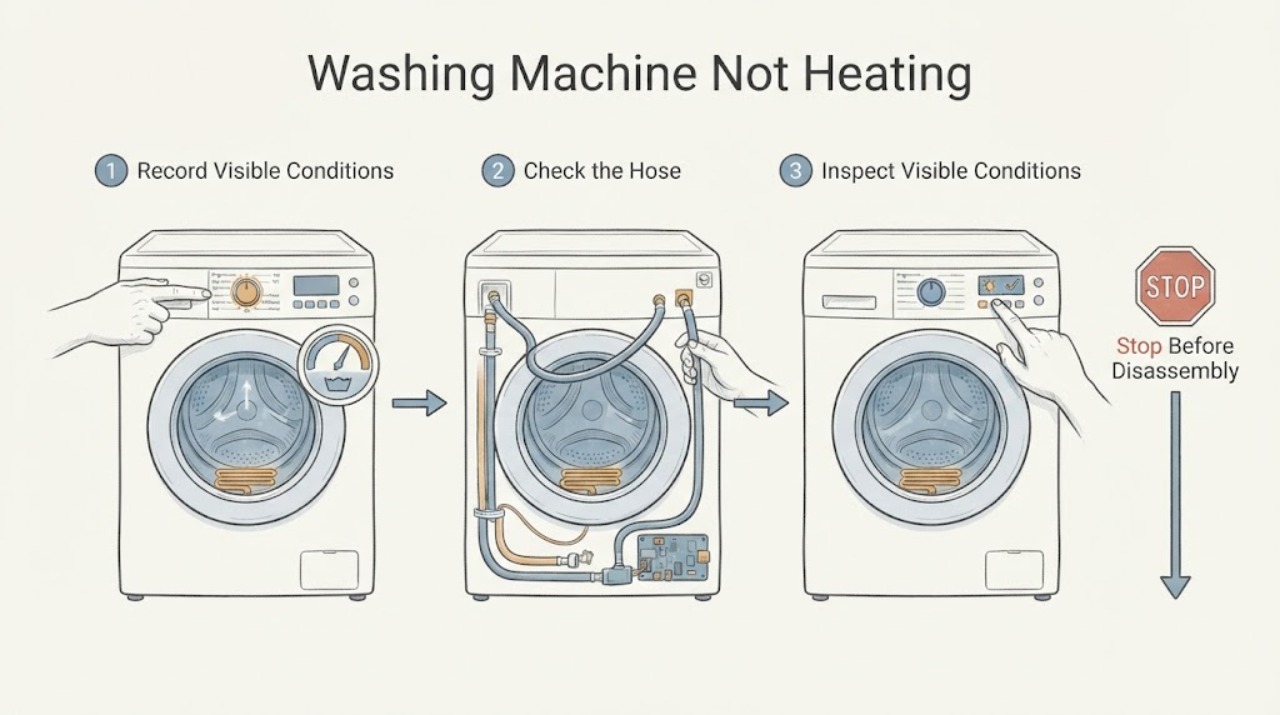
Work through in order
Diagnostic checks
Use only checks that match the exact appliance or system and its official guide.
-
Check 1
Record the Indesit model, programme name, selected temperature, option buttons, display or flashing-light pattern, and the stage at which you expect heating. Compare the programme with the exact user manual and avoid using a cold, rinse, spin, economy, or quick stage as the heating test.
Expected result: The chosen programme is cold/low-temperature or still in fill/tumble/rinse/spin, the selected temperature is higher, or the machine pauses or stops at the expected heating stage.
Next step: Use a model-appropriate programme and observe the sequence from outside without touching hot water or glass. If the programme stalls at heating, record the exact stage and continue with the water, drain, and code checks.
Stop if: Do not touch the door glass or drain water as a temperature test, and do not run a high-temperature cycle when there is a leak, electrical fault, or unsafe installation.
Why this matters
Why: A cool early stage may be normal and does not establish a heater failure. A machine that repeatedly stops or fails to advance during the main wash heating stage has a meaningful symptom that should be correlated with water supply, drain, and codes.
-
Check 2
Check the incoming water path from a dry position: verify the household cold-water tap is open, the fill hose is not kinked or crushed, the visible connection is not leaking, and the machine's door is closed firmly. Do not disconnect a pressurized hose or reach behind a wet appliance.
Expected result: The tap is closed, the hose is kinked or leaking, a tap symbol or fill warning appears, the door does not latch, or filling completes normally.
Next step: Open the tap and correct only a plainly visible hose position or door obstruction, following the manual. If the hose connection leaks, the inlet is blocked, or the machine still cannot fill, stop and arrange service.
Stop if: Do not loosen fittings, bypass the door lock, operate with water near the outlet, or continue if the machine is leaking or the floor is wet.
Why this matters
Why: The machine cannot progress to its heating stage without the required fill. Indesit identifies a water-supply problem as a cause of a programme stopping mid-cycle, and a door that is not closed prevents normal operation; a normal fill shifts attention toward the drain, programme, sensor, heater, or control.
-
Check 3
Observe the programme after a normal fill without opening the door. Note whether the drum tumbles, the machine pauses at the main wash stage, advances through wash and rinse, or ends with water still inside. Keep hands away from the door, drum, and any hot or moving water.
Expected result: The machine fills and advances normally, pauses during the main wash, stops with water inside, or reaches the end indicator without a heating stage.
Next step: Match the observed phase to the model manual. If water remains, first follow the manual's safe drain/filter and hose checks; if the machine pauses only at heating, record the phase and inspect codes before service.
Stop if: Do not open the door against a lock, drain hot water by hand, reach into a moving drum, or continue a cycle with standing water near electrical parts.
Why this matters
Why: A programme that ends normally may be using a low or cold temperature rather than failing to heat. A pause during the expected heating stage can involve heater control or sensing; standing water can prevent completion and may be a drain or pump problem that is separate from the heater.
-
Check 4
Check the drain path only when the machine is switched off and the water is cool enough for the model's manual procedure. Inspect the visible drain hose for kinks or crushing, confirm the standpipe or under-sink connection is positioned as specified, and clean the pump filter only if the exact manual provides a safe user procedure and there is no hot or contaminated water.
Expected result: The drain hose or plumbing is blocked/kinked, the filter contains debris, water remains after a pump-out, the pump runs continuously, or drainage is clear and the machine empties normally.
Next step: Correct a visible hose position or clear an accessible filter only as the manual directs, then run the model's safe drain check. If water remains, a pump runs continuously, or the code returns, stop and arrange service before further heating tests.
Stop if: Do not remove a filter with hot water behind it, work with standing water and connected power, force a locked door, or dismantle the pump or drain system.
Why this matters
Why: Indesit identifies a blocked or incorrectly positioned drain path as a cause of stopping mid-cycle or not emptying. The official error page associates F05 with a waste-pipe blockage or pump issue, F07 with a heating-circuit fault where the pump may run continuously, and F11 with a pump-circuit fault; these signals require model-aware interpretation.
-
Check 5
Read and record every displayed code or flashing-light pattern exactly, including the programme phase and whether the pump runs. Compare it with the official Indesit error-code page and the exact model manual; do not infer a code from a similar-looking light pattern.
Expected result: The machine shows F03, F07, F08, F15, F05, F11, another code, or no code while failing to heat.
Next step: Follow only the code procedure for the exact model. If a documented safe reset is allowed, perform it once; if the code returns or the machine still does not heat, record it for a qualified technician.
Stop if: Do not repeatedly reset a fault, bypass a sensor or heater, open the control panel, or continue a high-temperature cycle after a fault code with smoke, odor, leak, or electrical symptom.
Why this matters
Why: Indesit describes F03 as a temperature-sensing fault, F07 as an electronic/heating-circuit fault, F08 as a heater fault, and F15 as a heater-control fault for washing machines or washer dryers. F05 and F11 point toward waste/pump issues. A code is a diagnostic direction, not permission to replace a part without model evidence.
-
Check 6
If no fill or drain problem explains the symptom, assess the heating result through the programme behavior rather than touching the glass. Note whether the machine pauses during the main wash, completes a full programme with consistently cold water on a confirmed heated setting, or resumes after a single manual-approved reset.
Expected result: The machine completes the heated programme, pauses repeatedly at heating, completes with cold water, or a reset changes the result only temporarily.
Next step: Stop using high-temperature programmes until the issue is resolved if the machine stalls, overheats, or gives a code. Provide the programme, temperature setting, phase, code, fill/drain result, and reset history to service.
Stop if: Do not measure resistance, remove panels, access terminals, or handle the heater or sensor with the appliance connected to mains.
Why this matters
Why: Repeated failure at the heating phase can involve the heater, temperature sensor, heater relay/control, wiring, or a protection device. A one-time recovery does not prove the heater is healthy; recurring failure needs service diagnosis.
-
Check 7
Protect yourself and the appliance while deciding whether to continue. Look for scalding water, standing water by the outlet, a leak, burning smell, smoke, arcing, a hot plug, damaged cord, unusual vibration, or a breaker that trips when the machine heats. If any appears, stop the programme and isolate power only from a dry safe position when possible.
Expected result: A heat, water, fire, or electrical hazard is present, or the machine remains dry, stable, and free of abnormal odor or electrical symptoms.
Next step: For a hazard, keep the machine off and arrange qualified appliance/electrical service. If no hazard exists, complete only the model-specific low-risk programme, fill, drain, and code checks.
Stop if: Stop immediately for scalding water, standing water near electrics, burning smell, smoke, arcing, damaged insulation, or repeated breaker trips; do not reproduce the fault.
Why this matters
Why: The user-level checks are no longer appropriate when hot water, wet electrics, fire signs, or a circuit fault is involved. Continuing can cause burns, shock, fire, or further appliance damage.
-
Check 8
If the fault persists, record the model, programme and temperature, stage of failure, fill and drain result, exact code or light pattern, whether the drum tumbles, whether water remains, and any reset or safety symptom. Arrange qualified service for the heater, sensor, control, pump, lock, wiring, or other internal diagnosis.
Expected result: A simple programme or hose correction restores normal completion, or the washer still completes cold, pauses at heating, leaves water, or repeats a code.
Next step: Monitor only a normal completed cycle after a simple correction. Otherwise keep the machine off or on a safe non-heated state and provide the symptom record to service.
Stop if: Stop user troubleshooting for any internal access, unsafe hot water, wet electrical area, burning smell, smoke, arcing, or repeated breaker trip.
Why this matters
Why: A corrected setting or external obstruction is different from a persistent heating-system fault. Indesit identifies several temperature, heater, control, and pump fault paths that require an engineer when they remain after safe checks.
Use your observations
Decision map
Find the observation that best matches what you see, then follow the next safe action.
-
PATH 01Safety boundary
What you see
The selected programme is cold, low-temperature, rinse, spin, economy, quick, or still before its heating stage.
Do this next
Do not use that stage to judge heating; use the exact manual to select a programme that is intended to heat and observe its phase.
Why this path and its safety boundary
Safety stop: Continue with fill, drain, and error-code checks.
-
PATH 02Safety boundary
What you see
The machine cannot fill, shows a tap/fill warning, the door does not latch, or the inlet hose is kinked or leaking.
Do this next
Correct only a visible tap, hose-position, or door obstruction allowed by the manual; service persistent fill, lock, or leak faults.
Why this path and its safety boundary
Safety stop: Observe whether the machine reaches the main wash heating phase.
-
PATH 03Safety boundary
What you see
The programme stops with water inside, the pump runs continuously, or the drain hose/filter/plumbing is blocked.
Do this next
Use only the exact manual's cool-water drain and filter procedure; service persistent water, pump, or F05/F11/F07 symptoms before testing heat.
Why this path and its safety boundary
Safety stop: Continue with the exact heating-phase and code interpretation.
-
PATH 04Safety boundary
What you see
The display or lights show F03, F07, F08, or F15 during a wash or at the heating stage.
Do this next
Record the exact code and programme phase and arrange model-specific service if the code returns; do not replace or bypass a heater or sensor blindly.
Why this path and its safety boundary
Safety stop: Do not infer a heating fault from a cold early or non-heating programme; continue safe observation.
-
PATH 05Safety boundary
What you see
A confirmed heated programme repeatedly completes cold or pauses at heating after fill and drain are normal.
Do this next
Keep the machine off heated programmes and arrange qualified service for conditional heater, temperature-sensor, wiring, or control diagnosis.
Why this path and its safety boundary
Safety stop: Monitor a normal completed cycle after a documented external correction.
-
PATH 06Safety boundary
What you see
Scalding water, standing water near electrics, a leak, burning smell, smoke, arcing, cord damage, or a repeated breaker trip is present.
Do this next
Stop immediately, isolate power only from a dry safe position when possible, do not reproduce the fault, and arrange qualified service.
Why this path and its safety boundary
Safety stop: Complete only the exact model's low-risk checks.
-
PATH 07Safety boundary
What you see
The machine remains cold or stalled after all applicable programme, fill, drain, and code checks.
Do this next
Provide service with the model, programme, temperature, failure phase, code/light pattern, fill/drain observations, and safety symptoms.
Why this path and its safety boundary
Safety stop: Continue normal use while monitoring the corrected condition for recurrence.
Helpful context
Understand the symptom
A washing machine does not heat continuously. It normally fills first, then may tumble or pause while the selected wash temperature is reached; rinse and spin stages are not a reliable heating test. Economy, quick, cold, and low-temperature settings can make the door or laundry feel cool. The useful question is whether the machine reaches the heating stage and then advances, pauses, or reports a fault—not whether the first water feels warm.
Indesit models use different displays, indicator lights, programmes, and service codes. The official Indesit error-code page identifies F03, F07, F08, and F15 in different temperature, heating-circuit, heater, and heater-control situations, while F05 and F11 relate to drainage or pumping. Record the exact code and programme phase; do not apply a code from one model to another.
Heating diagnostics can expose hot water, moving parts, and mains electricity. Never touch the door glass or drain water to decide whether it is hot. If there is standing water, isolate power only from a dry and safe position; if the machine leaks near an outlet, smells burnt, smokes, arcs, or trips the breaker, stop immediately and arrange qualified service.
Only after diagnosis
Potential parts
- water-heating element
Only consider this part after a qualified diagnosis confirms a heater fault on the exact model, rather than relying on a cold early programme or a generic symptom.
Confirm the full model and the manufacturer's parts information before any order; do not install or test a heater while connected to mains. - temperature sensor
Only consider this part when the exact model code or professional testing identifies a temperature-sensing fault such as F03.
Sensor design and fit vary by model; use the full model information and qualified installation. - drain pump
Only consider this part when a persistent drainage fault remains after the manual's safe hose and filter checks and a pump fault is confirmed.
Confirm model fit and electrical safety with the manufacturer's parts information or a qualified technician.
When checks do not resolve it
Need a professional?
Provide the model, programme and temperature, stage where it pauses or completes, exact display/light code, fill and drain result, door/lock behavior, drum movement, reset history, and any scalding, leak, odor, smoke, arc, or breaker symptom.
Have this ready
- Have the model manual, a written sequence of observations, and photos of any code or visible hose issue taken from a dry safe position. Do not open panels, handle hot water, or test mains components.
Common questions
FAQ
How can I tell if my Indesit washing machine is really not heating?
Check the selected programme and temperature first. A cold-fill, rinse, spin, economy, quick, or early wash stage may not feel warm. Observe whether the machine reaches its main wash heating phase and then pauses, completes cold, or displays a code; do not touch the door glass or drain water as a test.
Can a water-supply problem make an Indesit machine appear not to heat?
Yes. If the machine cannot fill, it may never reach the heating phase and may stop mid-cycle. Check the tap, visible inlet hose position, door closure, and any tap warning as the manual allows; service a persistent fill or leak problem.
Can a blocked drain cause an Indesit heating problem?
A blocked or incorrectly positioned drain can leave water inside or stop the programme, making heating symptoms hard to interpret. Indesit associates F05 and F11 with waste or pump faults and F07 can include a heating fault with a continuously running pump. Follow only the model's cool-water drain procedure.
What do F03, F07, F08, and F15 mean on an Indesit washing machine?
On Indesit's published washing-machine code guide, F03 indicates a temperature-sensing fault, F07 an electronic or heating-circuit fault, F08 a heater fault, and F15 a heater-control fault. Record the exact code and model because code behavior and repair instructions can vary.
Should I replace the heating element or temperature sensor myself?
Not from the symptom alone. A confirmed heated programme that remains cold can involve the heater, sensor, control, wiring, or another condition. Keep the machine disconnected and have the exact model and fault code diagnosed before considering a conditional part.
When should I stop using an Indesit washing machine that is not heating?
Stop for scalding water, standing water near the outlet, a leak, burning smell, smoke, arcing, damaged insulation, unusual heat, or a breaker that trips. Isolate power only from a dry safe position when possible and arrange qualified service; do not reproduce the fault.
Read the exact guide
Official sources
- Indesit Washing Machine Repairs | Indesit ServiceIndesit Service · Official Indesit repair landing page used for model-specific manual and indicator-light caution.
- Indesit | Washing Machine Faq | Indesit ServiceIndesit Service · Official Indesit troubleshooting guidance used for fill, drain, door, programme, and model-variation checks.
- Indesit | Washing Machine Error Codes | Indesit ServiceIndesit Service · Official Indesit guidance for the listed code families; exact model and display style control.
Community feedback
Share a repair observation
Share a plain-text repair observation. Accepted observations are published automatically; this page may take a moment to update.