
On this page
Start here
Quick answer
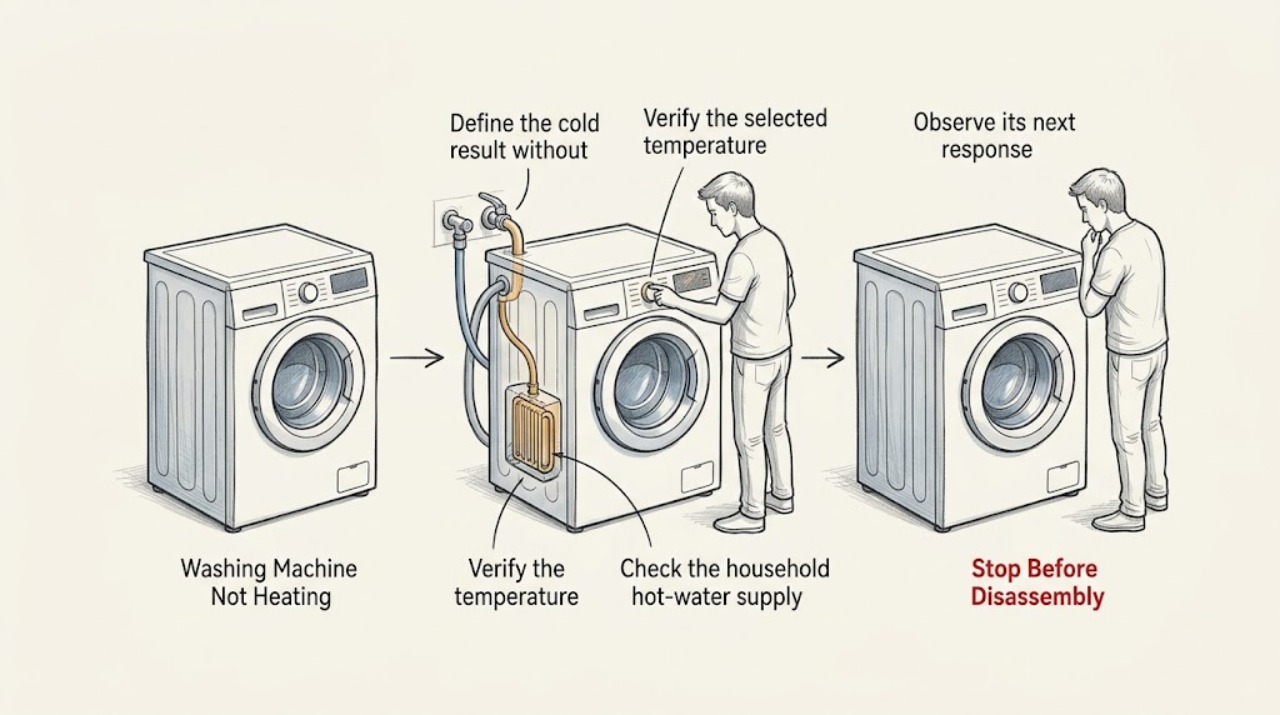
Most Kenmore washers do not make all of their hot wash water internally: the selected cycle may blend incoming hot and cold water, while only some models add an internal heater or steam option. Start by comparing the selected temperature with what the load actually receives, not by assuming a failed heater. Check the exact Kenmore manual for the model's temperature behavior, then safely confirm that the household hot-water supply is available and that the hot and cold connections are not reversed or restricted. A cold result can be normal for a cold or energy-saving cycle, a short first fill, a long run from the water heater, or a model that regulates temperature. If a model that supports internal heating stays cold on its documented heated or sanitize cycle, or shows a fault, arrange qualified service. Stop for scalding water, leaks near electrical parts, burning smell, arcing, damaged cords, or repeated breaker trips; do not open the washer or test live wiring.
Work through in order
Diagnostic checks
Use only checks that match the exact appliance or system and its official guide.
-
Define the cold result without touching hot water
Record whether the complaint is cold water entering, laundry that stays cold after a complete cycle, or a heated or sanitize cycle that never reaches its documented result. Note the selected temperature, cycle, load, and stage at which the water was observed. Do not put hands into the tub or handle hot water to estimate temperature.
Expected result: Only a cold or energy-saving cycle is cold, the initial fill is cool, all cycles are cold, or a model-documented heated cycle remains cold.
Next step: Use the exact Kenmore manual to identify the cycle's expected behavior, then continue with the household hot-water and model-feature checks. Treat a scald risk as a stop condition.
Why this matters
Why: The result separates normal cycle behavior or incoming-water conditions from a possible temperature-control or internal-heating fault.
-
Verify the selected temperature and cycle
With the washer empty or unloaded only when the manual permits, select a cycle and temperature that the exact model documents as warm, hot, sanitize, or steam-capable. Confirm that an energy-saving, cold-clean, rinse-only, or fabric-protective option has not replaced the requested temperature; follow fabric-care labels and do not choose heat that could damage the load.
Expected result: The selected cycle is intentionally cold or temperature-limited, the display changes to a warmer option, or the documented heated cycle still behaves cold.
Next step: Run only the model-documented safe selection once. If a supported heated cycle still stays cold, record the display and cycle result for qualified service rather than repeating tests.
Why this matters
Why: Cycle controls can change the target temperature and may regulate hot and cold input; a cold result on a cold setting does not prove that a heater failed.
-
Check the household hot-water supply safely
At a nearby household faucet, confirm that hot water is available without opening the washer hoses. Note whether the water heater has recently been heavily used, whether the washer is far from the heater, and whether hot water arrives only after the supply line runs. Do not alter a water-heater setting or handle very hot water without scald protection.
Expected result: The nearby faucet never becomes hot, hot water is delayed or depleted after several loads, or the household supply is normal while the washer result remains cold.
Next step: Resolve a household water-heating issue through the appropriate qualified service route. If the home's hot supply is normal, continue with model-specific inlet and temperature checks; do not infer an internal part yet.
Why this matters
Why: A washer that relies on incoming hot water cannot heat a load beyond the supply it receives; a normal household supply with a documented heated-cycle failure points back toward the appliance or its control logic.
-
Inspect accessible hot and cold inlet context
With the washer stopped and the water supply handled according to the exact manual, look only at accessible valves and hoses for a closed supply, a visible kink, leakage, or signs that hot and cold connections may be reversed after installation. Do not disconnect a hose, remove inlet screens, or put hands near hot water unless the model instructions explicitly make that a safe, cool, isolated task.
Expected result: A valve is closed, a hose is kinked, a connection appears reversed, a leak is present, or the accessible installation appears correct.
Next step: For a visible supply-setting issue, use the model manual or a qualified installer to correct it and check for leaks. For a leak or uncertain connection, stop and arrange service rather than loosening the line.
Why this matters
Why: Restricted, reversed, or unavailable hot input can make a washer's warm or hot selection appear ineffective; a leak adds a water and electrical hazard and should not be tested further.
-
Determine whether this model has internal heating or steam
Enter the complete Kenmore model number in the official manual resources and read the specifications for water heating, temperature sensing, sanitize, or steam features. Compare the documented feature with the cycle used; do not assume that a different Kenmore model's heater or steam option applies to this washer.
Expected result: The manual identifies a non-water-heating design, an internal heater or steam feature, or no reliable manual is available for the model.
Next step: For a non-water-heating model, focus on cycle selection and household hot supply. For a documented heater or steam model that stays cold, arrange qualified service. If the model cannot be confirmed, do not open the washer or assume a feature exists.
Why this matters
Why: A non-water-heating washer depends on incoming hot water, while a water-heating model can have an additional heater or sensor path; the service diagnosis changes accordingly.
-
Escalate a documented heated-cycle failure
Record the model number, selected cycle and temperature, household hot-water result, inlet observations, displayed messages, cycle time or stage, and whether the water remained cold throughout. Stop the washer if there is scalding water, a leak near electrical parts, burning smell, arcing, abnormal heat, a damaged cord, or a tripped breaker.
Expected result: A documented heated or sanitize cycle remains cold after the supply checks, an error returns, or any electrical, water, smoke, heat, or breaker symptom occurred.
Next step: Keep the washer out of service as appropriate and arrange qualified Kenmore appliance repair. Do not open panels, test live terminals, defeat a safety device, or repeatedly reset a tripping circuit.
Why this matters
Why: The remaining possibilities include a temperature sensor, heater, inlet valve, control, wiring, or an installation fault that cannot be safely confirmed by a consumer.
Use your observations
Decision map
Find the observation that best matches what you see, then follow the next safe action.
-
PATH 01Next step
What you see
Only a cold, energy-saving, rinse, or fabric-protective cycle produces a cold result.
Do this next
Treat the result as cycle-dependent until the exact manual says otherwise. Use a documented warm or hot cycle once if safe for the load, and stop if a hazard appears.
-
PATH 02Next step
What you see
The nearby household faucet has no hot water or hot water is depleted or delayed.
Do this next
Address the household water-heating or supply issue through qualified service; a washer that relies on incoming hot water cannot correct an absent hot supply.
-
PATH 03Next step
What you see
The hot and cold connections appear reversed, a valve is closed, or an inlet hose is visibly kinked.
Do this next
Use the exact manual or a qualified installer to correct the accessible installation and check for leaks. Do not loosen a pressurized or hot connection as a home test.
-
PATH 04Next step
What you see
The exact model is non-water-heating and the household hot supply is normal.
Do this next
Use the model's documented temperature and cycle behavior; if the result remains outside that guidance, arrange qualified service for the inlet or control path.
-
PATH 05Next step
What you see
The exact model documents internal heating or steam, but a supported heated or sanitize cycle remains cold.
Do this next
Keep the washer out of service as appropriate and arrange qualified diagnosis of the heater, sensor, control, and supply. Do not open the cabinet or repeat a long heated test.
-
PATH 06Next step
What you see
Scalding water, a leak near electrical parts, burning smell, arcing, abnormal heat, a damaged cord, or a repeated breaker trip is present.
Do this next
Stop using the washer and do not touch wet energized equipment. Keep people away from the hazard and obtain qualified or emergency help as appropriate.
Helpful context
Understand the symptom
What not heating means on a washer
A washer can appear not to heat even when it is working as designed. Some machines use the home's hot-water supply, some regulate a blend of hot and cold water, and some models generate part of the heat internally. A cold cycle, a short first fill, or water that cools in a long supply run is different from a heated or sanitize cycle that never reaches its documented behavior. The model number and cycle are essential.
Check the water path before suspecting an internal heater
Confirm that the selected cycle is intended to use warm or hot water and that the home has hot water available. Look for accessible signs of a closed supply, reversed hot and cold connections, or a kinked inlet hose, but do not loosen a pressurized hose while the machine is connected. A hot-water issue at the household tap can affect a washer that relies on incoming water rather than internal heating.
Internal heat and steam are model-dependent
Energy Star defines water-heating and non-water-heating washer categories, and Kenmore's washer range includes models with different cycles and temperature features. Do not assume that every Kenmore washer has a heater, steam generator, or the same temperature sequence. If the exact manual documents internal heating and the heated cycle remains cold, the heater, sensor, control, or supply may need qualified diagnosis.
Safety boundary
Stop conditions
- Stop immediately for a leak near electrical parts, scalding water, burning smell, smoke, arcing, abnormal heat, a damaged cord, or a breaker that trips again.
- Do not put hands into the tub to judge temperature, loosen hot or pressurized hoses, open the cabinet, test live wiring, or bypass a lid or door safety device.
- Do not assume every Kenmore washer has an internal heater or steam feature; verify the exact model manual before choosing a heated-cycle diagnosis.
- Stop repeated testing when a supported heated cycle remains cold or an error returns, and arrange qualified repair.
Only after diagnosis
Potential parts
- internal water-heating element
Consider only when the exact manual confirms an internal heater and qualified diagnosis links a supported heated-cycle failure to that element.
Many washers do not heat water internally; confirm the complete model and manufacturer fit information before ordering. - temperature sensor or thermostat
Relevant only when model-specific testing connects incorrect temperature control or a heater fault to the sensor or thermostat.
Do not infer the part from a cold load alone; qualified diagnosis and exact model confirmation are required. - hot or cold inlet valve
Consider only when qualified diagnosis finds that the correct incoming-water path is not being controlled or supplied after accessible checks.
Turn off water safely before any service work and confirm exact model fit; do not work around leaks or hot water. - electronic control or wiring component
Relevant only when a persistent heated-cycle or temperature-control fault is traced to the control or wiring by qualified service.
Do not perform live electrical testing or replace a control based on temperature symptoms alone.
When checks do not resolve it
Need a professional?
Arrange qualified Kenmore appliance service when a model-documented heated or sanitize cycle remains cold after the selected-cycle, household-supply, and accessible installation checks; when an inlet, temperature, or control fault is indicated; or when a leak, scald risk, burning smell, arcing, abnormal heat, damaged cord, or repeated breaker trip occurs. Use the exact model manual before ordering any part.
Common questions
FAQ
Do Kenmore washing machines heat their own water?
It depends on the model. Energy Star distinguishes non-water-heating washers that rely on incoming water from water-heating washers that generate some or all hot wash water internally. Check the exact Kenmore manual before assuming a heater or steam feature exists.
Why is my Kenmore washer cold when I select warm or hot?
The cycle may regulate or blend hot and cold water, receive a delayed or depleted household hot supply, or intentionally limit temperature. A non-water-heating model depends on incoming hot water. Verify the model, cycle, and household supply before suspecting an internal part.
Can I feel the water in the tub to check its temperature?
No. Hot wash water can scald. Use the documented cycle behavior and safe observations instead of putting hands into the tub or handling hot water during diagnosis.
When does a cold heated cycle need service?
If the exact model documents internal heating or a sanitize cycle and it stays cold after the selected-cycle and supply checks, arrange qualified service. Stop immediately for leaks near electrics, burning smell, smoke, arcing, abnormal heat, damaged cords, or repeated breaker trips.
What information should I give a Kenmore technician?
Provide the complete model number, washer type, selected cycle and temperature, load, safe water-supply observation, hot-water availability, inlet and hose context, displayed messages, cycle stage, and any leak, scald, smell, smoke, arc, heat, cord, or breaker symptom.
Read the exact guide
Official sources
- Customer Care & Support | Kenmore AppliancesKenmore · Kenmore product manuals, parts and literature, repairs, and customer-care routing
- Find Your Manual | Kenmore Appliance Manuals & GuidesKenmore · Kenmore model-number lookup for washer manuals and model-specific appliance documentation
- Clothes Washer Test Procedure and DefinitionsU.S. Environmental Protection Agency ENERGY STAR · Official clothes-washer definitions distinguishing water-heating and non-water-heating designs and thermostatically controlled hot/cold supply
- 4.5 cu. ft. ENERGY STAR® HE Top Load Washer w/ Triple Action Impeller - WhiteKenmore · Opened Kenmore washer example showing cycle-specific temperature management, cold-clean operation, and delayed-start behavior; not a universal specification
- Avoiding Tap Water ScaldsU.S. Consumer Product Safety Commission · Hot-water scald risk and precautions when handling or checking residential hot water
Community feedback
Share a repair observation
Share a plain-text repair observation. Accepted observations are published automatically; this page may take a moment to update.