
On this page
Start here
Quick answer
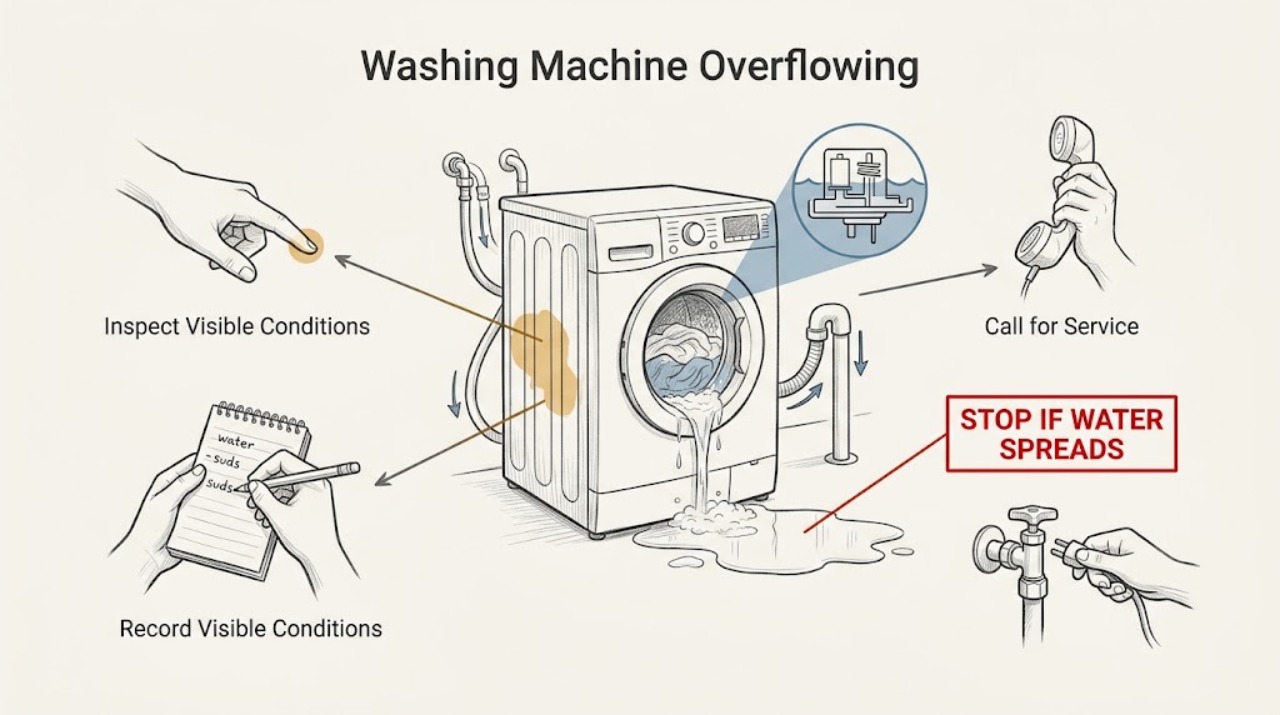
If an Amana washing machine is actively overflowing, press Pause or Cancel from a dry position and close the household hot and cold water valves if they are safely reachable; do not reach through standing water or unplug a wet appliance. If the display shows F8 E3 on a front-load model, Amana defines that condition as too much water or foam and points first to HE detergent, excess suds, and a Clean Washer cycle. For other models, distinguish a normal deep-fill or sensing cycle from water rising past the intended level, then check that inlet hoses are not kinked, the drain hose is correctly positioned and not blocked, the load is not creating splash, and only the manufacturer's recommended detergent amount is used. Do not open the console, bypass the water-level control, or keep refilling a machine that will not stop. If water continues entering with the controls off, the tub overfills again, a hose or valve leaks, or water reaches electrical parts, keep the washer off and arrange qualified appliance or plumbing service.
Work through in order
Diagnostic checks
Use only checks that match the exact appliance or system and its official guide.
-
Check 1
From a dry position, press Pause or Cancel and observe the water. If the supply valves are clearly accessible without reaching through water, close both household hot and cold washer valves. Note whether water stops when the cycle is canceled, continues with the controls off, is leaking from a hose or connection, or has reached the floor near electrical parts.
Expected result: Water stops with the cycle, continues entering after the controls are off, leaks at an accessible hose or connection, or is near electrical equipment.
Next step: Keep the washer off for continued filling, a leaking connection, or water near electrical equipment. Do not unplug a wet appliance or open its console; arrange qualified appliance or plumbing help. If the water stopped safely, continue with the display and model-specific checks.
Why this matters
Why: Water that stops with the program can be related to a fill, suds, load, or cycle-state condition. Continued filling with the controls off points beyond a simple setting and requires service; water near electrical equipment is an immediate safety boundary.
-
Check 2
Record the exact error code or flashing light and identify whether the washer is front-load or top-load. On a front-load model, compare F8 E3 with the model manual; on any model, note whether the display instead shows a water-level, wash, sensing, or other alert.
Expected result: A front-load display shows F8 E3, a water-level alert such as F3 E1 appears, a wash or sensing light is flashing, or no specific alert is shown.
Next step: Follow only the entry for the exact model. For F8 E3, check detergent and suds below; for a persistent water-level alert, do not access wiring or sensors and arrange qualified service after the safe external checks.
Why this matters
Why: Amana defines F8 E3 on front-load washers as too much water or foam. Amana describes F3 E1 as a water-level detection problem, while a wash light can mean the level has not changed or the control does not detect that it changed. No code does not rule out a hose, drain, load, or valve problem.
-
Check 3
Check the detergent and foam condition without adding more water: confirm that the product is HE detergent where required, the amount follows its label and the washer manual, and no thickened or unsuitable bleach product was used. Observe whether dense suds are visible or the display shows Sud, Sd, or F8 E3.
Expected result: There are dense suds, too much detergent was used, non-HE detergent was used, an unsuitable thickened bleach was added, or the water is clear and the dose was correct.
Next step: If the model manual permits it and the water level is safe, allow the documented suds-reduction or cleaning cycle to finish; otherwise keep the machine off and remove standing water only by a model-approved method. If F8 E3 or overflow returns with correct detergent use, arrange service.
Why this matters
Why: Amana states that excess suds can create the F8 E3 overflow condition, reduce spin speed, and produce error codes. Clear water with a correct dose makes a suds explanation less likely, so do not repeatedly run the washer while it overfills.
-
Check 4
With the washer off and the tub at a safe level, inspect the visible inlet hoses and household faucets for kinks, unusual flow, or a loose external connection. Check the accessible drain hose path for a kink, blockage, excessive insertion, or an installation that does not match the manual; do not pull hoses from internal fittings.
Expected result: An inlet hose is kinked, a faucet or connection leaks, the drain hose is blocked or positioned incorrectly, or the visible supply and drain paths are normal.
Next step: Correct only an obvious external kink or accessible connection issue while the washer is off, following the model installation instructions. If filling remains abnormal, a hose leaks, or no external cause is visible, keep the valves closed and call qualified appliance or plumbing service.
Why this matters
Why: Amana says inlet hoses should be open and free of kinks, and that incorrect drain-hose positioning or a blockage can disrupt water flow. These checks may explain a fill or drain-related incident but do not confirm the internal water valve or level sensor.
-
Check 5
Compare the water level with the selected cycle and load. On a top-load washer, note whether the machine is sensing, using Bulky or Deep Water Wash, or adding a deeper rinse; check whether a large, water-resistant, or uneven load is causing water to splash off the basket or top.
Expected result: The cycle is designed for a deeper fill, sensing is still in progress, the load is oversized or water-resistant, the washer is not level, or water is actually above the intended level or splashing out.
Next step: If the level matches the selected cycle, let sensing complete without adding water and use the manual's cycle guidance. If the load is causing splash, stop safely and redistribute or reduce it only after the water is controlled. If the washer truly overfills, leave it off and arrange service.
Why this matters
Why: Amana documents higher fills for certain cycles and says sensing can add water in stages. Amana also links splash-over to an unlevel washer and large, oversized, water-resistant, or uneven loads. Water above the intended level or filling beyond a stopped cycle is not normal deep fill.
-
Check 6
After the cause has been corrected and the tub is safe, use at most one model-approved reset or Clean Washer cycle, staying nearby. Observe whether the code clears and the fill stops at the expected level, or whether the same alert, uncontrolled filling, leak, or overflow returns.
Expected result: The alert clears and the washer fills normally, the same alert returns, the tub rises beyond the expected level, or water continues entering after cancellation.
Next step: Keep the water valves closed and the washer off for a recurring or uncontrolled overflow. Provide the technician the model, exact code, cycle, detergent, load, water behavior, and checks already completed; do not bypass a valve or water-level control.
Why this matters
Why: A cleared suds or cycle-state alert supports that user-level cause, but it does not prove the water-level control or inlet system is healthy. A recurring alert or uncontrolled fill needs diagnosis rather than more resets.
Use your observations
Decision map
Find the observation that best matches what you see, then follow the next safe action.
-
PATH 01Next step
What you see
Water continues entering after Pause or Cancel, the tub is rising uncontrollably, or water has reached an electrical outlet or component.
Do this next
Keep the washer off, close accessible household water valves without entering water, and obtain qualified appliance or plumbing service. Do not unplug a wet appliance, open the console, or attempt to bypass the inlet valve or level control.
-
PATH 02Next step
What you see
The display shows F8 E3 or visible dense suds, and filling stops normally when the cycle is canceled.
Do this next
Use the exact model guidance for HE detergent, dose, unsuitable bleach, and the Clean Washer or suds-reduction cycle. Do not keep restarting an overflowing machine; a returning F8 E3 needs service.
-
PATH 03Next step
What you see
The water level matches a documented deep-fill or sensing cycle, with no spill or uncontrolled filling.
Do this next
Do not add more water. Let sensing complete, use the cycle recommended for the load, and verify that the washer is level if water splashes from the basket.
-
PATH 04Next step
What you see
External hoses, detergent, load, and cycle selection are normal but a water-level alert or overflow returns.
Do this next
Keep the washer off and arrange qualified appliance service. A persistent water-level or control fault is not a user-adjustable setting; do not open the cabinet or perform electrical tests.
Helpful context
Understand the symptom
First decide whether it is a true overflow or a deep-fill cycle
Amana top-load washers can use substantially more water on Bulky, Deep Water Wash, or certain rinse cycles, and sensing can add water in stages. That is different from water rising above the intended level, spilling over the basket, or continuing to enter after the cycle is stopped. The exact model, front- or top-load design, displayed code, and point in the cycle change the next check.
Stop water and keep electrical work out of a user check
Use controls from a dry position and close accessible household water valves if you can do so without stepping into water. Keep the console and cabinet closed. Do not reach into standing water, unplug a wet appliance, remove the water-level control, bypass an inlet valve, or open wiring. If water is near an outlet or electrical component, leave the area safe and obtain qualified help.
Only after diagnosis
Potential parts
- water-level sensing component
Only consider this category after a qualified diagnosis confirms a persistent water-level detection fault following safe hose, drain, detergent, load, and cycle checks; overflow alone does not identify a sensor.
Confirm the exact Amana model and product number from its rating label and use authorized service information before selecting a component. - water inlet valve assembly
Only consider this category when a qualified technician finds that the washer is not controlling water entry after the external supply and cycle conditions are correct.
Valve configuration and fit vary by model; do not replace or bypass it based only on an overflow symptom.
Common questions
FAQ
What does F8 E3 mean on an Amana washer?
On Amana front-load support, F8 E3 is an overflow condition caused by too much water or foam. Check HE detergent type and amount and the model's suds or cleaning guidance. If the code returns or water does not stop normally, keep the washer off and arrange service.
Could a deep fill look like an Amana washer overflow?
Yes. Amana says some top-load cycles, including Bulky or Deep Water Wash, use deeper fills, and Auto Sensing may add water in stages. Do not add water manually. Treat water spilling over, rising beyond the selected cycle, or continuing after cancellation as a true overflow.
Can detergent cause an Amana washing machine to overflow?
Excess detergent or non-HE detergent can create dense suds. Amana says excess suds can produce an overflow code, reduce spin speed, and leave a very wet load. Use the detergent and amount specified for the exact washer and stop if the machine continues to overfill.
When should I call for Amana washer overflow repair?
Call qualified service if water continues entering after Cancel, an F8 E3 or water-level alert returns, the tub overfills with correct detergent and normal hoses, or a hose or valve connection leaks. If water has reached electrical equipment, keep the washer off and obtain appropriate qualified electrical help as well.
Read the exact guide
Official sources
- F3E1 - Error CodeAmana Product Help · Official Amana guidance that F3 E1 means the washer cannot detect water level and may involve control or wiring, with one documented reset and service escalation.
- Leaking from Front or Top - WasherAmana Product Help · Official Amana guidance on level, oversized, water-resistant, and uneven loads that can splash water from the basket, plus service escalation.
- F8 E3 - Front Load WasherAmana Product Help · Official Amana guidance defining F8 E3 as too much water or foam and addressing HE detergent, excess suds, cleaning, reset, and service; the code is model-specific.
- Water Levels by Cycle - WasherAmana Product Help · Official Amana explanation of low-water sensing, deeper fills for selected cycles, and why water may not fully submerge a load; it helps distinguish expected fill from overflow.
- Using Auto Sensing Cycle - WasherAmana Product Help · Official Amana explanation that Auto Sensing determines load-appropriate water and can perform multiple small fills; applies only to models with the feature.
- Wash Light On or FlashingAmana Product Help · Official Amana guidance on a Wash light caused by unchanging or undetected water level, water supply, inlet screens, and drain-hose positioning.
- Excessive Suds in a Front Load WasherAmana Product Help · Official Amana guidance on HE detergent, over-dosing, Sud/Sd displays, reduced spin, and rinse response; use the exact model and detergent instructions.
- Not Filling or Long Fill - WasherAmana Product Help · Official Amana guidance on inlet hoses, water supply, drain-hose routing, water-level options, anti-flood devices, and Bulky cycle behavior; exact requirements vary by model.
Community feedback
Share a repair observation
Share a plain-text repair observation. Accepted observations are published automatically; this page may take a moment to update.