
On this page
Start here
Quick answer
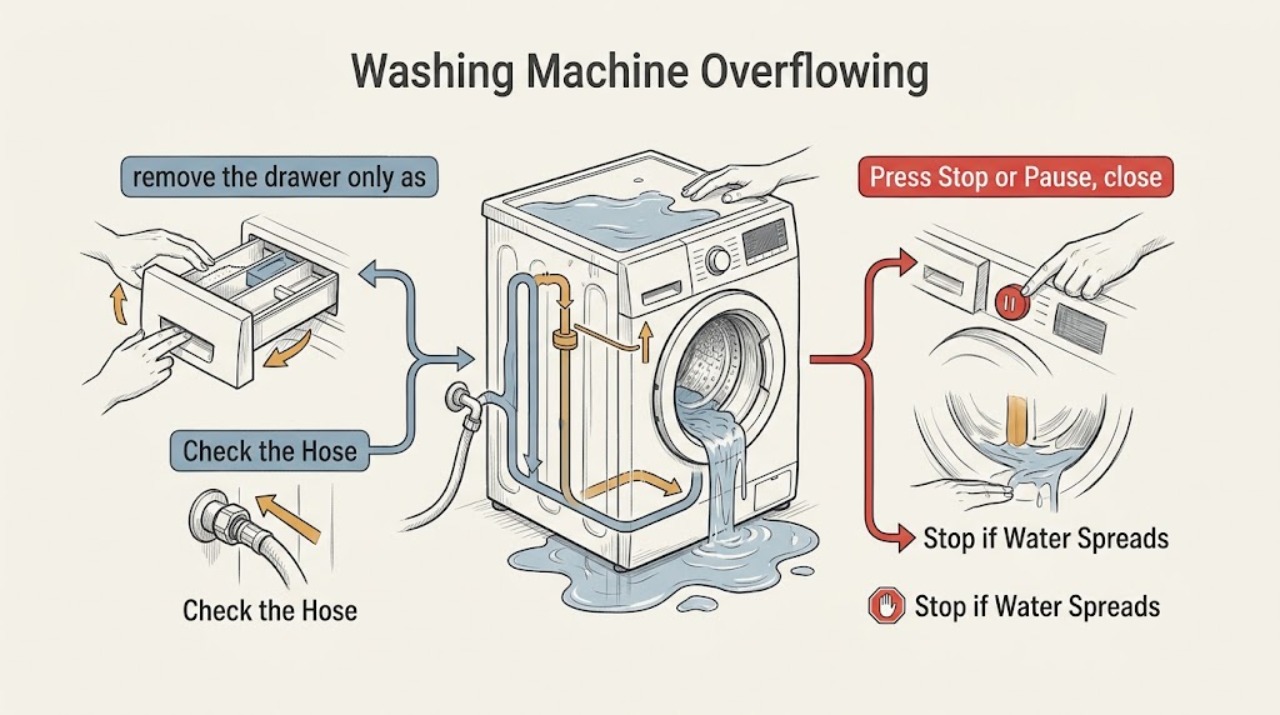
If an LG washing machine is overflowing, stop the cycle and close the water faucets if water is still entering. Keep water away from the plug, outlet, and controls; only disconnect power if the area is dry and the plug is safely reachable. Record whether water is entering the tub, spilling from the detergent drawer, backing up from the drain, or appearing around a hose. Excess detergent or a clogged drawer can make water or suds spill from the drawer, while a high-fill condition can involve the water-level sensor or inlet valve. An FE, E04, or E12 overfill indication should be treated as a stop-and-service condition, and a persistent overfill after a safe single reset needs inspection. LG top-load models also adjust water to the load, so wet or bulky laundry can change the visible level without proving a failed part.
Work through in order
Diagnostic checks
Use only checks that match the exact appliance or system and its official guide.
-
Check 1
Press Stop or Pause, close both water faucets if water is still entering, and keep people away from standing water; disconnect power only from a dry, safely reachable location.
Expected result: Water that continues entering after the cycle is stopped is different from water left in the tub or water coming from the drain path.
Next step: Do not restart while water is near electrical areas; after the area is safe, continue with location and timing checks.
Why this matters
Why: Continued filling raises the priority of a water-supply or control fault, while a stopped inlet shifts attention to the source of the visible spill.
-
Check 2
Identify where the first water or suds appears: detergent drawer, door or lid edge, inlet hose connection, bottom of the cabinet, tub rim, drain hose, standpipe, or nearby sink.
Expected result: A front drawer trail during filling suggests a dispenser-flow problem; a rising tub suggests fill or drain behavior; water at the standpipe or sink suggests a household drain restriction.
Next step: Follow the drawer, tub-level, drain-backup, hose, or external-source branch rather than treating every puddle as the same failure.
Why this matters
Why: The first location is more diagnostic than the final puddle, which may spread across the floor.
-
Check 3
If water or suds came from the dispenser, remove the drawer only as the model guide permits and inspect the drawer and its housing for hardened detergent, residue, a blocked inlet, or filling above the marked limit.
Expected result: LG says excess detergent, incorrect detergent placement, and residue can restrict flow and cause overflow from the front of the drawer; a clean path with water still entering elsewhere needs another branch.
Next step: Clean the accessible drawer parts with lukewarm water, a soft brush, and a cloth, then leave the washer unused if overflow returns or water reached controls.
Why this matters
Why: A dispenser restriction or oversudsing problem can look like a tub leak but is addressed through correct detergent quantity and drawer cleaning.
-
Check 4
Check the drain hose from the outside for a kink, pinch, dislodged end, or an unusually high route, and observe whether the standpipe or sink backs up while the washer drains.
Expected result: A kinked or pinched hose, a displaced hose, or backup at the household drain points to restricted drainage rather than an inlet that is adding too much water.
Next step: Correct only an obvious external hose position if the floor is dry and the model instructions support it; arrange plumbing or appliance service if backup or overflow persists.
Why this matters
Why: Drain backup can force water back toward the tub or floor and can be mistaken for overfilling.
-
Check 5
For a top-load model, note the selected cycle, whether the laundry was already wet, and whether the load is light and bulky; do not add water while the machine is filling.
Expected result: LG states that top-load machines sense load weight and can select a higher level for wet laundry, while bulky light items can float and splash or change the visible level.
Next step: Use the model-appropriate cycle and load guidance only after the floor is dry; if the tub reaches the point of overflow with a normal load, stop and request service.
Why this matters
Why: A load-related level or splash pattern is different from a tub that keeps filling after the cycle is stopped or an overfill code that returns.
-
Check 6
Read and photograph the exact display code and note whether it appeared during filling, washing, or draining; compare it with the matching LG model information rather than a code list for another design.
Expected result: LG lists FE as an overfill error on top-load models and identifies FE, E04, or E12 as overfill indications in a front-load troubleshooting guide; PE points to water-level sensing on the referenced models.
Next step: After a single model-supported reset only when no water or electrical hazard remains, stop and schedule service if the code or overflow returns.
Why this matters
Why: The code and machine design narrow the diagnosis, but a code alone does not identify a compatible part across all LG models.
-
Check 7
Record the full model number, cycle, first leak location, water or suds appearance, whether the faucets were closed, and any visible hose or drawer condition for LG support or a technician.
Expected result: A complete record distinguishes a fill-time drawer spill, drain-time backup, load-related splash, hose connection issue, and repeated overfill condition.
Next step: Keep the washer out of service for recurring overflow, wet controls, a damaged hose, a returning overfill code, or any unexplained water source.
Why this matters
Why: LG support material is model-sensitive, and a technician can use the sequence and location to choose a safe inspection path.
Use your observations
Decision map
Find the observation that best matches what you see, then follow the next safe action.
-
PATH 01Next step
What you see
Water continues entering after the cycle is stopped, or the tub rises toward the top.
Do this next
Arrange appliance service rather than repeatedly starting the washer or sourcing a valve or sensor without model confirmation.
Why this path and its safety boundary
Why it matters: Keep the water faucets closed and the washer out of service; this pattern can involve an inlet or water-level control fault.
-
PATH 02Next step
What you see
Water or suds starts at the detergent drawer during filling and residue or excess detergent is present.
Do this next
If the drawer overflows again when clean and correctly filled, stop using the washer and request inspection.
Why this path and its safety boundary
Why it matters: Clean the accessible drawer and housing as the model guide permits and use only the recommended detergent amount and type.
-
PATH 03Next step
What you see
Water appears during draining and the standpipe or sink backs up, or the drain hose is kinked or displaced.
Do this next
Correct only an obvious external hose position when safe; obtain appliance or plumbing service if the restriction or overflow remains.
Why this path and its safety boundary
Why it matters: Treat the symptom as a drain-path or household plumbing restriction and keep the washer stopped while water is backing up.
-
PATH 04Next step
What you see
A top-load machine shows a different visible level with wet or bulky laundry but does not continue filling or overflow with a normal load.
Do this next
Use the correct cycle and load guidance after the area is dry; stop and request service if the tub actually overflows.
Why this path and its safety boundary
Why it matters: The level may reflect LG's load-sensing behavior or splash from a floating bulky item rather than a failed component.
-
PATH 05Next step
What you see
An FE, E04, E12, or PE code returns after the model-supported single reset, or the tub reaches overflow level.
Do this next
Keep the faucets closed and the machine unplugged when safe to do so, then provide the exact code and model to service.
Why this path and its safety boundary
Why it matters: The referenced LG guidance directs the owner toward inspection or service for a recurring overfill or water-level fault.
-
PATH 06Next step
What you see
Water reaches the outlet, plug, control panel, wiring area, or floor remains wet; there is smoke, burning, arcing, or repeated power interruption.
Do this next
Only disconnect power if it can be done without standing in water or touching a wet appliance; arrange urgent professional assessment and do not restore power to test it.
Why this path and its safety boundary
Why it matters: Stop immediately and keep clear of the wet or damaged electrical area.
Helpful context
Understand the symptom
An overflowing washer is a flood risk, so the first objective is to stop water movement and protect the surrounding electrical area. Do not keep running cycles to reproduce the symptom. Once the floor and controls are safe, the location and timing of the water usually separate a dispenser spill, excessive suds, drain backup, hose leak, load-related splash, or a true overfill condition.
LG washer behavior varies between top-load and front-load designs and between models. A top-load machine can change its fill level after sensing a wet or bulky load, while an FE-family overfill message or a tub that keeps filling points toward a control or water-level problem. Use the complete model number when consulting LG support or arranging service.
The checks below are external, low-risk observations. They are intended to identify the next branch, not to authorize opening the washer, testing energized parts, or replacing a component before the model and fault are confirmed.
Safety boundary
Stop conditions
- Close the water faucets and stop using the washer for uncontrolled filling, a tub approaching overflow, or an overfill or water-level code that returns.
- Stop for water near a plug, outlet, controls, or wiring, or for a wet floor that makes reaching the plug unsafe.
- Stop for smoke, burning smell, visible arcing, damaged hoses, repeated power interruption, or any sign of electrical or structural damage.
- Do not open internal panels, work on energized parts, defeat a door or safety interlock, or keep running cycles to reproduce flooding.
Only after diagnosis
Potential parts
- water inlet valve
Only consider this category after service confirms that water continues entering or the model-specific diagnosis identifies an inlet fault.
Confirm the complete model and manufacturer fit information before ordering. - water-level pressure sensor or sensing component
Only consider this category when the exact model and a recurring water-level or overfill diagnosis support it.
Do not assume a code or symptom maps to the same component across LG washer designs. - detergent drawer or dispenser component
Only consider this category if the drawer or its housing is physically damaged after residue and detergent quantity have been ruled out.
Verify model-specific fit and the correct drawer configuration before sourcing a replacement. - drain hose or drain-path component
Only consider this category when an external inspection finds damage or a confirmed restriction that is not a household plumbing problem.
Confirm routing, length, and model compatibility with LG guidance or a technician.
When checks do not resolve it
Need a professional?
Arrange qualified appliance service for continued filling, a returning FE, E04, E12, or PE indication, a tub that actually overflows, an unexplained cabinet leak, wet controls, or a damaged hose connection. Use LG support and the complete model number to obtain model-specific instructions. Contact a plumber when the household standpipe or sink backs up independently of the washer.
Common questions
FAQ
Why is my LG washer overflowing from the detergent drawer?
Excess detergent, the wrong detergent placement, or residue can restrict flow and make water or suds spill from the drawer. Stop the cycle, clean the accessible drawer as the model guide permits, use the recommended detergent amount, and request service if the drawer overflows again when clean.
Does an FE code always mean the inlet valve is bad?
No. LG uses FE for an overfill condition on the referenced washer families, and water-level sensing or drain behavior can also affect the symptom. Record the exact code and model; if the code or overflow returns after a safe, model-supported reset, keep the faucets closed and arrange service.
Can a large load make an LG top-load washer look overfilled?
Yes. LG says top-load machines sense load weight, and wet or bulky light laundry can change the detected or visible water level and may float or splash. That does not explain a tub that keeps filling after the cycle is stopped or actually reaches overflow level.
Read the exact guide
Official sources
- [LG Top Load Washer] Error Code ListLG USA Support · LG top-load washer FE overfill and PE pressure-sensor code guidance
- [LG top load washing machine water supply] The water level cannot be adjusted. The water level is too high. The water level is too low.LG USA Support · LG top-load washer load sensing and water-level behavior
- WM4080_2023_Owners-Manual_Washer_Eng.pdfLG · Opened LG washer owner's manual with model-specific overflow, hose, and service guidance
- [LG Washing Machine] Water Overflowing from Detergent DrawerLG USA Support · LG washer dispenser overflow, detergent residue, and drawer cleaning guidance
- LG SupportLG USA Support · LG product support and model-specific troubleshooting routing
- LG Front Load Washer - Error Code List(New)LG USA Support · LG front-load washer overfill, water-level, drain, and service-code guidance
- Leaking - Top Load Washer Audio DescriptionLG USA Support · LG top-load washer leak, drain backup, hose position, load, and detergent guidance
Community feedback
Share a repair observation
Share a plain-text repair observation. Accepted observations are published automatically; this page may take a moment to update.