
On this page
Start here
Quick answer
If a Maytag washer is overflowing, stop the cycle immediately and keep people away from the water. If the floor is dry and safe, close the washer's hot and cold supply taps; if water is near an outlet, cord, or appliance, do not step into it or touch the plug or controls. A machine that continues filling after the cycle is stopped needs qualified service, not repeated resets. If the overflow is foam, use only the model's documented suds guidance and correct HE detergent quantity; if water returns from the drain, inspect the accessible hose and standpipe for kinks, blockage, sealing, or siphoning. Top-load and front-load models differ, so do not assume a filter, pressure control, or emergency drain is user-accessible. Stop for hot water, uncontrolled flow, leaks near electricity, smoke, burning odor, sparks, or a returning overflow and arrange appropriate service.
Work through in order
Diagnostic checks
Use only checks that match the exact appliance or system and its official guide.
-
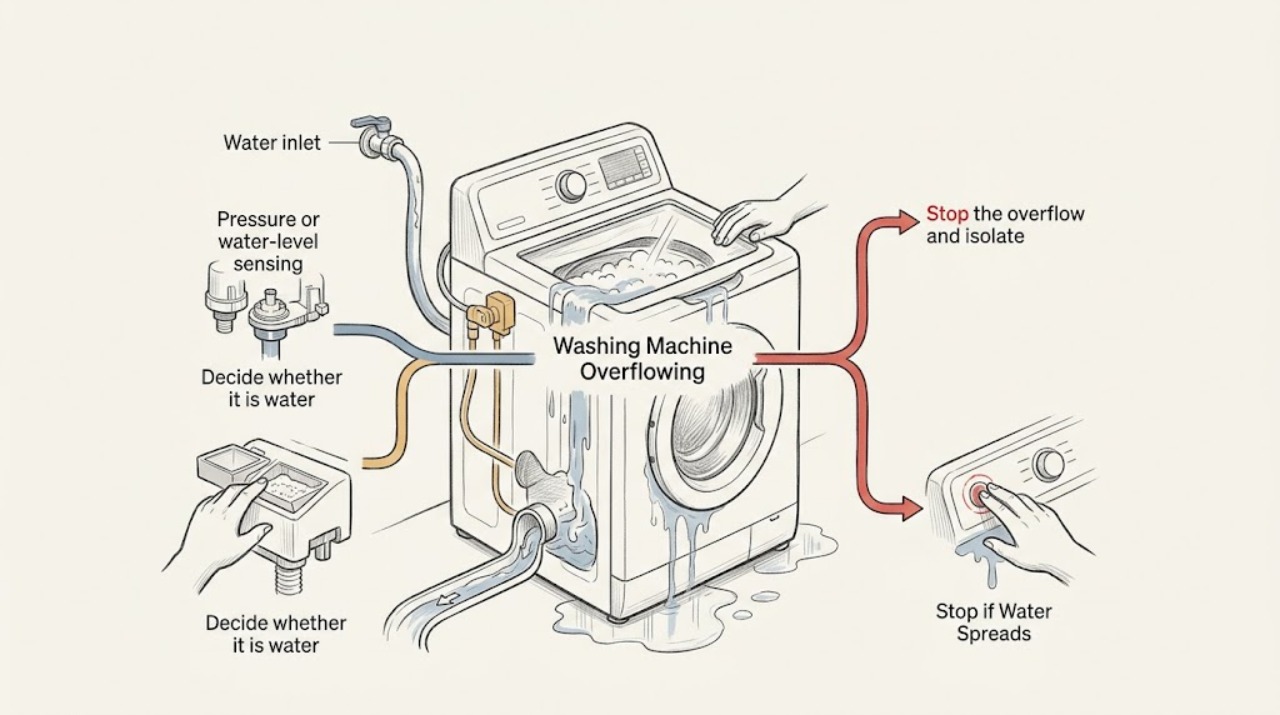
Stop the overflow and isolate the area safely
Press Stop or Cancel if it can be done without touching water. If the floor is dry and the taps are safely reachable, close both hot and cold washer supply taps. Keep away from water near an outlet, cord, power strip, or appliance; disconnect power only from a dry, safe location and never touch a plug while standing in water.
Expected result: Water continues entering after the cycle stops, a supply tap will not close, water is hot or spreading, or water is near electrical parts; alternatively, the flow stops and the floor is safe.
Next step: For continued flow, unsafe water, or electrical exposure, keep the washer off and obtain qualified appliance, plumbing, or electrical help. If the flow stopped safely, clean up without entering an unsafe area and continue with identification.
Stop if: Stop immediately for water near electricity, hot water, an unsafe floor, a tap that cannot be closed, smoke, burning odor, sparks, or a damaged cord.
Why this matters
Why: Uncontrolled filling is a water-supply or control safety issue, while wet electrical surroundings can make ordinary troubleshooting dangerous.
-
Decide whether it is water, foam, or drain backflow
Once safe, note whether clear or soapy water is rising from the tub, foam is spilling over, or water is coming back from the standpipe or laundry sink. Record whether it happens during filling, washing, draining, or after the machine stops. Do not restart the washer to reproduce the overflow.
Expected result: The tub fills continuously, foam expands, the drain backs up, or water rises only when the household drain is used; alternatively, the source cannot be identified.
Next step: Follow the matching branch below. If the source is uncertain or the overflow returns, keep the machine out of service and call qualified help.
Stop if: Do not run another cycle when the tub is full, foam is escaping, water is hot, or the cause is uncertain.
Why this matters
Why: The three patterns lead to different checks: inlet or water-level control, excessive suds, or an external drain blockage or siphoning path.
-
Check the detergent and foam branch
If the overflow is bubbles or foam, record the detergent type, amount, concentration, additives, and whether a bulk dispenser was enabled. Do not add more detergent, bleach, or a chemical defoamer. Follow the exact model's documented suds-reduction or rinse guidance only after the area is safe.
Expected result: Non-HE detergent, excess detergent, an incompatible thickened bleach, or duplicate detergent from a bulk dispenser coincided with the overflow; or there is little foam and mostly clear water.
Next step: Allow the model's documented suds routine to finish only if no overflow or hazard remains, then correct detergent practice. If foam persists, the tub overflows again, or clear water is entering continuously, keep the washer off and arrange service.
Stop if: Stop for foam reaching electrical parts, chemical irritation, overflow, hot water, smoke, burning odor, or any chemical mixing.
Why this matters
Why: Maytag says non-HE or excess detergent can create excessive suds, lengthen the cycle, reduce spinning, and leave water or foam incompletely removed.
-
Inspect the accessible drain hose and standpipe
With power off and the floor safe, inspect the rear drain hose without tilting the washer. Look for a kink, pinch, clog, airtight taped connection, a household standpipe or sink backup, or water returning after draining. Correct only visible routing or external blockage according to the installation instructions.
Expected result: The hose is restricted, the standpipe backs up, the connection is sealed, or water siphons or returns; alternatively, the external drain path is clear.
Next step: Restore the manual's hose routing and air gap without moving or tilting the appliance, then have the household drain cleared if it backs up independently. If the washer still overflows, stop and request service.
Stop if: Do not disconnect a full hose over an unsafe floor, use chemical drain cleaner, pull a hard-to-move or stacked washer, or disturb internal hoses.
Why this matters
Why: Maytag explains that a kinked or clogged hose, blocked drain, sealed hose, or incorrect placement can restrict drainage, create siphoning, or send water back toward the washer.
-
Respect front-load and top-load differences
Identify whether the washer is top-load or front-load and record the exact model number. Check the lid or door area for a visible obstruction only when the basket is stopped. For a front-load model, use a pump-filter procedure only if the manual identifies an accessible filter and the water is cool and controllable; do not assume a top-load model has one.
Expected result: The lid or door does not latch, the model has an accessible filter, the filter area contains lint or an object, or no user-accessible filter is documented.
Next step: Remove only visible lid or door debris and follow the exact model manual. If a filter is not documented or cannot be opened with safe water control, leave it closed and arrange service.
Stop if: Do not bypass a lock, force a door, open a filter with hot or uncontrolled water, tilt the washer, or remove a panel.
Why this matters
Why: A lid or door interlock can stop the intended cycle, and Maytag limits drain-pump filter access to some front-load models; a filter cannot explain every overflow.
-
Separate load or cycle behavior from continuous filling
With no standing water or overflow hazard, record the selected cycle, load size, lid or door state, and any code or flashing light. If the event was foam or a drain-backup pattern, do not label it a failed water-level control. If clear water continues to enter with the cycle stopped, do not run a spin or rinse test.
Expected result: The overflow tracks a particular cycle or code, occurs only with excessive foam, or clear water continues entering after controls are Off.
Next step: Use the model manual for a code or cycle correction only when the washer is safe. For continued filling, keep both supply taps closed when safely possible and arrange qualified service.
Stop if: Do not repeatedly press Start, reset a continuing fill, or open the console to inspect a valve or pressure system.
Why this matters
Why: A cycle-specific symptom can involve suds, drain sequencing, or a lock, while continued filling after stop points toward an inlet valve, water-level sensing, or control problem requiring service.
-
Use a single documented recovery only after the water is safe
After the water is contained, the floor is dry, and the model manual permits it, perform one documented control reset or cancel-and-drain sequence. Observe without adding detergent or starting a new wash; do not use a reset to test an overflowing inlet or a suspected water-level fault.
Expected result: The control returns to normal without renewed filling or overflow, or water starts entering again, a code returns, or the machine remains unresponsive.
Next step: If any overflow or fault returns, keep the washer off with the supply taps closed when safe and request qualified service. Do not keep cycling power.
Stop if: Do not reset around standing water, a leak, electrical damage, smoke, burning odor, sparks, or continuous water entry.
Why this matters
Why: A reset can clear an interrupted control state but cannot prove that an inlet valve, pressure sensor, drain path, lock, or control is safe.
-
Prepare a service handoff for a recurring overflow
Keep the washer out of service when the safe external checks do not resolve the overflow. Give the technician the model number, top-load or front-load type, clear water or foam description, fill or drain stage, whether flow continued after Stop, cycle and code, detergent and additive details, hose and standpipe observations, filter availability, and any leak or electrical event.
Expected result: The machine continues filling, overflows again, has a returning code, has water inside or under the cabinet, or the cause would require panel, pump, valve, or pressure-system access.
Next step: Request qualified Maytag appliance service and plumbing service when the household drain backs up independently. Use emergency help for an unsafe flood, electrical exposure, smoke, or fire risk.
Stop if: Do not replace a valve or sensor based on symptoms alone, bypass a lock, tilt the washer, or perform live electrical tests.
Why this matters
Why: Remaining causes can include an inlet valve, water-level pressure system, control, drain pump, internal hose, lock, or household plumbing; those are model-specific service diagnoses.
Use your observations
Decision map
Find the observation that best matches what you see, then follow the next safe action.
-
PATH 01Next step
What you see
Clear water continues entering after Stop, a tap cannot be closed safely, or the overflow is uncontrolled.
Do this next
Keep people away, close the washer supply taps only from a safe position, and obtain qualified appliance or plumbing service. Do not reset or run another cycle.
-
PATH 02Next step
What you see
Water is near an outlet or cord, the water is hot, the floor is unsafe, or there is smoke, burning odor, sparking, or a repeated electrical trip.
Do this next
Do not touch the plug or controls in water. Leave the area as appropriate and obtain qualified electrical, appliance, or emergency help.
-
PATH 03Next step
What you see
Foam or bubbles are the material overflowing and non-HE, excess, duplicate, or concentrated detergent is plausible.
Do this next
Follow the exact model's documented suds guidance only when the overflow is stopped and safe; correct detergent practice and service a returning overflow.
-
PATH 04Next step
What you see
Water returns from the standpipe or sink, or the hose is kinked, clogged, sealed, or incorrectly routed.
Do this next
Correct only accessible external routing or obstruction, preserve the manual's air gap, and call plumbing or appliance service if the backup or overflow remains.
-
PATH 05Next step
What you see
A top-load lid or front-load door does not latch, or a model-specific filter area is obstructed.
Do this next
Use only visible, model-approved checks; never bypass the lock or open a filter with hot or uncontrolled water. Arrange service if the interlock or filter problem remains.
-
PATH 06Next step
What you see
The washer overflows repeatedly, continues filling, returns a code, or requires access to a valve, pressure sensor, pump, control, or internal hose.
Do this next
Keep the appliance out of service and arrange qualified Maytag repair, with plumbing help when the household drain is the source.
Helpful context
Understand the symptom
Overflowing is not one fault. The washer may be admitting water when it should stop, making foam that rises out of the tub, or receiving water back from a blocked or incorrectly installed drain. First make the flood and electrical area safe, then identify whether the material is water or suds and when it appears.
Top-load and front-load Maytag models use different lids, doors, pump filters, and water-level systems. The exact model manual controls safe access. Do not tilt the washer, open a full filter, bypass a lock, or remove panels to find a valve or pressure sensor.
When checks do not resolve it
Need a professional?
Request qualified Maytag appliance service when water continues entering after Stop, the overflow recurs, a code returns, the lid or door interlock fails, a drain or pump fault remains, or diagnosis would require tilting, panel removal, valve or pressure-system access, or live electrical testing. Request plumbing help when the standpipe or utility sink backs up independently. Stop and obtain appropriate emergency or electrical help for hot water, unsafe flooding, water near electricity, smoke, burning odor, sparks, or a repeated breaker trip.
Common questions
FAQ
What should I do first if my Maytag washer is overflowing?
Stop the cycle and keep people away from the water. Close the hot and cold supply taps only from a safe, dry position; never touch a plug or control in standing water. If water continues entering or the floor is unsafe, keep the washer off and call qualified service.
Can too much detergent make a Maytag washer overflow?
Excess or non-HE detergent can create excessive suds that interfere with rinsing, draining, and spinning, and foam can appear to overflow. Follow the model's suds guidance only after the area is safe, and do not mix chemicals.
Could the drain hose cause a Maytag washer overflow?
Yes. A kink, clog, sealed connection, incorrect insertion, or household drain backup can restrict drainage or cause siphoning and return water. Inspect only accessible external routing with power off; do not tilt the washer or open internal hoses.
Does a Maytag washer have a user-cleanable pump filter?
Only some front-load models expose a drain-pump filter. Check the exact manual before opening anything, and use safe water containment. Do not assume a top-load model has the same filter or remove a panel to find one.
When should I stop using an overflowing Maytag washer?
Stop for continued filling, water near electricity, hot or uncontrolled water, leaks, smoke, burning odor, sparks, repeated breaker trips, a returning overflow, or any need to bypass a lock or access a valve or pressure system. Keep the washer off and arrange qualified service.
Read the exact guide
Official sources
- Cleaning the Drain Pump FilterMaytag Product Help · Only models whose manual identifies the accessible filter procedure.
- Excessive Detergent or SudsMaytag Product Help · Official Maytag top-load guidance; use the exact model and detergent instructions.
- Lid Locking on a Top Load High Efficiency WasherMaytag Product Help · Official Maytag top-load guidance; features vary by model.
- Sud - Error CodeMaytag Product Help · Official Maytag top-load guidance; display behavior varies by model.
- Excessive Suds in a Front Load WasherMaytag Product Help · Official Maytag front-load guidance; exact dispenser and cycle behavior vary by model.
- Washer Not Draining or Spinning? Troubleshooting GuideMaytag Product Help · Official Maytag washer guide; front-load and top-load implementation details remain model-specific.
- Not Spinning - WasherMaytag Product Help · Official Maytag top-load guidance; exact model cycle and installation details control.
- Checking the Fill Hoses if the Washer is not FillingMaytag Product Help · Official Maytag washer supply guidance; it does not authorize valve or pressure-control disassembly.
- Not Draining - Front Load WasherMaytag Product Help · Official Maytag front-load guidance; filter access and hose details are model-specific.
- Not Draining - WasherMaytag Product Help · Official Maytag top-load guidance; exact installation details control.
Community feedback
Share a repair observation
Share a plain-text repair observation. Accepted observations are published automatically; this page may take a moment to update.