
On this page
Start here
Quick answer
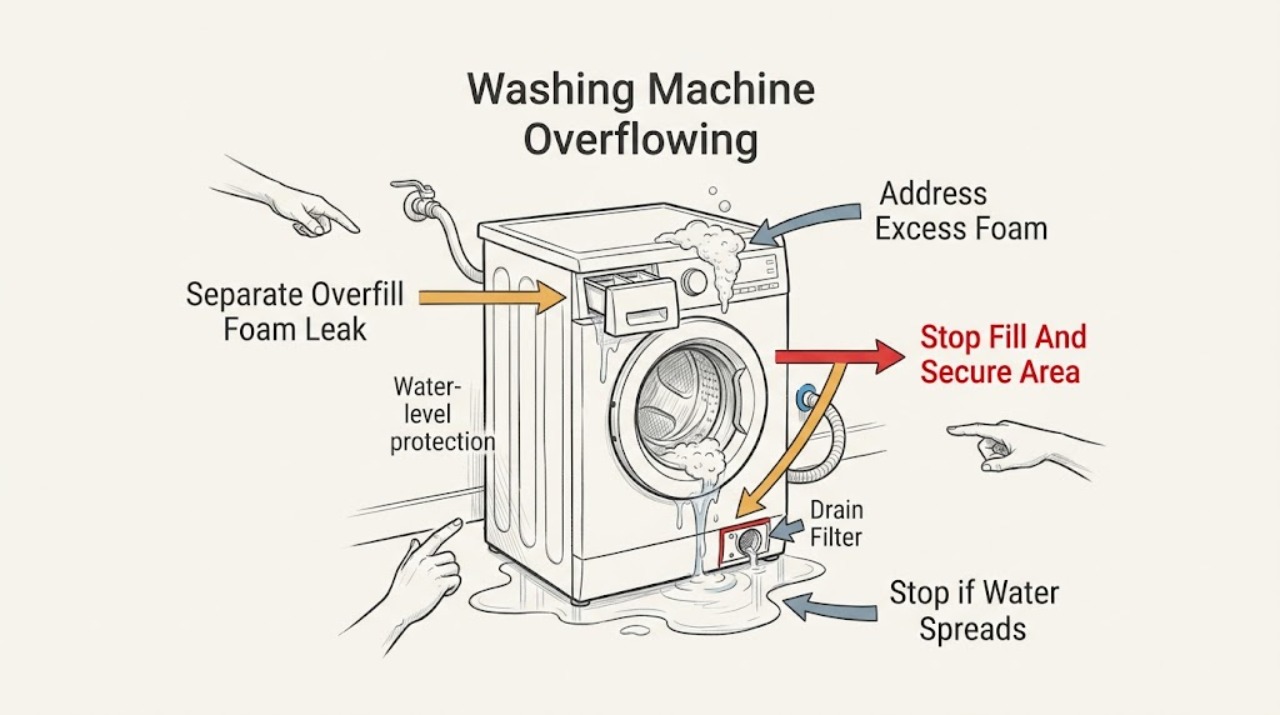
If an ASKO washing machine is overflowing, stop the programme and prevent more water from entering before inspecting anything: close the appliance's water shutoff if water continues to flow, and disconnect power only when it is safe to do so. First distinguish a drum that is genuinely too full from suds or an external leak. ASKO describes water-overfill protection and leak detection on supported models, with the system able to close the inlet and activate the anti-block drain pump; its documentation also describes foam detection that adds rinse water and drains repeatedly. After the machine is safe, check the visible drain path, pump filter, detergent drawer, door area, hoses, and any displayed code only as the exact model instructions allow. If water keeps entering with the controls stopped, the floor or cabinet is wet, the level protection does not clear the condition, a hose or seal is damaged, or the overflow returns after the safe checks, leave the water supply closed and arrange qualified appliance service.
Before you begin
Safety first
- Keep the water supply closed for continued admission or leakage. Do not open panels, probe live wiring, bypass water-level protection, force the door, or work on inlet, pump, sensor, or control components.
Work through in order
Diagnostic checks
Use only checks that match the exact appliance or system and its official guide.
-
Check 1
Press Stop or Pause if the controls respond, keep clear of moving water and the drum, close the washer's water shutoff when water continues to enter, and disconnect power only from a dry, safe position and only as the installation permits.
Expected result: Record whether water stops when the programme is stopped, whether water continues to enter with the controls off, whether the drum is visibly above its normal level, and whether water is on the floor or near electrical equipment.
Next step: Keep the water shutoff closed and do not restart the washer if water admission continues, a leak is visible, or electrical equipment is wet; otherwise continue to the matching drum, foam, drain, or external-leak check.
Stop if: Stop immediately for spreading water, wet electrical connections, a damaged supply hose, hot water, smoke, sparking, or any need to reach inside a powered or moving appliance.
Why this matters
Why: Water that continues to enter after the programme is stopped is an inlet or control symptom, not a detergent or drain-only problem. Floor water or water near electrical equipment creates a safety boundary. A stopped fill with retained water moves the check toward foam, drainage, or a water-level protection event.
-
Check 2
From outside the appliance, observe the drum, door, detergent area, underside, supply-hose connections, and drain-hose area without removing panels; do not open the door against a high water level or force a locked door.
Expected result: Classify the event as a clear high drum level, thick foam or suds, water escaping at the door or detergent area, water at a hose or filter location, or no visible leak with water retained inside.
Next step: Keep the supply closed until the category is clear; follow the foam, external-leak, drain, or inlet branch, and use the exact model manual for door release and emptying instructions.
Stop if: Do not force the door, remove a hose under pressure, tilt the washer, or use chemical drain products to clear an overflow.
Why this matters
Why: Thick suds can make the condition look like an overfill and are consistent with ASKO's documented foam-control behavior. A leak at a seal or connection is different from water entering too quickly. Retained water without an external leak points toward drainage or level-control checks rather than wiping up and restarting.
-
Check 3
If the drum contains unusually thick foam, stop adding detergent or other products, note the detergent type and recent dose, and allow only the model-approved rinse or drain response after the water supply is secure.
Expected result: Record whether foam reduces during the machine's rinse-and-drain response, whether suds return on a subsequent safe test, and whether water escapes from the drawer, door, or cabinet despite a modest water level.
Next step: Use only the detergent amount and product specified for the exact model and local water conditions; arrange service if foam persists, the machine cannot complete the response, or water leaks from the appliance.
Stop if: Do not add extra detergent, bleach, drain cleaner, or an improvised anti-foam chemical, and do not keep running cycles while foam or leakage is escaping.
Why this matters
Why: ASKO says excess foam can be detected and removed by adding rinse water and draining consecutively. Recurrent foam points to a detergent or dosing issue, while a leak with modest water suggests a seal, drawer, hose, or installation issue rather than a true overfill.
-
Check 4
When the appliance is powered off, the water supply is closed, and the model instructions identify the filter as user-accessible, prepare a shallow container and towels, drain residual water using the model's drain arrangement, then inspect and clean the pump filter and visible drain path.
Expected result: Note whether the filter or hose contains threads, coins, pins, buttons, lint, or other debris; whether the drain hose is kinked or blocked; and whether water flows out normally after the filter is restored.
Next step: Reinstall the filter and hose exactly as the model instructions specify, check for leaks at the restored access point, and perform one controlled drain or rinse only if the appliance is dry and the manual permits it; otherwise arrange service.
Stop if: Stop if water is hot, the filter will not move without force, the access area leaks, the pump makes a harsh noise, or cleaning would require removing panels or live wiring.
Why this matters
Why: ASKO's cleaning guide says the drain filter collects pocket debris and should be cleaned to avoid drainage problems. Debris or a kink can explain retained water and a protection response, but a clean path with continued overflow does not prove the pump or level system is healthy.
-
Check 5
With the supply closed and the appliance dry enough to inspect, check the visible inlet hose, drain hose, door seal or Steel Seal area where applicable, detergent drawer, and filter-cover perimeter for a loose connection, split hose, displaced seal, residue trail, or recent installation change.
Expected result: Record a dry, intact path; a leak at the inlet; a leak at the drain connection; water from the drawer or door area; or water emerging from underneath or behind the cabinet.
Next step: Do not use the washer while a connection, seal, or cabinet leak remains; photograph the location and provide it with the model and event timing to qualified service.
Stop if: Do not tighten hidden fittings, open the cabinet, tilt the machine, or continue a wash with water escaping underneath or behind it.
Why this matters
Why: A visible hose, drawer, door, or filter-area leak can be isolated for service or an installation correction. Water from underneath or behind the cabinet is not a safe reason to remove panels, and a dry exterior with an over-high drum keeps the inlet and level-control branches open.
-
Check 6
If the water supply is closed, the visible drain path is clear, foam is absent or controlled, and the machine is dry and safe, consult the exact model manual for any displayed overflow or water-level message and perform only its stated reset or drain procedure.
Expected result: Record whether the machine completes the manual-approved drain, whether the water level remains normal, whether the code or overflow returns, and whether water begins entering again immediately when the supply is reopened.
Next step: Leave the water supply closed and arrange qualified appliance service for any recurrence, continued admission, leak, or unresolved protection event; provide the code and the sequence of observations.
Stop if: Do not bypass a water-level alarm, repeatedly reset an overflowing washer, or test continued filling unattended.
Why this matters
Why: A cleared one-time protection response may be associated with a temporary obstruction or foam event, but a repeated code, renewed high level, or immediate refilling shows that the underlying condition remains unresolved. ASKO's protections are not a substitute for testing the inlet, level system, or control by a technician.
Use your observations
Decision map
Find the observation that best matches what you see, then follow the next safe action.
-
PATH 01Next step
What you see
Water continues entering after the programme is stopped or after the appliance is disconnected from power, or the drum rapidly rises again when the water supply is reopened.
Do this next
Keep the water shutoff closed, do not operate the washer, and arrange qualified service for the inlet and level-control system; do not replace a valve or sensor based on this symptom alone.
-
PATH 02Next step
What you see
The drum or door area contains thick suds, while the water level itself is not clearly above normal.
Do this next
Stop adding detergent, follow the model-approved rinse or drain response, review the exact detergent dosing instructions, and arrange service if foam or leakage returns.
-
PATH 03Next step
What you see
The machine is no longer filling, but water remains in the drum and the visible filter, hose, or drain path contains debris or a kink.
Do this next
With supply and power safely secured, follow the model-approved residual-water and filter procedure, restore the filter without leaks, and stop for service if drainage remains poor.
-
PATH 04Next step
What you see
Water is escaping at the inlet or drain connection, detergent drawer, door area, filter cover, underside, or behind the cabinet without a clearly over-high drum.
Do this next
Keep the water supply closed and stop using the washer; arrange qualified service or an installation correction, especially for water from underneath or behind the appliance.
-
PATH 05Next step
What you see
The machine stops filling and drains normally after the exact manual-approved procedure, with no recurring code, leak, foam, or abnormal level.
Do this next
Keep the result under observation during one controlled, attended cycle; stop and arrange service if the protection event returns.
-
PATH 06Next step
What you see
Water is near electrical equipment, a hose or cabinet is damaged, the filter will not move safely, the level alarm persists, or the overflow returns after visible checks.
Do this next
Do not restart or dismantle the washer. Keep the water supply closed and use qualified appliance service; follow local emergency guidance for an immediate electrical or flooding hazard.
Helpful context
Understand the symptom
Stop the source before diagnosing the cause
An overflowing washer can be a high-water condition inside the drum, a large amount of foam, a leak from a hose or seal, or water that cannot leave through the drain path. Stop the programme and close the washer's water shutoff if water continues to enter. Keep hands and controls dry, protect yourself from hot water, and do not reach into a powered or moving appliance. If there is water near electrical equipment, visible hose damage, or water spreading across the floor, stop and use qualified help.
ASKO's protections reduce risk but do not identify the failed part
ASKO's published laundry material describes high-water-level and leak detection, an anti-block drain pump, and foam detection on supported models. Those protections may stop filling and start draining, but a protection event is a symptom, not proof that one particular valve, sensor, pump, or control has failed. Model generations and regional installations differ, so treat the exact manual's display message and drain procedure as authoritative.
Use the water and foam pattern to choose the next safe check
If the drum is full of relatively clear water and the machine is still filling, the inlet side or level-control decision needs service once the water supply is closed. If the drum contains thick suds or foam and the water level looks deceptively high, review the detergent quantity and product instructions; do not add more detergent or chemical cleaner. If the drum is not overfull but water is on the floor, inspect only visible hose, door, dispenser, and filter-area locations for a leak. A blocked drain filter can leave water in the machine, but filter cleaning should follow ASKO's power-off procedure and the model manual, with a container or towels ready for residual water.
Safety boundary
Stop conditions
- Close the water supply and stop use when water continues entering, an overflow repeats, or water is escaping from underneath or behind the washer.
- Do not reach into a powered or moving drum, force a locked door, or handle hot residual water without the exact model procedure and suitable protection.
- Do not open panels, probe wiring, bypass the level-protection system, or adjust or replace an inlet valve, sensor, pump, or control from symptoms alone.
- Stop for wet electrical equipment, a damaged hose or seal, smoke, sparking, or water spreading across the floor; use qualified help and local emergency guidance where appropriate.
- Arrange service when filter and visible drain checks do not restore safe draining, the machine repeatedly reports high water, or the cause cannot be matched to the exact manual.
When checks do not resolve it
Need a professional?
Arrange qualified appliance service when the washer continues to fill after stopping, the overflow or high-level indication returns, water leaks from the cabinet or hidden connections, the drain path is clear but water remains, foam repeatedly escapes, or any check requires opening the appliance. Keep the water supply closed until the condition is assessed.
Safety scope: Keep the water supply closed for continued admission or leakage. Do not open panels, probe live wiring, bypass water-level protection, force the door, or work on inlet, pump, sensor, or control components.
Common questions
FAQ
What should I do first if my ASKO washer is overflowing?
Stop the programme, close the water shutoff if water continues entering, and keep away from wet electrical equipment. Do not force the door or restart the washer until you know whether the event is foam, retained water, an external leak, or continued filling.
Can too much detergent make an ASKO washer look like it is overflowing?
Thick foam can make the level look higher and can trigger foam-control behavior. ASKO describes repeated rinse-and-drain action for excess foam. Stop adding detergent and follow the exact model's approved response; recurring foam or leakage needs service.
Should I clean the drain filter when water remains in the drum?
Only if the filter is user-accessible and the model instructions permit it. ASKO's cleaning guide says to secure the appliance, drain residual water into a container or onto towels, remove debris, and reinstall the filter and hose; use caution with hot water.
What if the washer keeps filling after I stop it?
Keep the water supply closed and do not operate the washer. Continued admission after stopping is not a drain or detergent-only symptom; arrange qualified service to assess the inlet and level-control system without replacing a part by guesswork.
Why is water on the floor if the drum is not too full?
Inspect only visible, safe areas for a supply or drain-hose connection, detergent drawer, door area, or filter-cover leak. Water from underneath or behind the cabinet, or a damaged hose or seal, is a stop-use and service condition.
Does ASKO's overfill protection mean the washer is safe to keep running?
No. ASKO documents protection features on supported models, but a protection event does not identify why the level was high. If the event returns, a leak appears, or water keeps entering, leave the supply closed and arrange service.
Read the exact guide
Official sources
- ASKO STEEL SEAL Washing Machine brochureASKO · ASKO laundry brochure covering multiple washer families and supported features; exact protection features vary by model, so the owner's manual controls the installed machine.
- ASKO Washer Cleaning GuideASKO · ASKO USA cleaning guide containing washer maintenance instructions; model-specific access, temperature, and safety instructions still control.
Community feedback
Share a repair observation
Share a plain-text repair observation. Accepted observations are published automatically; this page may take a moment to update.