
On this page
Start here
Quick answer
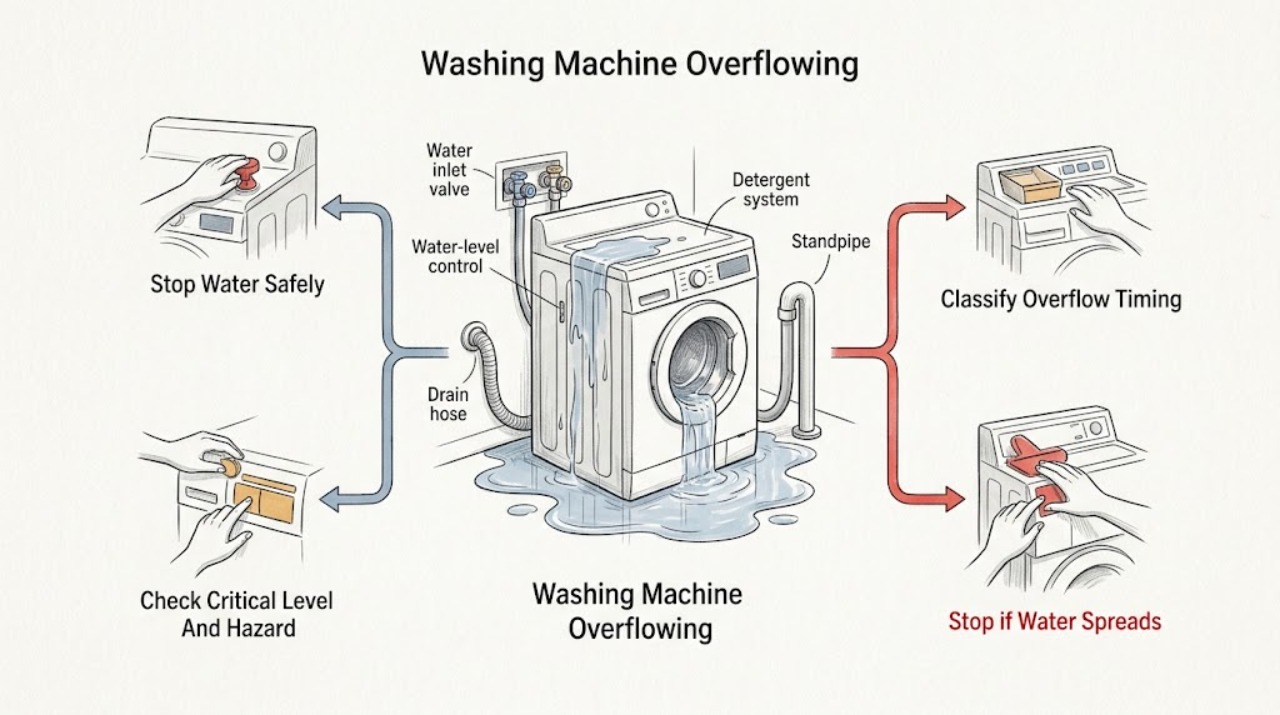
Stop the fill or wash cycle immediately from a dry position. Press Pause or turn the washer off at its controls; if water is still flowing and the shutoff valves are safely reachable without standing in water or touching wet electrical parts, close both hot and cold supply valves, or shut off the home's water supply. Do not unplug the washer while standing in water. Once the water and power are safely off, keep people away from the spill and arrange cleanup without energizing wet equipment. If the tub fills while the washer is off, a water-inlet valve may be leaking and the supply must remain closed. If it fills and drains at the same time, the drain hose may be too low or pushed too far into the standpipe, creating siphoning. Suds can also push water over the basket, especially with too much or non-HE detergent. A persistent overfill, a critical-level code, a failed water-level control, damaged hose, blocked household drain, burning smell, sparks, or repeated breaker trips requires qualified appliance service; do not open the cabinet, bypass the pressure or lid system, or test live wiring.
Before you begin
Safety first
- From a dry position stop the cycle and close the water supply. Do not unplug while standing in water, touch wet electrical parts, reset a repeatedly tripping breaker, open panels, bypass the water-level or lid system, remove hoses under pressure, or restart a wet or repeatedly overflowing washer.
Work through in order
Diagnostic checks
Use only checks that match the exact appliance or system and its official guide.
-
Check 1
From a dry position, press Pause or turn the washer off at the control panel. If water continues entering and the hot and cold shutoff valves are reachable without stepping into water or touching wet electrical parts, close both valves; otherwise shut off the home's water supply from a dry safe location.
Expected result: Water stops at the controls, water continues after the control is off, the supply valves stop it, or water cannot be safely reached or controlled.
Next step: Keep the washer off, keep people away from the spill, and arrange safe cleanup. If the supply cannot be stopped, contact a plumber or emergency water service; do not cross pooled water to unplug the washer.
Stop if: Do not unplug while standing in water, touch wet outlets or cords, or restart a wet appliance.
Why this matters
Why: Water continuing after a cycle stop suggests a valve or control problem; closing the supply is the immediate containment step. An unsafe or inaccessible electrical/water area requires outside help rather than a closer inspection.
-
Check 2
From a dry position, read the display and note an FE or other critical-level message, the tub level, water on the floor, a burning smell, smoke, sparks, exposed wiring, or a breaker trip.
Expected result: An FE message or tub at a critical level is present, water is contained below electrical parts, or an electrical hazard or repeat breaker trip is present.
Next step: For a critical level, keep both water and power off and call qualified service. For smoke, sparks, or fire risk, leave the area and contact emergency help; do not approach the washer to take more photos.
Stop if: Do not reset a tripping breaker, touch wet electrics, open panels, or continue a cycle after a critical-level event.
Why this matters
Why: GE treats FE as water at a critical level and directs the user to turn off water and power and call service. Smoke, arcing, hot or wet electrical parts, and repeat trips are immediate electrical stop conditions regardless of code.
-
Check 3
Once the water is controlled and the area is safe, record whether the tub filled while the washer was off, filled and drained at the same time, overflowed during agitation, or leaked from a hose, dispenser, door, or rear connection.
Expected result: Water enters while off, enters and leaves during fill, rises with suds or agitation, or appears outside the tub path.
Next step: Use the corresponding valve, drain-hose, suds, or external-leak branch. If the source is hidden or uncertain, keep water closed and arrange service rather than reproducing the overflow.
Stop if: Do not deliberately refill the tub, remove hoses under pressure, or disassemble the cabinet to locate the source.
Why this matters
Why: Water entering while off points toward an inlet valve; simultaneous fill and drain suggests siphoning; sudsy agitation points toward detergent/splashing; a hose, dispenser, door, or rear leak follows a different repair path.
-
Check 4
With water supply closed, inspect only the visible hot and cold hoses, faucet connections, and accessible washer rear area for a split hose, loose connection, dripping valve, or water entering the tub while controls are off. Do not move a stacked or built-in washer.
Expected result: A hose or connection is visibly damaged, the tub continues to gain water while off, the external fittings are dry, or the source is hidden.
Next step: Keep both supply valves closed and arrange model-specific appliance or plumbing service for any damaged hose, continuing fill, or hidden source. Replace hoses only according to the model installation instructions and never while pressurized.
Stop if: Do not loosen fittings under pressure, pull the washer through pooled water, or remove the cabinet or console.
Why this matters
Why: An external hose leak needs safe hose/plumbing assessment; water entering the tub while off is consistent with a water-inlet valve that is not closing. Dry visible connections do not clear an internal valve, pressure, or control fault.
-
Check 5
If the washer was filling and draining at the same time, inspect the visible drain hose routing without moving the appliance. Compare the hose height, insertion depth, air gap, and standpipe connection with the exact GE installation instructions for the top-load or front-load model.
Expected result: The hose is too low, pushed too far into the standpipe, missing an air gap or anti-siphon support, kinked, correctly routed, or the household drain is backing up.
Next step: Correct only a clearly visible routing issue permitted by the model instructions, then have the drain or appliance assessed before a supervised test. Call a plumber for a blocked household drain.
Stop if: Do not push the hose deeper, seal the standpipe opening, remove a drain pump, or run repeated fill tests.
Why this matters
Why: GE says low drain height or excessive insertion can create siphoning, so water leaves as fast as it enters. A backing-up household drain is a plumbing fault, while a correctly routed hose shifts attention to the water-level control or inlet system.
-
Check 6
After a one-time controlled suds event and only when the washer is dry and cleared for use, note whether excessive foam or splash preceded the water, whether the load contains soap-retaining towels or blankets, and whether detergent type and amount match the model and product directions.
Expected result: Dense suds and splash are present, the event occurred with a soft-water or heavily soiled load, no suds are present, or water overflowed while the washer was off.
Next step: Use the correct low-sudsing/HE detergent and measured amount on a future permitted cycle, or wash residue-prone items without added detergent as the guidance allows. If overflow recurs, stop and call service.
Stop if: Do not mix bleach, ammonia, acids, or unapproved cleaners, and do not run another cycle while water or foam remains uncontrolled.
Why this matters
Why: GE associates excess detergent, retained soap, soft water, and non-HE products with suds and overflow. No suds, water entering while off, or a critical-level message needs a different diagnosis.
-
Check 7
If the drain route is correct and suds are not the cause, use only the model's documented water-level control or load-size setting; do not open the console or pressure system. Record whether changing the permitted setting stops the fill at the expected level.
Expected result: The washer responds normally to the documented level setting, continues filling, shows an error, or the control is not user-accessible.
Next step: If the documented setting does not correct the level, close the water supply and arrange appliance service. Do not infer the failed part or attempt to clean a pressure tube or bypass a switch.
Stop if: Do not remove the console, blow into a sensing tube, bridge a switch, or energize a washer that previously overflowed.
Why this matters
Why: GE says a sticking water-level control can be reset up or down on relevant models, while the fill system differs across generations and may use timed or sensed filling. Continued overfill can involve a pressure switch, sensing tube, inlet valve, control, or wiring.
-
Check 8
Keep the water valves closed and the washer out of service when overflow persists, the source is hidden, a critical-level code appears, or any electrical hazard occurred. Prepare the model, timing, water path, display, hose routing, detergent, and food or property damage details for service.
Expected result: The washer has a repeat overflow, water enters while off, a failed visible hose or valve is suspected, the drain is blocked, or the event resolved only after a simple documented correction.
Next step: Arrange qualified GE appliance service or plumbing/electrical help as indicated. Restore water and power only when the relevant professional or model instructions establish that the appliance and area are dry and safe.
Stop if: Do not bypass the lid or pressure system, open live panels, keep testing an overflowing machine, or use it with damaged hoses or wet electrical parts.
Why this matters
Why: A repeat or unexplained overflow can involve an inlet valve, water-level sensing, control, drain installation, plumbing, dispenser, seal, or wiring. A single dry floor after cleanup does not prove the fault is repaired.
Use your observations
Decision map
Find the observation that best matches what you see, then follow the next safe action.
-
PATH 01Safety boundary
What you see
Water is actively overflowing, the tub is at a critical level, or water is near electrical parts.
Do this next
From a dry position pause or turn off the washer, close the hot and cold supply valves if safely reachable, or shut off the home's water. Do not unplug while standing in water; keep the washer off and call service.
Why this path and its safety boundary
Why it matters: Contain water and prevent shock or further property damage before diagnosing.
Safety stop: Do not cross pooled water to touch a plug, cord, outlet, or appliance panel.
-
PATH 02Safety boundary
What you see
Water drips into or fills the tub while the washer is not running.
Do this next
Keep both water supply valves closed and arrange qualified appliance service for the valve or valve assembly.
Why this path and its safety boundary
Why it matters: GE identifies a water valve on the back of the washer as a possible failed valve that is allowing water into the tub.
Safety stop: Do not reconnect water to see whether the valve fails again, remove the cabinet, or replace the valve without model-specific diagnosis.
-
PATH 03Safety boundary
What you see
The washer never reaches its level because water enters and leaves at the same time.
Do this next
Compare visible hose routing with the exact model installation instructions and correct only a clear permitted routing issue; call a plumber for a blocked household drain.
Why this path and its safety boundary
Why it matters: A low drain, excessive hose insertion, missing air gap/support, or household drain issue can cause siphoning.
Safety stop: Do not push the hose farther down, seal the standpipe, or repeat overflow tests.
-
PATH 04Safety boundary
What you see
Foam and splash rise over the basket during agitation or leave a small amount of water at the end of a cycle.
Do this next
Use the model- and detergent-specified low-sudsing/HE product and measured amount on a future safe cycle; stop and seek service if water overflows again.
Why this path and its safety boundary
Why it matters: Excess detergent, soap retained in fabrics, soft water, or a non-HE product can produce suds that push water toward the overflow path.
Safety stop: Do not mix cleaning chemicals or use a suds explanation for water that enters while the washer is off or for a critical-level code.
-
PATH 05Safety boundary
What you see
The drain route is correct and suds are absent, but the washer continues filling or does not recognize the selected level.
Do this next
Keep the water supply closed and arrange model-specific service; use only a documented user-level reset if the exact manual allows it.
Why this path and its safety boundary
Why it matters: A water-level control, sensing tube, inlet valve, control, or generation-specific fill algorithm may be involved.
Safety stop: Do not open the console, blow into a pressure tube, bypass a switch, or test live wiring.
-
PATH 06Safety boundary
What you see
Water appears at a fill hose, drain hose, dispenser, door, rear connection, or household drain rather than from the tub level.
Do this next
Keep water closed, document the location, and have the hose, plumbing, dispenser, or seal assessed without moving the washer through water.
Why this path and its safety boundary
Why it matters: A damaged hose, blocked dispenser or household drain, seal issue, or installation problem may be causing the apparent overflow.
Safety stop: Do not loosen pressurized fittings, open the cabinet, or run another load to reproduce a leak.
-
PATH 07Safety boundary
What you see
A burning smell, smoke, sparks, exposed wiring, hot outlet, wet electrical part, or repeated breaker trip is present.
Do this next
Keep people away, do not touch wet electrics or reset the breaker, and contact qualified electrical or appliance service; use emergency help for active smoke or fire.
Why this path and its safety boundary
Why it matters: The immediate risk is electric shock, fire, or further equipment damage.
Safety stop: Do not unplug from pooled water, open panels, or reconnect the washer.
Helpful context
Understand the symptom
Control the water before diagnosing the cause
Overflowing water is a damage and electrical-safety event first. From a dry position, pause the cycle or turn the washer off at its control panel. If water continues to enter, close the hot and cold supply valves only when they can be reached without standing in water or touching wet electrical equipment. GE's flooding guidance specifically says not to unplug while standing in water; once power is safely off, turn off the water. If the valves are inaccessible or do not work, shut off the home's main water supply and call for help. Do not restart a wet washer to see whether it drains.
Three different water paths can look like one overflow
Watch the timing only from a safe, dry location. Water that enters when the washer is off points toward an inlet valve that is not closing. Water that enters and leaves continuously during filling points toward drain-hose siphoning or an installation problem. Water that rises too high during agitation may be pushed by excess suds, an incorrect detergent dose, or a water-level control fault. A hose, dispenser, door seal, or household drain can also leak without the tub itself overfilling. The timing changes which check is useful; it does not justify opening the cabinet.
Siphoning is a drain installation problem, not a bad fill valve by itself
GE explains that a drain hose that is too low or pushed too far into the standpipe can let the washer fill and drain simultaneously. The required drain height and insertion depth vary by top-load and front-load design, so use the exact installation instructions rather than a generic measurement for every model. Inspect only the visible hose and standpipe from a dry position; do not pull a stacked or built-in unit forward. If the drain is blocked, overflowing, or connected incorrectly, a plumber or appliance technician may be needed.
Suds can lift water over the basket
GE says detergent combines with water and air to form suds, and excess suds can cause splashing and small amounts of water to come from an overflow tube. Too much detergent, soap retained in towels or other fabrics, non-HE detergent, and soft water can increase this effect. After a spill is controlled and the washer is safe to use again, follow the model and detergent instructions, measure rather than pour by guesswork, and avoid mixing cleaning chemicals. A suds-related episode does not explain water entering while the washer is off or a critical-level fault.
A valve or water-level fault needs service when simple timing checks do not resolve it
If water drips into the tub while the washer is turned off, GE identifies the rear water valve as a possible failed component and recommends repair. If the washer never stops filling, GE suggests checking the drain hose for siphoning and resetting the water-level setting; an unresolved problem requires service. Do not disconnect hoses, remove the console, blow into a pressure tube, bridge a switch, or replace a valve based on appearance. A water-level sensor, pressure switch, inlet valve, control, or wiring fault must be diagnosed with the model-specific procedure and power safely isolated.
A critical-level code is an immediate stop
Some GE electronic washers display an FE message when water reaches a critical level. GE directs the user to turn off water and power and call service. Messages vary by model, so do not infer that an unlisted code means the same thing. Even without a code, continuous filling, water across the floor, a failed shutoff valve, or a tub above its normal level is enough reason to keep the machine off until the source is controlled.
Drying the room does not make a wet appliance safe
Keep water away from outlets, cords, the control panel, and the motor area. Do not stand in pooled water to unplug the washer, and do not touch a cord, receptacle, or breaker with wet hands. If there is a burning odor, smoke, arcing, exposed wiring, a hot outlet, or a breaker that trips again, leave the washer off and get qualified electrical or appliance help. Photograph the water path, display, hoses, and drain from a dry position, and record whether water entered while the washer was running or off.
Only after diagnosis
Potential parts
- washer water inlet valve assembly
Consider this category only when water enters the tub while the washer is off or a qualified diagnosis confirms that the inlet valve is not closing.
Confirm the full GE model, hot/cold port configuration, electrical specification, and manufacturer fit information; close the supply and isolate power safely before any authorized replacement. - washer water-level sensing or pressure-control component
Consider this category only when hose routing and detergent causes are excluded and a qualified diagnosis links the overfill to water-level sensing or control.
Confirm the full GE model and the exact sensing/control design; do not bypass the pressure system, blow into a tube, or select a part by appearance.
When checks do not resolve it
Need a professional?
Safety scope: From a dry position stop the cycle and close the water supply. Do not unplug while standing in water, touch wet electrical parts, reset a repeatedly tripping breaker, open panels, bypass the water-level or lid system, remove hoses under pressure, or restart a wet or repeatedly overflowing washer.
Common questions
FAQ
What should I do first if my GE washing machine is overflowing?
From a dry position pause or turn off the washer, then close the hot and cold supply valves if safely reachable. Do not unplug while standing in water. If the valves cannot be reached safely, shut off the home's water supply and arrange help; keep the washer off until the area and appliance are dry.
Why does my GE washer fill with water when it is turned off?
GE identifies a failed water valve on the back of the washer as a possible cause. Keep the supply valves closed and arrange service for the valve or valve assembly. Do not reconnect the water repeatedly or remove the cabinet to test it.
Why does my GE washer fill and drain at the same time?
A drain hose that is too low or pushed too far into the standpipe can cause siphoning, so water leaves while it enters. Compare the visible routing with the exact GE installation instructions for your top-load or front-load model. A blocked household drain needs plumbing service.
Can too much detergent make a GE washer overflow?
Yes. GE says excess detergent, soap retained in fabrics, soft water, and non-HE products can create suds and splashing that push water over the basket or through the overflow path. Use the model- and product-specified low-sudsing detergent and measured amount after the washer is safe to use.
What does FE mean on a GE washer during an overflow?
GE's Consumer Help Indicator uses FE for water reaching a critical level. Turn off water and power and call service. Do not rely on a code interpretation from another model, and do not restart the washer after a critical-level event.
Can I unplug a GE washer if water is on the floor?
Do not unplug it while standing in water. From a dry position use the controls, and if needed the appliance breaker, only when it is safe to do so; then close the water supply. Do not touch wet cords, outlets, or panels.
When should I call service for a GE washer that overflows?
Call service for water entering while off, a critical-level code, continuous filling after a documented drain check, repeat overflow, an unknown leak, damaged hoses, a failed shutoff, or a water-level control concern. Treat smoke, burning odor, sparks, exposed wiring, wet electrics, and repeated breaker trips as immediate stop conditions.
Read the exact guide
Official sources
- Washer - Drips or Fills When Not Turned OnGE Appliances · GE Appliances support guidance for a washer that drips or fills while off; exact valve assembly varies by model.
- Washer - Won't Stop FillingGE Appliances · GE Appliances support guidance for washers that fill continuously; model type and installation instructions control exact drain requirements.
- Top Load Washer - Excess SudsGE Appliances · GE Appliances guidance for top-load washers; detergent and model instructions control a particular load.
- Washer - Consumer Help IndicatorGE Appliances · GE electronic washer indicator guidance; messages vary by model and the owner's manual controls interpretation.
- Washer - Drain HeightGE Appliances · GE and Hotpoint washer installation guidance; the exact model's installation instructions control the final routing.
- Washer - Water Shut-Off LocationGE Appliances · GE Appliances plumbing guidance; valve locations vary by installation and the home plumbing system.
- Front Load Washer - Leaking WaterGE Appliances · GE Appliances support guidance for front-load washer leaks and flooding; model instructions control a particular installation.
- Top Load Washer - Fill FunctionGE Appliances · GE top-load washer fill-system guidance; generation and model-specific installation instructions apply.
Community feedback
Share a repair observation
Share a plain-text repair observation. Accepted observations are published automatically; this page may take a moment to update.