
On this page
Start here
Quick answer
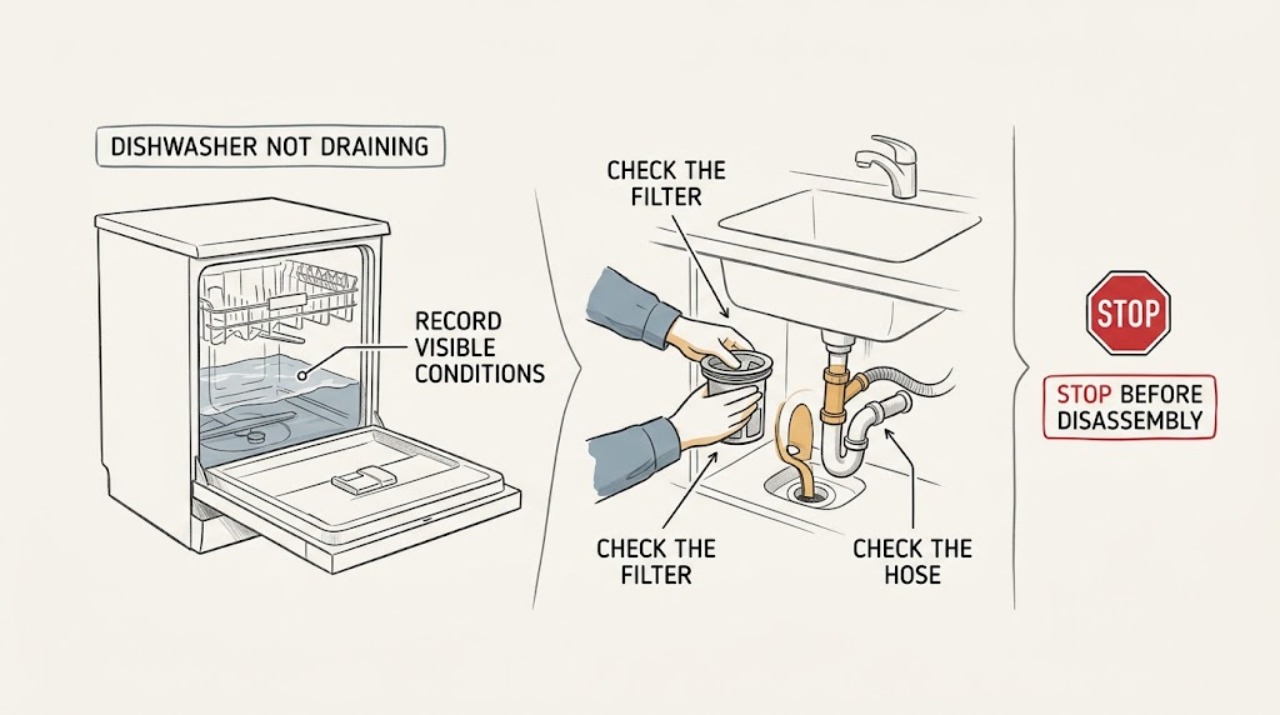
If an Ariston dishwasher leaves water behind, first make sure the cycle has actually finished and note the exact display or indicator pattern. Switch the appliance off, shut off the water tap, and disconnect the plug before cleaning the accessible filter assembly. Remove food residue from the filters and trap without removing the pump protection, then check the visible drain hose for kinks or compression and check the connected sink drain for a blockage. Ariston manuals use model-specific drain indications such as F3 or 3, so do not treat either as a universal code. If the filter, hose, and sink drain are clear but water remains, the hose cannot be safely accessed, a leak is present, or the fault returns, stop and arrange authorised service rather than opening the appliance or testing the pump.
Work through in order
Diagnostic checks
Use only checks that match the exact appliance or system and its official guide.
-
Check 1
Check whether the wash cycle has ended, then record the panel state before pressing buttons: normal end indication, a running cycle, an error or flashing indicator, or water remaining with no clear indication. Do not open electrical covers or reach into standing water.
Expected result: The cycle is still running; the end indication is present; F3, 3, or another model-specific indication appears; or the panel gives no useful indication while water remains.
Next step: Wait for a cycle that is still running and use the exact model manual for any drain or reset control. If the cycle ended or the indication returns, continue with the safe filter and external drain-path checks.
Why this matters
Why: Water during an unfinished cycle is not proof of a blocked drain. An F3 or 3 indication is documented on some Ariston models, but the different manuals show that the code presentation is model-dependent.
-
Check 2
Switch the dishwasher off, shut off the water tap, and disconnect the plug using the normal accessible disconnect before maintenance. Remove the racks and clean the cylindrical, cup, and stainless-steel filter elements under running water with a non-metallic brush as the model manual describes.
Expected result: The filters contain food residue or another visible object; the trap is dirty; a filter is loose or damaged; or the filters and trap are clear.
Next step: Remove only visible residue carefully, refit the complete filter assembly correctly, and do not run the dishwasher without filters. Do not remove the black wash-cycle pump protection or go farther into the pump area as an ordinary user.
Why this matters
Why: Ariston says clogged filters or foreign objects in the filtration system can prevent waste water from flowing away correctly. A loose filter can also make the filtration system unsafe to operate; a clear filter shifts attention to the external drain path.
-
Check 3
With power still disconnected, inspect the visible drain hose along its accessible route for a kink, squash, or sharp bend. If it joins the sink drain, check that connection for an obvious blockage and confirm that the sink drain pipe itself can carry water away; do not pull out an integrated appliance to reach hidden plumbing.
Expected result: The hose is bent or compressed; the sink drain pipe is blocked; the visible route is clear; or the hose connection cannot be reached without moving the appliance or opening a panel.
Next step: Correct only an obvious accessible hose bend or sink-drain blockage, then refit the connection without forcing it. If access requires moving the appliance or the hose position is uncertain, stop and arrange qualified service.
Why this matters
Why: Ariston lists a bent drain hose and a blocked sink drain pipe as no-drain causes. The installation instructions also specify a model installation range for the outlet hose, so an incorrectly routed or inaccessible connection needs model-specific attention rather than a guessed pump diagnosis.
-
Check 4
After the filter assembly is correctly seated and the external drain path is clear, make one test using the drain or programme procedure specified for the exact Ariston model. Stay nearby and stop if water leaks, the pump runs continuously, or the fault indicator returns.
Expected result: The water leaves; the water level does not change; the same drain indication returns; a leak appears; or the dishwasher completes the test normally but later repeats the symptom.
Next step: If the symptom persists, stop repeated tests and contact authorised service with the model, serial or rating-plate information, exact display, and checks already completed. Do not open the pump housing or test energized wiring.
Why this matters
Why: Successful draining after a filter or external-path correction supports a restriction in that path. Persistent standing water or a returning indication after those checks points to a fault that cannot be identified safely from the outside.
-
Check 5
Before requesting service, inspect only for safety symptoms: water leaking from the appliance, a damaged plug or cable, an unusual burning smell, repeated electrical tripping, or a need to touch internal parts to continue. Keep the appliance off if any of these is present.
Expected result: There is a leak, damaged electrical equipment, an electrical trip, a burning smell, or no safety symptom but the no-drain condition remains.
Next step: Do not restart a leaking or electrically abnormal dishwasher. Arrange authorised service and provide the model number, exact fault indication, whether the cycle finished, and the filter and hose findings.
Why this matters
Why: A leak or electrical symptom changes the task from a routine filter or hose check to a safety and service issue. Even without a visible hazard, persistent no-drain behavior after the documented external checks does not prove which internal part has failed.
Use your observations
Decision map
Find the observation that best matches what you see, then follow the next safe action.
-
PATH 01Next step
What you see
The cycle has not finished and there is no abnormal leak or electrical symptom.
Do this next
Allow the programme to finish and follow the exact model's drain or reset instructions if the end indication is followed by standing water.
Why this path and its safety boundary
Why it matters: The remaining water may be part of the active wash programme rather than a completed-cycle drain failure.
-
PATH 02Next step
What you see
The cycle ended, the filter or trap contains food residue, and the hose and sink drain appear unobstructed.
Do this next
Clean and correctly refit the complete filter assembly, preserving the pump protection, then perform one model-specific drain test.
Why this path and its safety boundary
Why it matters: A filtration restriction is a plausible first explanation because Ariston links clogged filters with incorrect waste-water flow.
-
PATH 03Next step
What you see
The cycle ended and the drain hose is visibly kinked or the connected sink drain is blocked.
Do this next
Correct only the accessible hose or sink-drain condition, then retest once without moving an integrated appliance or opening a panel.
Why this path and its safety boundary
Why it matters: The external drain path is more likely to be restricting flow than an identified internal pump failure.
-
PATH 04Next step
What you see
The filter, visible hose, and sink drain are clear but water remains after a completed cycle, or the documented drain indication returns.
Do this next
Stop DIY disassembly and arrange authorised service with the exact model and indication. Do not remove the pump protection or make a live test.
Why this path and its safety boundary
Why it matters: The remaining fault may be inside the drain system or controls, but these observations do not select a compatible pump or other part.
-
PATH 05Next step
What you see
A leak, damaged electrical part, burning smell, repeated trip, or standing water requiring contact with hidden components is present.
Do this next
Keep the dishwasher off and arrange appropriate qualified service; do not restart it to reproduce the fault.
Why this path and its safety boundary
Why it matters: The symptom has crossed the safe user-check boundary.
Helpful context
Understand the symptom
Confirm that this is a completed-cycle drain problem
An Ariston dishwasher can still contain water while a wash cycle is in progress. Before treating the symptom as a failed drain, note whether the cycle has ended, whether the control panel shows an error or flashing indicator, and whether the water level changes at all. The manuals show different model-specific drain indications, including F3 on one model and 3 on another, so record the complete model and the exact display rather than copying a code from a different machine.
Start with the accessible filter and drain path
Ariston's maintenance instructions link clean filters with correct waste-water flow. With the appliance powered off and disconnected as the manual directs, clean the filter assembly and inspect the trap for food residue or other visible objects. Refit every filter correctly; do not run the dishwasher without the filters and do not remove the black wash-cycle pump protection. The visible hose and sink-drain checks come next because either can stop water from leaving even when the filter is clean.
Use the stop point instead of guessing at a pump
If the cycle has ended and the accessible filter, hose, and sink drain are clear, a remaining-water symptom does not identify a particular pump, wiring fault, or replacement part. Do not remove the pump cover, reach into internal components, or make a live electrical test. Ariston's operating instructions say not to touch internal parts when the appliance breaks down and direct persistent problems to authorised assistance.
When checks do not resolve it
Need a professional?
Water remains after the cycle has ended and the filter, visible drain hose, and sink drain are clear., The model-specific drain indication returns, the hose cannot be reached without moving the appliance, or a panel must be opened., There is a leak, damaged electrical equipment, a burning smell, repeated tripping, or any need to touch internal parts.
Have this ready
- The complete Ariston model and serial or rating-plate information.
- The exact display, light pattern, or drain indication and whether the cycle had finished.
- Filter and trap condition, visible hose and sink-drain findings, and whether one documented test changed the water level.
Common questions
FAQ
Why is my Ariston dishwasher not draining after a cycle?
Ariston manuals list an unfinished cycle, a bent drain hose, a blocked sink drain pipe, and a filter clogged with food residue among the possible causes. Confirm the cycle ended, disconnect power before maintenance, clean and refit the filter assembly, and check only the visible hose and sink drain. If water remains after those checks, arrange authorised service.
What should I check first on an Ariston dishwasher with standing water?
First determine whether the wash cycle is complete and record the panel indication. Then switch the dishwasher off, shut off the water tap, disconnect the plug, and clean the accessible filter assembly and trap. Check the visible drain hose for a kink and the connected sink drain for a blockage before considering service.
What does F3 mean on an Ariston dishwasher?
One Ariston daily reference guide shows F3 with a no-drain condition and lists an unfinished cycle, bent drain hose, blocked sink drain pipe, or food-residue-clogged filter. Other Ariston manuals display the drain indication differently, so confirm the exact model and use its manual rather than treating F3 as universal.
Can I remove the pump protection to clear an Ariston dishwasher blockage?
Do not remove it as a routine user check. Ariston's filter-cleaning instructions say to inspect the trap and remove visible food residue while never removing the black wash-cycle pump protection. If the blockage appears to be behind that protection or water still remains, use authorised service.
When should I stop troubleshooting an Ariston dishwasher that will not drain?
Stop when the filter, visible hose, and sink drain are clear but water remains, the model-specific indication returns, access requires moving an integrated appliance or opening a panel, or a leak or electrical symptom appears. Keep the appliance off for a leak or electrical abnormality and arrange authorised service.
Read the exact guide
Official sources
- DAILY REFERENCE GUIDEAriston · Ariston dishwasher manual for the identified model family; drain indication and controls may vary by model
- Operating instructionsAriston · Ariston LFF 8M122 dishwasher manual; use the appliance's own manual when controls or installation differ
Community feedback
Share a repair observation
Share a plain-text repair observation. Accepted observations are published automatically; this page may take a moment to update.