
On this page
Start here
Quick answer
If an ASKO dishwasher identified only as 1605 will not fill after you move into a house, first confirm the complete model name, article number, serial number, and market; ASKO says the model name alone is not a unique identifier. From a dry, safe position, check whether the house-side dishwasher shutoff valve is open and whether the visible inlet hose is kinked or damaged. Confirm the door closes fully, a delayed start is not selected, and the control has actually started the program. Notice whether the machine is silent, drains briefly and then stops, or runs the drain pump continuously. Do not borrow a newer ASKO error-code procedure, disconnect the inlet valve, pull out a built-in unit, or perform a powered test on plumbing or wiring. If the valve is open and the visible path is clear but no water enters, or if the pump runs continuously, close the water supply as appropriate and arrange qualified ASKO service or plumbing help.
Before you begin
Safety first
- Owner checks are limited to identifying the product label, observing the normal controls, checking the house-side shutoff and visible hose from a dry position, and recording the first-start behavior. Do not remove panels, pull out the built-in dishwasher, loosen water connections, test the inlet valve or wiring, bypass the door switch, or run repeated fill attempts.
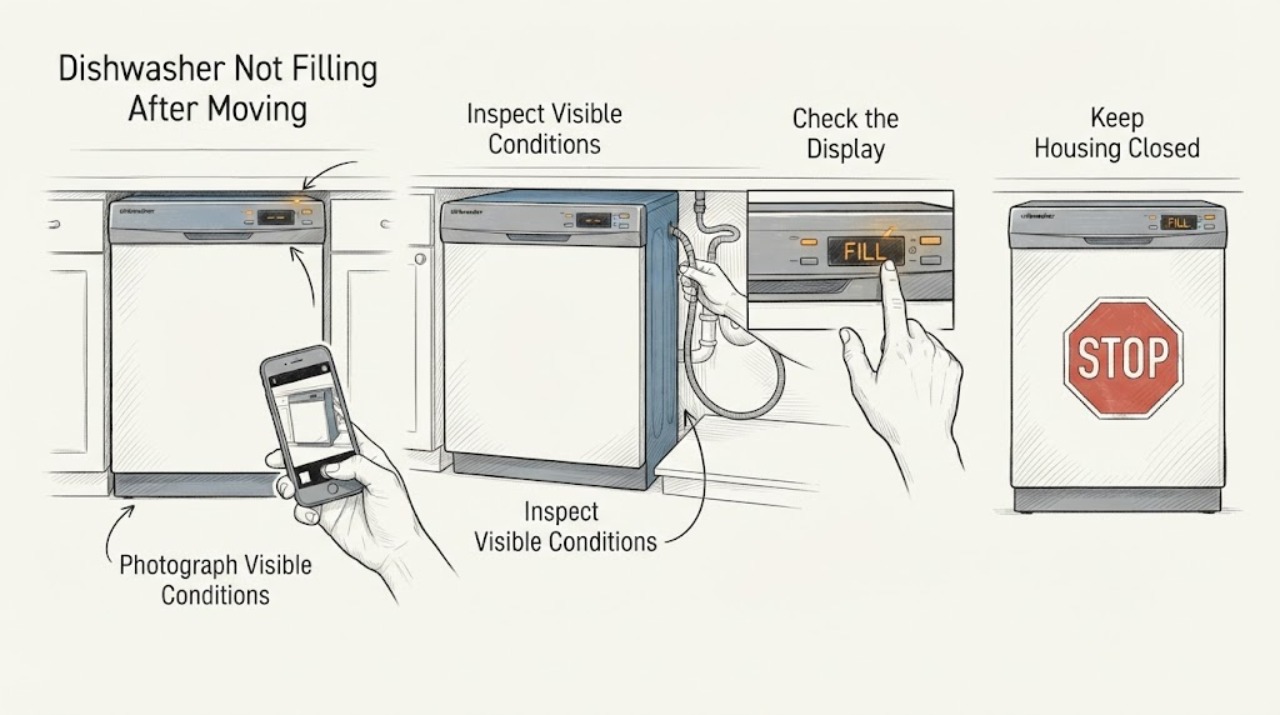
Work through in order
Diagnostic checks
Use only checks that match the exact appliance or system and its official guide.
-
Check 1
Open the dishwasher door and photograph the complete product label: model name, article or product number, serial number, and any market or voltage information. Treat '1605' as a lead, not as a complete manual identity.
Expected result: The label provides a full model name plus unique article and serial numbers, or only '1605' can be read and the rest is missing or obscured.
Next step: Use the complete label in ASKO's manual finder and service request. Until the identity is confirmed, do not apply a current ASKO error-code sequence or order an inlet component.
Stop if: Do not remove trim or panels to find an inaccessible label, and do not rely on a control-panel photograph alone.
Why this matters
Why: ASKO says the model name is not unique, while the article number identifies the product for service and the serial number is unique. A partial identity can point to the wrong manual, connection specification, or control procedure.
-
Check 2
From a dry standing position, check the house-side dishwasher shutoff valve and the visible section of the inlet hose. Confirm the valve is open only if there is no leak, and look for a kink, crush point, crack, or wet fitting. Do not loosen the fitting or pull the dishwasher forward.
Expected result: The shutoff valve is closed, the visible hose is kinked or wet, the valve and visible hose look normal, or the supply connection is hidden behind the built-in unit.
Next step: If the valve was closed and there is no leak, open it normally and use the exact manual's start procedure once. If the hose or fitting is wet/damaged, or the connection is concealed, keep the valve closed and arrange qualified plumbing or appliance service.
Stop if: Do not disconnect a pressurized hose, replace the inlet valve, tighten a concealed fitting, or work on plumbing while power is connected.
Why this matters
Why: ASKO's owner guide identifies a closed shutoff valve as a no-water possibility, and its installation guidance calls for an accessible valve, kink-free hose, and watertight connections. A clear visible section does not rule out a concealed connection or house plumbing issue.
-
Check 3
Use only the normal front controls and the confirmed model's manual: check that the main power is on, the door closes fully without a rack or dish blocking it, a delayed start is not selected, and a program has been selected and started. Do not enter service mode.
Expected result: The dishwasher is silent, the door does not close or latch normally, a delay or cancel state is active, or the control indicates that a program has started but no water enters.
Next step: Correct only an obvious door or program-selection issue using the exact manual. If the controls indicate a start yet the tub stays dry with an open, leak-free supply, stop after one controlled attempt and arrange service.
Stop if: Do not force the latch, bypass the door switch, repeatedly cancel/start, or test wiring with the door open.
Why this matters
Why: A silent machine or door/program state can prevent a fill request before any inlet component is involved. The available ASKO owner guidance uses normal Start/Stop and door checks, but the exact button timing can vary by platform and is not being generalized to 1605.
-
Check 4
Listen and watch from outside for the first minute of one safe start, without opening the door during operation: note silence, a short drain followed by a stop, an attempted fill with no visible water, or a drain pump that keeps running. Do not repeat the start to reproduce the behavior.
Expected result: The pump runs continuously, the unit drains briefly and stops, the unit remains silent, or the unit sounds as though it is filling but no water reaches the tub.
Next step: For a continuously running pump, turn power and water off safely and contact ASKO Customer Care. For silence, a brief-drain stop, or an attempted fill with a clear visible supply, preserve the observation and arrange service rather than changing parts.
Stop if: Do not reach into the tub, remove the filter or pump cover while testing fill behavior, or continue operation when water leaks or electrical symptoms appear.
Why this matters
Why: These patterns separate a pump/protection or control sequence from a supply-path symptom, but none proves a valve, sensor, pump, or board failure. ASKO specifically directs power and water off when the drain pump runs continuously.
-
Check 5
If the dishwasher has been idle or recently moved, record whether the house water was shut off during the move, whether the drain or inlet route may have been pinched, whether the dishwasher is level and secured, and whether the problem began on the first attempted cycle. Do not slide out the appliance to inspect concealed connections.
Expected result: The no-fill condition began immediately after moving in, a visible hose route is pinched, the connection is concealed, or the machine was previously known to fill normally.
Next step: Give the move-in timing and photographs to the landlord, installer, plumber, or ASKO service provider. Keep the valve closed if the connection is wet or uncertain and do not pull out the built-in unit.
Stop if: Do not alter the drain route, reuse an old inlet hose, modify the electrical connection, or perform a concealed installation repair yourself.
Why this matters
Why: The timing increases the value of checking the house-side valve, visible routing, and installation handoff, but it does not prove that moving damaged a valve or that the appliance itself is defective. ASKO requires professional water, drainage, and electrical connections in its installation guidance.
Use your observations
Decision map
Find the observation that best matches what you see, then follow the next safe action.
-
PATH 01Next step
What you see
The complete ASKO label is available and shows a model name, article number, serial number, and market that match the dishwasher in the house.
Do this next
Open the matching ASKO manual and follow only its normal start and no-fill instructions. Give the complete identity to service if the appliance still will not fill.
Why this path and its safety boundary
Why it matters: The service and manual lookup can now be tied to the actual appliance. The number 1605 by itself would not have established that identity.
-
PATH 02Next step
What you see
The house-side shutoff valve is closed, the visible inlet hose is kinked, or the visible connection is wet or damaged, and there is no immediate electrical hazard.
Do this next
Keep the valve closed if there is wetness or damage; arrange a qualified plumber or appliance technician. Correct only an obvious kink or normally closed valve when the exact manual permits it and there is no leak.
Why this path and its safety boundary
Why it matters: A house-side or visible supply-path issue is more likely than a proven internal inlet-valve failure, but a wet fitting can worsen if pressure is restored.
-
PATH 03Next step
What you see
The visible supply is open and dry, the door closes and a program starts, but the tub stays dry; the machine is silent, briefly drains and stops, or attempts to fill without water.
Do this next
Stop after one safe controlled attempt, retain the exact model and behavior record, and arrange ASKO service. Do not apply a newer ASKO code map or disassemble the inlet system.
Why this path and its safety boundary
Why it matters: The remaining possibilities include a model-specific start/protection sequence, concealed installation issue, or internal control or fill system fault. User observation cannot distinguish a valve, sensor, or board.
-
PATH 04Next step
What you see
The drain pump runs continuously, water leaks, the breaker trips, the cord or outlet is damaged, or the dishwasher is connected in a way that cannot be safely inspected.
Do this next
Turn off the water and isolate power only through a safe, accessible disconnect; otherwise do not touch the appliance. Arrange qualified ASKO, plumbing, or electrical service and do not pull out the unit.
Why this path and its safety boundary
Why it matters: This is a water, electrical, or installation safety stop, not a routine no-fill adjustment. ASKO directs power and water off for continuous pumping and requires qualified connections.
-
PATH 05Next step
What you see
Only the number 1605 is known, or the displayed code, control layout, supply standard, or market does not match the available manual.
Do this next
Photograph the label and display, use ASKO's model/article lookup, and request service with the complete identity. Do not borrow an F4/F12 or other newer-platform procedure.
Why this path and its safety boundary
Why it matters: The available official ASKO evidence cannot establish a unique 1605 platform or authorize a code-specific or wiring procedure. The safe symptom-level supply and start checks remain limited.
Helpful context
Understand the symptom
A dishwasher that arrived with a house can fail to fill because the appliance is not actually starting, the house-side supply remains closed, or the connection was disturbed during moving or installation. The identifier '1605' is not enough to select a manual: ASKO distinguishes a model name from the unique article and serial numbers on the appliance label. Because the exact 1605 market manual was not available in the opened ASKO documentation, this page stays at safe symptom-level checks and does not import a newer platform's fault-code map.
The first useful distinction is what happens after a normal start command. A quiet machine points toward power, door, control, or program selection. A brief drain before stopping can be an initialization or protection behavior, but it does not identify a failed valve. A continuously running pump is a stop condition in ASKO's owner guide. Check only the house-side valve and visible hose without pulling the built-in dishwasher or working on the inlet valve.
When checks do not resolve it
Need a professional?
Contact ASKO service for persistent no-fill with an open, dry visible supply, silence or an abnormal initial-drain sequence, an incomplete model identity, or any return after the manual's permitted normal start check. Contact a plumber for the house valve or concealed supply connection, and an electrician for unsafe power conditions.
Safety scope: Owner checks are limited to identifying the product label, observing the normal controls, checking the house-side shutoff and visible hose from a dry position, and recording the first-start behavior. Do not remove panels, pull out the built-in dishwasher, loosen water connections, test the inlet valve or wiring, bypass the door switch, or run repeated fill attempts.
Have this ready
- Provide the full model name, article/product number, serial number, market, photos of the label and display, whether the dishwasher was moved or idle, house-valve position, visible hose condition, door/program state, and whether it was silent, briefly drained, attempted filling, or pumped continuously.
Common questions
FAQ
Is ASKO 1605 enough information to find the correct dishwasher manual?
Not necessarily. ASKO says the model name is not unique and identifies the product using the article number and serial number on the label. Photograph the complete dishwasher label and use those identifiers for the manual or service request.
What should I check after moving into a house if the ASKO dishwasher will not fill?
From a dry position, check that the house-side dishwasher shutoff is open and that the visible inlet hose is not kinked, cracked, or wet. Confirm the door closes and a program actually starts. Do not pull the machine out or disconnect a concealed fitting.
What if the ASKO dishwasher drains but never fills?
A brief drain can be part of a start or protection sequence, but it does not identify a failed inlet valve. If the visible supply is open and dry and the tub remains empty after one safe start, record the behavior and arrange service rather than repeating cycles or using a newer ASKO fault-code procedure.
What if the drain pump runs continuously while the dishwasher will not fill?
ASKO's owner guide directs you to turn power and water off and contact Customer Care for a continuously running drain pump. Do not keep restarting the dishwasher or investigate the pump and inlet valve yourself.
Read the exact guide
Official sources
- User manualsASKO Global · Supports looking up documentation by product code or model name and selecting the local market; the opened page requires JavaScript and did not expose an exact 1605 result.
- ASKO Dishwasher Cleaning GuideASKO / askona.com · Supports general ASKO dishwasher owner-level checks for no water, normal start, drying, and continuous pump behavior; it is not asserted to be the exact 1605 manual and its F4 procedure is intentionally not reused.
- How to find the serial number, article number, or model name on an ASKO productASKO · Supports identification before applying a manual or service procedure; the opened page is a general ASKO identification guide, not an exact 1605 repair manual.
- ASKO Dishwasher Installation InstructionsASKO · Used only for general ASKO installation safety: accessible shutoff, qualified connections, kink-free hoses, and leak checks. It is explicitly not treated as the exact 1605 manual or a model-specific dimension/code source.
Community feedback
Share a repair observation
Share a plain-text repair observation. Accepted observations are published automatically; this page may take a moment to update.