
On this page
Start here
Quick answer
The Beko DW451 is a discontinued slimline integrated dishwasher, so first confirm the rating-plate model before applying this manual. If it turns on but does not take in water, look first for standing water or a drain pump that is still trying to empty the tub: Beko explains that a dishwasher that cannot drain may not proceed to filling. With power safely off, check only the visible drain and inlet hose routing, confirm the water tap is open, and make sure the door closes and latches. The DW451 manual also permits user cleaning of the accessible filters when they are correctly refitted. If the tub stays full, the machine still will not fill with a normal supply, or a leak, electrical smell, or repeated trip appears, stop using it and arrange authorised service rather than replacing an inlet valve or control board by guesswork.
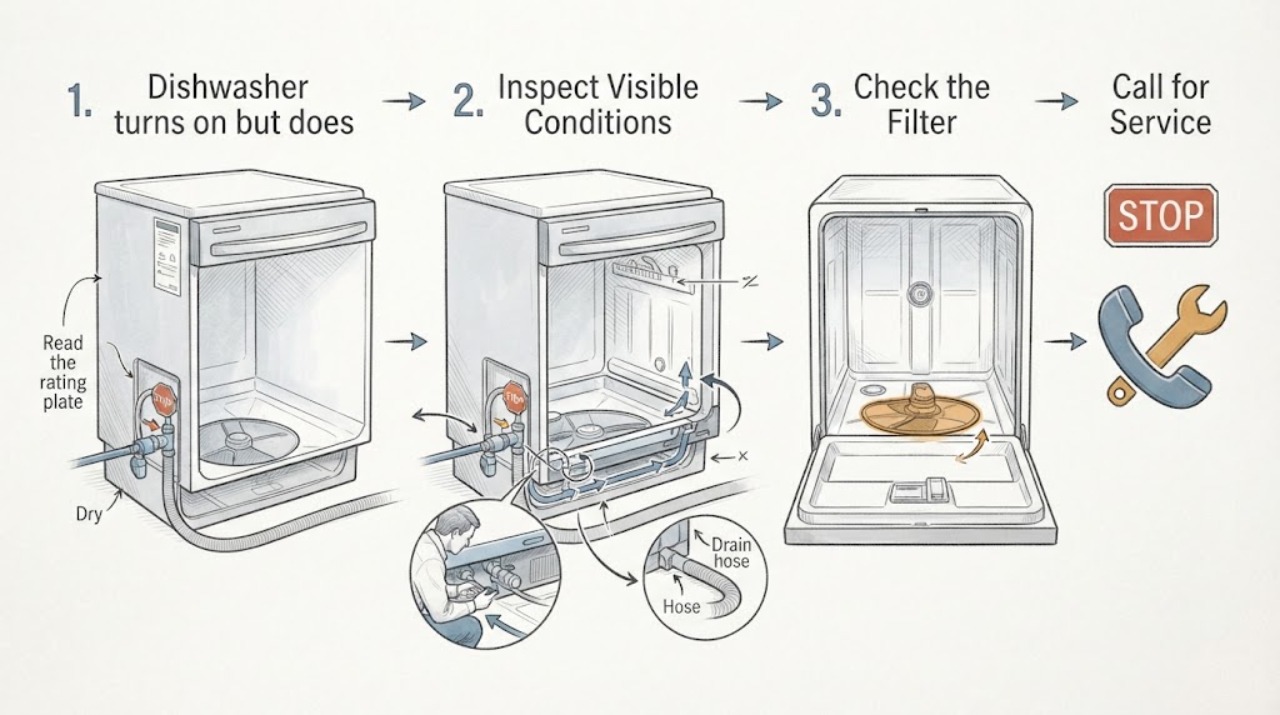
Work through in order
Diagnostic checks
Use only checks that match the exact appliance or system and its official guide.
-
Check 1
Read the rating plate and compare it with DW451 before relying on this article or its manual; note the market suffix if one is shown.
Expected result: The plate says DW451 or a closely related but different model, or the plate cannot be read.
Next step: Use the exact model shown on the plate for the manual and service request. If it is DW451, continue with the visible checks below.
Why this matters
Why: The Beko page identifies DW451 as a discontinued slimline integrated dishwasher, so a different suffix may have different controls or service information.
-
Check 2
With the dishwasher stopped and isolated from power if safely accessible, look at the bottom of the tub for standing water. If you already heard a pump run after starting, do not keep restarting it; record whether the water level changes during one safe observation.
Expected result: Water remains in the tub, the pump runs without clearing it, or the tub is dry and no pump-out is heard.
Next step: If water remains, continue only to the accessible filter and visible drain-hose checks. If the tub is dry, check the supply and door conditions without opening panels.
Why this matters
Why: Standing water or a pump that cannot clear it makes a drain-path problem a higher-priority explanation for a no-fill symptom; a dry tub makes that particular obstruction less likely but does not prove that the inlet side works.
-
Check 3
After power is safely off, inspect the user-accessible drain filters beneath the lower basket. Rinse away food residue under a tap and refit the complete filter assembly correctly; do not run the dishwasher without its filters.
Expected result: The filter contains food or foreign material, or it is already clean and correctly seated.
Next step: If the filter was blocked, perform one safe short retest after refitting it. If water remains, the filter is clear, or access would expose wiring, stop and arrange service.
Why this matters
Why: A blocked filter can restrict drainage and leave the programme unable to reach filling. A clean, correctly seated filter lowers the likelihood of that accessible cause but does not clear an internal pump or hose fault.
-
Check 4
Check only the visible drain and inlet hose routing for a kink, crush, twist, slipped connection, or obvious leak, and confirm the connected water tap is fully open. Do not pull the integrated unit out by force or disconnect a pressurised line.
Expected result: A hose is visibly restricted or leaking, the tap was closed, or the routing and tap appear normal.
Next step: Correct only a plainly visible routing issue that can be reached safely, then retest once. For a leak, forced access, or a normal supply with continued no-fill, stop and contact authorised service.
Why this matters
Why: Beko links restricted hoses and an unavailable tap with water-taking and drainage problems. A normal visible supply shifts the remaining uncertainty to an internal stage rather than proving a particular part failed.
-
Check 5
Close the door normally and observe whether it aligns and latches with the expected click before starting one programme; do not defeat the latch or hold the door closed while the machine runs.
Expected result: The door will not close smoothly, the latch does not engage, or the programme starts and then stops at the fill stage despite a latched door.
Next step: If alignment or latching is abnormal, stop and arrange service or installation correction. If it latches normally but the fill stage still fails, provide the service agent with the exact stop point and water-level observation.
Why this matters
Why: Beko states that a door that cannot close properly prevents a programme from starting. The DW451 installation guidance also connects correct leveling with smooth door closure and sealing; a latched door followed by no-fill does not identify the inlet or control component.
-
Check 6
On one controlled retest only, note the sequence: does the pump drain first, does any water enter, does the display stop, and is there a warning, leak, unusual noise, or electrical trip?
Expected result: The dishwasher fills after the visible correction, never admits water with the tap and hoses normal, or stops with water remaining or a safety symptom.
Next step: Stop using it for persistent no-fill, standing water, leaks, abnormal noise, burning smell, smoke, or repeated trips. Give the authorised service agent the model, programme, sequence, warning, and whether water remained.
Why this matters
Why: A change after a visible check supports that accessible condition as the cause. No change with a normal supply, or any leak, burning smell, smoke, or electrical trip, requires professional diagnosis rather than a guessed replacement part.
Use your observations
Decision map
Find the observation that best matches what you see, then follow the next safe action.
-
PATH 01Next step
What you see
The tub contains water or the pump runs without clearing it before the dishwasher ever reaches the fill stage.
Do this next
With power safely off, check the accessible filters and visible hose routing once. If water remains or access requires opening the appliance, stop and arrange authorised service.
Why this path and its safety boundary
Why it matters: The symptom is more consistent with the drain state blocking programme progress than with a proven failed inlet valve.
-
PATH 02Next step
What you see
The tub is dry, the tap is open, visible hoses are correctly routed, and the door latches, but no water enters and the programme stops at filling.
Do this next
Stop repeated starts and arrange authorised service. Do not open panels or order an inlet valve, pump, or control board from the symptom alone.
Why this path and its safety boundary
Why it matters: A user-accessible supply or door condition is less likely; the remaining inlet, sensor, or control cause is unproven and model-specific.
-
PATH 03Next step
What you see
The water or inlet hose leaks, the door cannot latch, the appliance trips power, or there is smoke, a burning smell, or exposed wiring.
Do this next
Stop the programme, isolate water or power only if it can be done without contact with the hazard, keep the area clear, and use authorised service or the appropriate emergency response.
Why this path and its safety boundary
Why it matters: This is a safety or installation problem, not a routine no-fill check.
-
PATH 04Next step
What you see
Cleaning a visibly blocked filter or correcting a reachable hose kink restores drainage and the next safe run fills normally.
Do this next
Monitor the next normal programme without repeated resets. If no-fill or standing water returns, stop and give service the before-and-after observations.
Why this path and its safety boundary
Why it matters: The result supports an accessible restriction as the immediate cause, while recurrence can still indicate a deeper drain or installation issue.
Helpful context
Understand the symptom
What the symptom does and does not prove
Power at the display only shows that some controls are available; it does not prove that the dishwasher has completed its door, drain, or water-inlet checks. On this exact integrated model, use the rating plate and the DW451 manual to confirm that the instructions fit before moving the appliance. A no-fill complaint can be caused by a drain state that prevents the next stage, a closed tap or restricted hose, or a door that never reaches its latched position. Those observations do not identify an inlet valve, pump, sensor, or board by themselves.
Use one safe retest, not repeated resets
After a visible, low-risk restriction is corrected and the dishwasher is safely reassembled, make one controlled programme start and note whether it drains, fills, or stops. Do not remove cabinet panels, bypass a door or flood switch, probe wiring, or test a valve or pump while energised. An integrated appliance that must be pulled out to reach a hose is a service boundary, especially if water is leaking or the floor/cabinetry could be damaged.
When checks do not resolve it
Need a professional?
Call an authorised Beko service agent when the DW451 still will not fill after the tap, visible hoses, door latch, and accessible filter checks; when water remains or the pump runs without draining; or when integrated access, a hose leak, electrical smell, smoke, or repeated power trip is involved.
Have this ready
- Provide the rating-plate model and market suffix, selected programme, point where the sequence stops, any displayed warning, whether water is standing in the tub, and what changed after the visible checks.
Common questions
FAQ
Does the DW451 turning on prove that the water inlet is working?
No. A powered display does not prove that the door is latched, the drain stage has cleared, or the water-inlet stage has been authorised. Record the sequence and check visible conditions before any internal diagnosis.
Can I clean the Beko DW451 dishwasher filter myself?
The DW451 manual describes removing and rinsing the accessible filter assembly, then refitting it correctly. Isolate power safely first, do not run without the filter, and stop if access is not user-safe or water remains afterward.
Should I replace the inlet valve because the dishwasher does not fill?
Not from this symptom alone. Beko's guidance starts with drainage, tap, hose, and door conditions; a normal visible supply followed by persistent no-fill needs authorised diagnosis of the internal stage.
Read the exact guide
Official sources
- Why is my Beko dishwasher not filling with water?Beko UK · Brand-level Beko UK guidance for the no-fill symptom; use exact DW451 instructions for model-specific controls.
- Slim Line Integrated Dishwasher DW451Beko UK · Exact DW451 product page; UK market and discontinued product, so the rating plate controls if the appliance has another suffix.
- DW451 User ManualBeko UK · Exact DW451 manual for the UK product family; confirm the appliance rating plate and market before applying it.
- How to fix a dishwasher that won’t take in waterBeko · Brand-level Beko support guidance; hose, drain, filter, and door checks are used only as safe symptom-level checks, not as proof of a particular part failure.
Community feedback
Share a repair observation
Share a plain-text repair observation. Accepted observations are published automatically; this page may take a moment to update.