
On this page
Start here
Quick answer
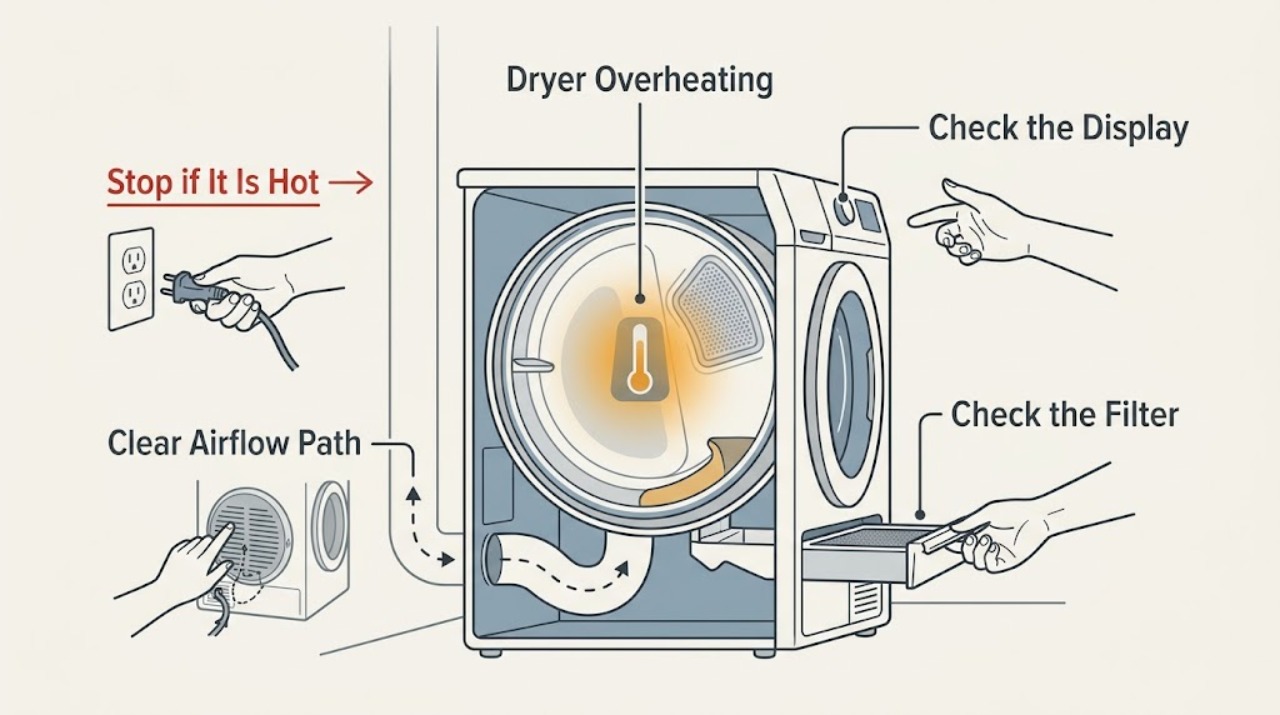
If an Asko dryer is overheating, stop the cycle and let it cool before checking anything. Clean the user-accessible door lint filter and, on heat-pump models, the lower lint filter or heat-exchanger filter exactly as the model manual describes; check that the front air intake, external exhaust, and room ventilation are not blocked, and reduce an overloaded or very wet load. ASKO manuals state that clogged filters can cause overheating and longer drying, while the machine may shut down preventively. Do not run it with a missing or damaged filter, do not open cabinet panels or work near internal electrical or refrigerant parts, and do not keep restarting it. Burning smell, smoke, sparking, a hot or damaged cord, melted material, a fault code, or repeated overheating is a stop condition for qualified appliance service; an external outlet or wiring concern belongs with a qualified electrician.
Work through in order
Diagnostic checks
Use only checks that match the exact appliance or system and its official guide.
-
Check 1
Stop the cycle from the normal controls and let the dryer cool fully. From outside, note whether the load is merely warm at the end of a completed cycle, unusually hot, damp after a very long cycle, or accompanied by a burning smell, smoke, sparks, or a fault message.
Expected result: The dryer completed its cool-down normally, the cycle became unusually long, the machine stopped with an overheat or error indication, or a hazard sign is present.
Next step: If any hazard sign is present, stop using the dryer and arrange qualified service. Otherwise continue only after it is cool, using the filter and airflow checks below; do not repeatedly restart it to see whether the symptom returns.
Why this matters
Why: A normal cool-down is expected at the end of a program, but excessive heat, an unexplained shutdown, or a fault indication makes airflow, filter condition, ambient ventilation, or a protection/control fault more likely. Odor, smoke, sparks, or heat damage is not a cleaning branch.
-
Check 2
With the dryer cool and switched off, remove and inspect the door lint filter from its normal user access. Clean away fibers, check that the filter is intact, and reinstall it fully. If the model has a lower lint or heat-pump filter, clean that user-accessible filter only by the model manual's method; do not touch sharp heat-exchanger fins or use hard tools on them.
Expected result: The door filter or lower filter is visibly packed with lint, damaged, missing, damp where the manual says it must be dry, or clean and correctly seated.
Next step: Replace a damaged filter through the approved model-specific channel and do not operate without it. If the filters were clogged, let the dryer cool and run only the model-approved normal program with a small, suitable load; if overheating remains, stop and escalate.
Why this matters
Why: ASKO says filters must be cleaned regularly and that insufficient filter cleaning can reduce efficiency, lengthen drying, and contribute to overheating. A damaged or missing filter is a stop condition, not a reason to run a test cycle.
-
Check 3
Identify the drying system from the rating plate or manual. For a vented model, inspect the accessible external duct and outlet for crushing, kinks, lint accumulation, or a blocked termination. For a condenser or heat-pump model, check the front cool-air intake and the clear space around the appliance; do not remove cabinet panels or reach into the machine.
Expected result: An external duct is kinked or blocked, the air intake is covered, the dryer is tightly enclosed, or the external path and clearances look open.
Next step: Correct only an obvious external obstruction without disassembling the dryer, then allow it to cool before one supervised normal cycle. If the path cannot be made clear, or the symptom returns with clear airflow, call appliance service.
Why this matters
Why: ASKO installation guidance requires unobstructed exhaust or ventilation openings and adequate room ventilation. Restricted air movement can extend drying and allow heat to build; an open-looking exterior does not rule out an internal fan, heat exchanger, or sensor fault.
-
Check 4
Review the last load without opening the cabinet: note whether it was overfilled, tightly balled, dripping wet, mixed with heavy items, or made from a material the manual says not to tumble-dry. Check whether the condensate tank warning is displayed on a condenser or heat-pump model.
Expected result: The load was too large or very wet, items were tangled into a dense bundle, prohibited material was present, or the condensate tank warning is shown.
Next step: Remove unsuitable items, use the correct program and a smaller load, spin or wring laundry as allowed by its care label, and empty the condensate tank as the model manual directs. If the dryer still overheats with a suitable load, stop testing and arrange service.
Why this matters
Why: ASKO troubleshooting guidance connects long or poor drying with load size, insufficient spinning, tangled laundry, room conditions, and filter status. A full condensate tank can pause a program on applicable models; these observations do not prove an internal heater or thermostat fault.
-
Check 5
After the dryer is cool, filters are correctly installed, the external airflow is unobstructed, and the load is suitable, run one model-approved normal program while remaining nearby. Observe whether heat rises normally, the cycle reaches its cool-down, the display gives a filter or error message, or the dryer shuts down hot again.
Expected result: The cycle completes with normal cooling, drying remains unusually long, a filter or fault message returns, or the dryer overheats or stops again.
Next step: If the symptom returns, stop using the dryer and provide the technician the model, type, serial number, program, load, time to overheat, messages, and the checks already completed. Do not bypass a thermal protector or continue cycling the appliance.
Why this matters
Why: A single normal cycle that completes after maintenance supports an airflow, load, or maintenance explanation but does not certify internal safety parts. A returning message or repeated overheat points toward a fault requiring diagnosis rather than more resets.
-
Check 6
Inspect the power cord, plug, and accessible wall outlet visually only after the dryer is cool. Look for scorching, deformation, looseness, water, or a breaker that has tripped; do not remove an outlet cover, open the dryer, or perform live electrical testing.
Expected result: The cord or outlet is hot or damaged, the breaker trips again, there is water or scorching, or the exterior supply looks normal.
Next step: For damage, repeated trips, or any uncertainty around the household supply, leave the dryer off and contact a qualified electrician; for repeated dryer overheating with a normal supply, contact qualified appliance service. Do not substitute a larger fuse or use an extension cord.
Why this matters
Why: Visible heat or repeated protection operation can be an electrical safety issue outside the user troubleshooting path. A normal-looking cord and outlet do not exclude an internal electrical or control fault.
Use your observations
Decision map
Find the observation that best matches what you see, then follow the next safe action.
-
PATH 01Next step
What you see
Smoke, burning smell, sparks, melted material, a hot or damaged cord, water near electrical parts, or a repeated breaker trip is present.
Do this next
Stop immediately, keep the dryer off, and arrange qualified appliance or electrical service as appropriate. Do not restart, open panels, or work on wiring, heaters, sensors, or refrigerant components.
-
PATH 02Next step
What you see
The user-accessible filters are clogged but intact, and there are no hazard signs.
Do this next
Clean and correctly reseat the filters using the exact model manual, clear only an obvious external airflow obstruction, let the dryer cool, and try one suitable load. Repeated overheating requires service.
-
PATH 03Next step
What you see
The dryer is vented and the external duct or termination is kinked, blocked, or not exhausted as required.
Do this next
Keep the dryer off until the external path is corrected by a qualified installer or technician if it cannot be safely corrected from outside. Do not dismantle the cabinet or alter the duct with improvised materials.
-
PATH 04Next step
What you see
Filters and visible airflow are clear, the load is suitable, but the dryer still overheats, shows a fault, or shuts down repeatedly.
Do this next
Stop further testing and book qualified appliance service. The technician may need to assess airflow components, temperature sensing, overheat protection, or controls; the user should not bypass or test those parts internally.
Helpful context
Understand the symptom
Overheating is usually an airflow or protection symptom, not a part diagnosis
A warm drum at the end of a normal cycle is different from clothes that are unusually hot, an extended cycle, a dryer that stops before cooling, or a burning odor. ASKO uses model-specific filter and drying-system layouts, so identify whether the dryer is vented, condenser, or heat pump before following a cleaning instruction. Use only the filters and access points described for the exact model.
Cool it and keep internal work out of a user check
Stop the program, allow the dryer and laundry to cool, and keep the appliance disconnected only when the plug is safely accessible and there is no damage. External filter cleaning is a user check; cabinet panels, internal wiring, refrigerant circuitry, sensors, heaters, and safety devices are not. Do not operate without a correctly installed filter or with a damaged filter. Stop immediately for smoke, a burning smell, sparks, melted fabric or plastic, water near electrical parts, or a hot or damaged cord.
Only after diagnosis
Potential parts
- temperature sensor or overheat protection device
Only consider this category after the filters, external airflow, room ventilation, and load have been checked and the dryer still overheats or reports a temperature-related fault; the symptom alone does not identify a part.
Confirm the exact model and type from the rating plate and use the model manual or authorized service information before selecting any component. - fan or airflow assembly
Only consider this category when a qualified diagnosis finds inadequate internal airflow after user-accessible filters and the external path are clear.
Fitment varies by drying system and model; have an authorized technician verify the component and safety requirements.
Common questions
FAQ
Why does my Asko dryer get very hot and then stop?
A clogged filter or restricted airflow can make an ASKO dryer overheat; some models preventively stop or turn off a compressor and need to cool. Clean only the model-approved user filters and check visible airflow. If it stops hot again, or there is an odor, smoke, sparks, damage, or an error, leave it off and arrange qualified service.
Should I keep running an Asko dryer if the lint filter is damaged or missing?
No. The ASKO manual says to reinstall the lint filter and never operate the dryer without a lint filter or with a damaged one. Replace it through model-specific authorized support before using the dryer.
What can I safely check when an Asko dryer overheats?
After it cools, check the door lint filter, any model-approved lower filter, visible vent or air-intake obstructions, room ventilation, load size, and a condensate-tank warning where applicable. Keep cabinet panels closed and do not test internal electrical, heating, sensor, or refrigerant parts.
When should I call for Asko dryer repair?
Call qualified appliance service when overheating repeats after safe filter, airflow, ventilation, and load checks, or when a fault message returns. Stop immediately for smoke, burning smell, sparks, melted material, a hot or damaged cord, water near electrical parts, or repeated breaker trips; household supply concerns belong with a qualified electrician.
Read the exact guide
Official sources
- Installation and ConnectionASKO official documentation · Official ASKO installation guidance on grounded supply, accessible outlet, no extension cord, and qualified electrical connection; exact electrical requirements are model and market specific.
- User ManualASKO / Gorenje official documentation · Official ASKO manual sections on filters, heat-exchanger filter care, overheating, ventilation, condensate tank, and load troubleshooting; exact filter layout varies by model.
- Installation and ConnectionASKO official documentation · Official ASKO vented-dryer installation guidance on outdoor exhaust, clear ducting, bends, and lint-safe routing; do not apply vent-specific details to condenser or heat-pump models.
- User ManualASKO / Gorenje official documentation · Official ASKO manual sections on error handling, trained repairs, visible error codes, room conditions, loads, and service identification; use the exact model manual for controls.
- Professional Tumble DryerASKO official product documentation · Official ASKO product specification confirming a heat-pump dryer has thermal and electronic overheat protection; it does not diagnose a household model or authorize component replacement.
Community feedback
Share a repair observation
Share a plain-text repair observation. Accepted observations are published automatically; this page may take a moment to update.