
On this page
Start here
Quick answer
If a Bauknecht washing machine is not filling, first decide whether it takes no water at all or simply uses less water than expected. For a no-fill fault, switch the machine off, make sure the water tap is fully open, the inlet hose is connected and not kinked, the door is closed, a program is selected, and Start/Pause has been pressed. Check for a delay or Demo mode only with the model instructions. Do not open the cabinet or work on live water-valve wiring. If the inlet checks are clear but the machine still does not fill, repeatedly fills and drains, leaks, or shows a recurring warning, close the tap, switch it off, and arrange qualified appliance service.
Before you begin
Safety first
- Do not open panels, test live water-valve or sensor wiring, bypass the door interlock, alter pressure tubing, or continue operating with a leak or unstable water supply. Close the water tap and disconnect power only when safe and appropriate for external inspection.
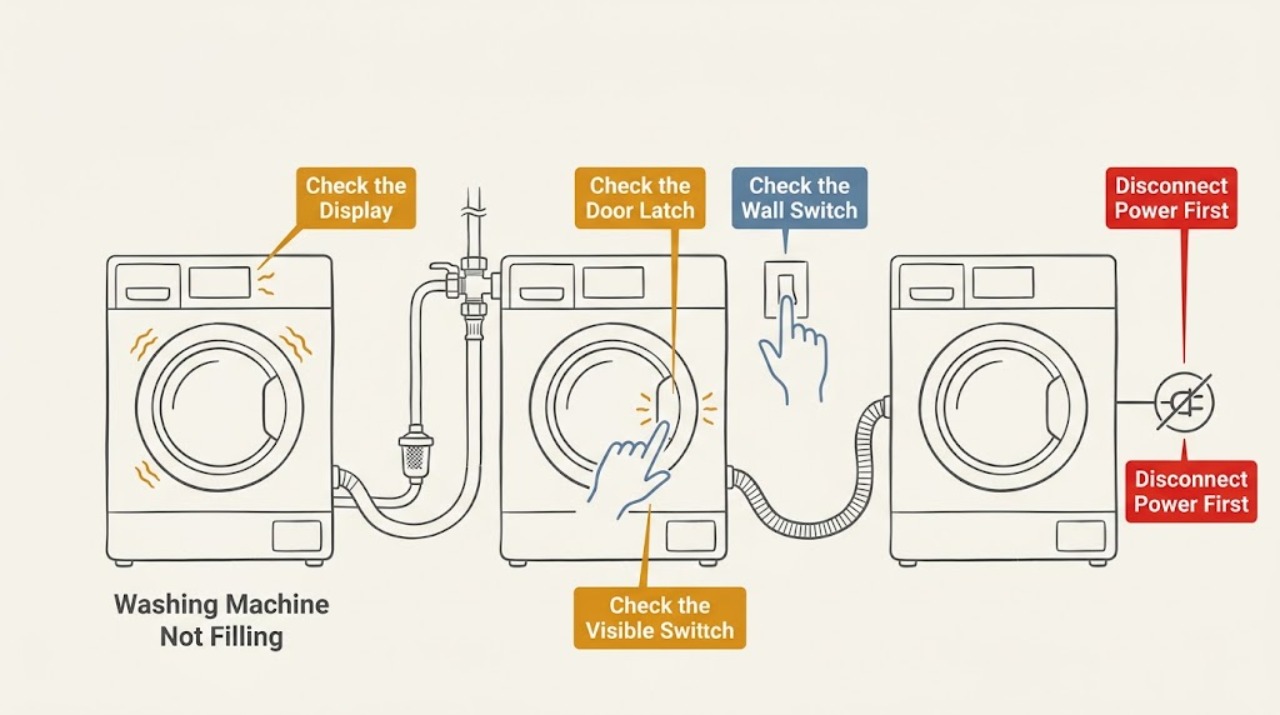
Work through in order
Diagnostic checks
Use only checks that match the exact appliance or system and its official guide.
-
Check 1
Run no further cycles until you identify the symptom: note whether no water enters, only a small amount enters, or water enters and immediately drains. Check the display for a water-supply or other warning without opening the cabinet.
Expected result: The drum stays dry, the machine uses a modest amount of water but completes normally, or water appears briefly and then leaves.
Next step: If the cycle completes normally, do not add water manually. If there is no fill or the machine repeatedly loads and unloads, switch it off and continue only with the matching external checks.
Stop if: Stop for a leak, water spraying from a connection, a recurring warning, or any need to remove panels or test the inlet system electrically.
Why this matters
Why: A modest visible fill can be normal on newer Bauknecht machines; a completely dry drum points to supply, door, program, or inlet-control checks, while immediate draining points to a drain-hose or related installation condition.
-
Check 2
Switch the washer off and inspect the accessible water tap and inlet hose. Confirm the tap is fully open, the hose is attached at both visible ends, and it is not sharply kinked, crushed, cracked, or under tension. Do not pull the machine out by the hose.
Expected result: The tap is closed or partly closed, the hose is loose or kinked, the hose is visibly damaged, or the supply path appears open and intact.
Next step: Correct only an obvious tap position or accessible hose routing issue. If the hose is cracked, leaks, or requires disconnection, close the tap and arrange service or follow the exact manual procedure; do not reuse a damaged hose.
Stop if: Stop for a split hose, water spray, a leaking connector, a stuck tap, flooding, or any need to remove the rear cover or access wiring.
Why this matters
Why: A closed tap, loose connection, kink, damaged hose, absent supply, or low household pressure can prevent water from reaching the washer; a clear external path shifts attention to the door and control state or an internal inlet fault.
-
Check 3
Close the loading door gently until it latches, select a normal wash program, confirm the machine is not paused or delayed, and press Start/Pause once. Look for a door-open, Demo, Test, or water-supply indication; use the model manual for any mode change.
Expected result: The door latches and the cycle begins its normal sequence, or the door does not latch, the program remains paused or delayed, or a Demo/Test indication remains.
Next step: If the door and program state are corrected, make one supervised start attempt. If the door will not lock or the control state cannot be changed from the front panel, stop and arrange service.
Stop if: Stop for cracked glass, a damaged door seal or latch, an open-door indication with a closed door, or any attempt to bypass the interlock.
Why this matters
Why: The inlet valve is not normally commanded until the machine accepts the door and program state. A no-fill symptom can therefore be caused by a closure or control state rather than the water path.
-
Check 4
If the exact Bauknecht model manual explicitly describes cleaning the inlet-hose mesh filter as a user task, close the water tap, switch off and unplug the washer, and follow that procedure without forcing a connection. Otherwise, do not remove the hose or filter; simply record that the external supply is clear.
Expected result: The model documentation permits the check and the mesh filter is visibly obstructed, or the manual does not provide a safe user procedure or the filter appears clear.
Next step: If the documented cleaning is completed and all connections are dry and secure, make one supervised fill attempt. If the washer remains dry or a connection leaks, close the tap and arrange service.
Stop if: Stop for a damaged mesh, stuck hose fitting, water leak, a triggered water-stop hose, or any need for pliers, panel removal, or electrical testing outside the manual procedure.
Why this matters
Why: An obstructed inlet screen can restrict flow, but the screen, valve, hose, and water-level system are model-dependent and a failed connection can create a leak.
-
Check 5
If water enters but the level never builds, observe the drain hose externally during the first seconds of a supervised cycle. Check only that it is not visibly submerged or installed in an obviously incorrect position; do not pull out a built-in machine or alter plumbing without the installation instructions.
Expected result: Water enters and immediately leaves, the drain hose end is visibly submerged or poorly routed, or water remains in the tub but the machine reports a fill fault.
Next step: Correct only an obvious external hose-position issue described by the model installation instructions and make one supervised test. If the symptom persists, close the tap and arrange service.
Stop if: Stop for flooding, a drain hose that cannot be secured, a machine that must be moved, or any need to open the pump, pressure switch, or cabinet.
Why this matters
Why: The Bauknecht guide identifies drain-hose installation and a submerged hose end as causes of continuous loading and unloading; water remaining in the tub with a fill fault points toward sensing, inlet, or control diagnosis instead.
-
Check 6
Arrange qualified appliance service when the tap, hose, door, program, and any model-documented filter check are clear but the washer still does not fill, or when it fills and drains, leaks, or shows a recurring warning. Provide the model identifier, display message, and whether you hear an inlet hum or see any water movement.
Expected result: No safe external correction restores a stable fill, or the fault is intermittent, recurring, leaking, or accompanied by an unusual sound or warning.
Next step: Close the water tap and switch off or unplug the washer until it is assessed, especially if a hose or connection leaks. Do not keep restarting a machine that is waiting for water or overflowing.
Stop if: The professional boundary begins before opening panels, testing the inlet valve or pressure circuit, removing the door lock, or bypassing a safety control.
Why this matters
Why: The remaining causes may include the inlet valve, door interlock, pressure or water-level sensor, wiring, control board, or drain installation, and the symptom alone cannot identify a safe replacement.
Use your observations
Decision map
Find the observation that best matches what you see, then follow the next safe action.
-
PATH 01Next step
What you see
The machine uses a modest visible amount of water but completes normally without a warning.
Do this next
Arrange qualified service and follow the exact model guidance.
Why this path and its safety boundary
Why it matters: Do not add water manually or replace an inlet part. Bauknecht says newer machines may use less water while retaining wash and rinse performance.
-
PATH 02Next step
What you see
The tap is closed or partly closed, or the inlet hose is loose, kinked, cracked, or under tension.
Do this next
Arrange qualified service and follow the exact model guidance.
Why this path and its safety boundary
Why it matters: Correct only the obvious accessible tap or routing issue. Replace or service a damaged or leaking connection before using the washer.
-
PATH 03Next step
What you see
The door does not latch, Start/Pause was not pressed, the machine is paused or delayed, or Demo/Test mode is active.
Do this next
Arrange qualified service and follow the exact model guidance.
Why this path and its safety boundary
Why it matters: Use the exact model instructions to restore a valid program and door state. If it will not latch or leave the mode, arrange service without bypassing the interlock.
-
PATH 04Next step
What you see
The tap and hose are sound but a model-documented inlet mesh filter is obstructed.
Do this next
Arrange qualified service and follow the exact model guidance.
Why this path and its safety boundary
Why it matters: Only clean it using the model's safe, unplugged procedure and check for leaks before a supervised test. Otherwise leave the inlet assembly closed and arrange diagnosis.
-
PATH 05Next step
What you see
Water enters briefly but immediately leaves, or the machine continuously loads and unloads water.
Do this next
Arrange qualified service and follow the exact model guidance.
Why this path and its safety boundary
Why it matters: Check only the visible drain-hose position described by the installation instructions; a submerged or incorrectly routed hose can cause this pattern. Escalate if the path is inaccessible or the symptom persists.
-
PATH 06Next step
What you see
The external supply, door, program, and documented filter checks pass but the washer still stays dry or shows a recurring fill fault.
Do this next
Arrange qualified service and follow the exact model guidance.
Why this path and its safety boundary
Why it matters: Keep the tap closed and the washer off and arrange qualified diagnosis of the inlet valve, interlock, water-level sensing, wiring, controls, and related plumbing.
Helpful context
Understand the symptom
Do not confuse low water use with a no-fill fault
A modern washer may not fill the drum to a visibly high level. Bauknecht says that newer machines can use less water while still delivering a proper wash and rinse. Treat it as a no-fill fault when the machine never admits water, displays a water-supply warning, or stops waiting for water. This distinction prevents unnecessary work on a washer that is operating normally.
Start with the supply and start conditions
The safe external checks are the tap, inlet hose, door closure, selected program, Start/Pause state, and any delay or Demo indication. Inspect the hose for an obvious kink or loose connection, but do not dismantle the inlet valve or probe wiring. Use the exact model manual for any reset or mode change because Bauknecht controls differ by model.
Stop if water enters and immediately leaves
A machine that fills briefly and then drains is not the same as one that never receives water. The opened Bauknecht guide lists drain-hose positioning and a submerged hose end as possible causes of continuous loading and unloading. If the hose path is not clearly accessible and correctable, or water leaks, close the tap and arrange service.
Safety boundary
Stop conditions
- Do not open the cabinet, test live inlet-valve or pressure-switch wiring, or bypass the door interlock.
- Do not keep restarting a washer that remains dry, repeatedly fills and drains, overflows, or shows a recurring warning.
- Close the water tap immediately for a leaking or spraying hose, a connection that leaks while the machine is off, or flooding.
- Do not pull out a built-in or loaded appliance, force stuck hose fittings, or improvise a drain-hose or inlet-filter modification.
- Do not order or replace an inlet valve, sensor, door lock, or control board from the no-fill symptom alone.
Only after diagnosis
Potential parts
- washing-machine inlet hose or water-stop hose
Only consider the hose after inspection confirms a crack, leak, damaged water-stop indicator, or connection failure that cannot be corrected by safe external routing.
Confirm the exact appliance model and hose type before ordering; a hose must match the installation and safety requirements. - washing-machine inlet mesh filter
Only consider the inlet screen after the model procedure or technician inspection confirms an obstructed or damaged mesh that restricts flow.
Use the model documentation and do not substitute an unverified screen or omit it from the inlet connection. - washing-machine water inlet valve
Only consider the valve after water reaches the machine, the door and program state are valid, and qualified testing confirms that the valve is not admitting water.
Inlet valves are model-specific electrical components; have fitment and testing confirmed by a qualified technician. - washing-machine water-level sensor or pressure system
Only consider the water-level sensing system when the inlet path is clear but the machine misreads the level, stays in a fill phase, or repeatedly fills and drains after plumbing is verified.
Do not alter pressure tubing or wiring based on a symptom; exact model diagnosis is required. - washing-machine door interlock
Only consider the door interlock when the door closes but the washer does not acknowledge it and therefore never commands the fill phase.
The interlock is a safety-critical, model-specific component and should be diagnosed and fitted by a qualified technician.
When checks do not resolve it
Need a professional?
Arrange qualified appliance service when the tap, inlet hose, door, program, and any model-documented filter check are clear but the washer still does not fill; when it fills and drains immediately; or when there is a leak, recurring warning, unusual inlet sound, or water entering while the machine is off. Close the water tap and switch off the appliance until assessed.
Safety scope: Do not open panels, test live water-valve or sensor wiring, bypass the door interlock, alter pressure tubing, or continue operating with a leak or unstable water supply. Close the water tap and disconnect power only when safe and appropriate for external inspection.
Common questions
FAQ
Why is my Bauknecht washing machine not filling at all?
Check that the tap is fully open, the inlet hose is attached and not kinked, the door is latched, a program is selected, and Start/Pause has been pressed. If it remains dry with those checks clear, arrange service.
Is a low visible water level always a fault?
No. Bauknecht says newer machines may use less water while still washing and rinsing effectively. A no-fill fault is different: the machine stays dry, stops waiting for water, or shows a water-supply warning.
Could Demo or Test mode stop my Bauknecht washer from filling?
It can on some models. If the display shows Demo or Test, use only the exact model manual's procedure to leave that mode; do not guess at button combinations.
Why does my washer fill and then drain immediately?
Check only the visible drain-hose position against the installation instructions. A submerged or incorrectly routed hose can cause continuous loading and unloading. Escalate if the hose path is inaccessible or the pattern continues.
Should I replace the water inlet valve myself?
Not from the symptom alone. An inlet valve, door interlock, water-level sensor, wiring, or control fault can produce similar behavior. These parts require model-specific diagnosis and qualified fitting.
Read the exact guide
Official sources
- Ich habe den Eindruck, dass die Waschmaschine nicht ausreichend Wasser aufnimmt. Was kann ich tun?Bauknecht · Bauknecht explains that a newer machine may not visibly fill the drum fully while still achieving effective washing and rinsing.
- Quick GuideBauknecht / Whirlpool group documentation · The opened manufacturer-hosted guide lists inlet-hose connection, kinking, tap, household supply, pressure, door, Start/Pause, and drain-hose installation conditions for no-fill or continuous fill-and-drain symptoms; it directs persistent faults to technical assistance.
- Was ist zu tun wen die Wasserzufuhr gestört ist?Bauknecht · Bauknecht's official FAQ for a water-supply fault directs users to check that the tap is fully open and the inlet hose is attached.
- Finden Sie schnelle Lösungen und einfache zur Fehlerbehebung - BauknechtBauknecht · Bauknecht's troubleshooting hub presents self-help guidance by product group and directs users to repair assistance when self-help does not resolve the fault.
- Die Waschmaschine schaltet sich ein, nimmt aber kein Wasser auf. Was kann ich tun?Bauknecht · Bauknecht's opened FAQ identifies Demo or Test mode as a possible reason a washer appears to take no water and provides a model-specific reset direction.
Community feedback
Share a repair observation
Share a plain-text repair observation. Accepted observations are published automatically; this page may take a moment to update.