
On this page
Start here
Quick answer
If a Bosch washing machine starts but does not fill, first stop for any leak, damaged cord, or water near electrical parts. Then confirm the cold-water tap is fully open, the inlet hose is not kinked, the door is closed, and the selected program is actually waiting for water. If the tap symbol is displayed, Bosch identifies blocked supply filters, a kinked or blocked drain path, a blocked pump, or low water pressure as possible causes; its check is about 2.5 gallons (10 liters) per minute from a fully open tap. Turn the tap off before removing an inlet hose, unplug the washer, and clean only accessible filters or pump areas described by the exact manual. Do not immerse an AquaStop electric valve. If E23/F23 or a leak appears, turn off the water and stop using the washer; if supply checks pass but filling still fails, arrange appliance service for the inlet valve, pressure-sensing, or control circuit.
Before you begin
Safety first
- Service may need to test the inlet valve, water-level sensing, wiring, control logic, or leak-protection system using the model-specific procedure. The article does not authorize live electrical testing, cabinet disassembly, or bypassing a safety device.
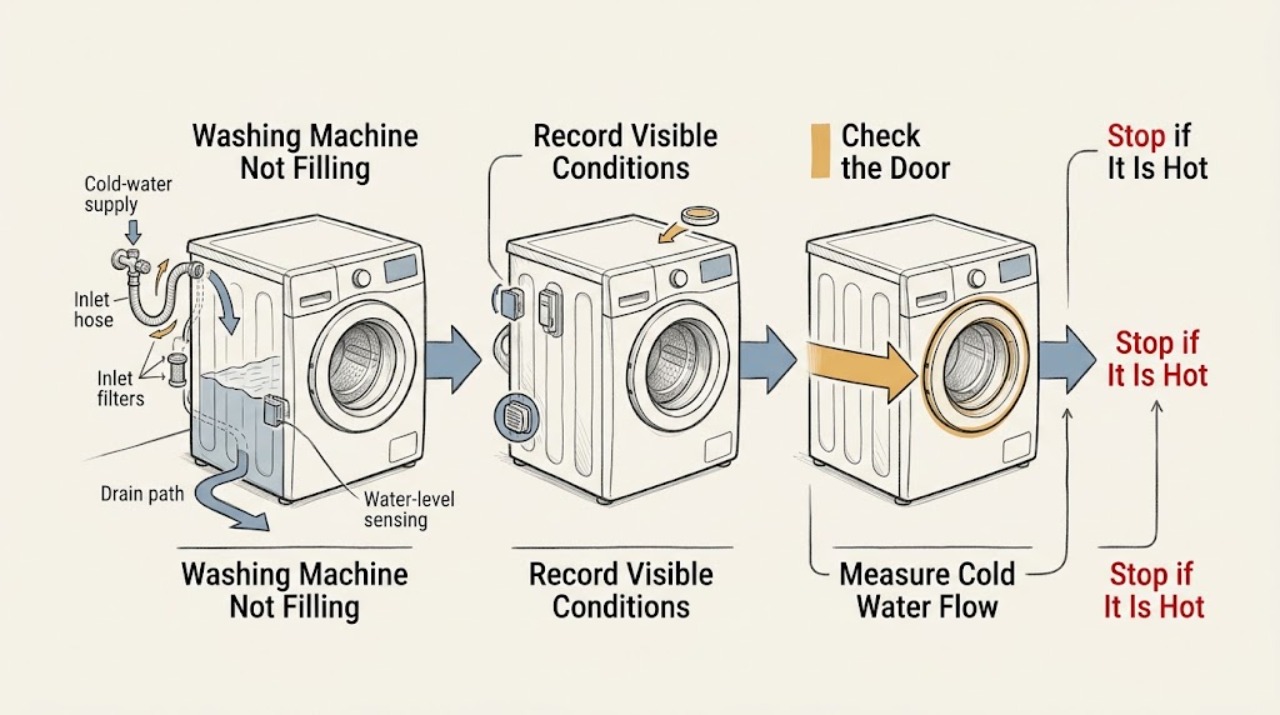
Work through in order
Diagnostic checks
Use only checks that match the exact appliance or system and its official guide.
-
Check 1
Stop the cycle, look from a dry stable position for water on the floor or around the washer, and note the display symbol or code, door-lock behavior, unusual electrical smell, and whether the drum contains water; do not reach into water or touch a wet plug.
Expected result: There is an active leak, an E23/F23 or AquaStop indication, water near electrical parts, a damaged cord, or no immediate hazard but a tap symbol or other code.
Next step: For a leak, E23/F23, wet electrical parts, or cord damage, keep the washer off, close the water tap if it is safe to do so, and arrange service. If the area is dry, continue with the supply checks.
Stop if: Stop immediately for water near electrics, smoke, burning odor, sparking, a damaged cord, uncontrolled water, or any need to handle a wet plug.
Why this matters
Why: A leak or AquaStop indication takes priority over fill troubleshooting. A tap symbol points toward the water-entry/drain checks, while a different code must be interpreted in the exact model manual.
-
Check 2
With the washer dry and powered off, confirm the door is fully latched, the intended fill program is selected, and the cold-water tap feeding the washer is fully open; inspect the visible hose for a sharp bend without pulling the appliance out.
Expected result: The door was not latched, the program was paused or delayed, the tap was closed or partly open, or the visible hose is kinked; or all of these conditions appear normal.
Next step: Correct only the simple condition found, keep the hose routed without a bend, and run a short suitable program while watching the connection. If it still does not fill, stop the program and continue with the tap-flow check.
Stop if: Do not force the door, pull a stacked or fixed installation, or continue if water starts leaking.
Why this matters
Why: A door or program state can prevent the fill command, while a closed tap or kinked hose can prevent water entry. If the simple condition was corrected, the washer should be retested once under observation; a normal setup moves the check to supply flow and filters.
-
Check 3
After closing the washer's tap and unplugging the appliance, place a suitable container under the accessible cold-water tap and briefly open that tap fully to judge its flow; keep the container stable and avoid wet electrical areas.
Expected result: The tap produces approximately 2.5 gallons (10 liters) per minute, produces much less, produces no water, or the flow surges or stops.
Next step: If flow is low, do not compensate by altering the washer; have the water-supply problem assessed. If flow is adequate, close the tap and continue only with the model-approved hose and filter inspection.
Stop if: Stop for a leaking shutoff, burst hose, flooding, contaminated water, unsafe access, or any need to enter an electrical area.
Why this matters
Why: Bosch uses about 10 liters per minute as a practical water-pressure check. Little or unstable flow points to the household tap, shutoff, plumbing, or supply rather than proving a washer fault; normal flow makes the washer hose and filter the next focus.
-
Check 4
With the water tap closed and the washer unplugged, use the exact model manual to identify the inlet-hose screen or supply filter; place a towel or container below the connection, remove only the accessible connection, and clean visible debris gently with a small brush if the manual allows it.
Expected result: The filter or screen is obstructed, the hose is kinked or damaged, the connection seal is displaced, or the inlet path looks clear and dry. If an AquaStop assembly is present, its electric valve remains dry.
Next step: Restore the filter and connection exactly as specified, keep the hose free of bends, reopen the tap slowly, check for leaks, and perform one supervised fill test. Service the washer if the path is clear but filling still fails.
Stop if: Stop for a cracked fitting, seized connection, damaged AquaStop, persistent leak, or any instruction that requires a cabinet panel or live electrical test.
Why this matters
Why: Debris, a kink, or a damaged hose can restrict filling before the valve. A clear, dry supply path makes an internal valve, sensor, or control diagnosis more likely; an AquaStop valve must not be submerged or treated as a generic hose.
-
Check 5
If the tap symbol remains and the water supply is adequate, inspect the visible drain hose for a kink and follow the model manual before cleaning the pump area; keep the appliance Off and unplugged, and assume retained water may be hot.
Expected result: The drain hose is kinked or blocked, the pump area is identified by the manual as accessible and obstructed, or the drain path appears clear.
Next step: Correct only a visible hose routing issue or clean an accessible pump area exactly as the manual describes; restore the cover securely, check for leaks, and retest once. If the symbol returns, document it for service.
Stop if: Do not loosen a pump cover when water may be hot, enter pooled water, force a stuck cover, or continue if the pump area is inaccessible or leaking.
Why this matters
Why: Bosch notes that a blocked or kinked drain hose or a blocked pump can be associated with the tap symbol and can affect the machine's ability to accept cold water. A clear drain path does not identify the inlet valve or sensor by itself.
-
Check 6
After one supervised retest, record whether any water enters, whether the tap symbol or code returns, and whether the washer drains or stops before filling; do not remove panels or test a valve with live voltage.
Expected result: The washer fills normally, fills only intermittently, never opens the inlet, returns a code, or leaks during the test.
Next step: Use the result to choose service urgency, preserve the exact code and model information, and provide the technician with the water-flow, hose, filter, and drain observations.
Stop if: Stop using the washer for a leak, E23/F23, electrical symptom, repeated uncontrolled fill, smoke, burning odor, or any need to bypass a safety device.
Why this matters
Why: A normal fill after a corrected supply issue supports leaving the internal parts untouched. Intermittent or absent fill after adequate flow and a clear inlet path needs model-specific service diagnosis; a leak or safety code is a stop condition.
Use your observations
Decision map
Find the observation that best matches what you see, then follow the next safe action.
-
PATH 01Safety boundary
What you see
Is there an active leak, water near electrical parts, or an E23/F23/AquaStop indication?
Do this next
Close the water tap if safe, leave the washer unplugged, keep people away from the wet area, and arrange appliance service. Do not resume filling tests.
Why this path and its safety boundary
Safety stop: No cabinet opening, wet-plug handling, or bypass of leak protection.
-
PATH 02Safety boundary
What you see
Does the fully open cold-water tap provide roughly 10 liters per minute?
Do this next
Treat household flow as adequate and inspect the washer's approved inlet path next.
Why this path and its safety boundary
Safety stop: Stop for a leaking or unsafe shutoff, flooding, or inaccessible plumbing.
-
PATH 03Safety boundary
What you see
Is the inlet hose kinked or is an accessible supply filter visibly obstructed?
Do this next
With the tap closed and washer unplugged, correct the routing or clean the filter only as the exact manual permits, then perform one leak-checked supervised retest.
Why this path and its safety boundary
Safety stop: Do not immerse an AquaStop valve or perform live electrical measurements.
-
PATH 04Safety boundary
What you see
Does the tap symbol return after adequate supply flow, a clear approved inlet path, and one supervised retest?
Do this next
Record the exact display behavior and arrange service; include whether the washer drains and whether any water enters.
Why this path and its safety boundary
Safety stop: Stop for a leak, hot-water exposure, smoke, electrical odor, or any repeated safety code.
-
PATH 05Safety boundary
What you see
Is the tap symbol accompanied by a kinked drain hose or a pump obstruction described by the model manual?
Do this next
Address only the accessible, manual-approved drain check with the washer Off and unplugged; treat residual water as potentially hot and retest once after leak checking.
Why this path and its safety boundary
Safety stop: Do not force a pump cover, handle hot residual water, or open inaccessible components.
Helpful context
Understand the symptom
Separate a supply problem from a washer problem
Not filling does not automatically mean the inlet valve has failed. A closed tap, low household flow, a kinked hose, or debris at the hose filter can prevent the washer from receiving water. A Bosch tap symbol is a clue about water entry, not proof of one failed part. Record whether the washer drains, locks the door, makes a brief valve sound, shows a code, or leaves water in the drum; those observations change the next safe check.
Use the model manual for access steps
Bosch washer layouts and AquaStop arrangements vary. Use the manual for the exact model before opening a service flap or removing a hose. Turn the program to Off, unplug the appliance, and close the water tap before disconnecting water connections. Keep an AquaStop electric valve dry, and do not probe a live inlet circuit or remove cabinet panels as part of a household check.
A failed fill after normal supply checks needs service evidence
When the tap is open, flow is adequate, the hose and accessible filters are clear, and the door and program are correct, the remaining possibilities move inside the appliance. An inlet valve that does not open, a water-level sensor that does not report the fill, wiring, or control logic requires model-specific testing. Provide the observed code, whether the drum was empty or partly full, and the checks already completed so a technician can avoid repeating safe basics.
Only after diagnosis
Potential parts
- washing machine inlet hose or filter assembly
Consider this category only if the hose is damaged or its approved filter remains obstructed after the water tap and routing are confirmed.
Confirm the complete model identifier and the manufacturer's fit information before ordering any hose or filter assembly. - water inlet valve
Consider this category only after adequate household flow, a clear approved inlet path, and a supervised retest show that the washer still does not admit water.
Valve configuration and fit vary by model; a qualified technician should confirm the diagnosis and exact replacement. - water-level sensing component
Consider this category only when supply and inlet checks pass but the washer's fill decision or water-level reading remains abnormal.
Use the exact model documentation and professional diagnosis; do not assume a sensor is compatible from appearance alone.
When checks do not resolve it
Need a professional?
Arrange qualified appliance service when the washer still will not fill after the dry program/door check, adequate tap flow, approved inlet-hose and filter inspection, and one supervised retest; call sooner for an active leak, E23/F23/AquaStop indication, electrical symptom, damaged cord, smoke, burning odor, or repeated uncontrolled filling.
Safety scope: Service may need to test the inlet valve, water-level sensing, wiring, control logic, or leak-protection system using the model-specific procedure. The article does not authorize live electrical testing, cabinet disassembly, or bypassing a safety device.
Have this ready
- The complete Bosch model identifier and the exact display symbol or code
- Whether the door locks, the drum is empty or partly full, and whether the washer drains
- The tap-flow result, hose routing, filter condition, and any drain-path observation
- Photos of the dry connection area or any visible leak, without opening panels
- Whether the problem is constant or intermittent and what changed before it began
Common questions
FAQ
Why does my Bosch washing machine hum but not fill?
A humming sound does not prove that water is reaching the drum. Check the door and program, confirm the cold-water tap has adequate flow, inspect the approved inlet hose and filter with the washer unplugged, and stop if there is a leak. If those checks pass and no water enters, arrange model-specific service for the inlet valve or sensing/control system.
What does the tap symbol mean on a Bosch washer?
Bosch says the flashing tap symbol indicates that cold water cannot enter. Its guidance includes checking the tap and water pressure, supply filters, a kinked or blocked drain hose, and a blocked pump; use the exact model manual for access and treat retained water as potentially hot.
Can I clean the Bosch washer inlet filter myself?
You can inspect and gently clean an accessible inlet filter only when the tap is closed, the washer is unplugged, and the exact model manual permits it. Keep an AquaStop electric valve dry, restore the connection correctly, reopen the tap slowly, and check for leaks.
When should I stop troubleshooting a Bosch washer that will not fill?
Stop for water near electrical parts, an active leak, E23/F23, smoke, burning odor, a damaged cord, uncontrolled filling, hot residual water, or any need to open panels or perform live tests. Close the water tap if safe and arrange qualified appliance service.
Read the exact guide
Official sources
- E23 or F23 in the display of your washing machineBosch · Bosch washing machines showing E23 or F23 or indicating AquaStop activation.
- What Does the Tap Symbol on a Bosch Washer Mean?Bosch · Bosch washing machines displaying a flashing water-tap symbol or failing to admit cold water.
Community feedback
Share a repair observation
Share a plain-text repair observation. Accepted observations are published automatically; this page may take a moment to update.