
On this page
Start here
Quick answer
If a Frigidaire washing machine is not filling, first allow the sensing portion of the cycle to finish, then confirm both water faucets are fully open, the inlet hoses are not kinked, the water pressure is adequate, and the lid or door is fully closed. Turn the water off before checking hose screens and look for leaks or a siphoning drain connection. A blank or paused control, an error for slow fill, no water from the household faucets, or a valve that still will not admit water after these checks needs qualified service rather than repeated starts.
Before you begin
Safety first
- User diagnosis is limited to cycle observation, external faucet and hose checks with water turned off, accessible screen care, lid or door observation, and safe drain-hose inspection. A qualified technician must diagnose internal valves, pressure sensors, controls, wiring, and leak sources.
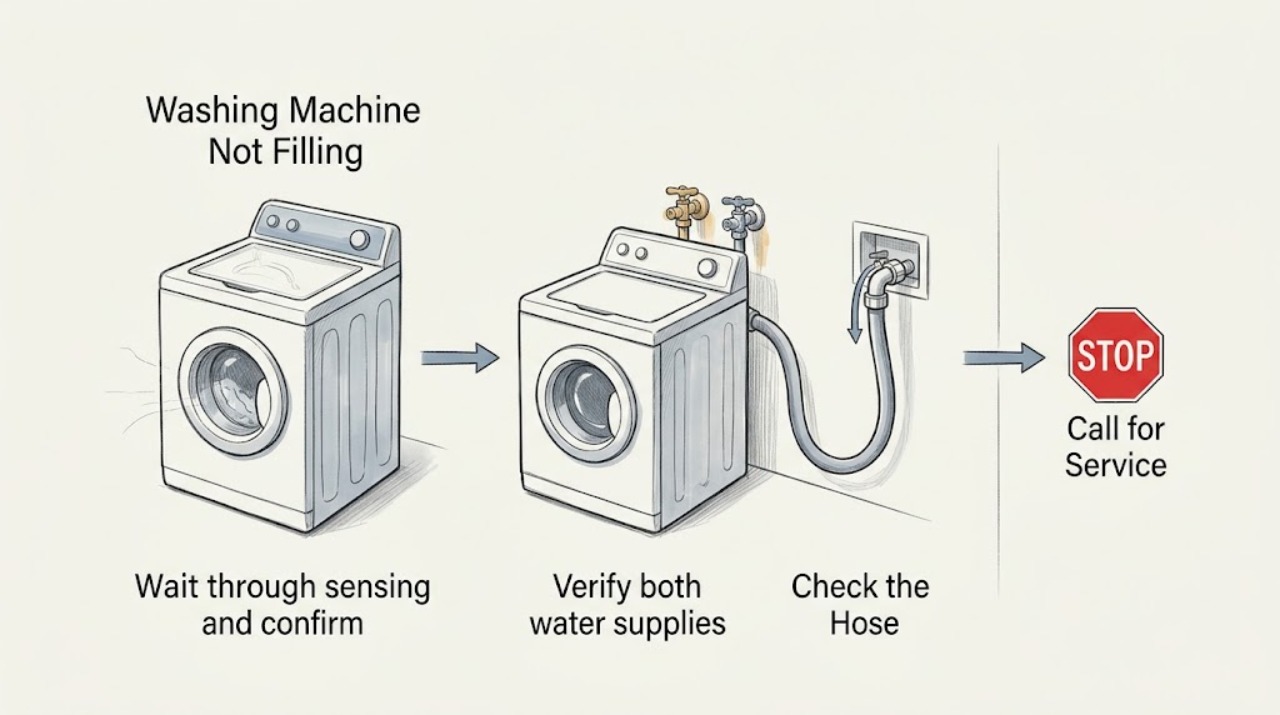
Work through in order
Diagnostic checks
Use only checks that match the exact appliance or system and its official guide.
-
Wait through sensing and confirm the cycle actually started
Load the washer as usual, select a normal cycle, close the lid or door fully, and press Start or Start/Pause according to the model controls. Observe the beginning of the cycle long enough for the model's sensing stage to complete; do not repeatedly cancel and restart it.
Expected result: The washer begins filling after sensing, remains paused or beeps, displays a fill-related code, or never shows any water-entry activity.
Next step: If water enters normally, no repair is needed for the delay. If the washer remains paused or shows a slow-fill/no-fill symptom, continue with supply and lid checks.
Why this matters
Why: Delayed filling can be normal sensing behavior on some Frigidaire models. A pause, open-lid indication, or fill code changes the path toward controls, lid status, or water supply rather than proving a failed inlet valve.
-
Verify both water supplies and household flow
Confirm the hot and cold laundry faucets are fully open. Check for other household water use while the washer should fill, and if the faucet itself seems weak, stop the washer and verify flow at the faucet using a safe container or a plumber's normal procedure. Do not leave a hose connection unattended while checking for leaks.
Expected result: One faucet is closed or weak, both faucets have normal flow, or water is available at the faucets but the washer receives none.
Next step: Restore a safe, stable water supply and retry once. If the household supply is inadequate or unstable, resolve that plumbing issue before washer diagnosis; if supply is normal, inspect the hoses and inlet connections.
Why this matters
Why: A closed faucet, supply interruption, or inadequate pressure can prevent or slow filling. Normal faucet flow moves suspicion toward hose routing, screens, lid or door status, or the washer's inlet system.
-
Inspect inlet hoses and screen area without flooding
Turn off both water faucets before touching the inlet hoses. Look for kinks, pinches, crossed hot and cold connections, loose fittings, damaged hose bodies, or a flood-safe hose that the model guidance does not support. If the model instructions permit it, remove the hoses at the valve with the water off and inspect the accessible inlet screens for debris; reconnect snugly and check for leaks.
Expected result: A kink, incorrect connection, damaged hose, clogged accessible screen, or leak is found, or the hoses and screens appear clear.
Next step: Correct only the external hose or screen issue described by the model instructions, reopen the faucets slowly, and check every connection for leaks. If no external issue is found, continue without removing cabinet panels.
Why this matters
Why: A restricted hose or blocked screen can reduce or stop flow before water reaches the tub. A leak or damaged hose is a safety and flood concern. Clear connections with no flow issue point toward the lid, drain path, or internal valve/control diagnosis.
-
Confirm the lid or door is closing and locking
Close the top-load lid or front-load door firmly and inspect the opening for clothing, detergent residue, or an obstruction. Check whether the display acknowledges the closed lid or door and whether the cycle can start without forcing the latch. Do not bypass a lid switch or door lock.
Expected result: The washer starts filling after the lid or door is corrected, reports it open, or still refuses to fill with the closure confirmed.
Next step: If the closure is damaged, misaligned, or not recognized, keep the washer out of service and arrange repair. If it is recognized, proceed to the drain-hose and fill-result checks.
Why this matters
Why: Frigidaire washers may not operate with an open lid or door because the control does not permit the cycle to proceed. A confirmed closure with no fill moves suspicion toward supply, screens, valve, or control components.
-
Check the drain hose for siphoning and leaks
With the washer stopped, inspect the drain hose where it enters the standpipe or drain. Confirm it is secured and installed at the model-specified height and is not pushed so far into the drain that incoming water immediately siphons away. Look underneath and around the tub for water leakage; do not pull a full or unstable appliance away from the wall alone.
Expected result: Water enters and immediately disappears, the drain hose is too low or unsecured, water leaks from the tub or hose, or the drain arrangement appears correct.
Next step: Correct only the external drain routing allowed by the installation instructions and monitor for leaks. Stop and request service or plumbing help if the tub leaks, the hose is damaged, or the water path is inaccessible.
Why this matters
Why: Incorrect drain-hose placement can make a washer appear not to fill because water leaves as quickly as it enters. A leak is a separate flood or component fault and should not be solved by continuing the cycle.
-
Use the fill result to prepare service information
Record the model, load type, top-load or front-load configuration, the time before any water enters, faucet status and flow, hose and screen condition, lid or door behavior, displayed code, drain-hose arrangement, and any leak or unusual sound. Photograph only safe external connections and do not open the console or cabinet.
Expected result: The washer still does not fill, fills slowly after all external checks, shows a persistent code, or has a leak or control fault.
Next step: Turn off the water if there is leakage, keep the washer out of service, and contact Frigidaire support or a qualified appliance technician with the recorded details.
Why this matters
Why: A repeatable no-fill result with normal external supply and closure checks points toward the inlet valve, pressure sensing, control, wiring, or another model-specific fault that cannot be identified safely from the outside.
Use your observations
Decision map
Find the observation that best matches what you see, then follow the next safe action.
-
PATH 01Next step
What you see
The washer fills after the sensing stage completes.
Do this next
Use the model's normal cycle and allow the sensing stage to finish before judging the fill. Investigate only if the delay becomes a repeatable no-fill or error condition.
-
PATH 02Next step
What you see
A faucet is closed, weak, or water is being used elsewhere while filling.
Do this next
Restore a stable household supply and retry once. Resolve a plumbing or pressure problem before replacing washer parts.
-
PATH 03Next step
What you see
An inlet hose is kinked, reversed, leaking, or an accessible screen is obstructed.
Do this next
Turn off the water, correct the external connection or clean the accessible screen per the model instructions, then reopen water slowly and check for leaks.
-
PATH 04Next step
What you see
The lid or door is not recognized as closed.
Do this next
Do not bypass the lock or switch. Keep the washer out of service and arrange diagnosis of the lid or door-lock system.
-
PATH 05Next step
What you see
The washer has normal supply, hoses, screens, closure, and drain routing but still does not fill or shows a persistent fill code.
Do this next
Stop repeated starts and request qualified diagnosis of the inlet valve, pressure sensing, control, and wiring for the exact model.
Helpful context
Understand the symptom
Not seeing water immediately does not always mean the washer is broken. Many Frigidaire high-efficiency models sense the load before opening the water valve, while a true no-fill problem can come from the household supply, hose routing, lid or door status, inlet screens, drain setup, or an internal valve or control fault. Identify whether the machine is top-load, front-load, or a laundry center and whether the tub eventually receives any water.
Protect against flooding and electric shock: stop the cycle before moving hoses, turn off the water before disconnecting a hose, clean only accessible screens, and keep hands and tools away from live wiring. Stop for a leak that cannot be controlled, a damaged cord, burning odor, smoke, or repeated breaker trips.
Safety boundary
Stop conditions
- Turn off the water and stop for an active leak, a split or damaged hose, water near electrical parts, or a tub leak that cannot be safely contained.
- Do not bypass the lid or door lock, open the console, test live wiring, or remove internal valves or controls as a user check.
- Stop for smoke, burning odor, damaged cord, repeated breaker trips, or any electrical fault indication.
- Do not keep restarting a washer that shows a persistent no-fill code, fills and leaks, or cannot close and lock its lid or door.
Only after diagnosis
Potential parts
- water inlet hose or hose screen
Consider only when a technician or the model instructions confirm an externally damaged hose or a screen that cannot be restored by approved cleaning.
Match the exact Frigidaire model and connection type; a no-fill symptom alone does not establish a hose or screen replacement. - water inlet valve assembly
Consider only after normal faucet flow, hose routing, screens, and lid or door status are confirmed and qualified testing identifies an inlet-valve fault.
Confirm the exact model, valve configuration, and technician diagnosis before ordering. - lid switch, door-lock, pressure-sensing, or control component
Consider only when qualified diagnosis confirms that the washer is not authorizing fill because of a lock, sensor, control, or wiring fault.
Internal safety and control components require exact model matching and qualified installation.
When checks do not resolve it
Need a professional?
Arrange qualified service when the washer still will not fill after sensing, open faucets, clear external hoses and screens, a recognized closed lid or door, and correct drain routing. Call sooner for a persistent fill code, inlet-valve or control suspicion, an unrecognized lid or door lock, a leak, damaged wiring, smoke, burning odor, or repeated breaker trips.
Safety scope: User diagnosis is limited to cycle observation, external faucet and hose checks with water turned off, accessible screen care, lid or door observation, and safe drain-hose inspection. A qualified technician must diagnose internal valves, pressure sensors, controls, wiring, and leak sources.
Common questions
FAQ
Why does my Frigidaire washer take a while before filling?
Some Frigidaire high-efficiency washers sense the load before adding water. Allow that stage to finish. If no water enters afterward, check the faucets, hoses, lid or door, screens, and error indicators.
What should I check if my Frigidaire washer has no water?
Make sure both faucets are open, the inlet hoses are not kinked, household water flow is adequate, the lid or door is closed, and accessible inlet screens are clear with the water turned off before hose work.
Can a drain hose make a Frigidaire washer look like it is not filling?
Yes. Incorrect drain-hose placement can let water leave as it enters. Check the installation instructions and stop for any leak rather than continuing the cycle.
When does a Frigidaire washer not filling require service?
Request service when normal supply, hoses, screens, lid or door closure, sensing, and drain routing checks do not restore filling, or sooner for a persistent code, leak, damaged lock, electrical symptom, smoke, or burning odor.
Read the exact guide
Official sources
- What should I do if my Frigidaire Top Load washer is not filling with water properly?Frigidaire · Frigidaire top-load washer sensing, water-fill, lid, hose, screen, and drain checks
- Top Loading Washer - displaying Error Code E1 long fill timeFrigidaire · Frigidaire top-load washer slow-fill and no-fill error troubleshooting
- What should I do if my Frigidaire Laundry Center is not starting?Frigidaire · Frigidaire laundry-center washer power, faucet, lid, Start/Pause, and sensing checks
- Laundry Water Supply GuideFrigidaire · Frigidaire front-load and top-load washer water supply, hose, connector, and leak checks
Community feedback
Share a repair observation
Share a plain-text repair observation. Accepted observations are published automatically; this page may take a moment to update.